Art and History Meet in African-American Exhibit at Museum


by: Margaret Burroughs


FAITH LAPIDUS: The National Museum of African American History and Culture is presenting the exhibit. It is called “The Kinsey Collection: Shared Treasures of Bernard and Shirley Kinsey – Where Art and History Intersect.”

It is being shown at the NMAAHC gallery at the National Museum of American History on the National Mall. The National Museum of African American History and Culture is to begin building its own center next year.

Bernard and Shirley Kinsey began collecting African American art and historical objects in the nineteen seventies. Bernard Kinsey says it started with an old document sent to him by a friend.

BERNARD KINSEY: “It was a bill of sale from William Johnson, eighteen thirty-two, for five hundred dollars. And when I opened that Fed-Ex up and held this document in my hand it was like I was holding this brother in my hand. And I said I want to know everything about him, and how he lived and this period. And that just started this deep and wide quest.”

The bill of sale is in a part of the show called “Stories of Slavery and Freedom.” The bill of sale, like many objects in this area, is extremely unsettling. The physical fact deepens the knowledge that people were once considered property.

There is a second bill of sale nearby. This time the purchaser is Henry Butler in eighteen thirty-nine. The bill shows a payment of one hundred dollars to Anne Graham of Washington, D.C. for the freedom of Henry Butler’s wife and four children. The bill states: “Signed, sealed and delivered.”

There are also a pair of shackles from around eighteen fifty. This device was placed around the ankles to restrain captives on the way from Africa to the Americas. The exhibit display explains that the shackles are so small they may have been for a child.

As visitors move through the show, they move forward in time. Covers of Harpers Weekly magazine give an idea of the involvement of black men in the Union Army. One cover shows the Twentieth Colored Infantry of Eighteen Sixty-Four receiving a silk banner in New York City. The banner was made by their mothers, wives and sisters. A proud African American crowd watches the ceremony.

In the “Freedom Struggles” area, there are signs of racial separation. These include a drinking fountain sign with arrows pointing one way for “whites” and another for “colored.”

Toward the end of the exhibit visitors reach “Remembering the Faces of a People.” This joyous section includes oil paintings, woodcuts, drawings, sculpture, photographs, fabric art and more. It shows the many ways African American artists see themselves and their community.

And it was the best part of the Kinsey Collection for visitor Aaron Crenshaw, of Woodbridge, Virginia.

AARON CRENSHAW: “The touching artwork. I never knew about, never knew existed. Been in the military so I’ve seen, like, the military side. But the art factor. It’s just an eye opener, if you’ve never seen it before.”

The Kinsey Collection will be on view until through May first. For a link to the exhibit visit our website at voaspecialenglish.com.
read more>>>>>>>>>>>>>>>>>>>>

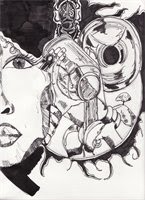
THE ART INSIDE OF ME!!!!!


I am a professional artist from Philadelphia,Pa. I am focused on providing high-quality service and customer satisfaction. I’m also focus to help my customers feel better. I can draw portraits,logos or any illustrations for any special occasions. I am based on the belief that my customers’ needs are of the utmost importance. I am committed to meeting those needs. As a result, a high percentage of my business is from repeat customers and referrals. I welcome the opportunity to earn your trust and deliver you the best service.

THE ART INSIDE OF ME!!!!!


Thank you for visiting my website. Art Inside Of Me is focused on providing high-quality service and customer satisfaction – I will do everything I can to meet your expectations.
Look around at my website and if you have any comments or questions, please feel free to contact me. I can also be found on www.octobergallery.com

Black History Museum: The Nobility of the everyday


By MAUREEN ELGERSMAN LEE

Before I moved to Virginia three and a half years ago, I started an intellectual journey unlike any I had embarked on before. The goal was as complex as it was simple: reconstruct the history of a small African-American community in a small city in northernMaine, a state with one of the smallest black populations in the country.

The goal was to understand why this black community almost tripled in size in the decades after the Civil War — and to learn where its members came from, where they lived and worked, what families they formed and what institutions they created.

While on this journey, I transcribed manuscripts of census returns that gave names, ages, occupations, addresses, property ownership, military service and literacy. I thumbed through countless high school and college yearbooks and found honor students, student-paper editors and band members. I read innumerable obituaries, which, in turn, led me to birth, marriage and death records. I even studied probate records — the final balance sheets of people’s lives.

read more>>>>>>>>>>>>>>>>>>>>>>>

Artist Explores African American Experience on Canvas


By Karla Dorweiler

“The most consistent theme in my work is that of visibility because I recognize that historically black people have generally been rendered invisible,” Best writes.

That theme carries through in all of her powerful paintings and collages, three of which are on display at the Farmington Hills Public Art Exhibition at City Hall. One piece, titled “Tubman’s Passage,” represents a slave’s journey from south to north.

Best didn’t approach the painting with the intention of telling that story.

“I had no idea what I was going to do when I went over to the canvas that day,” Best said. “After I started, it just came to me. I was really inspired in that piece.”

In December 2009, Best’s work was selected for a show at the Charles H. Wright Museum of African American History in Detroit. “Life for Me: The Artwork of Robbie Best” was on display for five months and featured 36 works.

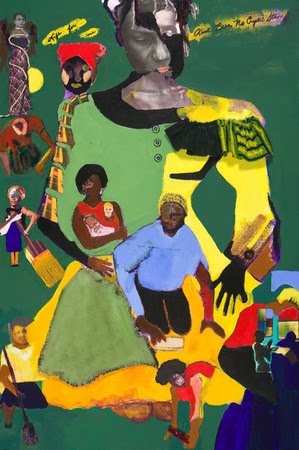
The title of the show was taken from the name of the collage at the center of the display, “Life for Me.” The piece was inspired by a Langston Hughes poem, “Mother to Son.”

“It’s about black women and their experience in this country,” Best said. “There are lots of black women with college degrees that still have to do manual labor to make a living.”

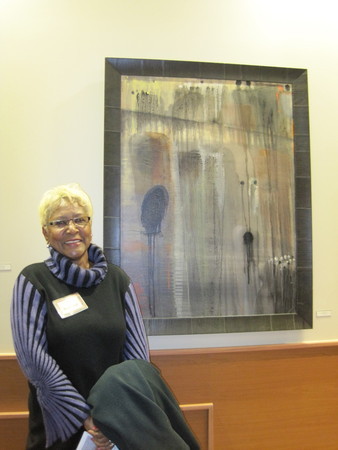
One of Best’s favorite paintings, “Depth,” was purchased by Henry Ford West Bloomfield Hospital and hangs in its Artist Avenue Gallery. She used a staining technique in which she dilutes the oil paint and then manipulates it on the canvas without a brush, adding layers as she goes. Best has used this process with other paintings, including “Tubman’s Passage.”

Creating art is spontaneous for Best. She never starts with a sketch, even when she has an idea in her mind.

“When I have tried to start with a sketch, my hands take over and do what they want,” she said. “It’s that interplay between the hand, the canvas, and the mind.”

Best hopes people will look at the layers in her art, just as she hopes they also see the layers of her culture.

“I want to tell a story with my art,” said Best. “If that comes across in my work, then I’m successful.”

To see Best’s artwork and learn how to purchase one of her pieces, visit robbiebest.com.

read more>>>>>>>>>>>>>>>>>>>>>

Artist Talk: Shantrelle Lewis


By C. Zawadi Morris

New Orleans Native and Bed-Stuy resident Shantrelle P. Lewis is the director of public programming and exhibitions at the Caribbean Cultural Center African Diaspora Institute (CCCADI). She also is curator for a new exhibit, “Sex Crimes Against Black Girls,” which opened Saturday February 5th at the Skylight Gallery in Restoration Plaza.

Lewis has traveled around the world in her pursuit to gain greater understanding of the African aesthetic first-hand, including to Cuba, Ghana, Nigeria, Brazil, Jamaica, the Dominican Republic, Haiti, Puerto Rico, Spain and London.

Her curatorial credits include exhibitions on a variety of topics, including Contemporary Haitian Art, a tribute to Betty Davis, the Haitian Revolution, The Feminine in African Sacred Traditions and New Orleans sacred traditions. Lewis is producing her first documentary The Wild Magnolia, as part of an oral history project of the Magnolia Projects in New Orleans, of which she is the Project Director.

Lewis sat down with Patch to provide insight on her motivation behind a very serious subject matter pervasive in the black community, and within the black Diaspora – childhood sexual abuse – also the subject of her latest project at Skylight Gallery.

read more>>>>>>>>>>>>>>>>>>>>

A Black History Moment: Synthia St. James, Fine Artist, Illustrator, Designer, Author


by Rev. Irene Monroe
Synthia Saint James (1949 – )
Fine Artist, Illustrator, Designer, Author

You may not know her name, but you have seen her paintings everywhere from gift bags in Macy’s Department Store to a 2’8″x150 foot tile mural for Ontario International Airport. Synthia Saint James is an internationally known artist whose illustrations are on over 60 book covers including the literary works of African American women authors like Alice Walker, Terry McMillan, Iyanla Vanzant and Julia Boyd.

With her paintings running in the thousands of dollars Saint James most noted work costs no more than 37 cents when the United States Postal Service commissioned her to create the first Kwanzaa Stamp in 1997.

As a self-taught visual artist Saint James command of color and geometric forms intertwined with history and tradition exude an indelible Afrocentric style promoting family and unity. Saint James early influences were French Impressionists, primarily Van Gogh and Monet. Her contemporary influences are Ernie Barnes, Charles Bibbs, Larry ‘Poncho” Brown and Varnette Honeywood.

“When I was five years old, I knew that I wanted to be an artist simply because I loved to color and draw. When I actually truly knew that I wanted to be an artist, I was probably about eleven years old and that was after seeing “Moulin Rouge.” The movie dealt primarily with the life of Henri Toulouse-Lautrec, but it spoke to me of the passion of artists, the struggle to succeed in making a living as an artist and the importance of remaining true to your individual creativity and your own style of painting. I fell in love with the French Impressionists and that whole era.”

A graduate of Los Angeles High, Saint James attended Los Angeles Valley College and Dutchess Community College in Poughkeepsie, N.Y. She conducts art-marketing seminars and is a keynote speaker for major corporations, organizations and schools promoting art.

Saint James has completed over 50 commissions for major organizations, corporations and individual collectors, including Brigitte Matteuzzi’s School of Modern Jazz Ballet (Geneva, Switzerland), Essence Magazine’s 25th Anniversary, The Girl Scouts of the USA’s 85th Anniversary, Attorney Johnnie L. Cochran, Jr., Coca Cola for “The Lady of Soul Awards”, the International Association of Black Professional Fire Fighters, in tribute to the 12 black fire fighters lost in the terrorist attacks on the World Trade Center, etc.

Saint James has also licensed her images on gift bags, T-shirts, magnets, boxes, deck cards, puzzles, mugs, and calendars, watches, a CD-ROM, and she has recently signed a deal introducing “THE SYNTHIA SAINT JAMES COLLECTION”, a sportswear clothing line.

She is the recipient of numerous awards like the 1996 Coretta Scott King Honor for her illustrations in NEENY COMING, NEENY GOING, the 1998 Black Women Lawyers, Inc. Women of Vision Award and the 2004 Women of the Year in Education from the Los Angeles County Commission for Women.

Synthia Saint James’s paintings are a treat to your soul and an uplifting experience conveying family, harmony and unity.

“My art, for me, is a release, but at the same time, every painting is a child that I’ve created. There are several messages that I wish to convey through my art. They are unity and acceptance of all cultures because we’re actually all the same.”

read more>>>>>>>>>>>>>>>>>>>>

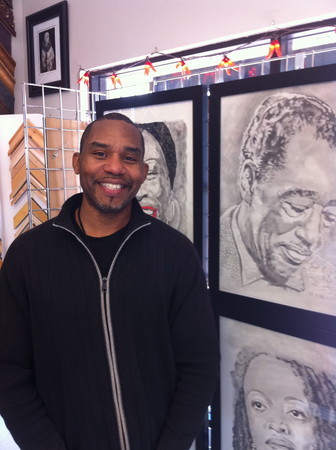
Artist Captures Artists in Local Show, B. jAXON wants to keep the legacy of African American blues and jazz alive.


By Jim Caroompas

The faces say it all – the sorrows, passions, joys, pain, are all there in the folds of the face, and most of all in the eyes. The faces are portraits of singers, musicians, fighters, actors and comedians. Most all of them are African American, and all are legends. And they can all be seen now through Feb. 28 at I’ve Been Framed on Ferry Street.

The artist is b jAXON (yes, that’s how he spells his name), a Hercules resident who has collaborated with frame shop owner and fellow artist Cathy Riggs to show his work in Martinez, after a successful stint at Hercules City Hall.

“I stumbled into Cathy’s realm,” he said. “She’s inducted me into the Martinez Arts Association. She’s been fabulous.”

His portraits include singers Marvin Gaye and Nancy Wilson, musicians Miles Davis and Louis Armstrong, boxer Mohammed Ali, and comedian Richard Pryor. He has also drawn rock musicians Jimi Hendrix and Carlos Santana.

“I’ve got hundreds of these portraits. They all evolve from the activity I’m engaged in at the time,” he said. “I get beat down trying to be an artist, then I pick it back up.”

“I’m a multi-media artist,” jAXON said. “There is audio that goes along with the visuals. I’ve definitely got music to go along with the faces. Trying to capture the passionate nature of the performance is what motivates me.”

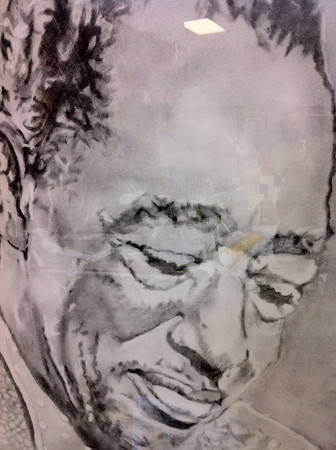
His portraits definitely reflect that motivation. Many of the pieces show the subjects in the middle of a performance. Others, like the one of blues master Muddy Waters, don’t need more than a facial expression to galvanize the observer into the subject’s world. jAXON’s deft handling of charcoal and pencil on canvas reveal a subtle mastery of the medium that requires close attention to appreciate.

But even a casual observer can see that mastery at work in the eyes of the subjects. Singer Diana Ross looks sorrowful, even though her pose is one of casual happiness, due to the eyes. jAXON captures that dichotomy superbly. Even more contradictory is the sadness in the eyes of late comedian Richard Pryor.

jAXON has big plans for his work. He wants to get a grant that will allow him to bring the portraits and the music that goes with them on a tour of schools, so that young people can see and hear the musical history of their culture.

“It’s important to me that kids know where their music comes from,” he said. “Once they hear it, they understand.”

read more>>>>>>>>>>>>>>>>>

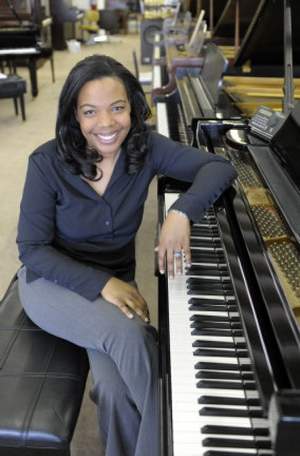
Pianist Kimberly Cann, 29, makes a musical mark on Asheville

How does a young classical pianist new to Asheville find a place in this area’s flourishing, some would say crowded, music scene?
For 29-year-old Kimberly Cann, who moved here two years ago, the answer might be, “Ask not what your community can do for you, ask what you can do for your community.”
With an impressive background that includes winning an important national competition at age 18 and a graduate degree from one of the nation’s top conservatories, the Eastman School of Music, Cann has been quietly making a name for herself by using her considerable musical talents to help local organizations.
“It was not my intention to be at the forefront of musical performance in Asheville,” Cann said with a laugh. “I wasn’t sure where I wanted to make my little niche. I was careful to get to know the community.”
She played a solo recital in Asheville as a benefit for Habitat for Humanity at St. Mark’s Lutheran Church in 2009.
Then she dazzled the audience last September at an Asheville Area Piano Forum benefit at Diana Wortham Theatre. She and her younger sister, Michelle, a student at the Cleveland Institute of Music and herself a rising piano star, played Rachmaninoff’s famously difficult Suite No. 2 for Two Pianos to an enthusiastic crowd.
In December, Cann became volunteer music coordinator for the YMI Cultural Center and began planning an ambitious series of events with Darin Waters, a historian of Asheville’s African-American community.
She wants to highlight the contributions of African-Americans to classical music. One of her concert pieces — which she’ll play Sunday at a sold-out show at the Asheville Art Museum — is “Troubled Waters” by Margaret Allison Bonds, a pianist and composer who in 1933 was the first African-American to solo with Chicago Symphony.
‘Rich heritage’
“For this generation (of African-American classical musicians), I think it’s really important that more of us continue to do what we do,” she said. “We forget what a rich heritage we all have in this wonderful music.”

In graduate school, Cann was encouraged to pursue a concert career. She performed a sold-out concert at the Bermuda Festival in 2006, which was hailed as a “triumphal return” to the island where her father was born and later was the musical director of the Bermuda Institute.

“I strongly considered going the route of international competitions,” she said, as a way to become known as a soloist. But “that takes 110 percent, eight to 12 hours of practice a day. Countless hours of music have to be at the tips of your fingers.”
Did she have to choose between a performing career and a teaching career?
“I am going to try to do it all,” Cann said with another laugh. “I cannot devote my life to full-time performance, I cannot devote my life to full-time teaching.”
For now Cann teaches 25 students from her studio in Weaverville and is ramping up her local visibility as a performer. In addition to Sunday’s concert at the museum, she’ll play dates in April and an August concert at the Diana Wortham with her sister.
‘A world-class pianist’
As a newcomer to Asheville’s music scene, Cann had a head start. She spent part of her childhood in Fletcher, where her father was music director for Fletcher Academy. She attended the academy’s Captain Gilmer Elementary School until the family moved to Florida when she was 13.
She then returned for three summers to study at the Brevard Music Center.
After graduate school and a teaching and performing gig at Northern Caribbean University in Jamaica, Cann decided to settle in Western North Carolina. “I’ve done a lot of world traveling,” she said, “and this is one of the best places in the world.”
Polly Feitzinger, one of the founders of what began as the Asheville Piano Teachers Forum, first heard Cann play as an 11-year-old.
“She was a star student and an amazing child prodigy,” Feitzinger said. “I will never forget her performance of the famous Rachmaninoff prelude in C-sharp minor. She had the understanding and incredible musicality to play this work, which usually is not taught to students who are that age.”
Feitzinger was delighted to discover that Cann had moved back to Western North Carolina. “She is a world-class pianist,” she said.
Bill Clark, co-president of the Piano Forum, invited Cann to play last fall’s benefit before he had heard her, something he doesn’t like to do with a new pianist. Based on Feitzinger’s recommendation, he took what he calls “a calculated risk.”
He was sitting at the rehearsal in front of Feitzinger.
“After the first movement, I looked back at Polly with a huge smile on my face,” he said. “I could not believe what I was hearing. They just nailed it. They were really inside the music. They understood the architecture of it, in addition to having fabulous technique.”
As the closing number of the concert, Clark says, the Cann sisters had the audience members on their feet. “It was extremely exciting,” he said.
Asheville writer Arnold Wengrow is a contributing editor of Theatre Design and Technology magazine.

Ala. Amistad Murals to go on nationwide tour

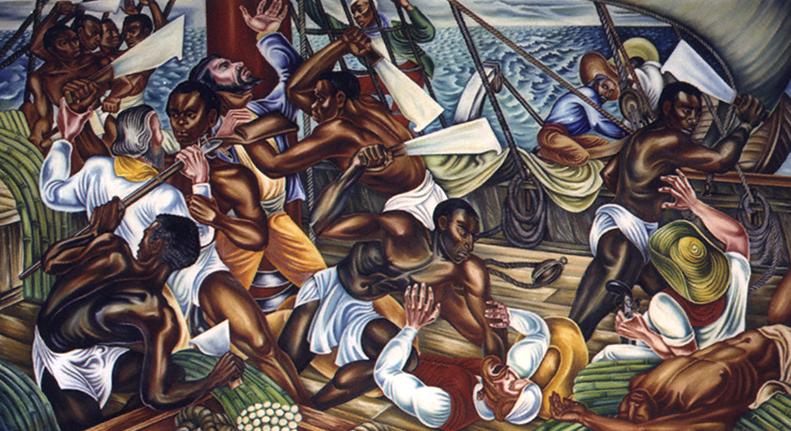
Ala. Murals depicting the famed slave revolt aboard the trading ship Amistad, which have hung on the campus of Talladega College for more than 70 years, are soon going on a nationwide museum tour.

Now valued around $40 million, the paintings by artist Hale Aspacio Woodruff were commissioned in 1938 and the first three panels have hung at the historically black school since the 1939 dedication of a library. Others were added later.

The murals were being taken down piece by piece Monday and will be restored before beginning a tour of several museums around the country. College President Billy C. Hawkins said the restoration and tour will help bring the school more revenue and attention. “We believe it’s a national treasure,” he said.

Upon arrival at the Atlanta Art Conservation Center, the murals will be adhered to another piece of fabric and then onto enormous wooden stretchers where they will be cleaned and restored.

“Once they are cleaned, any areas of damage will be restored,” said Larry Shutts, an associate conservator at the center. After almost 70 years of dirt and dust build-up in the library, Shutts said the paintings are in very good shape for their age.

After the restoration process, the murals will be presented next year at the High Museum of Art in Atlanta in an exhibit titled “Rising Up: Hale Woodruff’s Murals at Talladega College.” Exhibits also are scheduled at the National Museum of African-American History and Culture in Washington, D.C., and the Indianapolis Museum of Art in Indianapolis, Ind.
The restoration of all six murals comes with a $116,000 price tag that has been fully paid for by the High Art Museum, along with an insurance plan that fully covers the murals for the entire exhibition tour. According to a contract, each museum that hosts the Amistad murals exhibit will make a $25,000 contribution directly to Talladega College.

Keeping a Bucks sculptor’s legacy alive

A new scholarship this fall at the Pennsylvania Academy of the Fine Arts honors the late Selma Burke, a Bucks County sculptor whose work is familiar if you’ve ever studied your change.
That picture of Franklin Delano Roosevelt on the dime? It bears an uncanny resemblance to a bas-relief that Burke formed of FDR.

Until her death 16 years ago at age 94, Burke would tell visitors to her Solebury Township studio of the presidential commission she won over 11 other sculptors.

Lewis Tanner Moore, the Warrington collector of African American art, said Burke often recalled the day in 1944 when she unrolled a sheet of butcher paper across the Oval Office and sketched Roosevelt for 45 minutes in charcoal, while reminding him to sit still.

Her bronze relief of him has hung since 1945 at the Recorder of Deeds Building in Washington. Burke’s pride turned to outrage a year later, when the U.S. Treasury Department released a coin to honor the late president.
The design, by John Sinnock, the U.S. Mint’s chief engraver, looked suspiciously like Burke’s. She complained, but was never credited.

Numismatists have debated her contribution ever since. But there was no question in her mind – or Moore’s. She was robbed.

“The engraver needed something,” Moore said. “He used her artwork.”
The story of the coin figures prominently in the efforts of Burke’s followers to keep her name alive and raise money to promote young African American artists. Moore asked artist Faith Ringgold if she would make a print that members of the newly formed Selma Burke Sculpture Foundation could sell to fund the yearly $12,500 scholarship.
Ringgold produced an edition of 65 prints, each costing $1,100. She titled her work:
Dear Selma, every time I see a dime I think of you.
Burke didn’t need credit for the coin in order to be memorable, Moore pointed out. She lived art history, flowering in the Harlem Renaissance of the ’20s and ’30s, studying in Paris with Henri Matisse and Aristide Maillol, starting two schools of sculpture, teaching at Haverford and Swarthmore.
What Moore cherishes most about Burke is their friendship. During her last 15 years, Moore and his wife would call on the sculptor every few weeks. She cooked wonderfully, he says. Sometimes she’d hand him money to buy a good bottle of wine, then chide him if it wasn’t quite good enough.
“She was gracious and kind and a wonderful storyteller.”

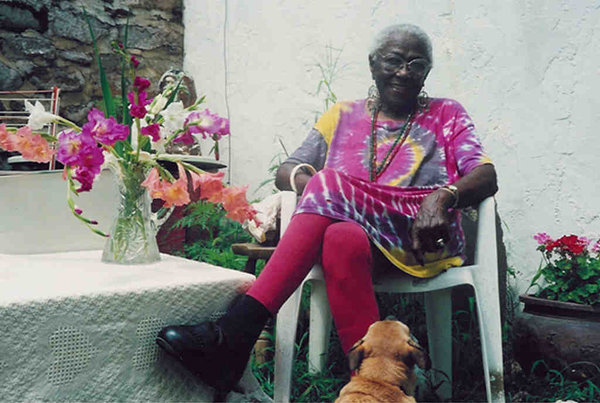
Thornton Township Black History Program Honors Dr. Margaret Burroughs

Tuesday, March 8, 2011 9:14 AM CST
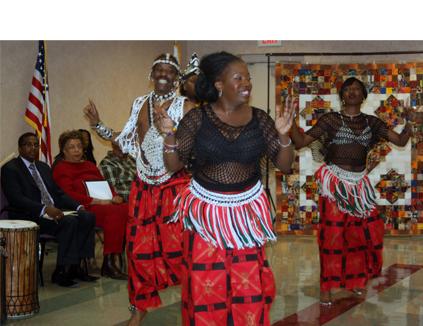
Thornton Township paid tribute to the late Dr. Margaret Burroughs, artist, poet, teacher and co-founder of the DuSable Museum of African American History during their annual Black History Month celebration held on Feb. 25. Those whose lives she touched shared their stories. The celebration also included performances by the Najwa African Dance Group, songs by Ugochi and the reading of two of Dr. Burroughs most well-known poems.

Barbara Horton of Dolton called it a wonderful, inspiring program. Although she never met Dr. Burroughs, Horton learned about her while transcribing her tapes as part of her work study program at Chicago State University. “I was surprised to learn about everything she did and was unaware of her artistic talent,” she said. Some of Dr. Burroughs artwork is now part of the township’s permanent collection which she had donated through the years.

Diane Dinkins-Carr, board president of the Southside Community Art Center said Dr. Burroughs was a wonderful mentor. She recalled visiting Margaret’s kitchen with her parents and hearing her great words of wisdom. “She left great footsteps to follow,” she said. Dinkins-Carr grew up at the art center where her father was the educational director.

Dr. Burroughs convinced her to join the board of directors. From there she became president in 1998 and continues to serve in that capacity.Dr. Burroughs was instrumental in starting the art center because she wanted a place for African American artists to exhibit their work. In 1935 a WPA (Works Project Administration) member told her that if she could find a facility they would fund it. The Southside Community Art Center opened in 1935 at 3831 S. Michigan. When the funding ceased Dr. Burroughs held drives to money to purchase the building and the lot which now has landmark status. Dinkins-Carr has vowed to continue Dr. Burroughs dream of bringing art the community and providing a place where emerging African American artists can become established artists.

Dr. Carol Adams, executive director of the DuSable Museum, said Dr. Burroughs lived her life between her two most well-known poems, What Will Your Legacy Be? and What Should I Tell My Children Who Are Black? That was her inspiration for starting the museum which is celebrating its 50th Anniversary. Dr. Burroughs often spoke of the needs of the community, stating “None will do it for me,” Adams said. She urged those in attendance to go out in the community and do what needs to be done. She added that Dr. Burroughs legacy also included reaching out to those who were imprisoned giving them hope for the future. “She memorialized her love of people by continuing to share her artwork with the community. She was a global activist, artist, and an institution builder,” Adams said.

Phillip London who served as her personal photographer in a volunteer capacity starting working with Dr. Burroughs in 1978 when he was a student. Several years later she asked him to travel with her around the world. Their trips included visits to South Africa and Cuba. “She was like a mother. She always had time to speak with you. She loved meeting the people and always had something to give them,” he said.

London shared some of his photos of Dr. Burroughs travels with the township for display and will donate them to the DuSable Museum. He too, carries on Dr. Burroughs legacy by mentoring young people pursuing a career in photography.

David Lowery, Jr., president of the South Suburban Branch of the NAACP, stressed the importance of continuing Dr. Burroughs dream. “We need to focus on our young people. Our children are perishing because they don’t know who they are and where they come from, “he said. “We must teach them.”

The participants thanked Thornton Township Supervisor Frank Zuccarelli and the Human Relations Commission for presenting the Annual Black History Program and for honoring the achievements of Dr. Margaret Burroughs. She was a longtime friend of the township.

Malcolm X’s Daughter Extradited to New York


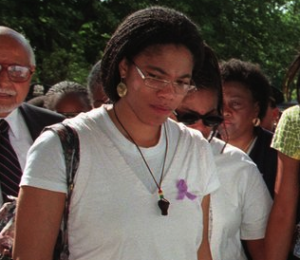
Malikah Shabazz, youngest daughter of iconic human rights activist, El Hajj Malik el-Shabazz (Malcolm X), has been extradited from North Carolina to New York City to face criminal charges stemming from the 2009 identity theft of a family friend.

Shabazz, who holds a Ph.D in Educational Administration and Human Development, will stand trial in Queens, NY for possession of stolen property, grand larceny, forgery, and criminal possession of forged instruments.

On February 22, one day after the 46th anniversary of her father’s death, Shabazz wasarrested for her crimes against the widow of her father’s bodyguard, who was with Malcolm X when he was assassinated in the Audubon Ballroom in Manhattan, NY.

“She used the fake identity to charge more than $55,000 in the victim’s name between August 2006 and November 2007,” said Queens District Attorney Richard Brown. The alleged theft represents a shameful betrayal of the friendship that existed between the two families.

Shabazz’s crimes were revealed when investigators, responding to a misleading report of truancy in her Mars Hill, North Carolina home, discovered a warrant for her arrest. Shabazz’s thirteen-year-old daughter was inside the home being properly home schooled, but the investigators were searching for a previous resident.

The beginning of February found several of the Shabazz sisters continuing their protracted fight over portions of their parents’ estate, with the proceedings escalating into accusations of theft, irresponsibility and “mental incapacity.”

Regardless of the arguments and legal battles, though, Shabazz’s five sisters were ready to hop a flight to North Carolina until they were informed by Malikah’s attorney that she would probably be returning to New York.

“We’re all sisters, despite the false and vicious reports put out in the media,” twin sister Malaak Shabazz said Tuesday. “We love her and our niece dearly. We’ll get through this.”

From Qubilah Shabazz’s attempted assassination of Minister Louis Farrakhan for his alleged involvement in her father’s murder, to the murder of Dr. Betty Shabazz by her grandson, Malcolm, this family has endured more pain than any one group of people ever should.

In her autobiographical book, “Growing Up X,” Ilyasah Shabazz offers a rare glimpse into the lives of one of Black America’s most revered families. The searing revelation that all the girls, Attallah, Qubilah, Gamilah, and twins Malikah and Malaak, had to live in silence with their mother holding on to Malcolm’s memory, often speaking of him in present tense, paints Malikah in an entirely different light


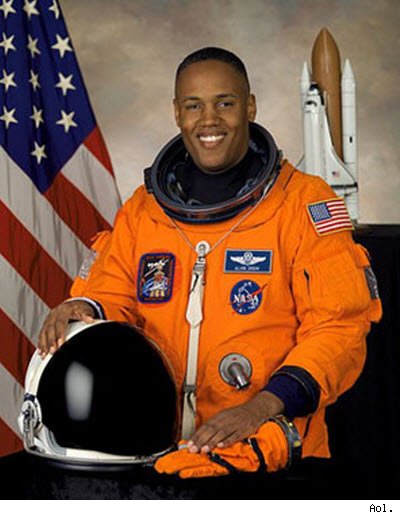
Benjamin Alvin ‘Al’ Drew Jr. Performs 2 Spacewalks as Part of Final Discovery Mission


As the Space Shuttle Discovery makes its final descent from the International Space Station Wednesday morning and then heads to the Smithsonian Institute to be preserved for history, Benjamin Alvin “Al” Drew Jr. will be able to say that he was part of a historic moment.

The retired Air Force colonel is the only African American aboard what will be the final mission of the Space Shuttle Discovery. The crew delivered the first humanoid robot in to space. Drew, 48, also performed a pair of spacewalks during this final historic trip.

The two spacewalks helped to upgrade important parts of the international space station. During one of the spacewalks, Drew was tasked with removing toxic ammonia from a cooling unit. According to Space.com, Drew was also “removing thermal coverings, attaching camera lens covers and adjusting loose radiator grapple beams that had been improperly installed during a previous shuttle mission.”

Discovery is NASA’s oldest and most traveled shuttle. Only two more shuttle launches remain before the program is shuttered for good. The shuttle is expected to disconnect from the International Space Station this morning and spend another two days in orbit before returning to Earth on Wednesday.

“What a great program, and I got to be a part of it,” Drew said in an interview before this trip.

Usher joins Beyonce, Nelly Furtado in donating Qaddafi money

R&B crooner Usher (pictured above) is the most recent A-lister celeb who is hanging his head low after learning that he accepted “blood monies” from Libyan terrorist dictator Muammar Abu Minyar el-Qaddafi (pictured below middle).

Usher released a statement on Friday, saying that although he was paid for only appearing at Beyoncé ‘s 2009 St. Bart’s concert, he is “sincerely troubled” and will donate monies to human rights organizations:

“I will be donating all of my personal proceeds from that event to various human rights organizations,” he said in a statement released to the Associated Press.

The statement also said Usher made a contribution Friday to Amnesty International, which the organization confirmed. Now, as far as how much Usher donated, according to the group, the performer requested the donation amount be kept private.

The singer is not the only performer who has decided to take their Qaddafi earnings and re-gift it to some humanitarian charity.