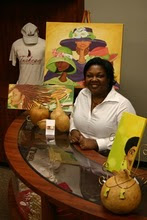
Nigel Freeman on Auctioning African-American Art
Oprah Helps Chef Fulfill Michelle Obama Wish
Aim higher, she told him.
How about a check to help fund the sort of healthy eating programs for children called for by another of his high profile clients, first lady Michelle Obama, recently called for?
Done.
On Monday, during a party hosted by celebrity chef Nigella Lawson, Smith says he’ll formally announce the $250,000 donation from Winfrey to his Common Threads nonprofit.
“We’re going to educate a lot of children about taking care of themselves,” Smith said during an interview late Friday at the South Beach Wine and Food Festival.
“I’d like to take this money to create healthy programs for children that mirror the first lady’s program,” said Smith, who recently lost 90 pounds thanks to his own healthy eating reforms.
Prince George’s County celebrates Black History Month
Beverly A. Collins Visual Artist
Born and raised in Cincinnati, OH, I studied art at Wayne State University and the University of Cincinnati prior to moving to Los Angeles in 1978. Not having worked in the arts during the majority of my adulthood, opting instead to be a wife, mother and subsequently a single-parent, I devoted my life to the rearing of my daughter. It wasn’t until I experienced the “empty nest” syndrome and the mass lay-off from a job I thought would carry me into retirement that I revisited the art within me with the passion that drives me today.
Upon receipt of the lay-off notice in 1997 and the accompanying severance check, I almost immediately went to the art supply store, purchased an easel, enough canvases to last for a while, pints of paint, and painted for seven days straight — 10-12 hours a day. Upon completion of this cathartic experience, I emerged from the paint and the canvas, not quite realizing what had just transpired, to witness a rebirth – the beginning of a new phase in my life. For the first time in my life, I felt as though I had identified my purpose — to glorify God in me by capturing the miracle of color on canvas and sharing it with all who will see.
Color, line, texture and form embrace the very essence of our existence. One needs only to see a rainbow . . . enjoy a flower . . . squeeze a big red ripe tomato . . . become dazzled by the beauty of a tropical fish . . . catch a glimpse of an exquisitely colored bird . . . watch a beautiful butterfly . . . or pet a lady bug to experience the miracle of color in our lives.
Through the use of color, line, texture and form I hope to capture in some small way the essence of our existence and thereby give homage to the universal power of God that makes it possible for the very same colors we see in a rainbow to again reveal themselves in our environment and all the things therein. Once this is done, it is my desire to put art into the hands of those who understand and appreciate the overwhelming power of color in their daily lives by capturing the beauty of color, line and form to be displayed in places where we can experience the power of its radiance, energy, and interaction.
Beverly A. Collins
(213) 925-5797
www.beverlycollins.com
Peter Oluwadare Adeniyi – Brazilian Artist
The Artist “Laid back Art ………… Laid back Life.”
Called Darton X, Peter Oluwadare Adeniyi is internationally well known , not only in África but also in Europe.
Born in June, 3rd 1968 in Ikere-ekiti, a small city in Ondo (State of Nigéria), Darton X has started painting since he was six, creating self-portraits from the mirrow of his own bedroom.
Taking part of a local School of Art, in 1978, Darton X twelve years old was 3th price at the conference of art show of west Africa in Nigéria. Darton X has emigrated to Italy in the 80’s, where he studied electronics and arts.
It defrayed his studies with his paintings and in little time as an artist, transferring all its directions to a universe of subtle tones and colors Returning to Africa, Darton X continued to study and to paint with many African artists, mixing its educational influences with the strong and intense colors of his home.
Developing his skills, Darton X started to try new roads in the way of the modern cubism. His paintings had started to possess the almost phantasmagoric expressions of its predecessors and ancestral Africans. Showing his works around of the world, Darton X has a strong relation with Spain, Portugal and the Consulate of France in the Bahia.
As a satisfied painter, Darton X says: “In art the possibilities are infinite and the talent blossoms of the skin. To paint allows us to see in the future while the artist confirms the gift.”
http://www.dartonx.20m.com/
Blackstream – not mainstream art.
We further define this growth period as being marked by a collective community conscientiousness that recognizes the creative, cultural and financial viability of African-American visual expression.
The interplay between artists, community members and available resources has created a fabric-like cohesion characterized by:
• Artists willing to create
• A community that can inspire its artists
• A community that accepts its own cultural
creations as having value
• Sufficient community resources to sustain the
exchange of value
The patrons and artists of the BlackStream Renaissance purchased and sold art, displayed it at home and at work and shared it with friends, family, co-workers and the general public. In short, they have made African-American art an indispensable part of their everyday lives. The African-American community is effectively supporting and building an art industry, perpetuated primarily by its own members.
Collecting African American Art
Dr. Mary Schmidt Campbell, former Executive Director of the Studio Museum in Harlem, has stated “…to give an object a home.” (-) “At the most private and personal level, that is the goal of the serious collector. Exercising taste, judgement, an intense love of a culture and its traditions, motivated by a caring not only for the visual forms of an artifact… but also a caring for the – creative willfullness – of a culture or an individual, the real collector feels a deep and abiding kinship with the objects he collects.”
The life enhancement that a piece of art generates for a collector is the most valid reason for selecting any art work. Collector motivation should be not solely whether a work of art will appreciate financially, but should be based on a link, a kinship, a connection with the essence and life force of the work. ‘The thing about art is that you only hold it in trust. There’s a living spirit in a great work of art. If you see it only in terms of its monetary value, the circle of communication is incomplete,” states Corrine Jennings of the Kenkeleba-Gallery, New York. An astute art collector will see the value of an artist’s work long before the investment oriented art collector takes note. A connoisseur with a sensitive eye uses esthetics rather than economic considerations in acquiring art work. Only esthetics is intrinsic to the art work. Economic or investment appreciation may be considered for the long run after the collector has found some valid esthetic reason to purchase a piece of art.
African Americans are purchasing Black Art because some have available more disposable funds and now have the means to collect art and support Black artists. In addition, African Americans now desire to make a cultural statement concerning their identity that the silk dress, expensive vacation or BMW can’t make. Non-African Americans purchase Black art because it offers a means to diversify an already established collection, i.e. art from the perspective of the African American artists hanging next to art rendered from the perspective of an Oriental or European artist and so on. Moreover, African American art is a “bargain” in terms of prices paid for other art. These new patrons have also helped to make the market stronger for Black art and to make African American art more and more of an investment.
Nonetheless, the link, the kinship, the connection, the life enhancement, the circle of communication, the esthetic value should be a collector’s primary motivation for acquiring art work. Should a piece of art appreciate over time, then that’s a plus.
Florida Highwaymen African American Artists
Buying Art as an Investment – What to buy, what to sell, and will it make me rich
As vice president and director of American and European painting and prints for Boston-based auction house Skinner Inc. and an appraiser on PBS’s Antiques Roadshow, Colleene Fesko looks at 10,000 paintings a year. In her career, she has come across incredible deals, ridiculous overvaluations, and everything in between. Fesko has five recommendations for people who want to put their money where their art is:
Brush up on the subject. Don’t just buy what you love – educate yourself first. “People in New England are lucky, because we have such wonderful museums and galleries and auctions and schools.” Take advantage of those, Fesko says.
Get to know the artist next door. Regional markets are doing well right now, she says. The Cape Ann School, for example is a community of artists in Gloucester and Rockport; some of its members have seen their work increase in value from $500 to $5,000 in the early 1990s to $15,000 to $25,000 today.
Seek out diamonds in the rough – and on paper. Look for work by any artist “studying with the finest teachers and who hasn’t hit yet,” she suggests. Drawings, watercolors, and fine-art prints tend to be undervalued, so you might just get a real deal on one of those.
Beware of bargains. You should “buy the best of what you can afford,” Fesko advises. That means look for the highest quality in the medium that interests you, and also pay special attention to wear and tear. “If something is in bad condition, it’s not a bargain.”
Embrace changes of art. Collections should be fluid over time. That heart-stopping landscape you bought when you were 25 won’t necessarily speak to you when you’re 50. When your tastes change, so should your collection. This advice applies no matter what your budget.
© Copyright 2006 Globe Newspaper Company.
Paul R. Jones, art collector and Bessemer native, dies at 81
By Michael Huebner — The Birmingham News
January 28, 2010, 1:45PM
Paul R. Jones’ mission to showcase African-American artist is being realized at museums and galleries nationwide. His collection of photography by Bessemer native P.H. Polk is on display at “To Make a Picture,” through May 23 at the Birmingham Museum of Art.
Paul R. Jones, who grew up in the Muscoda mining community near Bessemer and rose to become one of the nation’s most respected collectors of African-American art, died Tuesday in Atlanta. He was 81.
Known for his keen eye for quality art, Mr. Jones collected works by luminaries such as Romare Bearden, Elizabeth Catlett, and Henry Ossawa Tanner, amassing 2,000 works and placing him in Art and Antiques magazine’s top 100 U.S. collectors. In 2008, he donated the bulk of his collection — 1,700 works worth nearly $5 million — to the University of Alabama in Tuscaloosa. He gave hundreds of works to the University of Delaware in 2001. Lecture series bearing his name have been established at both universities.
Swann’s auction of African-American fine art

NEW YORK—Earlier this month, the biggest auction houses proved they were back on their game, posting strong numbers in London. Now their smaller brethren are proving that they can notch up sales too. Swann’s auction of African-American fine art took home a healthy $1.24 million total with buyer’s premium yesterday, just barely shy of its $1.3–1.9 million estimate. Of the 162 works on offer, 118 found buyers, netting the auctioneer a respectable 73 percent sold-rate by lot.
Malvin Gray Johnson, a member of the Harlem Renaissance, had a striking auction debut, as a collector paid $228,000 for his Swing Low, Sweet Chariot, 1928-29, which depicts a group of people pointing out at a dark, cloud-filled landscape. Swann declared it the artist’s “best known work,” and the bidder seemed to agree.
The somewhat peculiar premise of the auction led to an unusual mixture of artists, ranging across different time periods and styles. Jacob Lawrence’s circa 1941-42 gouache on board, Untitled (Two Card Players), went for $42,600, followed later by a choice David Hammons print from 1977, Untitled (Body Print), which earned a sporty $114,000, beating its $80,000–100,000 estimate with the addition of the buyer’s premium. It was the second most expensive lot of the evening.
http://www.artinfo.com/news/story/34011/swanns-african-american-art-auction-soars/
Art Webinars – Online Seminars

Conversation on Art #301 THE AFRICAN-AMERICAN ARTIST
An introduction to African-American achievements in the visual arts,
especially painting, from Colonial times to the present.
Saturday, February 27 3 PM
http://www.bestdeal123.com/pages/digital_downloads.html
**********
Conversation on Art #302 Collecting African American Art
A lively discussion on why the esthetic value of a work of art should be a
collector’s primary motivation for acquiring art work.
Monday, March 1 8 PM
http://www.bestdeal123.com/pages/digital_downloads.html
**********
Conversation on Art #303 Andrew Turner – In His Own Words
A look at the life and art of Philadelphia artist Andrew Turner.
Tuesday, March 2 8 PM
http://www.bestdeal123.com/pages/digital_downloads.html
**********
Conversation on Art #304 Group Show
We will take a look at a number of contemporary African American artists through video.
Artists include: Cal Massey, Leroy Campbell, BUA, George O’Neil and others.
Wednesday, March 3 8 PM
http://www.bestdeal123.com/pages/digital_downloads.html
**********
Conversation on Art #305 An Eye For Art
You will learn first how to – Describe the Work of Art
Then you will learn how to – Analyze the Work of Art
Next you will learn how to – Interpret the Work of Art
And lastly you will learn how to – Evaluate the Work of Art
Thursday, March 4 8 PM
http://www.bestdeal123.com/pages/digital_downloads.html
**********
Here is the link:
http://www.bestdeal123.com/pages/digital_downloads.html
These webinars will include video as well as text format.
Webinars are FREE.
Celebrating African American art in Toledo
As you know, February is Black History Month. For the last 15 years, the 20 North Gallery in downtown Toledo has been celebrating the month with art exhibits from African American artists.
Gallery owner Eric Hillenbrand says, “We have 21 different artists and an amazing array of talent.”
Eighty percent of the African American artists on the walls this month at 20 North Gallery are from right here in northwest Ohio.
This year artists have represented what they’ve seen in national politics with several new works inspired by President Barack Obama.
In addition, the featured artist Aaron Bivins lines the wall with vibrant displays honoring legends of jazz.
This year, if snow keeps you away, the entire show is available online.