[easyrotator]erc_31_1351232214[/easyrotator]
Swann Auction 10/18/12 Results
[easyrotator]erc_31_1351232214[/easyrotator]

Connecting People with Art since 1985
[easyrotator]erc_31_1351232214[/easyrotator]

Painter
… all of that classical imagery of South France is very alive as an experience inside of me. Maybe it is wht led me to the use of fluorescent colors in my paintings.
– It’s known that the childhood is one of the most important periods of an artist’s life. When you close your eyes and think about those years, what colors and what kind of memories do you see? Can you tell us about your father and how he inspired you?
Thinking of my childhood is definitly not my favorite thing. With an over protected crippled sister I often felt lonesome, not to say abandonned! Of course I also had nice times, like summer in Cavalaire where we lived on the Mediteranéan side, building huts and cabins and hunting butterflies. I have vivid images of colors, of brightness. Yellow, sunshine, blue, heat, cicadas, pin smell, light… all of that classical imagery of South France is very alive as an experience inside of me. Maybe it is what led me to the use of fluorescent colors in my paintings.
My dad was an architect ; busy man, rather harsh, demanding and critical ; I spent number of thursdays drawing on a drawing table in his office ; my education was drastic, there was no room for flaws or errors. Nonetheless, i do have a strong admiration for him. He was quite a talented architect.
He taught me photography and optique. He also took me with him on numbers of his construction sites and with him I started to have a different look on architecture.
Maybe in a way he inspired me on how to construct a painting as well as on disciplin, i cant really say, but i also like deconstruction and crazyness.
– You grew up in Southern France, and now, you live and work in Paris. While some artists, especially the ones who prefer working in traditional styles, dream about quite country houses in green valleys, you seem to be inspired by big and crowded cities, like Paris, New York and Vancouver. How does the urban culture affect you?
I love the urban culture, the one that grows in the street and that turns cities into play- grounds. All these graphs on the walls, on railways… It is such an untamed, wild and lively expression. Always on the move, cross- ing forbidden territories, borderlaw… Its exciting! I also love the racial diversity, the blend of colors, of people, the contrasts… Life in all its expressions! That is the magnetism of big cities.
At the same time, i do have also a strong need to escape from it. Painting is probably my main way to do it, even though i go back to nature quite often, but i dont feel like living surrounded by cows!
– When and how did you decide to earn your living by painting? If you were not a painter, what other job would you choose?
I left advertising eleven years ago. It was too much pressure and I wanted something on my own, the space to deliver my own expression. There is quite a number of jobs I would have like doing, but there is no accident, all of them are centered on image. (By the way, did you know that I have been a photographer?) Fashion design is one of them, filmmaking is also one of my favorites.
– In France, you have the soul of Impressionism all around you. From Claude Monet to Pierre Auguste Renoir, many great masters lived and created in that beautiful country. When you look back in art history, which artists and art movements do you find closer to yourself?
Impressionism is quite far away now. Museums do nurture that image, that part of art in history because it is very popular and it keeps attracting crowds. But in fact, a lot of things happened since : cubism, dada, surrealism, pop, etc
I do feel close to artists like Bacon, Warhol, Bodini, Freud. Because they are portraitist and i can relate to the way they see and how they translate it. I can also enjoy contemporary art, installations or some videos. Christos work is magic. He has a satellite vision, and his vision is grandiose… How he translates things on such huge scales; its compicated, its a game, its magnificent, its magic!
Abstract painting can also be close to me. In fact there is a part of my painting that is very close to abstract work, even if I end up being figurative…
– Both Renoir and Monet fell in love with the nature and greatly impressed by the power of it. How do you feel about nature and how do you evaluate our world’s future?
I am very close to nature, I love the sea, it is a space of freedom that you loose when you live in town. Respect, happiness, protection… These are the words that come up when i think of nature. Unfortunately, I see the future painted in black. I am not optimistic at all. One of these days, earth will break down…
– What do you think is the greatest invention of the past 100 years?
If you allow me 2, ill say internet and the dish washing machine.
– Do you listen to music while working? Does it affect the life on your canvas by changing your mood, or is it only a sound at the background for you?
Music can be both : a mood creator as well as a background. It depends.
Sometimes it will feed me with the energy i may be lacking. Most of the time, the one to one with the painting is easier, with music. It is also a soothing presence when facing a white canvas So it keeps the engine running softer but it is never the engine by itself.
– Most of the artists have a dream project waiting to become true one day. Do you have such a plan for the near future? If you had a limitless budget, what kind of personal project would you create? Close your eyes and think… No boundaries!
Id love the opportunity of painting a huge wall in a striking location and why not, to paint the China wall in fluo.
– Theme of Bak Magazine’s 15th issue is ‘Love’. What does this word mean to you? Have you found the love of your life?
Thats quite a question!
I was teached love of god through nuns, and that was definitly not an exemple. Much more an example of crazyness than anything else. So, i do have cracks on that territory.
Love can have quite a number of expressions… Talking about man/woman bounding, I dont have much memories of happy love. Besides some firy, intense and passionate temporary moments.
ortunately love shines in different fields. I am a passionate woman and i am passionate about my life, about doing my life with intensity. That is the way i approach painting, traveling, reading, etc. Somehow, painting may be the love of my life; and as in every couple relationship its a moving territory with high and lows, fights, weariness, desire, fire and water. It can be exhausting, exhilarating, boring, fun, sparkling… whatever i go through with it, i just cant stop loving it.

Vote for Romney. The only choice for your future. @MittRomney @TeamRomney #mittromney #VOTE #voteromney pic.twitter.com/9HFUhWul
“Clueless” star Stacey Dash was met with what she describes as a wave of “fury” after endorsing Mitt Romney, and now it seems a fellow actress is joining in the backlash.
Vivica A. Fox slammed Dash’s endorsement in an interview with TheGrio. She seemed visibly annoyed by the reporter’s mention of Dash, but gamely answered the question.
“I didn’t know she was a Republican. I will start there,” Fox said. The two actresses appeared together in the 2005 film “Getting Played.” “Second, I don’t know why she had to do a photo shoot in a ‘Baywatch’ red swimsuit with the boobs and the whole flag behind her. And she doesn’t have a job or something to promote right now. I just didn’t get it.”
Dash posted a photo of herself on Twitter wearing an extremely snug red bathing suit and posing in front of an American flag. In the corresponding tweet, Dash said Romney was “the only choice”:
Fox’s take? “Most politicians when you support them, you try to support them with class, you don’t need to do a swimsuit shoot.”

The Huffington Post |
By Mallika Rao Posted: 10/24/2012 3:29 pm Updated: 10/24/2012 4:02 pm
Currently when you google the phrase “Diego Koi,” the majority of the links thrown back have to do with koi ponds in San Diego. That situation is surely not long for this world (wide web). Because self-taught Italian artist Diego Fazio, who goes by DiegoKoi on his Deviant Art page, is racking up major Google points as we speak. Why? Probably because with only a pencil and paper, he can do this:
Hat tip to BuzzFeed who brought our attention to the former tattoo artist’s uber-real photorealistic drawings. According to a Google translation of Fazio’s Deviant Art profile, the 22-year-old has an affinity for the artwork of Katsushika Hokusai, and off the page, women’s eyes.
Check out a selection of Fazio’s work below (plenty of eyes included), and let us know what you think. For the full trip, head to Fazio’s Deviant Art page.


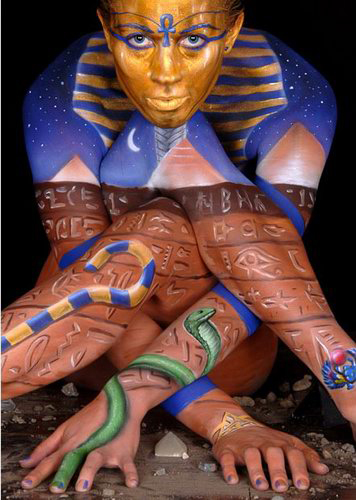
I’ve written about tongue tattoos and body piercings here at Bit Rebels, so when I saw this stunning body painting art, I thought it was only fitting to complete the trilogy with yet another form of body artistry.
If you are familiar with body painting, then you know the name Craig Tracy from New Orleans. He is known as one of the best body painting artists in the world. I first learned about this particular artist from a tweet sent by my friend, @phaoloo.
After seeing his work, what struck me the most was the presentation itself. His artistry is beautiful, but after spending up to nine hours painting each body, he takes the process one step further and places the person in a very specific pose to make an inspiring photograph. Sometimes he will also paint a wall or backdrop to add even more detail and depth to the photo.
Craig Tracy has been a painter for over twenty years, painting on every surface imaginable. He admits now that his favorite subject is the human body. The process of deciding what to paint on each body is full of creativity.

He never decides before seeing the body what he will paint, then after seeing the body, he will spend a few days seeing where that image combined with his own creativity takes him in his own imagination. Once the actual painting begins, it is quite involved and time consuming. But, I think you will agree, the end result is breath taking.

Jamaica 50th Independence Art Exhibition Celebrates the Visual Heritage of Jamaica
BOSTON, MA. –Plans are in high gear for the Jamaica 50th Independence Art Exhibition in Boston, MA. The exhibition will be held at the National Center of Afro-American Artists [NCAAA] and represents an ongoing series of activities in celebration of Jamaica’s 50th Independence Anniversary. Sponsored by the Boston area Jamaica 50th Anniversary Committee and NCAAA, the exhibition extends from October 18, 2012 to January 13, 2013. The Opening Reception will be held on Sunday, November 4, 2012, 3:00pm-6:00pm. The reception is free and open to the public.
Under the theme “Jamaican Artists: Celebrating 50 years of Independence”, the exhibition offers a rich and diverse introduction to the visual arts heritage of Jamaica. Featuring fifteen artists and more than 40 works, it honors the confidence, excellence and imagination of painters, sculptors and printmakers for Jamaica on the world stage where they have excelled. The exhibition presents Internationally-recognized contemporary artists Kofi Kayiga, Bryan McFarlane and Peter Wayne Lewis. It also includes Ralph Campbell, Colin Garland, Vernal Reuben, Barrington Watson and Gerry Dunlap. Among Jamaican artists working abroad are Albert Chong and Winsom. Godfrey Makonzi, originally from Uganda but now Jamaican, has several large ceramic sculptures of great distinction on display.
Taken together, the exhibition spans nearly fifty years and hints at the size and quality of art created by sons and daughters of Jamaica since its independence.
Page 2
“Artists from Jamaica have distinguished themselves in contemporary art for their originality, energy and imagination. They have dared to become themselves, breaking free of parochialism and colonialism to become a force in the international arena. They have accounted well for themselves over these five decades”, Edmund Barry Gaither, Director and Curator, Museum of the National Center of Afro-American Artists. Gaither further added, “The Museum of the National Center of Afro-American Artists is particularly proud to partner in presenting this exhibition because of its long interest in the art of Jamaica. It’s very first exhibition in January of l970 was Jamaica Art Since the Thirties”.
Denzil McKenzie, Jamaica Honorary Consul, Boston, says, “This is a very important exhibition of works of Jamaican artists. We are not likely to have another exhibition of this stature and magnitude for the foreseeable future. I am pleased to be associated with the exhibition and I invite art lovers throughout New England to join us to celebrate Jamaica’s 50th Independence Anniversary and enjoy the works of these talented and accomplished Jamaican artists.”
The National Center of Afro-American Artists is located at 300 Walnut Avenue, Boston, Massachusetts, 02119 [Tel] 617 442.8614. Website www.ncaaa.org
The Museum is open Tuesday through Sunday from 1pm until 5pm. Adult admission to the Museum is $4.00. Senior and student admission is $3.00.
For a calendar of events and more information about Boston area celebrations of Jamaica 50th Anniversary, visit http://www.jamaicaconsulboston.org/.
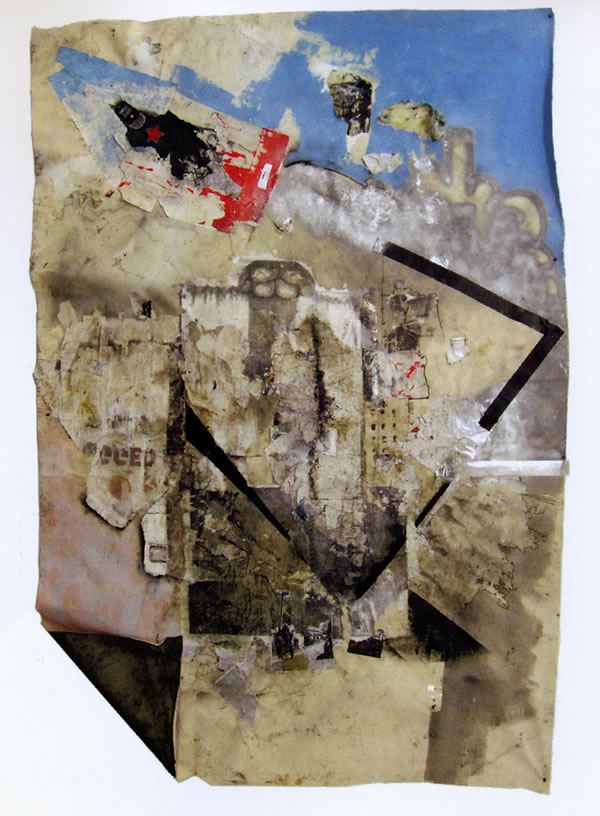
The Museum of the National Center of Afro-American Artists is pleased to present
HERO’S STORY: New Works by Cullen Washington, Jr, an exhibition of contemporary mixed-media works exploring the interplay between popular media heroes and black masculinity. The exhibition extends from October 18, 2009 through January 10, 2010.
The exhibition is accompanied by a twenty-eight page illustrated catalogue. A conversation with the artist will be presented on Sunday, November 15, 2009 at 3:00 p.m.
Click here to view selections from Hero’s Story
Since the beginning of transatlantic slavery, black masculinity has been embattled, under attack for its resistance to enslavement and exploitation. Subject to systematic destruction and forceful repression, black manhood was incompatible with the commoditization inherent in chattel. Nor did the relentless subversion of black masculinity lift with the nominal passing of slavery and colonialism, but rather, the battle shifted more toward constructions of blackness within social imagery generated by advertising and media.
So powerful were these strategies of subversion that black men sometimes came to see themselves through these manipulations, accepting one-dimensional images of themselves. In the visual arts, exploration of this terrain is not new, thus when Cullen Washington undertook this turbulent theme, he needed strategies that were visually and conceptually new.
 In HERO’S STORY, Washington examines black masculinity in the context of heroic narratives. Capitalizing on his fascination with dark tonalities, the irregularities of unstretched canvas and particularly visceral collaging, he introduces figurative and representational references that evoke an environment that is alternately urban and cosmic. The black male body, a central subject of objectification, stands at the junction of American historical identity and popular culture suggesting notions of the hero and the anti-hero. In either mode, Washington has sought to preserve autonomy, complexity and ambiguity as elements of black agency.
Dyno-mite in my room, for example, grows out of Washington’s own early fascination with the character JJ Evans from the popular 1970s television series Good Times. JJ was a kid in a struggling Chicago family who fancied himself popular with girls, always ready with a boast, and not above an occasional slight of hand that he called “finding things”. He became noted for his exclamation “Dyno-mite!” Full of himself, he was “good hearted” even if not always wise, and seldom at a loss for words to cast his predicament in the best light. He was an urban hero for teenage boys searching for themselves in a world of limited economic resources, where an outsized personality was an asset. Washington anchors the picture with a collaged image of JJ at its center. Nearby is a view into the bathroom suggesting the intimacy of the space, an intimacy indicated by other hints of the room interior, as well as pasted photographs and even a cigarette box. JJ ’s exuberance both inspired Washington, and gave his a larger than life heroism.
In Hulk Don’t Smash, Washington has counterpoised the green hero with a black urban giant who strides, muscles exposed, across his canvas dominating the street that falls away, a tree at one end and chain link fencing flanking the side. In this world of bicycles, graffiti, and high-rise buildings, might is positioned as a controlling force. One can easily pose questions of the utility of raw strength in today’s urban neighborhoods where wit and organizing skills may trump muscle, but it cannot be denied that young men still prize physical strength as a defining asset. Washington’s Hulk, despite his physicality, has a very sad but kind—even sweet—face. The consideration is whether he will really use his strength to right wrongs as the mythical Hulk did?
From the futuristic world of science fiction comes Luke Skywalker, protagonist of the Star War movies. Skywalker imposes the geography of rival cosmic world on black ghettos in Star Wars and 3rd Street. Laid over the thicket of city views and streetscapes is an airport landing strip and an airport tower, collapsing the distance between a fully invented world and the reality of Washington’s home town. In both, good and evil contest for control, and heroes are called for in order to assure the triumph of the positive. The ghetto must have its Luke Skywalker just as the galactic worlds needed theirs. In the related Final Frontier, we glimpse the face of this new type hero. Almost lost in a huge field of black relieved only by damask-like textural variations, a small space ship enters at the extreme lower left. Peering from it is a sliver of a black male’s face as he captains this vessel into the unknown. The great blackness before him, simultaneously a road divided by a white line and the universe, could as easily represent the mystery of the city as the expanse of the universe. Both must imagine their own heroes, and find ways to embody them in narratives.
 Boogie Man combines Washington’s frequent use of cityscapes with his mastery of figurative imagery. Here towers and urban skylines are subsumed into a massive face that is not immediately apparent. However, once the eye of the face emerges, the remaining outlines that describe the visage become clear. Especially prominent are the lips that appear just above a collage of Minnie Mouse. Alas, the face of the boogieman turns out to be a black youth. In virtually all stories of the boogieman, he lacks clear features and seems to be primarily a ghost-like entity suitable for threatening children or frightening those with Gothic imaginations. How can one yoke together such a character with the innocence of Minnie Mouse? In a world where black men are often unjustly feared, what does it mean to be perceived as the boogieman? How exactly does this juxtaposition work? No real answer is forthcoming from Washington.
Washington says that his goal is to “relate black males to roles other than basketball players, rappers or savages”. He rejects stereotypical characterizations, while asserting black males as “ hero and villain, deity and monster, form and abstraction”, or put differently, as complex and internally contradictory. Washington nuanced black figure refuse to resolve internal inconsistencies. Identities in his work are contingent and overlapping, sometimes inclining toward known mythic heroes and sometimes suddenly veering in a different direction. Despite his interest in mythic heroes and villains, Washington insists that his images are grounded in urban experiences such as shaped his own life, and that they retain an undogmatic relationship to issues of social justice and positive representation.
In HERO’S STORY, Washington’s unstretched canvases reveal a dense, visceral world in which collaged and decollaged elements, over-drawn and over-painted, evoke a dark environment haunted by ancient archetypes of heroes intermingled with contemporary stereotypes and icons of black maleness. Drawing on his own complex and contradictory relationship to popular culture heroes such as The Incredible Hulk and “JJ”, he re-imagines such figures often inverting the heroic narratives to which they belong. He conjures, as noted in his artist statement, “. . . a new mythology rising from the ashes of urban debris, grit, personal memory and universal dreams to give voice to the ever-changing (r)evolution of human existence.
Cullen Washington, Jr. was born in Alexander, Louisiana, and studied at Louisiana State University (B.A., 1994) and Tufts University/School of the Museum of Fine Arts (M.F.A., 2009). His previous exhibitions include New Perspectives: Cullen Washington and Ernesto Cuevas at the Rialto Art Center and Cullen Washington Jr. and James Taylor at Hammonds House Museum, both in Atlanta, as well as group exhibitions at Bunker Hill Community College (Boston, MA), Clemson University (Clemson, SC), Tufts University (Medford, MA), Schuylkill Gallery (Philadelphia, PA), Rockmart Art Center (Rockmaont, GA) and the Chicago Museum of Science and Industry (Chicago,IL).
He has received the Joan Mitchell Foundation MFA Grant, Arts Ambassadors Emerging Artist Award, Bartlett and Montague Travel Grant and other awards and honors.

The Wikipedia entry for James Patterson’s fictional character Alex Cross includes this nugget of understatement: “Alex has had bad luck with women.” That’s for sure, as anyone knows who’s seen the films “Kiss the Girls” and “Along Came a Spider,” with Morgan Freeman as Cross, the brainy police psychologist who’s either chasing down killers of women or women who kill. Women are something of an endangered sex in “Alex Cross”: one, half-dressed in black lingerie, dies after all her fingers are methodically snipped off. Another is similarly tortured to death; a third is shot straight through the chest. Where’s Madea when you need her?
That question will flicker through the heads of those who watch Tyler Perry try to fill Mr. Freeman’s trench coat as the title character here. A grim, dispiritingly stupid waste of time, energy, money and talent, directed by Rob Cohen, this is the first installment in what one of its producers warned Entertainment Weekly would be “the new Tyler Perry franchise, a worldwide one.” Good luck with that, bud. Because in order to sucker anyone into watching a sequel, you will need to fire the writers and the director. And then you will need to help Mr. Perry rethink his performance, which lacks both nuance and the majestic, uncompromising wrath that makes Madea so memorable, a fury that’s philosophically epitomized in a line from “Madea Goes to Jail”: “If the gotters get me I’m gonna get my Glock.”
The ineptitude of “Alex Cross” can’t be pinned only on Mr. Perry. He’s a likable screen presence, even when not wearing Madea’s wig and bosomy padding. But he doesn’t have the skill that can lift a performance up, up and away from the substandard movie surrounding it, one of Mr. Freeman’s enduring, oft-tapped talents. (Mr. Perry replaced Idris Elba, who could have brought depth even to these shallows.) That “Alex Cross” would present a challenge for any actor is evident from its clumsy opener, a chase sequence with Detroit cops and some disposable bad guy that is so visually nonsensical, so maladroit in its staging and editing (it’s a fair guess that the editor didn’t have many good choices to work with), that it looks as if the cops were shooting at one another.
Things don’t improve, despite nice small turns from Carmen Ejogo as Cross’s wife and Giancarlo Esposito as a Motor City underworld boss, or even the unintentional camp pleasure provided by Matthew Fox’s eye-popping turn as the finger-cutting psycho. This obligatory sicko (the Butcher of Sligo in Mr. Patterson’s novel “Cross”) is called Picasso for the cubistic drawings he leaves at the scene of his crimes. The association of Modern art with villainy isn’t new in movies: Hitchcock had fun with it in a memorable quick bit in “Suspicion,” in which a detective distrustfully eyeballs an abstract painting. Here, though, much like the Louis Vuitton bag that the killer hauls around and the Cadillac he drives, Picasso is an empty signifier, suggestive of nothing beyond weird product placement and bankrupt thinking.
“Alex Cross” is rated PG-13 (Parents strongly cautioned). Sexualized violence against women, torture, guns.
Alex Cross
Opens on Friday nationwide.
Directed by Rob Cohen; written by Marc Moss and Kerry Williamson, based on the novel “Cross,” by James Patterson; director of photography, Ricardo Della Rosa; edited by Thom Noble and Matt Diezel; music by John Debney; production design by Laura Fox; costumes by Abigail Murray; produced by Bill Block, Paul Hanson, Mr. Patterson, Steve Bowen, Randal Emmett and Leopoldo Gout; released by Summit Entertainment. Running time: 1 hour 41 minutes.
WITH: Tyler Perry (Alex Cross), Matthew Fox (Picasso), Edward Burns (Thomas Kane), Rachel Nichols (Monica Ashe), Cicely Tyson (Nana Mama), Carmen Ejogo (Maria Cross), Giancarlo Esposito (Daramus Holiday), John C. McGinley (Captain Richard Brookwell) and Jean Reno (Giles Mercier).

LOS ANGELES — The rebirth of black independent film is taking place in a small office in the San Fernando Valley.
This is where filmmaker Ava DuVernay and her staff of two operate AaFFRM, the African-American Film Festival Releasing Movement, a boutique distribution company dedicated to discovering and promoting black directorial voices. The fledgling company has released just four films since 2010, but one of its artists has already caught the attention of Oprah Winfrey: DuVernay herself.
Winfrey has repeatedly told her 14 million Twitter followers about DuVernay’s latest film, “Middle of Nowhere,” which expands to 14 more cities Friday after opening in six theaters last week. She described the film as “powerful and poetic.”
“Excellent job especially with no money,” Winfrey tweeted to DuVernay. “Bravo to you my sistah.”
The 40-year-old DuVernay, whose easy smile, animated energy and passionate dedication make her seem a decade younger, beams as she says, “I’m living my dream.”
There’s a massive congratulatory bouquet of orchids on the desk in her small office overlooking Van Nuys Boulevard. A bookshelf is crowded with recent awards, including the best director prize she won at the Sundance Film Festival earlier this year. (She was the first black woman ever to win.) Posters from her first documentary and first narrative feature adorn the walls. A magnum of Moet with a big gold bow on top sits on the floor.
Just a little over a year ago, DuVernay was a Hollywood publicist focused on other people’s movies. Through her namesake public-relations firm, she helped develop release strategies for films such as “The Help,” “Invictus” and “Dreamgirls,” while quietly dreaming of telling her own stories.
In 2002, the Los Angeles native and UCLA graduate sat down and wrote “Middle of Nowhere,” a story set in her hometown about a young medical student coping with her husband’s recent eight-year jail sentence.
“Where I’m from, it’s impossible not to look at this real epidemic in black and brown communities of incarceration and the women who are left behind,” said DuVernay, who grew up in and around Compton.
She pitched the script to some of her Hollywood colleagues, but got no traction and shelved it.
“Everyone in town has a script in the drawer, so I just joined the club,” she said.
Undaunted, she wrote a second screenplay, “I Will Follow,” which became her first feature — produced in 2011 with her own $50,000 savings. It earned raves from Roger Ebert and nearly tripled its budget in ticket sales.
“It proved there was an audience for low-budget, thoughtful films for women and people of color,” she said.
So she went back to her original script with new confidence, making the film last year for around $200,000. Set against a social-justice backdrop of prison inequity, the film is more about the interior lives of the women it features.
“It’s really trying to get to those quiet spaces which are just not being depicted in cinema,” she said. “I purposely didn’t want it to feel like castor oil or medicine, which is something that we get specifically when we’re dealing in African-American cinema. It’s always a lesson, or a history lesson. This is a beautiful love story, and the sister’s got a man who’s locked up. Let’s explore what that is.”
Bringing light to untold stories and broadening the scope of black independent film is what moves DuVernay to distribute her own projects and those of other black filmmakers.
“Black audiences are not used to art-house fare because they’ve not had any kind of diet of it. It’s not been provided to them,” she said. “And independent audiences are not used to black fare.”
She wants to cultivate and educate both audiences through her own films and AaFFRM.
“There’s something very important about films about black women and girls being made by black women,” she said. “It’s a different perspective. It is a reflection as opposed to an interpretation, and I think we get a lot of interpretations about the lives of women that are not coming from women.”
DuVernay is convinced that stories from underrepresented populations will find audiences in this digital age, just as her films have.
“It’s easier to get your hands on a camera now, easier to make a film, easier to get and find an audience and new ways to reach people through digital,” she said.
She plans to make a film a year, and so far she’s on track. Up next is a documentary about Venus Williams, and in February, DuVernay will start production on her third screenplay.
“Nowhere” producer Paul Garnes says DuVernay is a force in the resurgence of black cinema.
“Ava is part of a new generation of writer-directors of color who think out of the box, and declare that there are stories that we aren’t telling and that we must tell them, our way,” Garnes said.
That means skipping the big studios and their deep pockets and digging more into honest stories.
“If you want fame and you want industry and all of those things, then you need to ask permission,” said Duvernay. “But if you’re saying you want to be an artist who tells their stories and reaches an audience and is able to create a canon of art and work, there’s no reason you can’t do that.”
Bet Oprah would agree.

The church has long been a fundamental pillar in the black community, and one organization is making an effort to preserve the rich history of an institution deeply rooted in African American heritage.
Heritage Tourism Alliance of Montgomery County, has committed to preserving that legacy by publishing a guide of African American churches in the Washington area.
The guide, titled “Community Cornerstones: A Selection of Historic African American Churches in Montgomery County, Maryland,” details the history of 21 historically African American Montgomery churches. These churches, founded by free slaves, reflect the desire to create a new life after years of being in captivity and repeated violence. While most of the churches are still in use, three churches that are included in the guide are no longer standing.
Peggy Erickson, executive director of Heritage Montgomery, was inspired to create the guide after the tourism alliance filmed an Emmy Award winning video on the Civil War last year.
“This story needs to be told rather quickly because the congregations are vanishing and the people are growing old,” Ericksen told the Washington Post. “We need to get their stories out.”
The guide counteracts the struggle for many black churches to stay relevant in an evolving world where many argue the institution is already dead. . Churches like the Rossville A.M.E. Zion in Staten Island have fought to stay alive amidst “outward migration, new housing development, and gentrification” in their community.
Conflicting ideologies have also been a source of divide in the already weakened church. President Barack Obama’s endorsement of gay marriage this year added fuel to a growing debate throughout both the nation and the black community. While some black churches supported the president’s decision many denounced Obama’s controversial endorsement due to their conservative ideologies.

Published October 19, 2012
SodaHead.com
The Rolling Stones’ first concerts since 2007 are already causing controversy, although the first show in the series isn’t scheduled to happen until November.
The four dates — two at London’s 02 Arena (November 25 and 29) and two at Newark, NJ’s Prudential Center (December 13 and 15) — have angered fans with their shockingly high ticket prices.
Tickets for the London shows range from $172 to a staggering $650. However, despite this, eager fans bought up all the available tickets in just seven minutes. When you’ve sold over 200 million records, it seems you can just charge anything you want! 
SODAHEAD SLIDESHOW: See the most overpriced concert tickets.
The mini-tour commemorates the 50th anniversary of the first-ever Rolling Stones concert, and marks the first time the band have played together in five years.
In a statement, lead singer Mick Jagger commented, “Everybody loves a celebration, and London and New York are two good places to do it in!”
Published October 22, 2012
FoxNews.com
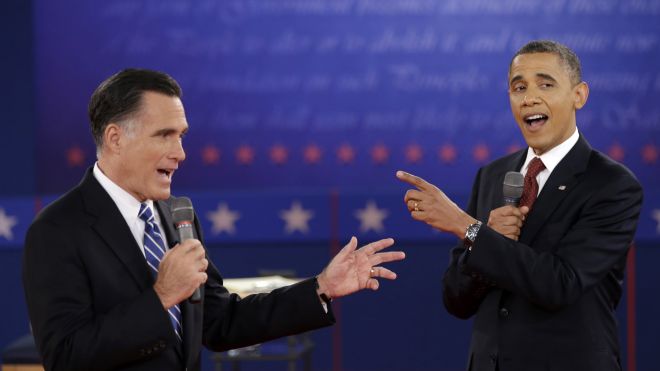
WASHINGTON – President Obama and Mitt Romney were spending the final hours before their third and final debate — a potentially decisive bout that will focus on foreign policy — studying hard, as new polling reinforces the view that Romney’s surge out of their first debate has made the race too close to call.
With two weeks until Election Day, neither candidate is likely to get another chance after Monday night to articulate his platform to such a broad audience. The debate offers the usual mix of opportunity and peril for the candidates. One slip-up could drive coverage for days, with precious few left on the calendar. A strong performance by either could turn a post-debate bounce into an Election Day victory.
And the race is tight enough for any needle-moving out of Monday night’s debate to make a difference. An NBC News/Wall Street Journal poll on Sunday showed the president and Romney tied at 47 percent. A new Politico/George Washington University Battleground tracking poll showed Romney leading 49-47 percent — marking the first time the Republican nominee has led since May.
The 90-minute faceoff at Lynn University in Boca Raton, Fla., offers the candidates their last opportunity to stand one-on-one before tens of millions of Americans and command their undivided attention before next month’s election. Both candidates largely dropped out of sight and devoted their weekends to debate preparations, a sure sign of the high importance they attach to the event.
The debate is likely to get testy. In the last round, the two candidates repeatedly interrupted each other, and the moderator, as they jostled for time. The sensitive subject of the Libya terror attack is also expected to be a top issue Monday night.
While the principals warm up for their evening debate in the battleground state of Florida, their running mates will be busy Monday seeking votes in two of the eight other states whose up-for-grabs electoral votes will determine the next president — Vice President Joe Biden in Ohio and Republican Rep. Paul Ryan in Colorado. Also still hotly contested: Iowa, New Hampshire, Nevada, North Carolina, Wisconsin and Virginia.
It fell to campaign surrogates on Sunday talk shows to frame the foreign policy matters that moderator Bob Schieffer will put before the candidates in a discussion sure to reflect “how dangerous the world is in which we live,” as the CBS newsman put it. Iran’s nuclear intentions, the bloody crackdown in Syria, economic angst in Europe, security concerns in Afghanistan, China’s growing power — all that and more are on the agenda.
And all feed into the broader debate over which candidate offers the steady hand and sound judgment for a nation facing myriad challenges at home and abroad.
Florida Sen. Marco Rubio, arguing for the Republicans, faulted Obama for “his failure to outline broad goals, real goals, a real view of what America’s role in the world should be.” Romney, by contrast, would “use America’s role in the world as a catalyst for peace, prosperity and freedom,” he said.
Ryan, campaigning in Colorado Springs, Colo., on Sunday, faulted the president for potential defense cuts and said that when adversaries “see us projecting weakness, when they see us hollowing out our military … they think we are a superpower in decline.” It was a likely preview of one of Romney’s arguments in the debate.
Obama adviser David Axelrod said that when the president took office “we were isolated in our position on Iran and in the world. And today, the world is unified against Iran with us, all because of the leadership of this president.”
The Obama campaign released a blistering memo from Senate Foreign Relations Committee Chairman John Kerry, D-Mass., accusing Romney of offering nothing but “endless bluster” on international issues.
“He is an extreme and expedient candidate who lacks the judgment and vision so vital for the Oval Office,” said Kerry, who is considered a leading candidate to succeed Hillary Rodham Clinton as secretary of state if Obama wins a second term.
When it comes to their foreign policy credentials, both candidates have reasons for optimism and concern: While foreign policy has been a strength of Obama throughout the campaign, some recent polls show his advantage narrowing. The Pew Research Center’s October poll, for example, found that 47 percent of Americans favored Obama to make “wise decisions about foreign policy,” while 43 percent preferred Romney.
The Associated Press contributed to this report.

Rosie Perez gives a great explanation on the reason why Hispanics and Latinos are not voting for him.
The other day we saw Jay-Z give a eloquent and poignant endorsement of the president, but now we take a look at the Latino/Hispanic vote; a strong vote that must be won by the presidential candidate in order to win the election. The Latino numbers are there for President Obama so far and Rosie Perez just hammered the message on home. Rosie Perez stood in the middle of a white room and laughed with Mitt Romney for a minute…
Mitt Romney’s infamous secretly recorded tape during a private fundraiser dinner is played and he’s talking about how his father was born in Mexico, but “had he been born to Mexican parents, maybe he’d have a better shot at winning this.” But Rosie has a rebuttal to his ignorant thoughts by first making the point that the population of America is 17 percent Latino.
“All you have to do is look at the statistics and Mitts point becomes crystal clear, Hispanics represent 17 percent of the population and account for less than two percent of all elected and appointed officials. The advantage is obvious. Think of all our Hispanic American presidents from Jorge Washington to Jorge Bush …”
But Rosie doesn’t let up. She shows him how wonderful life could be if he just had a few
“But a clean cut Hispanic American like Julian Castro or Ricky Martin OH…MY…GOODNESS! What if you were just a little bit gay Mitt think of all the advantages that would provide. What if you had a vagina?! (she gasps) If you were a gay Latina this election would be in the bag for you! Unfortunately for you Mitt YOU WERE CURSED with the hard knock life of growing up the son of a governor and auto executive…”
But when she gets serious, she drops the bottom line:
“The reason Latinas are not voting for you is because your policies suck!
She goes in, doesn’t she! Check her out! Another honest and on point celebrity endorsement for Obama!
-J.C. Brooks