Do Black Dancers Have A Place In Ballet? We Say, Yes. (Video)

Economic factors forced the disbanding of the Dance Theatre of Harlem Company in 2004. Now, eight years later, reading the series of pieces about the dearth of black dancers that recently ran in the UK’s Guardian newspaper, it is as if Dance Theatre of Harlem never existed.

With increasing frequency, the scarcity of black dancers on the ballet stage bubbles back to the surface–a sure sign of the need for change. The roving finger of blame identifies a different culprit with each round of discussion, yet because there are multiple factors at work, we are still far from a resolution.

In founding Dance Theatre of Harlem in 1969 at the height of the Civil Rights movement, Arthur Mitchell intended to put the question of whether black dancers belonged in ballet to rest for good. As a founding member of the groundbreaking Dance Theatre of Harlem and throughout my 27 years as a ballerina with that company, we demonstrated that dancers of many hues could not only perform ballet, but do so at the highest level. It was gratifying that, ten years into our existence, a second generation of dancers of color began arriving at our doorstep, ready to claim their place in ballet.

The good news is that we are back. The new Dance Theatre of Harlem Company will make its debut performance at the Kentucky Center in Louisville, KY on October 20. As artistic director, I have selected 18 racially diverse artists who will carry the legacy of Dance Theatre of Harlem forward into the 21st century. The idea at the heart of that legacy is that–given access and opportunity–an individual can create for his or herself a future outside of convention.

Once again a different perspective on the art form will enliven the field, but the absence of role models is not the only reason ballet remains so pale. The high cost of training for a career in ballet (though let us not assume that there are no African Americans of means who can afford to do so) and a literal old guard who prized a cookie-cutter similarity in the dancers they put on their stages stood in the way of diversifying the art form are certainly factors, but there are also systemic aesthetic and political issues that contribute to the exclusion blacks from ballet.

One of them is no doubt the notion of an idealized body. This essential aspect of ballet has often been cited as a reason to exclude black dancers. It hardly needs to be stated how great a mistake it is to assume that one group is uniquely qualified and another uniquely unqualified as it is also a mistake to hold the art form hostage to 19th century ideals of beauty in which pale skin was equated with goodness and dark with evil. No thinking person would allow him or herself to indulge in these kinds of discrimination, but such prejudices persist below the level of thought.

Ballet’s aesthetics have evolved. Compare the slope shouldered wasp-waisted Taglioni perched on the petal of a flower with George Balanchine’s ideal of a small-headed, long legged Amazon capable of fleet, space-gobbling, off-kilter movement. Balanchine himself dreamed of a company equally divided between blacks and whites. And even looking at the company he founded, New York City Ballet, the favored body-type has continued to change. And, as has been pointed out, a new, enlightened generation of artistic directors is broadening the perception of what ballet can look like by bringing dancers of color to their companies.

Beyond the physical look of ballet though, is the notion of what the ballet has come to signify an aspirational ideal. Historically, the classical arts, opera, music, ballet have been seen to convey the highest expression of the human spirit. They were closed clubs whose cachet was exclusivity. On the outside were all of those who did not match a particular set of standards. While ballet is an exclusive form of expression–only the truly inspired, strong and exceptionally gifted can master this rigorous artform, none of the aforementioned is contingent on race, ethnicity or nationality.

One of the opportunities we have now that a more substantive discussion of the role of diversity in the classical arts is arising, is the question, not of whether blacks belong in the art form, but what, exactly is the role of art at this point in human history, and how can that best be fulfilled? We are not living in a colonial world in which culture is a weapon of dominance. It is time to think differently: the art of ballet as a common language that transcends difference that can build unity.

WATCH the Dance Theatre of Harlem perform “Contested Space”:

Documents from the Black Arts Movement

“On Black Art”
by Ron Karenga

Black Art must be for the people, by the people and from the people. That is to say, it must be functional, collective
and committing.

Soul is extra-scientific, that is to say, outside of science; therefore we will allow no scientific disproof of it.

All that we do and create is based on tradition and reason, that is to say, foundation and movement. We began to
build on a traditional [sic], but it is out of movement that we complete our creation.

Art for art’s sake is an invalid concept, all art reflects the value system from which it comes.

We say inspiration is the real basis of education. In a word, images inspire us, academic assertions bore us.

Our art is both form and feeling but more feeling than form.

Our creative motif must be revolution; all art that does not discuss or contribute to revolutionary change is invalid.
That is […] why the “blues” are invalid, they teach resignation, in a word, acceptance of reality–and we have come
to change reality.

There is no better subject for Black artists than Black people, and the Black artist who doesn’t choose and develop
his subject will find himself unproductive.

All art is collective and reflects the values of the people. Therefore what makes us able to identify an artist’s work
is not individuality, but personality, which is an expression of the different personal experiences of the artist within
the Black framework.

Suppose Ray Charles had to sing Beethoven or Bach’s Carols, or Miles Davis had to play in the Philharmonic; it
wouldn’t go off at all. That’s why we have to have a pattern of development that is suited to our own needs.

The truth is that which needs to be told, and true creation is that which needs to be created and what we need to
create is Black images which speak to and inspire Black people.

We need a new language to break the linguistic straight [sic] jacket of our masters, who taught us his language so
he could understand us, although we could hardly understand ourselves.

In terms of history, all we need at this point is heroic images; white people have enough dates for everybody.

All education and creation is invalid unless it can benefit the maximum amount of Blacks.

Art is an expression of soul and creativity, sensitivity, and impulse is the basis.
Sensitivity, creativity and impulse are abstract to those who don’t have them. There is no art in the world you
should have to go to school to appreciate.

Borrowing does not mean you become what others are. What is important here is the choice of what one borrows
and how he shapes it in his own images. Whites are no less white by borrowing from Black and vice versa.

There is no such thing as art for art’s sake. If that’s so, why don’t you lock yourself up somewhere and paint or
write and keep it only to yourself.

The white boy’s classical music is static. He values the form rather than the soul force behind the creation. That is
why he still plays tunes written two or three hundred years ago.

All art should be the product of a creative need and desire in terms of Black people.
In Africa you won’t find artists of great name because art is done by all for all.
There is no premium on art in Africa just as there is no premium on dancing in the ghetto. All Blacks can dance.

In African art, the object was not as important as the soul force behind the creation of the object.

All art must be revolutionary and in being revolutionary it must be collective, committing, and functional.

Whites can imitate or copy soul, but they can’t create out of that context.
All nationalists believe in creativity as opposed to destruction and a nationalist must create for the Black nation.

Black art initiates, supports and promotes change. It refuses to accept values laid down by dead white men. It sets
its own values and re-enforces them with hard and/or soft words and sounds.

All art consciously or unconsciously represents and promotes the values of its culture.

Language and imagery must come from the peopl and be returned to the people in a beautiful language which
everybody can easily understand.

Soul is a combination of sensitivity, creativity and impulse. It is feeling and form, body and soul, rhythm and
movement, in a word, the essence of Blackness.

Muddy Waters and those in the same school are very deep, and so when bourgeois Negroes say that Muddy
Waters is too deep for them, they are saying, in a word, that Muddy Waters is more down to earth.

Reprinted from Black Theater 3, pp. 9-10.
Online Source: http://www.umich.edu/~eng499/documents/karenga1.html


St. Louis Zoo’s Halloween Ghost Display Removed After Critics Say It Looks Like A Lynching (VIDEO)


The Huffington Post | By Cavan Sieczkowski
Posted: 10/17/2012 2:24 pm EDT Updated: 10/17/2012 2:24 pm EDT

St. Louis Zoo officials removed a Halloween ghost display after some viewers called it offensive, saying the exhibit resembled slave lynchings.

The Halloween ghost display in question featured about 10 ghosts with black faces hanging from tree branches at the St. Louis Zoo in Missouri, according to Fox 2 Now. A photo of the display was posted on the St. Louis Zoo official Facebook page, prompting several Facebook users to comment that the scene, installed for the zoo’s “Boo at the Zoo” Halloween event, resembled slaves being lynched.

“It was like a complete outrage to me, it was very hurtful,” Chris Burchett, a zoo patron, told KMOV. “The picture appeared to be African-American people hanging from a rope.” Adding, “That’s a no brainer. It’s impossible that you could not see that that’s racist you know, there’s no way.”

Officials told The Kansas City Star that an outside vendor is responsible for the zoo’s ghost display. The ghosts had lights installed in their heads so they looked like bodiless glowing orbs at night.

Wyndel Hill, St. Louis Zoo Vice President for Internal Affairs, insists that the ghost exhibit was never meant to echo a ghastly lynching scene.

“The faces are black so that at night the lights inside the faces would be the only thing that you see,” he told KPLR 11. “I don’t know that it looks derogatory towards anyone, by the same token however, if someone is offended by it, it touches our sensibilities and we’ll remove it.”

Zoo officials said that the crew who installed the ghost display included African-American workers, according to KMOV, and that crew plans to replace the Halloween decorations so no one else is offended.

Documentary Film ‘Why Do You Have Black Dolls?’ Explores Beauty And Cultural Identity (VIDEO)


The Huffington Post  |  By
Posted: 10/17/2012 12:48 pm EDT

Why Do You Have Black Dolls?” is the title and question being tackled in a new short documentary film by director Samantha Knowles.

The film’s title and premise stems from an experience Knowles had as a child when an inquisitive 8-year-old playmate asked the very same question.

“Her question stuck with me for a long time. I can’t remember how I responded in that moment, but I saw this film as an opportunity to explore that question,” Knowles told Dartmouth Now.

The synopsis states that the film, which recently debuted at 15th annual Reel Sisters Film Festival, “explores the history, the beauty, and the pride that is the black doll. Through its characters, a little-known community of black doll enthusiasts, it reveals that the black doll is more than a plaything; it is a cultural artifact that represents the history of the people it depicts.”

This premise is exactly why it strikes a chord with some of us when we hear news like the beloved Kenya Doll from the ’90s is being relaunched or that a group of women are making natural hair Barbies. We also smiled from ear-to-ear after discovering images of the Disney princesses re-imagined as women of color.

The film resonates even more when you consider a bit of history involving black self-identity and dolls, case in point, the 1939 Clark Doll Experiment. The groundbreaking study conducted by sociologists Kenneth and Mamie Clark found that a majority of the black children (63 percent) that were questioned, preferred to play with a white doll over a black doll–and that the white doll was “nicer” than the dark-skinned one.

Today the results aren’t as jarring; ABC conducted a similar experiment in 2009, which found that 32 percent of black children wanted to play with the white doll.

Nevertheless, there still remains a significant desire (some would say a need) to have and to hold a doll that reflects the pride and cultural heritage of the black community, which is why Knowles’ film is more than just a look at black dolls and doll collectors–it begs deeper questions of identity and invites a really important conversation. But does it answer the fundamental question in the film’s title?


Check out the trailer for “Why Do You Have Black Dolls?” below and learn more about the film here.


Artist Lorna Simpson (VIDEO)

Lorna Simpson was born in 1960 in Brooklyn, New York, and received her BFA in Photography from the School of Visual Arts, New York, and her MFA from the University of California, San Diego. When Simpson emerged from the graduate program at San Diego in 1985, she was already considered a pioneer of conceptual photography. Feeling a strong need to re-examine and re-define photographic practice for contemporary relevance, Simpson was producing work that engaged the conceptual vocabulary of the time by creating exquisitely crafted documents that are as clean and spare as the closed, cyclic systems of meaning they produce. Her initial body of work alone helped to incite a significant shift in the view of the photographic art’s transience and malleability.

Lorna Simpson first became well-known in the mid-1980s for her large-scale photograph-and-text works that confront and challenge narrow, conventional views of gender, identity, culture, history and memory. With the African-American woman as a visual point of departure, Simpson uses the figure to examine the ways in which gender and culture shape the interactions, relationships and experiences of our lives in contemporary multi-racial America. In the mid- 1990s, she began creating large multi-panel photographs printed on felt that depict the sites of public – yet unseen – sexual encounters. More recently, she has turned to moving images – in film and video works such as Call Waiting, Simpson presents individuals engaged in intimate and enigmatic yet elliptical conversations that elude easy interpretation but seem to address the mysteries of both identity and desire. Over the past five years, her work includes drawings based on the characters in a recent video work constructed from found film footage. As a collection, these portraits become studies on the construction of identity achieved through the subtle interplay of lines and accents of color. Most recently, she began a project involving an archive of photographs from the 1950s, which she has been adding to by creating her own replicas of these images, posing herself to mimic the originals.

Her work has been exhibited at the Museum of Modern Art, New York; the Museum of Contemporary Art, Chicago; the Miami Art Museum; the Walker Art Center, Minneapolis; and the Irish Museum of Modern Art, Dublin. She has participated in such important international exhibitions as the Hugo Boss Prize at the Guggenheim Museum, New York, and Documenta XI in Kassel, Germany. She has been the subject of numerous articles, catalogue essays, and a monograph published by Phaidon Press. Simpson’s first mid-career survey was exhibited at the Los Angeles Museum of Contemporary Art, the Miami Museum of Art, the Whitney Museum of American Art, the Kalamazoo Institute of Art, and the Gibbes Museum in South Carolina. Of late, she had a solo exhibition at Salon94, New York, in 2008 and a solo exhibition at Obadia Galerie, Paris, in 2009. In 2010, she is the recipient of the International Center of Photography’s Infinity Award in Art.

[easyrotator]erc_55_1350557638[/easyrotator]

.

African American Art Auction at Swann Auction Galleries


HALE WOODRUFF (1900 – 1980)
Landscape Near Grasse.

Oil on canvas, 1930. 457×550 mm; 18×21 5/8 inches. Incised signature, lower left recto. Signed in pencil, lower right verso. Titled in pencil on the stretcher bars, verso.

Provenance: Cunningham Gallery, Wellfleet, MA; private Vermont collection.

Landscape Near Grasse is a striking Impressionist painting by Hale Woodruff; it recalls landscapes painted by Cézanne nearby in Provence. Grasse is also the location of paintings by American artists as diverse as John Singer Sargent and Loïs Mailou Jones.

Woodruff left Paris for Cagnes-sur-Mer on the coast of Provence in the summer of 1930, following in the footsteps of his countrymen Palmer Hayden and William H. Johnson, and such notables as Modigliani, Renoir and Soutine. Attracted to its artistic history, sunlight and cheap accommodations, Woodruff soon rented a studio at 34 rue Carnot, which he later learned was once Chaim Soutine’s atelier. Though Woodruff denied Soutine’s influence, one could argue that his later landscapes reflect an interest in both Cézanne and Soutine. Another Woodruff oil, Provençal Landscape, 1930, describes a very similar hilly scene with scattered red-roofed houses–he sent it to the Harmon Foundation in New York, where it was exhibited in 1931. Leininger-Miller pp. 130-32.
Estimate $20,000-30,000


Swann’s semi-annual auctions of African-American Fine Art boast museum-quality works by important American artists, and this October sale is no exception. Highlights include:

William Edouard Scott’s When the Tide is Out, oil on canvas, 1932, shown top left.

Charles White’s exquisite pen and ink drawing Songs of Life, 1953-54.

Three paintings by Hughie Lee-Smith, including Boy with Flute, oil on canvas, circa 1960.

Several Al Loving paintings, including his Untitled (Cube), acrylic on canvas, circa 1969.

Romare Bearden’s paper & fabric collage Girl in a Garden, 1972.

Title: AFRICAN-AMERICAN FINE ART
Date: October 18, 2012
Time: at 2:30 PM
Exhibition: Sat., October 13, 10-4
Mon., October 15, 10-6
Tues., October 16, 10-6
Wed., October 17, 10-6
Thurs., October 18, 10-noon
Contact Person: Nigel Freeman

African Art: Beyond the Masks

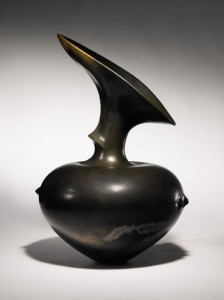
Magdalene Odundo, Untitled (Anthropomorphic Sculpture), 1991. SOTHEBY’S

By Posted 09/17/12

Her work has been exhibited at the Metropolitan Museum of Art in New York and in group shows at the Detroit Institute of Arts and the Seattle Art Museum. Critics and curators are drawn to her innovative use of one of the oldest materials, clay.
Yet the Kenyan-born ceramic sculptor Magdalene Odundo still cringes when her creations are displayed alongside traditional African pottery.

“Sometimes they plunk me in without explanation with, say, traditional women potters,” says Odundo, who teaches at the Surrey Institute of Art and Design, outside London. “Sometimes it works. But others, you throw your hands up and say, well, at least it’s publicity.” (Odundo is represented by Anthony Slayter-Ralph.)

Odundo’s dilemma is one faced by artists, curators, and museum directors all over the United States as they respond to the public’s growing interest in contemporary African art. Museums with well-established collections of classical African art are venturing into the contemporary realm and sparking lively debates about how to show classical and contemporary art together. Basic questions about where boundaries should be drawn between traditional and modern, between African and the African diaspora in the Americas and Europe, and between sub-Saharan and North African art are roiling the field. The debates, say curators, have made African art one of the most contentious and rapidly evolving fields in museums today.

“Everyone is wrestling with these questions. We go to symposia and forums, and that’s what we’re all talking about,” says Polly Nooter Roberts, who became the first consulting curator of African art at the Los Angeles County Museum of Art in December of 2011. “People used to think the traditional and the contemporary shouldn’t be mixed up, but now there’s a sense that if it’s done thoughtfully and not in a random way, it can work.”

At the same time, museums are increasingly splitting off Africa from other non-Western areas as a curatorial category. Arts of Africa, Oceania, and the indigenous Americas have been routinely lumped into a single department—at one time it was called “tribal art”—at encyclopedic museums. But now, the Nelson-Atkins Museum of Art in Kansas City and the Newark Museum in New Jersey, as well as LACMA, have appointed curators exclusively for African art, and other museums are expanding their African holdings and programs.

LACMA director Michael Govan says that when he took over his post in 2006, he was surprised to discover that the museum did not have an exclusively African program. He wants the museum to “engage very much on the contemporary” side of African art. “There is a growing sense of the globalization of art and a sense that we need to look at African art as more than an inspiration for modernism,” Govan says. “We have to rethink the old hierarchies and look past the totally Eurocentric view.”

Collecting criteria have broadened since 2000, when the founder and director emeritus of the Smithsonian’s National Museum of African Art, the late Warren Robbins, publicly scolded the museum for collecting contemporary art and showing it alongside traditional masks and sculpture. “Contemporary African art is European art that happens to be made by Africans,” Robbins told a forum. The museum brushed aside the criticism and in 2005–06 mounted “African Art Now,” a groundbreaking survey drawn from the collection of the businessman and photographer Jean Pigozzi. It included work by key figures not yet widely known in America, such as the Kinshasa painter Chéri Samba and Malian photographer Seydou Keïta.

Much of the push into African contemporary art today comes from the Newark Museum, which plans to triple the size of its African galleries to over 8,000 square feet by 2015. One gallery will be devoted to contemporary art, one to a mix of modern and traditional African art, which the museum began collecting in 1915, and another to shows of contemporary art.

Newark’s curator of African art, Christa Clarke, has gradually shifted the museum’s focus toward the contemporary. In 2010, the museum opened its first gallery for contemporary African art, and, says Clarke, “we’re acquiring aggressively.” Yet even as the museum moves headlong into the field with ample resources and expertise, Clarke still negotiates the delicate question of what exactly constitutes an “African” artist. It can be a tough call, especially for a curator who is uncomfortable even with the reductionist term “African art.”

“It’s a question you never really solve,” says Clarke. “In a museum structure, we have collecting guidelines that we follow. On paper, we mean artists born in Africa or who lived and worked in Africa for an important part of their careers.” Thus Kehinde Wiley, born and raised mostly in the United States, with a Nigerian father and an American mother, would probably not qualify. Yinka Shonibare, born in London of Nigerian parents and raised in Lagos, probably would.

“We let viewers know that these boundaries are necessary but, at the same time, somewhat arbitrary,” says Clarke. The artist’s biography comes into play but, paradoxically, not so much the art itself. “The art we’re collecting doesn’t have to look ‘African’ or even have anything African in the subject matter” to be included in the museum’s African program, she says.

The depth of Newark’s collection allows the museum to experiment with juxtapositions beyond familiar combinations of African masks with the early modernist paintings they inspired, most famously Picasso’s Les Demoiselles d’Avignon. “We’re looking beyond African art as an influence on the West,” says Clarke, to explore universal themes. She plans to place Gabon reliquary figures next to American colonial portraits to highlight ancestor worship.

Major museums are also looking at African art collecting in America. The Met will mount a show in November on African art connoisseurship in New York in the 1920s and its still underappreciated impact on American modernism. The exhibition, “African Art, New York, and the Avant-Garde,” will feature some 40 African wood sculptures acquired by top collectors of that era, alongside works by artists they influenced.

The Newark Museum explored a similar vein last year, adding a traditional mask from Côte d’Ivoire to its Stieglitz Gallery, a room meant to evoke the famed dealer’s Gallery 291 and including works by Georgia O’Keeffe and Marsden Hartley. “Stieglitz held one of the first gallery exhibitions devoted to African art in the U.S., so I thought it was an apt addition to the gallery,” says Clarke.

The Met also uses its growing African collection to reach across time and space. The museum’s curator of the art of Africa, Oceania, and the Americas, Alisa LaGamma, placed a Dogon carving of a mother and child together with a wood sculpture of a woman holding twin sons, by South African sculptor Claudette Schreuders, who studied traditional woodcarving techniques in Kenya. Near Schreuders’s sculpture hangs a work by El Anatsui, who uses cloth, bottle caps, metal scraps, and other materials to create richly textured hangings that recall kente textiles, of which his father was a master weaver in Ghana. (Both artists are represented by Jack Shainman Gallery in New York.)
The Met remains focused on traditional African art. A sprawling show last year, called “Heroic Africans,” explored depictions of power and rank in classical societies. “But in the last ten years we’ve been looking at the place for contemporary art,” says LaGamma, who makes the rounds of African biennials and contemporary art fairs, such as the Dakar, Senegal, biennial known as Dak’Art, and—before the recent turmoil in Mali—the photography biennial in Bamako.

But do contemporary artists want their works to be displayed alongside traditional, ethnographic African art? Plenty of curators say the answer is no.

“Contemporary African art strives for international recognition. It has a very different purpose from that of masks or traditional sculpture, which are made for local people and are very culture-specific,” says Enid Schildkrout, curator emerita at the American Museum of Natural History and chief curator emerita at the Museum for African Art in New York, who organized the international traveling show “Dynasty and Divinity: Ife Art in Ancient Nigeria” last year. She says that mixing contemporary and traditional art from Africa can look patronizing and simplistic.

“The resonances between them are curatorially driven, so you are left with a geographic focus that is finding a lot of resistance from artists,” Schildkrout says.

How the art of the African continent will be seen by the interested American public may become clearer when the Museum for African Art opens its new building on Manhattan’s Museum Mile next year.

With a substantial African collection, the Nelson-Atkins Museum announced in January that it will share the services of Detroit Institute of Arts curator Nii Quarcoopome, who will devote a quarter of his time to Kansas City’s African holdings. Quarcoopome’s title in Detroit (Curator of Africa, Oceania, and the Indigenous Americas) reflects the era when African art was stuck in a broader, non-Western context. Quarcoopome, who studied archeology in his native Ghana before earning a Ph.D. in art history from UCLA, says that “the traditional is much more my strength than contemporary.” But the museum’s contemporary collection already includes major works by Anatsui and Odundo, and part of Quarcoopome’s task will be to expand in that area, mainly by working with private collectors willing to make donations or long-term loans.

“There is more interest in the contemporary than in traditional right now,” Quarcoopome says, “but they can be combined. With Anatsui’s work, the connection to traditional crafts is so obvious, and he himself acknowledges this, so it’s quite natural to look back. It’s not like you’re imposing a particular reading of his work onto the viewer.”

Nelson-Atkins director Julián Zugazagoitia, sees the emphasis on the contemporary as part of a continuum from the traditional. The museum does not have a dedicated fund for acquiring African art, he says. “Given what we have in classical [African] art, we want to give a sense of stylistic reaches and traditions and then show how that jumps into the contemporary.”

Perhaps inevitably, the melding of the contemporary and the traditional has started to challenge people’s notions about the latter. The boundaries between them are not as clear as some might assume, and Western ideas about what classical African art should look like are often wrong, says Schildkrout. Dogon masks from the Niger basin, for example, often feature patches of bright paint and bits of plastic. Some dealers actually remove such touches because they think collectors won’t like them.

“The so-called traditional arts are constantly changing,” Schildkrout adds. “To call it ‘traditional art’ makes it sound like it’s stuck in time, and it’s not. We’re talking about lines that are very fluid.”

Roger Atwood has been a reporter and critic for ARTnews since 1999. Some of his articles can be read at rogeratwood.com.

Copyright 2012, ARTnews LLC, 48 West 38th St 9th FL NY NY 10018. All rights reserved.

Old Masters of Our Domain

Contemporary artists rock art-history classics to pay homage, show off, have fun, and comment on issues like race and class

By Posted 10/10/12

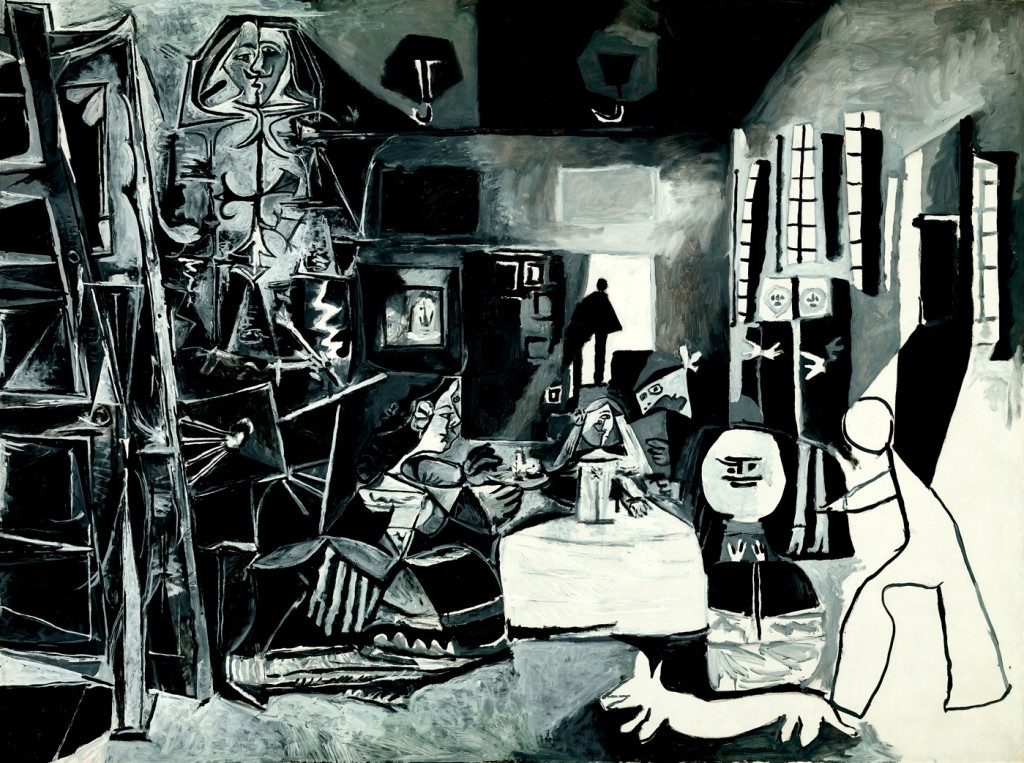
Among the many delights of “Picasso Black and White,” which opened at the Guggenheim last week, was seeing how the Spanish master treated his elders. This is apparent not only in the ways he echoed his nation’s painterly tradition with his own austere palette, but also in his recapitulations–or, as some might say, appropriations–of multiple art-historical icons. Poussin’s Rape of the Sabine Women and Delacroix’s The Women of Algiers are among the pictures Picasso takes for a modernist spin, riffing on pointedly on their subject matter as he brashly updates their stye. And then there’s Las Meninas, the Velázquez masterpiece showing the royal family, their entourage, and the artist himself. In Picasso’s manic re-interpretation–or, some might say, misreading–from 1957, the painter has grown to be the biggest figure in the room.

Pablo Picasso, The Maids of Honor (Las Meninas, after Velázquez) (Les Ménines, vue d’ensemble, d’après Velázquez), 1957, oil on canvas.

MUSEU PICASSO, BARCELONA, GIFT OF THE ARTIST, 1968/©2012 ESTATE OF PABLO PICASSO/ARTISTS RIGHTS SOCIETY (ARS), NEW YORK/PHOTO: GASSULL FOTOGRAFIA

For contemporary artists, quoting Old Masters is still an exercise, diversion, rite of passage, and vehicle for social and political commentary–showing that the great tradition of European painting still has its pull (or at least its uses) among the new avant-garde. Here are some examples that have popped up in recent shows:

Snake Eyes
The catalogue for Braco Dimitrijevic’s current show at Sperone Westwater is called “Between the Louvre and the Zoo,” but this encounter took place in the Kunsthalle Darmstadt.

Braco Dimitrijevic, Slow as Light Fast as Thought, 1995, digital color print, edition of 5 and 3 AP.

COURTESY SPERONE WESTWATER, NEW YORK.

Da Vinci Co-ed
In his recent show at Hasted Kraeutler, Ethiopia-born, Bronx-raised photographer Awol Erizku recapitulated masterworks using African American sitters with fabulous clothes and contemporary props. So Vermeer’s Girl with a Pearl Earring becomes Girl with a Bamboo Earring. And Leonardo’s fetching Lady with an Ermine, his much-interpreted 1496 portrait of the teenaged mistress of Duke Ludovico Sforza, is reimagined as modern-day beauty with a pit bull puppy.

Awol Erizku, Lady with a Pitbull, 2009.

COURTESY THE ARTIST/HASTED KRAEUTLER, NYC.

She’s in the Monet
Monet’s gardens at Giverny, considered a sculpture in themselves, if not one of the first works of land art, remain strong in contemporary artist’s imaginations–in part because the Versailles Foundation brings contemporary creators to live and work there each year. That’s how E.V. Day ended up in the Impressionist setting, recreated at the Hole Gallery last spring. It was a collaboration with her friend Kembra Pfahler, artist and lead singer of the death-rock band The Voluptuous Horror of Karen Black, who traveled to Giverney to strike a few poses.

E.V. Day & Kembra Pfahler, Untitled 17, 60 x 40 inches.

COURTESY THE ARTISTS AND THE HOLE.

Venus in Sludge
There’s a lot more trash around than there was when Venus emerged from the sea in Botticelli’s Birth of Venus, so Vik Muniz’s version, in his current show at the Mint Museum, “Garbage Matters,” rises from a landfill–even as she is created of material from it.

Vik Muniz, The Birth of Venus, after Botticelli (Pictures of Junk), 2008, digital chromogenic print.

COURTESY SIKKEMA JENKINS GALLERY, NEW YORK CITY/©VIK MUNIZ/LICENSED BY VAGA, NEW YORK, NY.

Oh Captain?
Raft of the Medusa, Gericault’s influential history painting depicting victims of a notorious shipwreck, is a bit worse for the wear in Concordia, Concordia, Thomas Hirschhorn’s rendering of the Italian cruise ship that ran aground last year, now at Barbara Gladstone. The captains in both instances were blamed for their incompetence.

Thomas Hirschhorn, Concordia, Concordia, 2012. Installation at Barbara Gladstone’s gallery on 21st Street.

PHOTO: ANNA KOWALSKA/©THOMAS HIRSCHHORN/COURTESY GLADSTONE GALLERY, NEW YORK AND BRUSSELS.

The Influence of Anxiety
In the catalogue for Kim Jones’s show of works on paper opening Friday at Pierogi, Kim Levin locates the origin of the artist’s Felliniesque hybrids– conjuring “boyhood fantasies merging with the actual experience of a veteran who has been in the hell of war”–in Tiepolo. But they also look like refugees from Goya’s Caprichos and contemporary caricature.

Kim Jones, Untitled, 1972-2011, acrylic and ink on paper.

COURTESY THE ARTIST AND PIEROGI.

Clothes Encounters
In his first show of female portrait subjects, earlier this year at Sean Kelly, Kehinde Wiley found his sitters on New York’s streets and dressed them in outfits designed by Givency’s Riccardo Tisci. The Honourable Mrs Graham (1757 – 1792), Thomas Gainsborough’s 1775 – 1777 portrait of a tragic beauty, inspired Wiley’s Mrs. Graham.

Kehinde Wiley, Mrs. Graham, 2012, oil on canvas.

©KEHINDE WILEY/SEAN KELLY GALLERY, NEW YORK.

Shock of the Old
The website for the Musée d’Orsay, where Courbet’s notorious 1866 Origin of the World is displayed, notes that the most famous portrait of a woman’s genitalia in art history had its roots in Titian, Veronese, Correggio and the tradition of carnal, lyrical painting. Mickalene Thomas’s version is one of several Courbet-inspired works in her show at the Brooklyn Museum.

Mickalene Thomas, Origin of the Universe 2, 2012, rhinestones, acrylic, oil, and enamel on wood panel.

PRIVATE COLLECTION, NEW YORK/COURTESY THE ARTISTS AND LEHMANN MAUPIN GALLERY, NEW YORK.

Copyright 2012, ARTnews LLC, 48 West 38th St 9th FL NY NY 10018. All rights reserved.

Beardenmania!

By Posted 07/19/12

Exhibitions, concerts, artists’ tributes, and even a postage stamp are part of the centennial tribute honoring Romare Bearden

The sight was a curator’s dream. Carla Hanzal, curator of contemporary art at the Mint Museum in Charlotte, North Carolina, looked in at her exhibition “Romare Bearden: Southern Recollections” on closing day to find the show packed. “It was downright emotional to see so many people in the galleries,” she remembers.

But although the show was closing in Charlotte, Bearden’s hometown, it was just beginning a tour that would take it to Tampa, Florida; and Newark, New Jersey, where it will be on view through August 19. And it was only the first of hundreds of exhibitions, programs, and performances organized to celebrate the centennial of Bearden’s birth.

“It’s uniquely imaginative,” said Robert O’Meally, Zora Neale Hurston Professor of English and director of the Center for Jazz Studies at Columbia University in New York, of the nationwide celebration of Bearden and his legacy.

It’s the party of a century—a fitting tribute to an artist known for his generosity, his gregarious nature, and his engagement with his times.

“He was an extrovert,” said June Kelly, the New York dealer who was Bearden’s manager until he died, in 1988. “Being around people fueled him with ideas and perceptions and imagery.”

Johanne Bryant-Reid and Diedra Harris-Kelley, co-directors of the Romare Bearden Foundation in New York, established by the Bearden estate in 1990 to preserve and perpetuate the artist’s legacy, created the template for the centennial tribute. In 2003, when “The Art of Romare Bearden,” organized by the National Gallery of Art in Washington, D.C., opened at the Whitney Museum in New York, the two contacted other New York institutions, asking if they would consider organizing mini-exhibitions or programs in conjunction with the show. “So we thought in a similar model, but on a much larger scale,” said Harris-Kelley of the current activities.

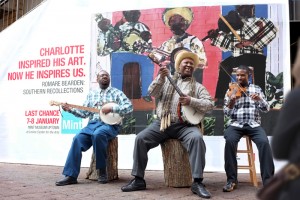
Since 2003, hundreds of thousands of Americans have enjoyed Bearden’s work in galleries or museums, packed concerts at which his jazz songs were performed, watched dancers interpret his narratives, and attended symposia about his life and times. In conjunction with the Mint Museum show, live musicians dressed as characters from Bearden’s collages performed on local train platforms and in front of an exhibition billboard, as if they had stepped right out of his work.

Last year the United States Postal Service launched the festivities by issuing a series of “Forever” stamps based on four of Bearden’s collages. New York’s Schomburg Center for Research in Black Culture mounted a retrospective that included both his first collage and his last painting. The Metropolitan Museum of Art hung his masterpiece The Block at the entrance to its contemporary galleries. And dozens of museums across the country pulled Bearden works from storage and put them on view.

At the Studio Museum in Harlem, curators honored Bearden by inviting 100 contemporary artists to make new work inspired by him. The museum, which Bearden helped found in the late ’60s, staged the show in three segments; the final group of pictures is on view through September 2. “I don’t think anybody who was asked refused,” said artist Charles Gaines, who created String Theory: Romare Bearden (2011) for the exhibition.

In November, the W. E. B. Du Bois Institute at Harvard University organized “Color and Construction: The Intimate Vision of Romare Bearden” and assembled a panel of Bearden experts to discuss the artist’s legacy. Last summer, the August Wilson Center for African American Culture in Pittsburgh hosted “Romare Bearden: The Last Years,” an exhibition of photos by Frank Stewart, in conjunction with the traveling print show organized by the Bearden Foundation, “From Process to Print.” This past winter, another Pittsburgh institution, the Andy Warhol Museum, paired his collages with work by Warhol.

“I think the work’s amazing,” said Ruth Fine, who curated the National Gallery show, the institution’s first-ever solo retrospective of an African American artist. “There have been a lot of people influenced by Bearden in the way a lot have been influenced by Rauschenberg.”

Bearden was known as an artist of great technical mastery, schooled in art history and grounded in modernism, as well as a chronicler who depicted the lives of African Americans with compassion and intelligence. To the late playwright August Wilson, Bearden was a role model, although they never met. “Bearden illuminates black life with a humanity and richness and fullness that I’d never encountered in such a way before,” he told Samuel G. Freedman of the New York Times in 1987. “Until then, I guess I’d always felt that the life I knew best didn’t have the value of the other life—white America.”

Ralph Ellison expressed a similar sentiment in his essay “The Art of Romare Bearden,” in the catalogue for a 1968 exhibition of Bearden’s work at the State University of New York at Albany. Bearden’s genius, Ellison said, was finding a way to “express the tragic predicament of his people without violating his passionate dedication to art as a fundamental and transcendent agency for confronting and revealing the world.”

Bearden continually reinvented himself. He attracted attention early as an abstract painter, exhibiting at the Kootz Gallery in New York with the likes of Adolph Gottlieb and Robert Motherwell. After serving in World War II, he went to Paris to study philosophy and also tried his hand at songwriting. In the ’60s he discovered collage, the medium that was to make his reputation. In his appropriation of imagery from popular media and in the photocopying and printing technology he used to compose his collage “paintings,” Bearden was ahead of his time.

“It’s interesting to me that the whole hip-hop era emerged about ’76, ’77 in the South Bronx,” said Mary Schmidt Campbell, dean of New York University’s Tisch School of the Arts, who is writing Bearden’s biography. “By the time he died, there was a very large culture of appropriation and sampling.”

Bearden’s work has a rare capacity to engage many different audiences, from schoolchildren who pick out “friends” living on the Harlem streets he painted to classical scholars who ponder his interpretation of the Homeric canon to abstract artists who study his techniques. Says Bridget Moore, of DC Moore Gallery in New York, which represents the Bearden estate, “I think in a way Bearden is opening paths to many people, ways of seeing, ways to think about our culture, our history, ways to think about art.”

Bearden’s fascination with the world around him also made him a coveted friend, known for his appetite for conversation and his wide-ranging interests. As North Carolina painter Herb Jackson remembers, Bearden’s studio became a kind of salon that attracted artists, musicians, dancers, and filmmakers. “The doorbell would ring; people were coming and going all the time. He was always open to everybody. He was very special in that way,” Jackson said.

Dance was an important part of Bearden’s life, through his wife, Nanette, who died in 1996. Bearden designed sets for her company, the Nanette Bearden Contemporary Dance Theatre, and sets and costumes for the Alvin Ailey American Dance Theater.
Nowhere have the centennial activities rivaled those in Charlotte, which was for Bearden “almost like Dublin was for James Joyce,” according to Hanzal. “It was almost mythological for him, a kind of Eden.” Bearden spent his early years in Charlotte, surrounded by a close extended family, before migrating to Harlem with his parents.

In addition to the Mint show, which attracted 44,000 visitors, the city announced a new park in Bearden’s honor, scheduled to open in time for the Democratic National Convention in September. The Arts & Sciences Council made an unusual grant to the Charlotte-Mecklenburg school district to underwrite teacher training about Bearden’s life and work and provide museum visits for all 11,000 fifth-grade students in the system.

The Harvey B. Gantt Center for African-American Arts & Culture exhibited the Stewart photos and works on paper owned by local collectors. Davidson College, where Bearden was awarded an honorary doctorate in 1977, sponsored a symposium; the Jerald Melberg Gallery mounted “Romare Bearden: An Artist Remembers His Birthplace”; the ImaginOn center exhibited the original illustrations for Bearden’s children’s book Li’l Dan the Drummer Boy; the symphony projected Bearden’s work during a concert of music by Duke Ellington and Aaron Copland; and a performance at the museum of short works by August Wilson, “The Dramatic Vision of Romare Bearden and August Wilson,” sold out, as did the premiere of a tribute by the North Carolina Dance Theatre.

“It was one of the most significant art experiences we’ve ever had in Charlotte,” said Patrick Diamond, who was development director of the Gantt Center at the time of the centennial. He and a committee are now “working towards creating an annual Romare Bearden festival.”

In New York, the Jazz at Lincoln Center series is honoring Bearden’s lifelong involvement with jazz in “Paris Blues Revisited: Romare Bearden, Albert Murray and Sam Shaw,” a collective project that celebrates Paris, New York, and music. Michael Rosenfeld Gallery assembled a collage show that was the most popular exhibition in the gallery’s history. The gallery was crowded six days a week, Rosenfeld said, with people waiting in line to get in.

The Bronx Museum, the Brooklyn Museum, and the Queens Museum of Art were among those that created small exhibitions from their collections.

Dorian Bergen, vice president of ACA Galleries in New York, which represented the Bearden estate for more than ten years, said the gallery will present “Romare Bearden: Urban Rhythms and Dreams of Paradise” this fall (October 27 through January 12).

Another large exhibition, the Smithsonian Institution Traveling Exhibition Service (SITES) show “Romare Bearden: A Black Odyssey,” will begin its tour at the Reynolda House Museum of American Art, in Winston-Salem, North Carolina, in October. The show features a series of collages reinterpreting the Odyssey and the Iliad narratives, pictures that were exhibited for the first time in 1977 and reassembled by DC Moore in 2007. The tour will end in 2015 at the Wallach Art Gallery at Columbia University. “This journey story, this odyssey, is a story that every culture tells. It’s the story of being human,” says Marquette Folley, project director of SITES.

The Stavros Niarchos Foundation in Athens is financing Web access to the “dialogue” created between the Homeric classics and Bearden’s work. The Smithsonian is also developing teaching guides for the show, as well as a “visually hip” app featuring Langston Hughes’s music, and a bulletin board where audience members can post personal contributions.

In great part, the Bearden centennial activities are designed not only to keep his work in front of contemporary audiences but also to help secure the recognition that many believe was denied the artist as an African American. Bearden enjoyed significant success in his lifetime, with dozens of solo gallery shows; a retrospective at the Museum of Modern Art in 1971; the publication of The Art of Romare Bearden: The Prevalence of Ritual, by Abrams; commissions to design sets for the Alvin Ailey American Dance Theater; and large-scale mural projects in New York, Pittsburgh, Baltimore, and other cities. He opened his own gallery to promote underrecognized Harlem artists and published several books. “Yet today Bearden is mentioned only in passing in art history surveys, in surveys of American art, and in discussions surrounding what is generally considered the mainstream of twentieth-century American practice,” Ruth Fine wrote in a 2005 essay for the American Philosophical Society.

Says June Kelly, “The embracing of African American artists within the mainstream took some time. Bearden should be priced like Louise Bourgeois—a million dollars. He’s as important as Jasper Johns or Ellsworth Kelly in terms of what he’s given to American culture.” At Christie’s May contemporary-art auction, Bearden’s midcentury collage paintings sold for sums ranging from $86,500 for a small-scale work to $338,500 for Strange Morning, Interior, a large collage from 1968.

Robert O’Meally, who is writing the catalogue essay and interpretive material for the SITES exhibition, sees Bearden’s “Black Odyssey” cycle as a metaphor for the American experience, since migration is a theme common to all citizens. Like the patchwork of Odysseus’s life, with its many turns, choices, and diversions, O’Meally says, “Bearden makes it clear that, yes, he’s a black man from North Carolina, but he’s also from Harlem and an American. And he can be all these things without losing integrity.”

Copyright 2012, ARTnews LLC, 48 West 38th St 9th FL NY NY 10018. All rights reserved.

How to be an African-American art lover: Why investing in original black art is affordable, easy and edifying

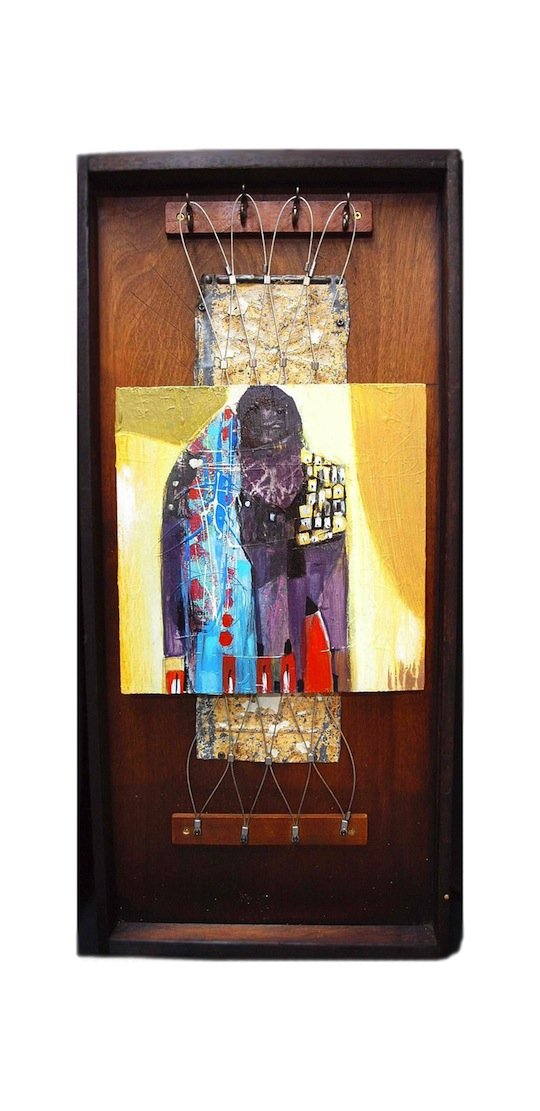
Al Johnson, This Everlasting Moment, 2012. Mixed media on panel with found objects in antique box, 14.5 x 32 x 2.5 in. – eMerge: Danny Simmons & Artists on the Cusp

by |

In today’s lean economic times, purchasing art might seem frivolous (and by all means don’t have your electricity cut off for the sake of owning a painting you can only view by candlelight), but you don’t have to be a millionaire to own quality artwork.  That idea was part of the theme at the panel discussion held recently at  Strivers Gardens Gallery in Harlem.  The discussion was part of series of events put on in conjunction with “eMerge: Danny Simmons and Artists on the Cusp,” an art exhibition featuring a wide range of talented artists.

The exhibit, which runs through September 6, 2012 at the Strivers Gardens Gallery, was co-curated by Souleo Enterprises, LLC and Lisa D. Hayes, Esq. It includes quilts, mosaics, paintings and even a door. Much of the work relates to African-American culture. Gentrification, hip-hop and survival are among the themes of the works. Prices for the pieces in the exhibit range from $125 to $15,000.

The all-female discussion panel, moderated by Hayes, provided insight into how a lover of black culture could come to own creative treasures like those on display in the exhibit. The joy black Americans can gain from buying original art derives in part from the ability to preserve our culture in images we approve of, while spend money on objects that can appreciate in value (rather than depreciating like most consumer goods).

Black art in America is a thriving realm just waiting for regular consumers to take part. Below are some of the tips and insider secrets the art professionals provided to aspiring collectors of regular means.

Educate yourself
“Educate your eye,” Amy Kisch, founder of AKArt and former Sotheby’s senior manager, told theGrio. “You might start seeing patterns or themes in the types of pieces you like.” Once you get an idea of what styles of art you enjoy, learn the lingo of the art world. The next time you’re in an art gallery, you will know what you want and how to articulate your tastes.

Another tip? “Read absolutely everything you can get your hands on,” advised Debra Vanderburg Spencer, a Harvard-trained arts management specialist. Her clients include Harlem’s beloved Schomburg Center for Research in Black Culture. By educating yourself, you can come to know the artists and types of art you might want to buy, as well as the various price ranges out there. You’d be surprised at what you love that might also have resale value in this varied field.

Go where the art is

Finding art to view, especially if you live in a big city, is not difficult. “Google galleries in your area and just go there. Get on their mailing lists. Go to flea markets and art fairs and local museums and non-profits,” suggested Krista Saunders, an independent curator who also attended the panel discussion. Break out of the pattern of buying posters and mass-produced prints. An artist in your neighborhood might have an original drawing or sculpture that you love. More famous artists might have limited edition prints of famous works available at small galleries in your area that are signed — but still affordable. These can beautify your home, and make valuable investments. In addition, many black-owned galleries and African-American artists have web sites and sell directly to the public anywhere.

Do it for love not money

Art can definitely be an investment and something of value to pass down to future generations, but the most important part of collecting art is the love. “Think of it as investing in your happiness,” said Kisch. “Your personal art collection is something you will live with and see everyday. You have to love it.” It truly uplifts the soul to look at original things of beauty that you adore in your home.

Make a fair deal

“Most galleries are more than willing to make payment arrangements,” said Tracy Causey Jeffrey, owner of Causey Contemporary Gallery in Brooklyn. “Smaller galleries in particular will do that because that’s guaranteed revenue.” Causey Jeffrey noted that most payment plans are for six months or shorter. She also pointed out that it is a huge faux pas to ask a gallery owner to shave off a few dollars. “Galleries are not flea markets,” said Causey Jeffrey. Yet, the flexibility of a payment plan can make acquiring a somewhat expensive piece more accessible.

Do a test run
There are websites that help you rent high-end handbags and clothes, so it only makes sense that there is one for art too. Artsicle.com allows its clients to rent art for as little as $25 with an option to purchase.  Rent-to-own might not sound classy, but it makes sense to “test drive” a piece of art before you commit to a significant investment.

Will you find a dusty forgotten Picasso or Romare Beardan at a thrift store for $5 through these methods? Probably not. But you can find art that thrills you within your budget and help support a living artist at the same time.

African-Americans in the fine arts are making interesting contributions to the field that you can easily make a part of your life, regardless of your income level. The beautycreativity of our culture is so often celebrated in pop media, African-Americans might want to consider exploring the world of original art so that we can explore another realm of black beauty.

Are you an art collector or enthusiast? In the comments, share your favorites pieces and artists.

Follow Demetria Irwin on Twitter at @Love_Is_Dope.

Rihanna: Naked, Unapologetic on New Album Cover

by at

A naked Rihanna bares all on the cover of her new album Unapolegetic.

It’s an aptly-titled name for the controversial singer’s record. Peep it:

Unapolegetic is her seventh studio album. Rihanna Tweeted the art earlier:

“The side effects of #R7 are starting to kick in, less than an hour!”

As for the release date, she added: “#navy is it that time? My NEW album “UNAPOLOGETIC” will be released on NOVEMBER 19th WORLDWIDE #Navy”

Hopefully the #Navy got the message, and isn’t bitter about Chris Brown.

Obama-Romney Debate Won By President (VIDEO)

Posted: 10/17/2012 12:48 am EDT Updated: 10/17/2012 3:20 am EDT

HEMPSTEAD, N.Y. — President Barack Obama stepped onto the stage here on Long Island ready to brawl. Within moments, he had called a Mitt Romney assertion “not true” and ridiculed his opponent’s five-point plan as a one-point plan — that one point being that the wealthy play by one set of rules, while everyone else plays by another.

It was a very different Obama from the one who barely showed up for the first debate. “Very little of what Governor Romney just said is true,” Obama said early in the debate. During the first debate, Obama looked down at his notes or his shoes while Romney spoke. Tonight, he turned away from the audience early to squarely face Romney while directly attacking him.

Romney gave it back to the president, as the two stood nose to nose, each looking as if he’d rather be swinging at his opponent than debating him. “That wasn’t a question, that was a statement,” Romney told Obama early on, attempting to assert the dominance he won by default in the last debate.

It’s easier to lose a debate than to win one. Romney was able to unambiguously win the first debate because Obama so clearly lost. Tonight’s debate went to Obama, but not by as wide a margin. “If you were scoring it on points, Obama wins on points,” arch-conservative Charles Krauthammer said on Fox News. Laura Ingraham and Joe Scarborough took to Twitter to ratify Krauthammer’s view.

The result is a race that is at once clearer and just as uncertain. It’s clearer because both candidates crystalized their vision of their opponent. For Obama, Romney is an out-of-touch plutocrat who invests in China and pays a lower tax rate than you, has a “sketchy deal” for you, and is more extreme than George W. Bush.

For Romney, Obama is simply a failure, and the sluggish economy is the evidence.

The lines drawn, it remains to be seen whether Obama will be tossed out of office for his inability to spur more economic growth — a potentially fatal consequence of an obsession with the deficit that predates even his election — or whether the remaining undecided voters give Obama a second term, reasoning that he did as well as possible under difficult circumstances largely brought about by policies Romney wants to restore.

Tonight, Obama won clear points on a range of issues, from pay equity and contraception access, to immigration and China policy. Despite a disadvantage on Libya going into the debate, one of Obama’s most decisive knockdowns came when Romney thought he had the president cornered on the issue. After spending weeks hammering the Obama administration for mishandling the crisis that took the lives of four Americans in Benghazi, Romney once again fumbled the facts.

The president had just reminded the audience that on the day after the attack, he called it an act of terror and pledged to bring justice to the attackers. Obama also handed his opponent a huge opportunity by conceding for the first time that he took full responsibility for the attacks that took place on the anniversary of Sept. 11. But Romney chose not to press Obama on a perceived intelligence failure that caused the attack — something the administration has struggled to explain — but instead challenged the president on semantics.

“I think it’s interesting the president said something, which is on the day after the attack he went in the Rose Garden and said this was an act of terror,” Romney said, then turning to the president. “You said in the Rose Garden the day after the attack, it was an act of terror? It was not a spontaneous demonstration, is that what you are saying?”

“I want to make sure we get that for the record,” Romney continued, his eyes widening. “It took the president 14 days before he called it an act of terror.”

To this, Obama responded, “Get the transcript,” but moderator Candy Crowley was quick to fact-check Romney. “He did, in fact, call it an act of terror,” she told Romney, to which the president quipped, “Could you say that a little louder, Candy? Terror.” The moderator did, however, point out that in the days following the attack, the administration indicated it was due to protests over an anti-Islamic video.

Still, in one of his most heated moments of the night, Obama delivered a sharp response to Romney for accusing the White House of playing politics with the crisis. The crowd applauded Obama loudly, breaking the rules, and Twitter went over capacity.

“Romney is fumbling through a question on Libya that he should be owning,” Scarborough tweeted, contributing to that brief collapse. “Considering how badly the Obama administration handled Benghazi, I’m surprised by Romney’s jumbled response to the Libya question.”

Obama also succeeded at getting under Romney’s skin. The surprisingly warm Romney of the last debate was clearly ruffled, as he ignored questions from the town hall audience to re-engage arguments that had just ended. The crowd audibly gasped early in the debate at one Romney brush-off of the president, according to the pool report.

And Romney blundered by making reference to his 47 percent remarks during his closing statement, promising that he would look out for 100 percent of Americans. That gave Obama the opening he needed to mention what Romney said he thinks of nearly half the country, and it gave Romney no chance to respond.

But the Romney campaign made the main — and perhaps only — point that it needs to make: The economy is rotten. It’s a message Romney delivers persuasively and effectively. And it happens to be true.

Following the debate, the Romney campaign blasted out video of Obama saying, “There are jobs that aren’t coming back.” He was referring to low-wage jobs that have gone to China, but the Romney camp clearly sees an opening.

Romney is also seizing on Obama’s argument that gas prices are higher now because the economy is doing better. “According to Barack Obama, everything’s good in the Middle East, everything’s good at home. The reason you’re paying $4 gas is because everyone’s making so much money,” said Stuart Stevens, Romney’s campaign manager, mocking Obama in the spin room. “If you ever want to hold up evidence that you know absolutely nothing about economics or about gas prices, I think that would be the perfect answer.”

The impact of the first debate on the polls was almost instantaneous. A host of national polls showed Romney enjoying a significant bounce, closing Obama’s lead and even gaining a slight advantage in some surveys. But while the GOP nominee successfully portrayed himself as an able leader and saw his favorability ratings climb, key swing states continued to project a narrow lead for Obama.

Romney’s advantage in the first debate came from his willingness to untether his comments both from reality and from his previous positions. He did so with authority and a certainty that gave the assertions the air of validity. What he said was true because he said it was true.

When it came to his 20 percent across-the-board tax cut, for instance, he insisted that it would not add to the deficit, despite the obvious fact that that is what tax cuts do. Otherwise they’re not tax cuts.

“What I’ve said is I won’t put in place a tax cut that adds to the deficit,” Romney said. “So there’s no economist [who] can say Mitt Romney’s tax plan adds 5 trillion [dollars] if I say I will not add to the deficit with my tax plan.”

Obama called out Romney early and often for inconsistency or untrue assertions, cutting off Romney’s most successful prior tactic. Romney backers tried to paint the more aggressive Obama as desperate. “He tried to do a somewhat charmless version of Joe Biden, but I don’t think it worked particularly well,” Stevens said. “When you saw a different Al Gore [in 2000] in every debate, I think people find that disconcerting. One thing they want in a president is a steadiness and a dependability. They see a person one week ago and they see a different person tonight, and they think, what’s next?”

Boca Raton, Fla., is next, on Monday evening.

First Major All Street Art and Graffiti Auction in New York Is Now On

By |

In about an hour, the Doyle New York Auction House will kick off its Inaugural Street Art Auction featuring graffiti and street art spanning from the 1980′s to the present. The 49 lots feature pretty much everyone, from Banksy to COPE2 to Faile to FUTURA to Dalek to D*FACE to Shepard Fairey to Anthony Lister.

Phillips de Pury and other houses have made a consistent successful street art sales, bundled along with their more art-art offerings, often for “emerging” buyers — but this is the first all street art/graffiti auction of its kind in the US. Consider it gone full legit.

There are a couple of pieces in the catalogue that stand out. David Choe’s much boasted about “rare watercolor” ($5,000 – $7,000) is actually killer, although the psycho-psychedelic Mickey Mouse motif is a bit too derivative of Ralph Steadman, but great. The INVADER tile comes with an official label inscribed with “Location/N. La Brea/Melrose Av./Los Angeles” — couple of blocks away from Mr. Brainwash’s warehouse of WTF. Speaking of which, who’s going to buy “Mr. Brainwash’s debut exhibition” piece “as seen in Exit Through The Giftshop” (est. $16,000-20,000), please, really, who?