‘Material Girls’: 8 African American artists update a tradition


They collect discarded objects, such as tiny glass medicine bottles. One dyes tissue paper and creates floats of color. One goes to a quarry and uses volcanic rock to make sculptures. Another sees beauty in the hardness and blackness of tires.

A group of African American women are paying homage to the generations-old tradition of turning the castoff into art at a show in Baltimore that looks back gently at grandma’s hands but delivers art that has today’s edgy energy.

“Material Girls” — at the Reginald F. Lewis Museum of Maryland African American History & Culture — features work by East Coast-based artists Chakaia Booker, Sonya Clark, Torkwase Dyson, Maya Freelon Asante, Maren Hassinger, Martha Jackson-Jarvis, Joyce J. Scott and Renee Stout.

Michelle Joan Wilkinson, the museum’s director of collections and exhibitions, selected the artists for their ideas and their use of textures and colors. Walking through the exhibit, Wilkinson says, “These are artists who had a concern for objects and materials, and some are heavily concerned about the environment.”

The artists — some established, others still experimental — express themselves boldly and surprise their audiences while exploring themes that range from a mother’s love to the benefits of solar energy.

The contrasts in the long gallery are provocative.

Asante, 29, a painter and sculptor who has a master’s degree from the School of the Museum of Fine Arts in Boston, works with tissue paper. She dyes the paper, leaving watercolor shades and then rolls and twists them into shapes that suggest stories.

One piece, created when Asante was pregnant, follows the nine months of gestation. She created nine billowing pieces, each one larger than the last, displayed on a wall-size, free-standing surface, the last tissue form flies alone, away from the wall.

Using rubber tires, Booker, 58, a sculptor who was featured in the Whitney Biennial in 2000, produces intricate patterns and swirls. The black material takes on a reflective beauty and is twisted and overlayed to suggest the interconnections of lives. One thick line of rubber parts, accented with more delicate coils and swirls, is called “The Fatality of Hope.”

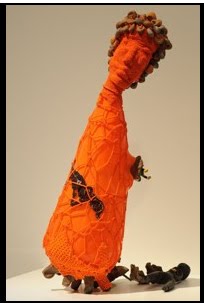
Dyson, 38, a multimedia artist who creates sculpture and installations, was featured in the Whitney Biennial in 2010. Dyson sometimes uses industrial materials but from toys. She has taken a commercial African mask and covered it with parts of model cars. The elongated face of the mask is popping with tiny wheels and windshields, perhaps a commentary on the overwhelming force of consumerism. In the opposite direction, Dyson recreated a solar energy room especially for the “Material Girls” exhibit, pushing visitors to think about how they treat the environment.

Jackson-Jarvis, 59, a leading Washington sculptor who had a retrospective at the Corcoran Gallery in 1996, works in volcanic rock, other types of stone, and glass and wood. Included in this show are pods that look as if they are growing. In each, a smaller piece is connected to a larger with a wood vine, symbolizing the mother-and-child relationship.

Read More >>>>>

Lake Wales Arts Council presents unique show

The Lake Wales Arts Council presents Against All Odds: The Art of the Highwaymen, an exhibit organized by the Orange County Regional History Center in Orlando, opening on Sept. 1 and running through Oct. 13.

The exhibit features paintings by all 26 Highwaymen as well as a painting by A.E. “Beanie” Backus, an accomplished Florida landscape artist who encouraged and inspired the artists.

A gallery talk by Highwayman Al Black is scheduled at 4:30 p.m. prior to the opening reception at 5 p.m. on Sept. 1 in the Michael Crews Gallery, Lake Wales Arts Center. A painting demonstration by Highwayman Robert Lewis is scheduled for Oct. 1 at 10 a.m. to noon. All are welcome to attend the gallery talk and opening reception for this exciting exhibition and the painting demonstration on Oct. 1.

The Highwaymen began as a group of African American artists who, against all odds, managed to prosper selling their paintings in the segregated South of the 1950s and ’60s.

The Highwaymen developed unique strategies to sell and market their artwork outside of the formal world of art galleries and exhibitions

Against All Odds: The Florida Highwaymen exhibition is generously sponsored in part by Raymond James Financial Services, Inc.

The Lake Wales Arts Center is located at 1099 SR 60 E, Lake Wales. Gallery hours are Monday through Friday, 9 a.m. to 4 p.m. There is no charge to visit the gallery. For details, call 863-676-8426.

LW Charter Schools Orientation Programs

Hi ho, hi ho! It’s off to school orientation we go. With the first day of school on Monday, back-to-school orientation days are filling the calendar as parents, students and teachers get ready for a new school year.

Read More >>>>>

26th Annual Philadelphia International OCTOBER GALLERY ART EXPO


Three Day Weekend of Art, Music & Great Food in Downtown Mt Airy, Philadelphia, PA 19119

October 14, 15 & 16, 2011

26th Annual Philadelphia International Art Expo is a three day indoor / outdoor art event along the 7000 – 7200 block of historic Germantown Avenue in the Mt Airy section of Philadelphia, PA 19119.

This event features 200 arts and crafts exhibitors / vendors.

Artists and sponsor booths are placed up and down historic Germantown Avenue from Mt Pleasant Ave. to Allens Lane.

Expo’s artful offerings extend into Mt Airy’s local shops, businesses & eateries. These businesses include:

More Info: http://phillyartexpo.blogspot.com/

U.S. Postal Service to honor 20th Century artist Romare Bearden

Romare Bearden, the 20th Century master of collages capturing the African American experience, has long been a popular artist. Now everyone can have a tiny bit of his expressive art with a new series of stamps to be issued by the U.S. Postal Service.

The Postal Service announced Tuesday the stamps will be available September 28.

Bearden was active for more than 50 years, spanning from the Harlem Renaissance to the Pop Art movement and beyond. He was a master in the complicated collage form of catching the rhythms and mannerisms of street scenes, ordinary tasks and the jazz life. He died in 1988.

His work is included in the collections of the Smithsonian American Art Museum, the Metropolitan Museum of Art, the Whitney Museum and the Studio Museum in Harlem. In 2003 and 2004 the National Gallery of Arthad a comprehensive exhibition on his work.

He was awarded the National Medal of Arts in 1987.

Read More >>>>>>

Edith M.S. Ingram, artist, writer concerned with black history; at 89

Edith Marie Stanton Ingram relished meeting people and often incorporated what she learned from their stories in her writing and artwork.

Mrs. Ingram, an accomplished artist and writer who published a historical novel in 2004 in tribute to her great-grandmother, a free African-American property holder in the early 1850s, died July 20 at the Metro West Medical Center in Framingham after a long battle with heart disease. The Wayland resident was 89.

Her artwork is in private collections in the United States, Canada, and Africa and is included in the permanent collection of the National Center of Afro-American Artists in Boston.

“Mother’s life revolved around many passions, but the greatest were her family and her art,’’ said Joyce L. McGlaston, a retired educator who lives in Green Valley, Ariz. “The two were intertwined in many ways. Her art was a reflection of her family’s history and ancestry, often evoking an African theme of subject, style, and color. And her family members were always encouraged and supported in their own creative endeavors.’’

Mrs. Ingram was born in Penlan, Va., the 13th of 15 children. During her early childhood, she lived in Columbus, Ohio; East Orange, N.J.; and Baltimore. After graduating from high school and in search of employment, she moved with her sister, Louise, to Boston. There, she met James Gilmore Ingram, a native of Danville, Va., who had moved with his parents to Boston when he was a child.

The couple married in 1942, at Ebenezer Baptist Church in Boston. They had two daughters and were married for more than 40 years when Mr. Ingram died in 1983.

“Our parents had a very long and happy marriage,’’ McGlaston said. “I think they were proud of their achievements as husband and wife. My dad loved their home in Holbrook, which they had built and for which he did a lot of the electrical work. It’s where they lived until he passed away, and that was a source of pride for both of them.’’

Philip Holman – a consultant in public policy, government relations, and strategic communications who knew Mrs. Ingram for about 15 years – said her loving, kind, and compassionate spirit will be sorely missed. He met her through her daughter Edith Renee Ingram of Washington, D.C.

“She was a very dedicated writer and researcher who was a truth seeker,’’ said Holman, also of the District of Columbia. “She wanted to know the truth about her family and other families and had a passion for setting the record straight and making it accurate for what happened to African-Americans during the antebellum period.’’

Holman, a former print and broadcast journalist, was especially impressed by Mrs. Ingram’s historical novel, “A Walk Among Blue Slate Markers,’’ which she published at age 83 and set in Penlan (Buckingham County), Virginia. He said Mrs. Ingram strongly believed people should know their history.

Read More >>>>>>

Take Away Project #12, Monroe Reeves speaks with Jeffrey Ratner

What is Art? Ask anyone this simple question and see how many unique answers you will get. I had the opportunity to interview self-taught artist, Monroe Reeves from Baltimore, Maryland on his insights concerning art. With such a broad question, Monroe responded passionately. “Art is the pulse of creation, change, movement that stimulates. It can affect one or all.”

Gallery visits are a great way to see through the world through the the eyes of differing artists. Often there is one piece within a gallery exhibition that sticks out in your mind—from this you may walk away with a memorable experience. “Roughly around 1992 in Tokyo while attending the opening of the National Museum of Art, a Salvador Dali painting I saw moved me,” Monroe reflects on a work that emotionally grabbed his attention. He continues, “I do not remember the exact name of the piece but it was of the back of a lady wearing a scarf. It gathered my complete attention and I felt as though I understood where Dali was, mentally. Dali had a way of twisting reality in a dreamlike manner.”

Upon leaving an exhibition you feel inspired, as if your creative energy has been re-charged. Art that Monroe finds most inspiring are “intricate small pieces such as mosaic tile and unusual objects that make up a large piece. You can see the image as a whole or look into the detail and find other forms.”

“Space in work brings life and movement. It can make you forget where you are.”

Photography, according to Monroe is the most influential medium within art. As the viewer, you are placed in a moment through another’s prospective. The old saying “a picture is worth a thousand words” is true; an image can tell an entire story by the creator who has captured a particular moment.

“I love all art but I find that computer graphics take away from physically reaching out and manipulating a piece,” Monroe explains. “I like to use my fingers in almost all of my work. Keep my fingers messy with what I’m using. You are more connected with the tradition of yesterday using non-computer oriented mediums especially working with paint.” Monroe continued to express his enthusiasm through watercolor by explaining the many ways in which it can be applied: wet, dry, dripped, sloppy, neat and tight. Each has its own emotion using a dry or wet brush. Mixing different paints together changes the characteristics of the color.

Art has and will continue to evolve. “Futuristic Architecture is the medium that I find to be most intriguing. It makes me feel as if I am getting a sneak peak into another century.”

Works of great artists have inspired Monroe to become the artist he is today; Juan Gris for his emotion in Cubism, Salvador Dali’s surrealism and Amedeo Modigliani for his rich color palette.

“I don’t want to be categorized as a particular artist, therefore I stay away from submitting my work to so called “black galleries.”’ Yes, I am African American but I don’t want my work to be based around cultural recognition. I am originally from Washington D.C., I am an American. Art is more than the artists’ roots. People should embrace and appreciate the work of an artist and not care so much about who they are but the work they create.”

I truly appreciated the time I spent with Monroe, his enthusiasm inspired me to stand by my own sense of artistic being. This interview has taught me that there is no right or wrong in the art world. I was also able to relate with Monroe through his career decisions. In the beginning of my college career I was a business management major. After the first few semesters I came to realize that it was not for me I decided to switch majors and further my education in what I admire most, Fine Arts. It was relieving to learn that in a similar situation Monroe stared a career in an office, and later backtracking to his artistic nature.

Review written by Jeffrey Ratner

Read More >>>>>>

Park Ave Summer Art fest opens

Park Ave Summer Art fest opens

View works from more than 300 artisans at the Chrysler Park Avenue Summer Art Fest. The event also features entertainment, food and activities from 10 a.m. to 6 p.m. today and 10 a.m. to 5 p.m. Sunday on Park Avenue. Admission is free. For details, go to rochesterevents.com.

Heritage celebration

The African/African-American Festival, presented by Rochester ABOVE, will feature music and dance performances, displays, food and activities. It will be held from 11 a.m. to 9 p.m. at Highland Park Bowl, 1200 South Ave. Admission is free. For details, call (585) 576-2471 or go to rochesterabove.org. Remembering Hunter

The Hunter Resch Foundation Carnival will feature raffles, games and food from noon to 7 p.m. at the Barnard Exempts Restaurant and Party House, 360 Maiden Lane, Greece. For details, call (585) 663-1250.

Read More >>>>>>

Women’s Civic Improvement Club celebrating 75 years as anchor in Oak Park Share


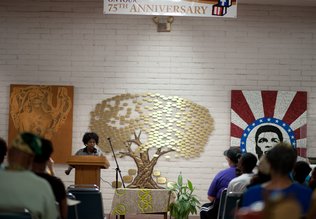
Framed by African American art, 18 local poets celebrated women at the Women’s Civic Improvement Club in Oak Park.

The “Poetry and Spoken Word Explosion” on Wednesday night was a fitting tribute to the club – the oldest black women’s organization west of the Mississippi River – as it celebrates 75 years of public service.

The club continues to battle poverty and fight for better education and political representation for people of color.

Founded as a refuge for single black women who couldn’t find safe places to live in the 1930s, ’40s, and ’50s, it provides a safe haven for children and adults through its Head Start and senior nutrition program.

The organization’s 100 members, ages 20 to 90, now include men and women of various races and religions.

Educator Mary Jane McLeod Bethune, writer Maya Angelou and activist Julian Bond are among the famous African American trailblazers who have addressed the WCIC over the years. Now the mission is to groom the next generation of civic leaders.

“The women in 1936 had a community mission and a caring heart to help people who were disadvantaged,” said executive director Segboye Davis. “We’re trying to jump-start the youth program so they don’t get caught up in crime, drugs, teenage pregnancies and all those other demons out there.”

The club hopes to create mentoring and performing arts programs and a computer lab, she said.

Davis, who manages the club’s Playmate Head Start programs for 120 children ages 3 to 5, said, “We have stood the test of time because WCIC stands for ‘We are Caring, Involved and Committed.’ “

After a freeway tore through its old Victorian mansion at 12th and X streets in the late 1950s, the WCIC built its center at 3555 Third Ave., a facility that has helped anchor Oak Park for decades, hosting political redistricting sessions, community meetings and cultural events like Wednesday’s spoken-word fest.

Activist Faye Kennedy, who joined the club at 16 and is now 56, began Wednesday night with an African “libation ceremony,” honoring the founding mothers and others who have passed on.

After intoning the name of each founder, Kennedy said a Swahili affirmation and poured water into a plant representing the earth.

“The WCIC is unique because it’s not part of a large national network like the NAACP – it’s been kept alive by locals using their expertise,” Kennedy said.

“Since 1936 it’s been one of the rallying points for black people in Sacramento,” said David Covin, professor of government and ethnic studies at California State University, Sacramento, and a 25-year member. “One of its strengths is simply its perseverance.”

Over the years the club has helped the poor pay their utility bills and weatherize their homes.

The organization still provides emergency relief for seniors “who might fall short on rent or need money for transportation,” Covin said.

Brenda Usher, a 23-year member, told the 100 people in the audience Wednesday that the club plans to reach out to the next generation of community leaders.

“We need to teach our children to be intelligent, wise, creative and strong of mind. If you don’t stand for something, you’ll fall for anything.”

Usher said she was impressed by Vietnamese refugees who’ve transformed Stockton Boulevard into a thriving business district.

One of the poets was a club veteran, Dr. Tchaka Muhammed, who strolled to the stage with his African walking stick and recited his poem “Ladyism.”

The club’s links to its storied past include former president Sarah Richey, 70, and Dora Daniels, 90, who help out every week.

When Richey arrived in Sacramento with her cosmetology license in 1962, she said, she moved into the WCIC after a landlord wouldn’t rent her a room because she was black.

“At the time there must have been 15 African American women living there, going to college and working,” Richey recalled. “I appreciate the opportunity that was given me, especially since I experienced housing discrimination the very first day I arrived in Sacramento. That’s why I stay connected.”

Daniels, who watered plants at the club Wednesday, has gotten some of her three children, nine grandchildren and seven great-grandchildren involved.

“I’m hoping we’ll have a group of younger women,” Daniels said. “I think if we’re still vocal in our communities, with the background and knowledge some of us have, we’re still relevant.”

OAK PARK CLUB HOSTS CELEBRATIONS

The Women’s Civic Improvement Club will host a free, 1930s-era house party from 6-9 p.m. today and a $25 gala banquet Saturday from 5:30-10 p.m. For information, call the WCIS at (916) 451-8870.

Read More >>>>>>

Art world on Heidelberg

Michael H. Hodges/ Detroit News Arts Writer


“Tyree Guyton is a talented artist — an environmental sculptor. We have at least one piece of his hanging in our galleries right now. I am surprised the project has lasted this long. But I think you only have to meet Tyree once to realize this is a determined individual with a very particular vision.” — Graham Beal, director, Detroit Institute of Arts

“Heidelberg asks the viewer a lot of questions — about cities, art-making, the placement of art, community and individual mark-making. I think 25 years is an amazing anniversary. It shows the truth of (Heidelberg executive director) Jenenne Whifield’s observation, ‘Those who say it can’t be done should move to the side.'” — Luis Croquer, director, Museum of Contemporary Art Detroit


“Artists are often at forefront, making us look at things in ways we haven’t seen before — and recognizing issues we sometimes want to ignore. Clearly I think quite a bit about the HP to have their 25th anniversary exhibition here at the museum (up through Nov. 27). I am very much taken with Tyree’s work, and his commitment, persistence and loyalty to his community and city. I like his passion for trying to create change. I am very moved by that.” — Juanita Moore, president & CEO, Charles H. Wright Museum of African American History


“I have always found the Heidelberg Project intriguing, not only as a work of public art — which is very different from art that appears in a gallery — because of the response it’s generated, ranging from the fanatical to the skeptical to the spiritual. Anything that can have that kind of effect has to be called successful at some level. Heidelberg is a huge asset for the city of Detroit. It calls into question a fascinating range of issues, from what makes art to the effect art can have on politics and the social order.” — Reed Kroloff, director, Cranbrook Academy of Art and Art Museum

“There are rich cultural resonances at Heidelberg that reach back to traditions of African grave decoration, and at the same time speak to the complexity of contemporary urban life. The other thing that’s provocative is that the project proposes an alternate notion of community redevelopment — organized around the arts instead of housing and shopping.” — John Beardsley, art historian at the Harvard Graduate School of Design


Germantown High School Students Touch Love Park, New Orleans


Afterschool stained glass art program with First United Methodist Church of Germantown featured in Center City before landing down the Bayou.

This summer, Love Park, Independence Mall andGermantown High School students are linked by an unexpected medium: stained glass.

Throughout August, student artwork is being displayed in Center City—currently at theFairmont Park Welcome Center at Love Park and later on the mall.

Organized by First United Methodist Church of Germantown (and not officially affiliated with the high school), the program brings the art of stained glass making to students who may otherwise lack access to art education. ArtistJoan Myerson Shrager helps coordinate the effort, and she spoke on what she calls her favorite subject—the kids and the art they create.

“It continues to blow my mind, and I’m a veteran artist. My artist friends ask the same thing: Did the kids really make them? Oh, yes,” the digital artist said.

For the past five years, Shrager and Paula Mandel have molded local students into stained glass artists. Once a week, a varying yet ultimately consistent group of seven to 10 students convene at the Germantown Avenue church and learn from Mandel the art of translating pen-and-paper designs to the starkly translucent pieces. Shrager helps Mandel—the stained glass artist—teach the students to draw, cut, grind and solder their way to art.

“You can’t imagine the interest—these kids don’t want to leave,” she said.

One way this program is different, Shrager said, is the service element. For the first few years, students crafted stained glass windows to be used at a school in South Africa for AIDS orphans.

“They’re not going home with a pretty window—they’re sending the window to the world,” she said.

Another important aspect is the cultural education all involved receive. With the South African art, students were challenged to think beyond making iconography familiar to them, and instead forged soccer balls, South African flags, and other culturally relevant images. Closer to home, Shrager said the program aids in tensions within the black community.

Serving mostly native African and African-American students, the Stained Glass Project has “brought these kids together and many have become close friends,” she said.

After the South African project finished, a native Ghanaian young man suggested their next stop: Katrina-torn New Orleans. “His best friend is a black American kid, and he wanted to help a place in the U.S,” she said.

Read More >>>>>>

Through a grant from First Trust Bank, seven or eight students will travel with their art to Morris Jeff Community School in New Orleans. In the meantime, the stained glass is being displayed daily at the Love Park Visitor Center through August 4. Then, the art moves to the Independence Mall Visitor Center (6th and Market Sts.) from August 5 to 31.

Artists whose work is being displayed downtown include:

  • Oyinkansola Adekitan
  • Deshawn Brewer
  • Muhammed Brewer
  • Janai Dallas
  • NaNaYaw Effah
  • Cornell Gilliland
  • Marie Jeanne Hahn
  • Tajir Revell
  • Dwayne Smith

For more information, visit the group’s Facebook page here.

Fifth Ward Culture Camp taps into children’s creativity

“With the recent financial cutbacks in education, the first disciplines to go are the arts,” said Frank Liu, “yet there’s a proven relationship between the ability of children to learn and exposure to the arts. The arts are the last things that should go.”

Liu is referring to Houston’s public school system and its recent funding reductions. In most cases, the arts were the first on the chopping block, while it’s statistically confirmed that participation in the arts improves academic performance.

Liu, a Houstonian and recent University of Pennsylvania grad, is taking action. He partnered with the Museum of Cultural Arts Houston (MOCAH), the Houston Ballet, the Back Porch Players, and the Conrad Johnson Music Foundation to bring arts to the children of B.K. Bruce Elementary in Houston’s Fifth Ward.

Liu created “Culture Camp.”

The Fifth Ward is located on the northeastern side of downtown and remains a desert of abandoned industrial property. Here, poverty is the norm. With its acres of dilapidated structures and smattering of housing projects, the area has been overlooked by many for years.

However, a glimpse of Houston’s future can be found here. At B.K. Bruce Elementary, the children are exploding with enthusiasm, energy and undeveloped talent. Bruce, Liu decided, was the perfect place to introduce Culture Camp.

Through the camp, third, fourth and fifth-grade students in Bruce’s summer school were introduced to dance, visual arts, music and theater. In the first three weeks, 35 students moved through a rotation of the four disciplines. In the last two weeks, the children settled into a specialty of their own choosing to prepare for a final performance.

At the culmination of Culture Camp, the students produced a showcase that included all the disciplines. The theater group re-interpreted “Romeo and Juliet.”The dance students performed a set from “The Nutcracker,” and music students left the audience breathless. Several hundred family members and neighbors came to watch the art unfold.

And art it was. In the priceless performance of “Rome and Juliet,” lines shifted between Shakespearian English and modern English, the little actors and actresses changed costumes and characters with flare — wigs and wardrobe flying. Music and dance student kept the audience on its feet cheering, while big, magnificent mosaics created in the visual art rotation filled the performance hall.

The enthusiasm and pride of the parents in the audience was surpassed only by the apparent joy of the children themselves.

But it wasn’t easy. It took all the kids a lot of hard work and practice to make it happen, and all had to develop untapped skills to get it done.

For example, on the first day of camp, music instructor Claude Robinson spent hours teaching scales. During the final performance, his children collectively played rousing renditions of “Crazy Train” and “La Bamba” and two songs they wrote themselves called “Culture Camp” and “Bruce Blues.”

“I have seen the kids grow a lot in these weeks,” said Lauren Anderson. “This camp was fantastic for them.”

Anderson is an education outreach associate for the Houston Ballet, and one of Houston’s real treasures. Dancing with the Houston Ballet since she was seven, Anderson is recognized as the country’s most distinguished African American ballerina.

“Culture Camp changed these kids’ perceptions of what they could accomplish. They came in with reservations about themselves and left with expectations for themselves. It was incredible,” Anderson concluded.

“If we choose to stand on the sidelines, many of the kids in our schools will grow up in an educational system without arts,” said President of MOCAH, Reginald Adams.

MOCAH is a nonprofit cultural arts organization that has worked overtime to keep the arts alive. The agency has produced more than 120 community-based art projects and engaged more than 16,500 at-risk youth in 40 local schools.

“When we provide our children with opportunities to exercise their creativity,” Adams continued, “We’re helping them develop decision-making skills. It encourages critical and analytical thinking, helps kids with problem-solving, and the challenges they’ll face as adults. They learn to see the world through a multi-faceted lens. That’s the power of art,” he concluded.

Liu realizes that there are many schools in our community with needs. His objective is to build a network of partnerships and sponsors to produce the model of Culture Camp many times over.

Liu enlisted the financial support of InTown Homes, a highly regarded, local real estate development company, to underwrite the expenses associated with Bruce’s camp. He also partnered with Zenfilm, a local film company renowned for its creativity, to produce a documentary on the birth of the camp so that other communities can mirror the effort.

As the final performance drew to a close, the Prince in “Romeo and Juliet” took center stage and spoke the last lines of the play directly to the audience. The crowd was silent.

“For never was a story of more woe, than this of Juliet and her Romeo,” the fifth grader’s solemn voice droned.

The youngster then laughed and yelled, “Peace out! I’m’ going to college!” and skipped off the stage.

The crowd roared.

Read More >>>>>

Art Dealer Charged With Smuggling Ivory Into U.S.

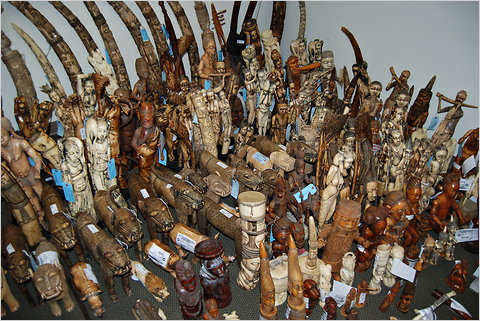
Some of the hundreds of carved ivory tusks a Philadelphia art dealer is charged with smuggling into the country through Kennedy International Airport.

Of the millions of tons of stuff that comes through Kennedy International Airport in travelers’ suitcases each year, some of it is not supposed to be there.

Like the tusks of hundreds of threatened African elephants.

A Philadelphia art and antiquities dealer, Victor Gordon, was arraigned on smuggling charges in federal court in Brooklyn on Tuesday after, the authorities said, they seized about a ton of carved ivory that he had had a confederate bring into Kennedy in his luggage between 2006 and 2009.

The seizure is one of the largest American seizures of elephant ivory on record, the United States attorney’s office said.

Mr. Gordon, 68, had his agent purchase raw ivory and get it carved and then stained or dyed so that it appeared old and therefore not subject to endangered species law, federal prosecutors in Brooklyn said. He then sold the carved tusks through his shop in Philadelphia, Victor Gordon Enterprises, they said.

Mr. Gordon pleaded not guilty before a federal magistrate. He is also charged with violating the Endangered Species Act and faces a maximum sentence of 20 years if convicted.

All told, agents of the federal Fish and Wildlife Service seized 491 carved tusks from Mr. Gordon, 13 of which he had brought to agents in Brooklyn in November 2009, the authorities said.

Trade in the ivory of African elephants is illegal under the 1975 Convention on International Trade in Endangered Species, better known as Cites.

“We all have a responsibility to protect endangered species, both for their sake and for the sake of our own future generations,” Loretta E. Lynch, the United States attorney in Brooklyn, said in a statement.

Read More >>>>>>