Legs and Lenses

Legs and Lenses

A PHOTO PARTY CELEBRATING YOU!!!!!!

Mike Pierce Photography will be hosting “LEGS and LENSES”. On March 5th, you are invited to come to Glamourville Studios and enjoy yourself in front of the Camera. Ever wanted to take some Hot Edgy photos, but couldn’t afford to pay for a full photoshoot? Well here is the perfect opportunity to do so at a fraction of the cost.

For only 75.00 you will:

Have your Make-up applied professionally
Be photgraphed in (2) two outfits
Experience a Professional Photoshoot in a Professional environment
Enjoy a socially festive atmosphere with food, drink, and music

You will Recieve:

(2) 8×10 prints (1 portrait and 1 full body)
access to a web gallery to see additional shots and share with friends.
And the most important thing…. A GREAT EXPERIENCE!!!!!

Friday, March 5, 2010 at 8:00pm
Saturday, March 6, 2010 at 12:00am
Glamourville Studios
1241 Carpenter Street
Philadelphia, PA

website

Gee’s Bend Quilts & Beyond

The Flint Institute of Arts is definitely a diamond in the rough. Although Flint has a reputation for a number of things, both positive and negative, the FIA is a wonderful place to experience culture in the fine arts, yet it is often overlooked. It hosts a collection of exhibits, both temporary and permanent, and it is worth checking out regularly.

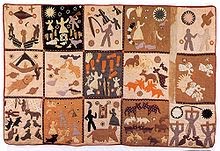
One of the current exhibits is “Gee’s Bend and Beyond,” which displays the quilts of a group of African American women from Gee’s Bend, Alabama. The art of quilt-making has existed since slavery, a tradition that has been passed down through the generations. The quilts featured in this exhibit were made by Mary Lee Bendolph, one of the best-known and most respected quilt-makers of Gee’s Bend, along with quilts by her mother and daughters. It also features art by two Alabama artists, who developed themselves as artists independently. Overall, the exhibit shows that even an old tradition can change and evolve in dynamic ways without necessarily losing its traditional meanings.

Quilt-making is all about variety and diversity. The style of the quilts varies greatly depending on the style, theme, material, and the quilter himself or herself. There are specific types of quilts such as housetop, which represents the roof a log cabin from an aerial view, or bricklayer, where the boxes are sown in a fashion resembling the way bricks are laid. However, improvisation is an essential part of the Gee’s Bend quilts. So while a quilt maker may start off with a style in mind, the finished product doesn’t necessarily reflect a particular style, rather it shows the creativity of its maker. There were several variations of the housetop quilts displayed, each unique and different from the rest. In most cases the patches varied in size, color, and positioning throughout the quilt.

Read More >>>>>>

October Gallery Webinars-Art Seminars

Conversation on Art #302 Collecting African American ArtA lively discussion on why the esthetic value of a work of art should be acollector’s primary motivation for acquiring art work.
Monday, March 1 – 8PM
Conversation on Art #303 Andrew Turner – In His Own WordsA look at the life and art of Philadelphia artist Andrew Turner.
Tuesday, March 2 – 8PM
Conversation on Art #304 Group ShowWe will take a look at a number of contemporary African American artists through video.Artists include: Cal Massey, Leroy Campbell, BUA, George O’Neil and others.
Wednesday, March 3 – 8PM
Conversation on Art #305 An Eye For ArtYou will learn first how to – Describe the Work of ArtThen you will learn how to – Analyze the Work of ArtNext you will learn how to – Interpret the Work of ArtAnd lastly you will learn how to – Evaluate the Work of Art
Thursday, March 4 – 8PM
These webinars will include video as well as text format.Webinars are FREE.

Sculptor Brings African American History to Life on Grand Scale

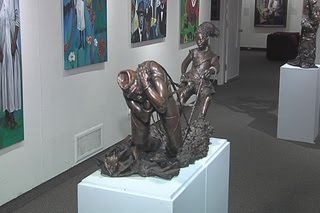
Ed Dwight’s ‘monumental’ works fill critical gap

Even as a child, Ed Dwight had a gift for art. But he set that talent aside to focus on careers that included engineer, test pilot, astronaut trainee (the first African American in the program) and entrepreneur.

It was as the owner of a large construction company, Dwight says, that his childhood love for creating art reawakened. “What I was doing with the construction company was just taking scrap material that was left over and I was bringing it home to my garage,” he recalls. “I just taught myself to weld to make some art for my house.”

A life-changing commission

The amateur artist turned professional 25 years ago, when Colorado’s first African American lieutenant governor picked Ed Dwight to sculpt a major public statue.

Read More >>>>>>>

Sotheby’s moves to 4Q profit on reduced expenses

Sotheby’s said that fourth-quarter net income was the second highest in its history due to an increase in the commission that it charges on auction sales and a cost-cutting drive.
The auction house said that income over the three months to December 31 was $73.6m (£49m), compared to a loss of $9.3m last time.

Bill Ruprecht, president and chief executive of Sotheby’s, said that the good fourth quarter was a “remarkable achievement”. Over the period, Sotheby’s increased commission from 16pc to 20.4pc compared to the previous year.

Mr Ruprecht said: “We are well poised to capitalise on an economic upturn and art market rebound as it occurs.”
The good run has continued. Sotheby’s recently sold L’Homme qui Marche 1 by Alberto Giacometti for $104.3m and Gustav Klimt’s Kirche in Cassone (pictured), for $43.2m.

Read More >>>>>>

‘American Stories: Paintings of Everyday Life, 1765-1915’ @ LACMA

What is an American? Today, as the 20th century — the so-called “American Century” — recedes in memory, the question can seem immodest or even grandiose. If we don’t know now, after decades wielding almost unimaginable superpower status around the globe, will we ever?

Still, there’s another way to look at it. The question arises anew because of the conflicted place in which the United States finds itself today.

With the national nervous breakdown unleashed by the 9/11 terrorist attacks — trauma Americans have collectively been unable to resolve — our identity remains a shambles. The uncertainty had been building for at least 30 years. In the aftermath of Abu Ghraib and AIG, once-settled matters of morality now appear unrecognizable.

5,200 Australians strip for art’s sake

There were all shapes and sizes – the large and the small, the young and the old, and even a heavily pregnant woman who had re-scheduled the birth of her twins so she could take part.

But the one thing the 5,200-odd people who posed for the American artist Spencer Tunick at the Sydney Opera House earlier today had in common was that they were all totally naked.

Thousands had gathered just before dawn on Monday, a mild and overcast first day of autumn, to take part in the shoot by the renowned (and controversial) photographer at one of Australia’s most iconic landmarks. Titled Mardi Gras: The Base, the shoot was commissioned by Sydney’s Gay and Lesbian Mardi Gras festival.

As the sun rose, Tunick instructed participants – many of who were clapping and cheering to support each other – to do a number of poses on the steps of the famous Sydney landmark, from standing up, lying down, and even embracing cheek to cheek, for over an hour.

Modern art collector Ernst Beyeler dies

By Eliane Engeler
Associated Press
Sunday, February 28, 2010

Ernst Beyeler, 88, whose early eye for undervalued Picassos and Impressionists helped him assemble one of Europe’s most famous art collections, died Feb. 25 at his home near Basel, Switzerland. No cause of death was reported.

Mr. Beyeler became a widely respected art patron after World War II by acquiring hundreds of works by Pablo Picasso, Paul Cezanne, Claude Monet, Henri Matisse and others. He presented them to the public in his Basel gallery and later in the foundation he founded near the German border.

His art collection grew to be worth at least $1.85 billion, thanks to his taste for quality and his personal connections with artists such as Georges Braque, Marc Chagall and Alberto Giacometti. He also was a friend of Picasso’s.
“Art must touch you and leave a strong visual and mental impression upon you,” Mr. Beyeler once told the Swiss weekly magazine NZZ Folio.

New attention for Harlem Renaissance artist with Greensboro roots

No grand monument marks the spot in Maplewood Cemetery where Malvin Gray Johnson’s family laid him to rest 75 years ago.
There’s no marker at all.

Yet somewhere beneath this grassy spot lies the grave of the man whom one researcher calls “the most significant artist to come out of Greensboro.”

After he left his native Greensboro for New York in 1912 at age 16, Johnson became a rising star in the 1920s and 1930s during the explosion of black culture known as the Harlem Renaissance.
Most of his works eventually made their way to historically black universities, some into private collections and a self-portrait into the Smithsonian American Art Museum.

But because he died so young — at 38 — and so long ago, the artist fell into obscurity in Greensboro and in art history.

“I didn’t know that he grew up in Greensboro,” says state Rep. Alma Adams, who shows images of Johnson’s work in her African American art class at Bennett College.

Fruitful hands Designs by Carole Carson

I first laid eyes on this pensive gentleman in a civil rights newspaper from the sixties called The Southern Courier. http://www.southerncourier.org/ I was captured by his eyes because I felt like they held the story of his life. I took a picture of the newspaper itself so that I could paint him. He was a sharecropper in Alabama, if my memory of the article serves me correctly. I could imagine how difficult his life must have been during that time of our history. Working hard for little pay. Taking care of a family. Fighting racism and inequality. He appears to have lived a long life…the suffering had to be long as well.

Nigel Freeman on Auctioning African-American Art

Nigel Freeman’s African-American Fine Art department at Swann Galleries surprised many market observers when it began holding sales devoted to African-American art. Leading up to his seventh semiannual auction of African-American art, which was held on Tuesday, February 23, and earned $1.24 million, Freeman took time to speak about how the idea came about, how his specialists select art for the sale, and what he sees as the future of African American art at auction.

Oprah Helps Chef Fulfill Michelle Obama Wish

When Oprah Winfrey recently asked her former personal chef what he wanted for his 50th birthday, Art Smith’s first thought was a new treadmill.
Aim higher, she told him.
How about a check to help fund the sort of healthy eating programs for children called for by another of his high profile clients, first lady Michelle Obama, recently called for?
Done.
On Monday, during a party hosted by celebrity chef Nigella Lawson, Smith says he’ll formally announce the $250,000 donation from Winfrey to his Common Threads nonprofit.
“We’re going to educate a lot of children about taking care of themselves,” Smith said during an interview late Friday at the South Beach Wine and Food Festival.
“I’d like to take this money to create healthy programs for children that mirror the first lady’s program,” said Smith, who recently lost 90 pounds thanks to his own healthy eating reforms.

Prince George’s County celebrates Black History Month

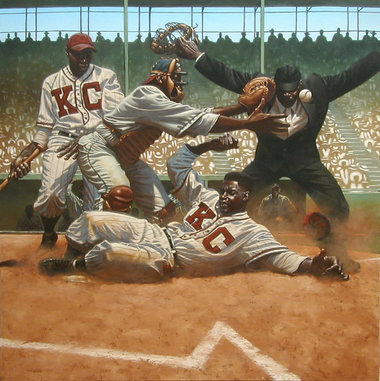
Speaking at Prince George’s County’s annual Black History Month celebration last week, former Negro Baseball League player and Temple Hills resident Jimmy Bland fondly recalled the black families in segregated southern communities that housed and fed ballplayers like himself.

“There were a lot of places we couldn’t go and a lot of places [where] we couldn’t eat, but we had a real good time,” he said.

Bland, 70, and two other county residents who played for Negro League teams were among those honored at the sixth annual Black History Month celebration Feb. 17 at the County Administration Building in Upper Marlboro.

Beverly A. Collins Visual Artist

Born and raised in Cincinnati, OH, I studied art at Wayne State University and the University of Cincinnati prior to moving to Los Angeles in 1978. Not having worked in the arts during the majority of my adulthood, opting instead to be a wife, mother and subsequently a single-parent, I devoted my life to the rearing of my daughter. It wasn’t until I experienced the “empty nest” syndrome and the mass lay-off from a job I thought would carry me into retirement that I revisited the art within me with the passion that drives me today.

Upon receipt of the lay-off notice in 1997 and the accompanying severance check, I almost immediately went to the art supply store, purchased an easel, enough canvases to last for a while, pints of paint, and painted for seven days straight — 10-12 hours a day. Upon completion of this cathartic experience, I emerged from the paint and the canvas, not quite realizing what had just transpired, to witness a rebirth – the beginning of a new phase in my life. For the first time in my life, I felt as though I had identified my purpose — to glorify God in me by capturing the miracle of color on canvas and sharing it with all who will see.

Color, line, texture and form embrace the very essence of our existence. One needs only to see a rainbow . . . enjoy a flower . . . squeeze a big red ripe tomato . . . become dazzled by the beauty of a tropical fish . . . catch a glimpse of an exquisitely colored bird . . . watch a beautiful butterfly . . . or pet a lady bug to experience the miracle of color in our lives.

Through the use of color, line, texture and form I hope to capture in some small way the essence of our existence and thereby give homage to the universal power of God that makes it possible for the very same colors we see in a rainbow to again reveal themselves in our environment and all the things therein. Once this is done, it is my desire to put art into the hands of those who understand and appreciate the overwhelming power of color in their daily lives by capturing the beauty of color, line and form to be displayed in places where we can experience the power of its radiance, energy, and interaction.

Beverly A. Collins
(213) 925-5797

www.beverlycollins.com

Peter Oluwadare Adeniyi – Brazilian Artist

The Artist “Laid back Art ………… Laid back Life.”

Called Darton X, Peter Oluwadare Adeniyi is internationally well known , not only in África but also in Europe.

Born in June, 3rd 1968 in Ikere-ekiti, a small city in Ondo (State of Nigéria), Darton X has started painting since he was six, creating self-portraits from the mirrow of his own bedroom.

Taking part of a local School of Art, in 1978, Darton X twelve years old was 3th price at the conference of art show of west Africa in Nigéria. Darton X has emigrated to Italy in the 80’s, where he studied electronics and arts.

It defrayed his studies with his paintings and in little time as an artist, transferring all its directions to a universe of subtle tones and colors Returning to Africa, Darton X continued to study and to paint with many African artists, mixing its educational influences with the strong and intense colors of his home.

Developing his skills, Darton X started to try new roads in the way of the modern cubism. His paintings had started to possess the almost phantasmagoric expressions of its predecessors and ancestral Africans. Showing his works around of the world, Darton X has a strong relation with Spain, Portugal and the Consulate of France in the Bahia.

As a satisfied painter, Darton X says: “In art the possibilities are infinite and the talent blossoms of the skin. To paint allows us to see in the future while the artist confirms the gift.”

http://www.dartonx.20m.com/