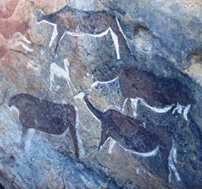
South African has a rich history of art with the oldest art objects in the world being discovered in a South African cave. Dating from 75,000 years ago, these small drilled snail shells could have no other function than to have been strung on a string as a necklace. The scattered tribes of Khoisan/San/ Bushman peoples moving into South Africa from around 10000 BCE had their own fluent art styles seen today in a multitude of cave paintings. They were superseded by Bantu/Nguni peoples with their own vocabularies of art forms.
New forms of art evolved in South Africa in the mines and townships. A dynamic art evolved using everything from plastic strips to bicycle spokes. Add to this the Dutch-influenced folk art of the hardy Afrikaner Trek Boers and the urban white artists earnestly following changing European traditions from the 1850s onwards, and you have an eclectic mix in South African art which continues to evolve today.
Information on South Africa
South Africa is located at the southern tip of Africa. South Africa’s coast stretches 2,798 kilometers and borders both the Atlantic and Indian oceans.To the north of South Africa lies Namibia, Botswana, Zimbabwe, Mozambique and Swaziland, while the Kingdom of Lesotho is an independent enclave surrounded by South African territory. Known for its diversity, South Africa has eleven official languages with English as the most commonly spoken language in official and commercial public life. South Africa is ethnically diverse, with Black, Caucasian, Indian, and racially mixed communities. In 2006, South Africa’s population was estimated at 47.4 million people. South Africa has three capital cities with Cape Town as the legislative capital, Pretoria the administrative capital, and Bloemfontein the judicial capital.
Stephanie was born in Tanga in Tanzania and educated at Loreto Convent Msongari in Nairobi, Kenya. She then joined the Kenya Arts Society to further her studies. In 1975 Stephanie moved to Bulawayo in Zimbabwe with her family. She continued her study in Bulawayo which is where she started working as a commercial artist. Stephanie now lives in Harare, Zimbabwe’s capital city, with her husband and two children.
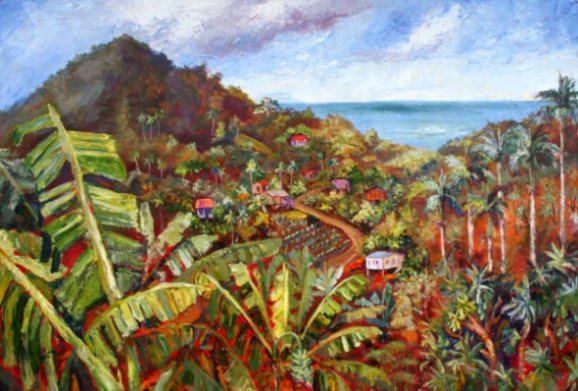
It is the colours of Africa, the people, their beadwork and scarification that are her inspiration. Her pictures are larger than most and she has had many exhibitions in Zimbabwe, Kenya, South Africa and the UK. While her main focus is on the peoples of Africa, Stephanie is a versatile artist and moves from oils to pastels with ease. She takes commissions from both the private and corporate sectors. As well as her painting and drawing, Stephanie is well known for her interiors in corporations, small businesses, hotels and private homes.
Artisans representing nearly 20 Caribbean islands will again converge in the British Virgins Islands (BVI) March 5 to 10 for the seventh annualCaribbean Arts and Crafts Festival. Instead of usual trivial trinkets and silly souvenirs, visitors can expect to find woven baskets, handmade furniture, carvings from tropical hardwoods, batik and silkscreen clothing, sculpted metals, hand fired pottery, and designer jewelry. The festival’s slogan for this year’s festival: “Craft-Culture working with Nature” is seen as a rallying cry for artisans and consumers to make the life style changes that the planet needs us to. This year’s event promotes the use of locally sourced natural and recycled materials for the production of practical and decorative arts and crafts.
The event is sponsored by the local chamber of commerce and the Caribbean Artisan Network, a nonprofit organization dedicated to the promotion and preservation of Caribbean arts and crafts. By creating links between artisans, the network functions to strengthen the production of traditional and innovative Caribbean crafts, through educational workshops, marketing initiatives and skill preservation efforts. The Artisan Network is dedicated to increasing the commercial viability of Craft as an income generator and as a crucial aspect of maintaining Caribbean cultural identity.
The five day festival begins at the beach in the east end of Tortola at Trellis Bay Village on March 5, moves to Spanish Town in Virgin Gorda March 9, and finally culminates in Tortola’s capital city, Road Town, at the Sir Olva Georges Park.
There was a point in history when the African artisans were enlightening the world. They were teaching the Greeks and Romans and building an art history to pass on to the generations to come. However, these great builders, sculptors, and creators were taken from their homeland and forced to be slaves in America. Their wonderful artifacts and works were stolen, destroyed, or lost upon their journey, leaving an open space in African history. Africa had been losing its cultural heritage to looters and dealers. As a result, African traditional and sacred objects have vanished completely from the continent, ending up in museums, universities, or private collections outside the continent. (National Geographic, www.nationalgeographic.com)
Generations to come had no recollection of their lost past only giving them the strength to build a new history. African-Americans have been struggling for over 100 years to rebuild and prove their artistic abilities that were lost during slavery. They are continuously fighting back to build a new future, one with history, culture, and power for their new world.
Lost but not hopeless, African-Americans have been able to prove their artistic ability after the end of slavery. This was a time when the world seemed to be moving forward and opening doors for the great African-American artists that we know of today. The hardship and pain many slaves had to endure influenced much of the early work of African-American artists.
“What does the Negro want? His answer is very simple. He wants only what all other Americans want. He wants opportunity to make real what the Declaration of Independence and Constitution and the Bill of Rights say, what the Four Freedoms establish. While he knows these ideals are open to no man completely, he wants only his equal change to obtain them.” Mary McLeod Bethune (Madyun, P.p.29).
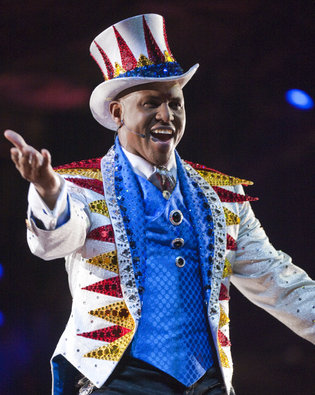
When Johnathan Lee Iverson joined Ringling Bros. and Barnum & Bailey shortly after graduating from college in 1998, he was the first African-American to take on the role of ringmaster, as well as the circus’s youngest emcee ever.
A singer first, the New York City native was a member of the famous Boys Choir of Harlem and had actually auditioned for a dinner theater role when the circus’s director, who happened to be directing the dinner theater, offered him a chance to travel the world and perform for millions.
“Nobody thinks about running away with the circus (except) clowns. That’s been their life’s mission, to work for Ringling Bros,” says Iverson, calling from Miami. He remembers seeing the circus repeatedly as a child. “The show to me back then was so overwhelming. I didn’t consider the ringmaster. The ringmaster gets lost in the melee of it all when your coworker is a 10,000-pound pachyderm.”
Starting Wednesday, Iverson hosts FUNundrum, a tribute to P.T. Barnum that celebrates the 200th anniversary of his birth.
“It’s incredible. I almost call it our Supergirl show. We have these women in this show who are doing unorthodox things,” says Iverson, citing the Torres Family, Duo Fusion, and Andrea Ayala Raffo, a fire twirler and third-generation hair-hanger, as examples.
FUNundrum marks Iverson’s return to the circus after a five-year break.
“I was doing the hungry artist thing,” says Iverson who juggled unemployment with work in commercials, theater, voiceover gigs, and freelance writing. When Ringling Bros. offered him his old job back, he jumped at the chance. “There’s nothing else outside this for me, unless I run for office, that provides the same stimulus and fun.”
The father of two’s political interest stems from his concern with education in the United States.
“We’re going into the global economy. We have to be able to stand and compete and be counted,” says Iverson, who is learning his dancer-wife’s native tongue, Portuguese. He’s glad his children are being educated on the road.
“The kind of education my children are getting here – traveling this country and going to school at the small class size, where we live with their teachers and the nursery staff. This is such a tight-knit community. Everybody knows everybody’s child. If my son walked outside right now, I wouldn’t worry. He has 300 people watching him.”
His love of the “Greatest Show on Earth” extends beyond the family-like community. He’s in awe of the performers. “When I left the show for five years, I realized that there’s Ringling Bros and the art of circus and then there’s everybody else,” he said. “I love Sean Penn and Halle Barry and Nathan Lane and Denzel Washington, but they have multiple takes to get it right.
“Here you’ve got one shot. If you get it wrong in the slightest way, it might cost you your life”
Patric McCoy will exhibit the work of many artists for ‘A Diaspora Rhythm’
As a vital piece of its annual Celebration of Black History, Elmhurst College will present an exhibition of work from the personal art collection of Patric McCoy.
McCoy’s vast collection features hundreds of works of art by contemporary African American artists. He will exhibit nearly 50 pieces in many media beginning this month–the first time any portion of his collection has been displayed for the general public.
The show, titled “A Diaspora Rhythm,” will run from January 23 – February 18 in the Founders Lounge of the College’s Frick Center, located at 190 Prospect Ave., Elmhurst (www.elmhurst.edu/campusmap). A reception will be held on Tuesday, February 1, from 4:30 – 6:30 p.m. including a gallery talk given by Patric McCoy at 5:00 p.m. Both the exhibit and the reception are free and open to the public.
McCoy is a founding member and president of Diasporal Rhythms, a Chicago-based organization of collectors of contemporary works by artists of the “African Diaspora.”
“This exhibition looks at the role of the collector and the importance of his/her capacity to encourage and support the development of artists,” said Suellen Rocca, curator and director of art exhibits at Elmhurst College. “Patric McCoy and the other members of Diasporal Rhythms are truly passionate in their goal of sustaining and validating contemporary artists of African descent.”
This exhibit is one of a dozen shows that Elmhurst College will present this academic year, in three different on-campus venues. Elmhurst College takes pride in its exhibits, as well as its unparalleled collection of Chicago Imagist art on display in the A.C. Buehler Library.
For more information, visit Elmhurst.edu or call (630) 617-3390.
Elmhurst College is a leading liberal arts college located eight miles west of Chicago. The College’s mission is to prepare its students for meaningful and ethical work in a multicultural, global society. Elmhurst College fosters learning and enriches culture through innovation, scholarship and creative expression. Approximately 3,400 full- and part-time students are enrolled in its 22 undergraduate academic departments and nine graduate degree programs.
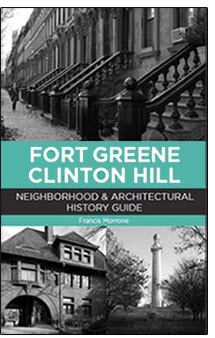
Walt Whitman, Spike Lee, Marianne Moore, Richard Wright and The Notorious B.I.G. may not have much in common other than the ability to capture human experience through words and images but they all spent formative years in Fort Greene and Clinton Hill. “Leaves of Grass” was written at 99 Ryerson Street; “Native Son” was penned on a bench in Fort Green Park, and many scenes from “She’s Gotta Have It” were filmed in the neighborhood.
“Maybe more so than any other part of New York of that size, the neighborhood is a microcosm,” Mr. Marrone, told The Local over a cup of tea at a café in Park Slope, where he lives. “It has everything. It has rich and poor, black and white going back to the neighborhood’s very beginning –- which is highly unusual for a northern American city.”
Whether he is tracing the rise of Greek and Gothic revival villas in the early 1900s from archival materials, or exploring the many African-American artists, musicians and writers who have called the neighborhood home, Mr. Morrone is nothing if not fastidious.
“I love nailing dates and also addresses,” he said. “I love the whole process of finding where everyone lives. Sometimes I spend days just tracking down an address, and sometimes if it can’t be tracked down, I become almost suicidal.”
The densely-packed guide is not especially easy to navigate, and Mr. Morrone’s phrasing is sometimes quaint. Mansions are “splendiferous” and the seating at outdoor cafes “enhances the charm of the street.” But his latest project is also chock-full of original research and historical nuggets that paint a vivid picture of Brooklyn’s diversity and explosive growth.
He also invokes first-hand sources, including newspaper articles by Walt Whitman, who moved to a small wooden house in a working-class section of Fort Greene in 1855. In the Brooklyn Daily Eagle, Whitman compared a bustling Myrtle Avenue to Manhattan’s Bowery Street and noted the “good natured brightness” of the Irishmen living in nearby shanties. “From Raymond to Fulton Street, all is the clattering din of traffic, turmoil, passage and business,” the poet wrote.
The new volume traces not just the history of the neighborhood, but also the history of the borough. City records show that in 1800, a mere 5,740 people lived in King’s county –- a quarter of them slaves. Fifty years later that number had mushroomed to 138,882. By the Civil War era, the City of Brooklyn -– now a mecca of the textile, book printing, shipping, oil refinery, and metal works industries -– was the third largest city in the United States.
“As a historian, I am fascinated by transitions,” Mr. Morrone said. “I was interested in Fort Greene particularly in the mid-sixties, when there was a lot of crime and poverty.”
A 1966 New York Times article described a frightened Marianne Moore fleeing the neighborhood that had been her home for 37 years as her building became increasingly unsafe. Yet this was hardly the first time the area had experienced a decline. In the 1930s, rows of brownstones were converted to rooming houses. A decade later, Gilded Age mansions were torn down to create housing projects that soon fell into disrepair.
“What fascinates me is all the stuff The New York Times didn’t mention,” Mr. Morrone said. “In this case, it was that at the very moment when Marianne Moore moved out Herbert Scott Harrison Gibson bought a house with his wife and began researching the history of the houses in Fort Greene. This didn’t sound like ‘Twilight of a Neighborhood.’ It sounded like people engaging the neighborhood in a new and unexpected way.”
Just two years after the article ran, New York Times dance critic Clive Barnes declared BAM “the dance center of the entire world.” Fort Greene was designated a historic district in 1978, followed by Clinton Hill in 1981.
“There is the whole story of decline and revival,” said Mr. Morrone. “Just about everything that happened to American cities in the last 200 years has happened in Fort Greene and Clinton Hill. It really is the story of the American history, and not just the story of these neighborhoods.”
Morrone enjoys digging up little-known facts from what he terms “the periphery of history,” and has invoked new technologies to do so. The guide also features an audio walking tour that is scheduled to be available as a free podcast on iTunes, and on the Brooklyn Historical Society’s Web site for the Thursday launch.
He also believes that online databases have transformed the way historians conduct research of archival materials such as newspapers.
“Back in the day, you could only find a fraction of what you were looking for,” Mr. Morrone said. “You had to be dependent on what were deemed ‘key words.’ Now you can create your own key words via engines such as ProQuest. It’s revolutionary.”
“You can actually find things that before you could never find,” he said. “This is going to cause histories to be rewritten. I am absolutely besotted with newspapers.”
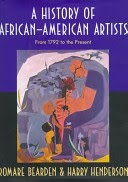
A landmark work of art history: lavishly illustrated and extraordinary for its thoroughness, A History of African-American Artists — conceived, researched, and written by the great American artist Romare Bearden with journalist Harry Henderson, who completed the work after Bearden’s death in 1988 — gives a conspectus of African-American art from the late eighteenth century to the present. It examines the lives and careers of more than fifty signal African-American artists, and the relation of their work to prevailing artistic, social, and political trends both in America and throughout the world. Beginning with a radical reevaluation of the enigma of Joshua Johnston, a late eighteenth-century portrait painter widely assumed by historians to be one of the earliest known African-American artists, Bearden and Henderson go on to examine the careers of Robert S. Duncanson, Edward M. Bannister, Henry Ossawa Tanner, Aaron Douglas, Edmonia Lewis, Jacob Lawrence, Hale A. Woodruff, Augusta Savage, Charles H. Alston, Ellis Wilson, Archibald J. Motley, Jr., Horace Pippin, Alma W. Thomas, and many others. Illustrated with more than 420 black-and-white illustrations and 61 color reproductions — including rediscovered classics, works no longer extant, and art never before seen in this country — A History of African-American Artists is a stunning achievement.
DECATUR – Vern Taylor has lived in many American cities in his lifetime, from his birth in Virginia to his young life in Washington, D.C., his high school years in Paducah, Ky., and ultimately his career as an architectural engineer and subsequent retirement in Springfield.
In one way, that life has brought his work to Decatur, as the Macon County History Museum prepares an exhibit featuring not his architecture, but his first love: Painting.
“I tried to pick things out that would be pleasing and captivating to the eye and the mind,” Taylor said of the pieces he chose for the exhibit, which opens Saturday. “I like to paint for the purpose of doing things that I think are uniquely beautiful or have inspired me, or motivated me in some particular way.”
Taylor’s exhibit, titled “A Lyrical Fantasy of My Personal Africa: the Serengeti; Along the Underground Railroad,” features paintings and verse Taylor has been creating for years. A theme running through many of the pieces, Taylor said, is the echoing effect slavery continues to have on the African-American experience. In many ways, he said, black Americans are still climbing a mountain.
“The black story is something that we don’t really discuss until it gets to be more of a problem,” he said. “For many years, the problem was the fact that we were in slavery, and when the Emancipation Proclamation came, there was still slavery in freedom, because there just wasn’t acceptance of blacks being equal.”
Taylor described himself as somebody who has always sought some creative outlet. When not painting, he sang in his high school choir and made a career out of architecture, eventually landing with the Illinois Department of Transportation, where he designed bridges and culverts.
Growing up in a household in a neighborhood of prominent black citizens in Washington and with a father who did administrative work at a university, Taylor said he didn’t really feel the effects of racial discrimination during the civil rights movement. All the same, moving to Kentucky brought with it a change in culture, he said.
“We were always aware of the differences in the treatment that went on,” he said. “It was a different kind of culture. We didn’t discuss a lot about racial differences, but we were always aware of the fact that we were black and there was always that divide.”
Taylor’s work has been displayed in other exhibits over the years, and he sells greeting cards featuring his original artwork.
Pat McDaniel, executive director at the museum, said Taylor came over to the museum the previous summer on the recommendation of a friend on the museum board, and McDaniel suggested hosting an exhibit.
“(Taylor) is a very talented individual and a brilliant artist. I think we’re lucky to be able to showcase his work,” he said.
McDaniel said Taylor’s work represents an artist’s journey from African roots to modern-day American society.
“It’s an artistic journey from his vision of Africa and his forebears that came over from Africa and how they got into American society. That’s what he’s been trying to do: Figuring out where he fits,” he said.
McDaniel said he’s designed the exhibit to reflect some of Taylor’s personal observations and inspirations, including quotes from Taylor alongside the pieces.
“I think artwork tells its own story, but what I try to do in my exhibits, especially when I use artists or photography, is incorporate quotes by the artist within the exhibit,” McDaniel said.
The Gadsden Museum of Art and the Lambda Eta Omega Chapter of Alpha Kappa Alpha Sorority have combined forces to plan the activities of the celebration of Black History Month at GMA.
The festivities begin with the opening reception from 2 p.m. to 4 p.m. Sunday. Music for the occasion will be presented by Desmond Mitchell and T.A.D. of Jazz, an accomplished group of musicians from Gadsden and Anniston. This is the group that recently played for the Lambda Eta Omega Chapter’s presentation of the 2010 Debutante Ball.
African-American artists Komeh Ottison and Henry McShan from Birmingham; Yvonne Wells from Tuscaloosa; Habiba, Tony Reddick and Willie “Toson” Coleman from Gadsden; Edward Jennings from Talladega; and Larry Allen from Leeds will have art work on display.
Their works range from art quilts by Wells featuring Rosa Parks and Martin Luther King to large urns by Allen featuring the unity symbol. Reddick’s figurative works include logos of AKA and Gadsden City High School Titans while Coleman’s works are nonrepresentational. Habiba presents portraits of strong African-American women in her figurative works. Komeh’s figurative works are contemporary in style and vibrant in color. McShan’s watercolors are of scenes from Birmingham, including the 16th Street Baptist Church as well as a self-portrait. Jennings, a native of New York now residing in Talladega, works in a variety of media, from classical wood cuts to traditional oils and watercolor to contemporary mixed media. His works feature both realism and fantasy.
Controversy continues to swirl around efforts to erect a monument toDenmark Vesey in Charleston, South Carolina, the former slave of a Bermudian sea captain who was executed for plotting a slave rebellion in the city in 1822.
One hundred and fifty years after the opening shots in the American Civil War were fired by Confederate forces on Fort Sumter in Charleston, the city remains divided over its history of slavery. The debate centres around the legacy of Denmark Vesey — who is thought to have visited Bermuda a number of times and spent some of his early life on the island before his seagoing master, Captain Joseph Vesey, settled in Charleston.
Local black activists first proposed the tribute in the 1990s so that the city would acknowledge the centrality of slavery to its past. They also hoped the Vesey monument would force Charlestonians to confront the reality that slaves were unhappy, so much so that they might violently rebel.
Resistance to the monument has been formidable. Some whites have offered a litany of excuses about the marginal role, and “benign nature”, of slavery in South Carolina. Ground on the memorial was finally broken in February 2010, but only after opponents had prevented the statue’s placement in downtown Marion Square.
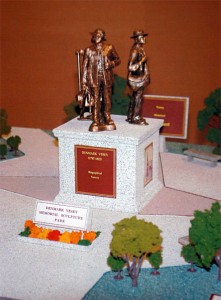
Instead the Denmark Vesey Memorial will stand in Hampton Park, far from the city’s historic district, far from the eyes of millions of tourists.
The design, by Colorado artist Ed Dwight, features a seven-foot Vesey with a Bible and carpentry tools. It’s hoped work will be completed on the memorial within the next year.
Charlestonians have debated for decades about preserving the memory of Denmark Vesey with any sort of monument. For generations, many of Charleston’s whites typically believed Mr Vesey to be a ruthless would-be mass murderer, while many blacks saw him as a hero, a martyr in the fight against the great injustice of slavery. During the Civil War, Frederick Douglass repeatedly invoked the name of this Bermudian’s slave while recruiting the black troops who would ultimately turn the tide against the Confederacy.
Nearly ten years ago, when the Charleston City Council first appropriated funds to erect a statue of Mr Vesey, controversy instantly erupted. The local newspapers were flooded with letters from readers, many appalled at the idea of memorializing a man one called an “advocate of ethnic cleansing” and another “a mass murderer.” One reader called Mr Vesey’s planned rebellion “nothing less than a Holocaust,” a local talk radio host complained about honoring “the guy who wanted to kill all the white people,” and he has been called a “terrorist.”
No paintings of Denmark Vesey exist, nor is there even a known physical description of him. Little is known about his life as a slave or later, as a free man, and even the notion that in 1822 he organized what was to have been the largest and most elaborate slave insurrection in US history is a matter of some historical dispute.
And the very dearth of certain facts about this remarkable figure serves as a sort of metaphor for the experience of slavery in America: white people feared the acquisition of power by blacks — seeing it when it sometimes might not have even been there – and did whatever they could to suppress the possibility.
At the same time, white arrogance and disdain of blacks was so strong as to see no value in recording the words or actions of a black man, or even to describe his appearance.
No slave – even one of extraordinary talent and good fortune like Mr Vesey – was thought to be remarkable enough to merit an account at the time. Only a handful of certain facts about the man exist and historical context and hearsay must fill in gaps. Though he was highly literate, Vesey seems not to have kept any record of his own life, or else it’s been lost over the years.
Much of what is known about Mr Vesey has been woven together by historians who’ve closely examined the record of Vesey’s trial and from the forced testimony against him by slaves. After almost 200 years, the truth about Denmark Vesey and his alleged insurrection remains both elusive and controversial.
Almost as little is known about Captain Joseph Vesey as is known about his former slave. He was born in Bermuda, where large sugar plantations and black slave populations were fewer than in the tropics. Joseph Vesey worked as a slave ship captain for at least 13 years, stopping at slave markets in Barbados, South Carolina, Haiti, and possibly West Africa.
In 1781, Captain Vesey bought a 14-year-old slave in the Caribbean, on what is now St. Thomas in the former Danish Virgin Islands, to sell with 390 other slaves to buyers on the French colony of Saint Domingue (present-day Haiti).
The boy said his name was “Telemaque,” or Capt. Vesey may have named him that; Telemachus was the son of Odysseus in Greek mythology.
Decades later, at his trial, testimony would recall how Captain Vesey and other officers admired the boy’s beauty and intelligence and therefore bequeathed him certain privileges. Their sentimental attachment to him ended, though, when he was left to do hard labor on sugar plantations at Cape Francis.
Three months after arriving there, though, Telemaque effectively forced Mr Vesey to buy him back from his owner because he suffered from “epileptic fits.” Mr Vesey refunded the plantation owner’s money, made Telemaque his personal assistant, and, perhaps not surprisingly, Telemaque never suffered another seizure.
For two years, Telemaque, who had a facility for languages, worked as an interpreter and assistant to Joseph Vesey in his slave-trading business, a position which afforded him some authority and protection.
When the captain retired, settling in Charleston, Telemaque was his slave for 17 years. After winning $1,500 in a lottery in 1799, Telemaque was able to buy his freedom on January 1, 1800 for $600. With the remaining money, he was also able to set up a carpentry business.
Captain Vesey’s motivation for allowing his release is unknown; he may have been somewhat sympathetic– he had other freed blacks living in his home – or he may have simply needed the cash.
As a free man, Telemaque chose Vesey for his surname, and, perhaps because he was born in a Danish Colony, Telemaque became Denmark.
In 1822, Mr Vesey was 55 years old. Very little is known about what fueled Mr Vesey’s change from a relatively prosperous free carpenter into the organizer of what was to be the largest slave rebellion in the history of the US.
In 1790, freedmen in Haiti, inspired by the French Revolution, petitioned the National Assembly for full citizenship. They were refused, and violence broke out, culminating in a revolt by almost half million slaves in 1791. Many whites fled to Charleston, and Capt. Vesey was treasurer of a group which raised funds to support the refugees from Haiti.
The Haitian slave revolt is thought to have been a source of inspiration to Mr Vesey, as were the appalling circumstances of the slave trade in which he was once compelled to engage as Captain Vesey’s interpreter. Historian and author David Robertson speculates that Mr Vesey’s “doctrine of negritude” may have come from the observation that black slave traders, who were complicit with white slave ship captains, could have, instead, curtailed the trade. Furthermore, “Vesey’s later insistence upon the genocide of all whites at Charleston” may have resulted from “the atrocities by whites he had witnessed” as a young man.
Mr. Robertson also believes Mr Vesey’s personal freedom and success were not satisfying to him because of the degree of spiritual autonomy he found in the African Methodist Episcopal Church. He goes on to identify Mr Vesey as a spiritual and political leader whose views were a precursor to modern Black Theology.
For the purposes of the rebellion, Mr Vesey was said to have portrayed himself as the black Messiah, recruiting thousands of slaves and black freedmen by appealing to their negritude and religion. The judges in the case against Mr Vesey later wrote that ”Every principle which could operate upon the mind of man was artfully employed” to recruit fellow rebels. ”Religion, hope, fear, and deception were resorted to as the occasion required.”
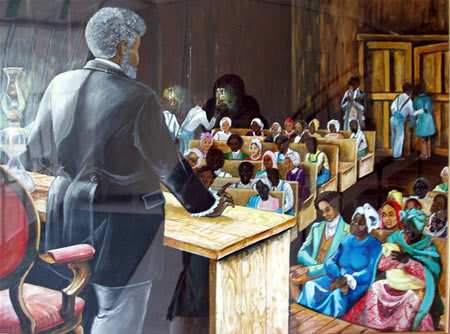
In 1816, free blacks from five states met in Philadelphia and formed the African Methodist Episcopal Church. In 1818, Charleston’s first A.M.E. Church was built, co-founded by Mr Vesey, and in June of that year, it was temporarily shut down by white authorities. 140 freemen and slaves were arrested for violating city ordinances by worshipping after sunset. It was shut down again in 1821, and the City Council warned Rev. Morris Brown against allowing classes at the church to become “schools for slaves.” Mr Vesey’s intense anger at these closings is also thought to have fueled his desire for the insurrection.
For nearly 200 years, it was assumed by most that Mr Vesey did head up a failed rebellion, though his prosecution was based on hearsay and coerced testimony and little or no hard evidence. In the 1960s and as recently as 2001, however, there was speculation by some historians that the insurrection was merely a construct of white politicians, jockeying for power and seeking to tamp down potential rebellion.
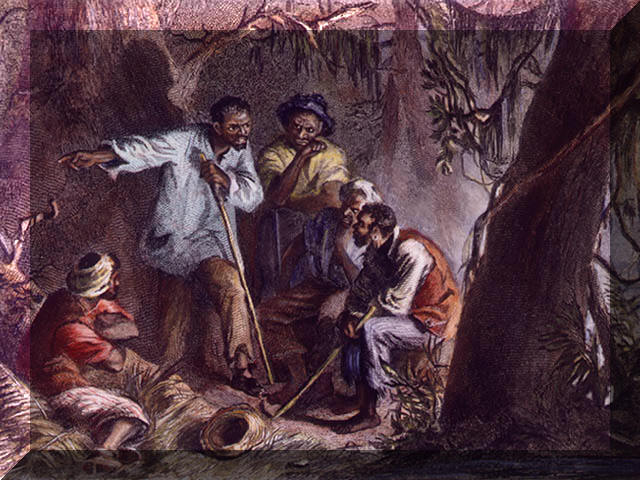
Conventional historical wisdom posits that Mr Vesey did indeed plan an insurrection (a contemporary depiction of the plotters clandestinely meeting appears below) which, if successful, would have had a radical impact on US history. Most white people in 1822 Charleston certainly believed the planned rebellion was real.
In the 1820s, South Carolina was the only state with a black majority. In Charleston — at the time the third biggest American city — slaves outnumbered whites by more than 3 to 1. In the 1800 US census, Charleston reported a population of 18,768 whites and 63, 615 blacks.
Not surprisingly, the white minority was terrified by the idea of slave rebellion and sought to protect themselves at every turn. The whites’ fear of a slave revolt led them to create a context in which such a revolt was virtually inevitable.
The eight to nine percent of the white population of Charleston that controlled its wealth created a veritable police state. For example, in addition to strict night time curfews, slaves were not allowed to appear during daylight hours wearing good clothes, smoking cigars, playing an instrument, or carrying a walking stick. Consequences for violation were severe. In 1820, a law was passed that forbade masters from freeing their slaves without first getting permission from the assembly.
Vesey’s insurrection was to include a wide-ranging combination of slave and freedmen groups: Muslims, members of Charleston’s African Methodist Church, French-speaking slaves brought to Charleston after the successful Haitian rebellion in 1791, Angola-born slaves, and those who spoke Gullah (a blend of English and African languages spoken in coastal South Carolina and Georgia).
Vesey surely utilised his multi-lingual skills as he spent four years teaching slaves to fight for their freedom. He compared them to the enslaved Israelites of the Bible, and repeated the anti-slavery arguments made in the “Missouri Compromise” bill.
Estimates as low as “several” thousand and up to nine thousand slaves in Charleston, its vicinity, and remote plantations, as well as, it’s agreed, a large number of whites, were to attack with weapons such as daggers, using military precision.
According to trial testimony – again, much of it coerced through threats and torture — Vesey’s plans would have ordered the arsenal and ships at Charleston harbor seized, the city burned, and the entire white population murdered, including women and children. Sea captains were to be spared so they could take the rebels to Haiti or Africa.
On May 30, 1822, slave Peter Prioleau overheard rumours of a planned insurrection and revealed this to his master. William Paul was arrested and placed in solitary confinement, where he was supposed to have implicated Peter Poyas and William Harth. When arrested, Poyas and Harth laughed about their alleged involvement in any plot, which convinced the authorities of their innocence, so they were released but put under surveillance.
Two weeks later, another slave, George Wilson, told his master he had heard about a plot from slaves in Governor Bennett’s household. The next day, Bennett ordered the arrest of the four accused plotters.
June 16, the night the insurrection was rumored to begin, most white Charlestonians fearfully kept watch, despite authorities’ efforts to keep the discovery of the plot quiet. Three days later, the first trial began.
Paul, who had remained in solitary confinement for weeks and had been threatened with hanging, was the mostly likely implicator of Mr Vesey as the leader of the insurrection. Mr Vesey was found hiding in his second wife’s home and was arrested June 22; his trial began four days later.
Though there was little or no physical evidence to implicate them, 131 people were charged with conspiracy, 67 men were convicted and 35 hanged, including Denmark Vesey.
Mr Vesey’s performance in court is as shrouded in contradiction and the absence of concrete fact as nearly everything else in his story. On the one hand, he is said to have rather brilliantly cross-examined witnesses and made a compelling final plea to the court. Other accounts claim he was never allowed to speak on his own behalf or confront his accusers.
There are two historical records of the trial. One major source is raw trial transcripts, on file at the State Archives in Columbia, South Carolina, which are essentially just a collection of notes from the interrogation of witnesses and show no cross examinations. These copies were probably edited and presented as part of Governor Bennett’s official report to the General Assembly in the fall of 1822.
Another source, found after the Civil War, is a pamphlet detailing the judges’ version of events. “The Official Report of the Trials of Sundry Negroes Charged with an Attempt to Raise an Insurrection in the State of South Carolina” may have been privately published to defend their actions against some public criticism.
This “Official Report” by the judges adds some testimony that is not in the raw transcript and omits other testimony such as an alleged poisoning scheme. The judges make no secret of of the fact that many witnesses were coerced to testify by solitary confinement, beatings, and threats of execution. The judges unapologetically stated that their proceedings departed “in many essential features from the principles of common law.”
No trial coverage appeared in the newspapers, only a notice of the executions and an editorial defending the judges’ integrity. Charleston resident and Associate US Supreme Court Justice William Johnson raised anonymous questions about the legality of the trials in The Charleston Courier.
Efforts at insurrection did not end with Mr Vesey’s arrest. On the day of his execution, two brigades of troops –- on guard day and night – were required to deter rebellious blacks from action. Foreseeing that slaves would continue to seek opportunities to organise and rebel, US troop re-enforcements were sent in August to guard against a renewal of the insurrection.
On July 2, Denmark Vesey and six others were hanged at dawn. Twenty-eight additional hangings followed, some botched, which necessitated the shooting of the condemned. One prisoner died in prison, and thirty-seven slaves alleged to be plotters were transported outside the state. Twenty-three slaves were acquitted, and three, though they were found not guilty, were still whipped for their suspected involvement. Four white men were also given short prison sentences for making statements sympathetic to the accused.
Later that year, the State Legislature would compensate masters with awards of $122.86 for each of their executed slaves.
By the Fall, leaders of the black AME Church were forced to flee the state. The AME congregation was said to have “voluntarily dispersed,” so authorities razed the building.
Governor Thomas Bennett’s official report to the legislature criticized the court since there was “no persuasive evidence that a conspiracy in fact existed or at most it was a vague and unfortunate plan in the minds or tongues of a few colored townsmen.”
Bennett asked State Attorney General Robert Y. Hayne for his opinion on the legality of the trials. Hayne replied that: “Magna Charta and Habeas corpus do not apply (to slaves) and indeed all the provisions of (the) Constitution in favor of liberty are intended for (white) freedmen only.”
On May 20, 1835, Captain Joseph Vesey died at 88, leaving no record of his thoughts about his former slave or the alleged insurrection.
Recently questions have arisen about whether or not the slave rebellion plot Mr Vesey was convicted of leading even really existed. Michael Johnson, a historian at Johns Hopkins University, wrote a scholarly article in 2001 which is to become a book. Johnson posits that the insurrection conspiracy that led to Vesey’s execution was a fabrication — a white politician’s ploy to discredit a rival — and the effort was abetted by the torture-induced testimony of terrified slaves.
Even apart from Mr. Johnson’s ideas, Mr Vesey’s legacy remains controversial in Charleston. For example, in 1976, the City of Charleston hung a painting of Mr Vesey by Dorothy B. Wright (pictured below) in the lobby of its Gaillard Municipal Auditorium. But soon after its unveiling, someone stole the portrait, tossing it into the bushes outside the auditorium. The portrait is now firmly bolted in place.
Henry Darby, an African-American social studies teacher, and now a member of Charleston’s county council, believes Mr Vesey –- who is buried in an unmarked grave in an unknown location –- is an important historical figure and deserves a monument. In a city with what some might call an obsessive interest in its own history, Mr. Darby feels, there are no memorials to the blacks who built the city.
Once outnumbering whites by more than three to one, blacks and their leaders languish unremembered, while statues remain for proponents of slavery. “From an educational perspective,” Mr. Darby says, Denmark Vesey’s story “is a point of history, so it needs to be told.”
Mr. Darby says this is a misinterpretation of the point of Mr Vesey’s rebellion, which he says was known to have had large numbers of white supporters. Mr Vesey and his people intended not to massacre whites for the sake of revenge or sport but “to escape, to get away” from enslavement by any means necessary.
But the focus remains for many on the aspect of Mr Vesey’s plot that sealed the conspirators’ fates at their trials. As recently as April 2006, Citadel history professor Kyle Sinisi was quoted in Charleston’s “City Paper” as saying, “I’m not a fan of applying our values of today to the past; this is cherry-picking history.” In the 1820s, Mr. Sinisi points out, many black freedmen owned slaves, and slavery lacked the “stigma” attached to it today. He believes the desire to memorialise Mr Vesey stems from an “obsession with race,” and feels “not overly enthusiastic about erecting a monument to a man bound and determined to create mayhem.”
In October 2001, Johns Hopkins University historian Michael Johnson claimed that Mr Vesey and his alleged co-conspirators were the victims of ambitious Charleston Mayor James Hamilton Jr., who created a false conspiracy in order to advance himself politically against South Carolina Governor Thomas Bennett, Jr. Bennett owned four of the first men arrested and charged with plotting rebellion.
Mr. Johnson’s conclusions first appeared in the “William and Mary Quarterly”, a prestigious journal of early American history. He is set to release a book on the subject soon.
Hamilton was known to have supported a militant approach to protecting slavery, in opposition to the recently developed Missouri Compromise, which allowed the US Federal government to restrict slavery in the West. Mr. Johnson posits that Hamilton wanted to discredit the more moderate Bennett and advance his own career, so with the support of other white authorities, he concocted the plot and enlisted the assistance of a kangaroo court.
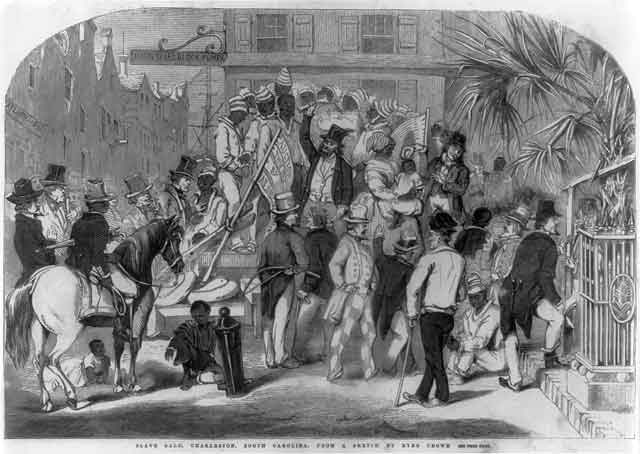
Given the disproportionate ratio of blacks to whites and the terrible circumstances in which blacks lived (a contemporary engraving of a Charleston slave auction in the 1820s is shown below), it was not difficult for everyone, black or white, in South Carolina at the time to believe that there was indeed a conspiracy. Even Governor Bennett, who thought Hamilton might be exaggerating the extent of Mr Vesey’s plot, still called the plan “a ferocious, diabolical design.”
Of great importance to Mr. Johnson’s argument is the fact that Mr Vesey and the others convicted of the conspiracy never admitted their guilt. Mr. Johnson also noted that most if not all of the “evidence” against Mr Vesey was largely coerced from slaves who had been tortured, placed in solitary confinement, and offered protection from prosecution if they would name “conspirators.” (Despite extensive torture, 90 percent of the incriminating testimony in the deadliest phase of the trials came from only six slaves, Mr. Johnson found.)
Most of the evidence for Mr. Johnson’s revisionist views comes from the transcripts of the court proceedings, which differ greatly from the “official report” published by judges in the wake of questions following the trial.
This court transcript does not even refer to a trial of Denmark Vesey, for example, but only a questioning of other witnesses and a determination that Vesey and five slaves were guilty of conspiracy. The witnesses, however, named people other than Vesey as the leader, offering no consensus that he headed up the plot.
Mr. Johnson concludes that white authorities may have framed Mr Vesey for several reasons, including the opportunity to shut down Morris Brown’s thriving AME church, of which Vesey was an important part. Johnson has said he believes that Denmark Vesey, as an outspoken freed man, was a logical choice to be made the ringleader. “My own take on this is: I think Denmark Vesey was a heretic at that time. He is a guy who thinks slavery is wrong, he hates white people, he thinks blacks should be equal to whites, and he won’t shut up about it. He’s endangering the black people and scaring the pants off the white people. And so he made himself a target.”
Governor Bennett protested the verdicts in his subsequent report to the legislature, objecting to the trials’ secrecy, convictions based on secret testimony, and the lack of an opportunity for the accused to face their accusers. He suggested that the testimony was “the offspring of treachery or revenge, and the hope of immunity.”
Responding to this and other public criticism, including by a justice of the US Supreme Court, the court, Johnson posits, arrested eighty-two more “suspects,” took more testimony about a planned slave rebellion, and executed twenty-nine more men. These actions solidified the idea in the popular mind that there had been a massive conspiracy to be defended against.
After the executions, James Hamilton Jr. was elected to Congress where he served in the House for seven years. He was elected South Carolina’s governor in 1830, leading arguments for “nullification”: states’ rights to declare any Federal law they considered unconstitutional null and void.
Mr. Johnson’s theories have served to deepen the controversy that surrounds Vesey, changing the question for some from “Was Denmark Vesey a freedom fighter or a terrorist?” to “Was Denmark Vesey a freedom fighter, a terrorist, or an innocent victim?”
Henry Darby’s feelings about Mr Vesey remain unchanged, perhaps even solidified. “I sort of resent when revisionist historians rely on old information to try to bring about something new,” he says, and cites the work of another historian, Richard Wade, who posited ideas similar to Johnson’s in the 1960s. Mr. Johnson, Mr. Darby believes, “is not bringing anything new to the field … he seems to be trying to galvanise people.”
The point, to Mr. Darby and others, is that the historical record is so flimsy that the truth is unlikely ever to be known, yet, Mr. Darby says, the notion that Mr Vesey and others organised a huge rebellion “seems empirically to be true.”
Mr. Johnson has said that he believes Charleston should, in fact, memorialise Mr Vesey, not because he was a freedom fighter, but because “he evidently believed that slavery was wrong and that blacks should be equal to whites,” and because he was the victim of a “vicious legalised murder.”
Mr. Darby says that although he believes Mr Vesey did plot rebellion, it doesn’t matter: “Whether one looks at him as a freedom fighter or as a victim, the fact remains that he was a black man who hated slavery and was executed for a cause.”
Joe Riley, the current mayor of Charleston, has called Mr Vesey “a significant figure in the long span of the civil rights movement.” “There are different sides to the story,” Mr Riley has said, “But in any event, he was a free black man trying to help enslaved Africans and it cost him his life. A monument to him is very important.”
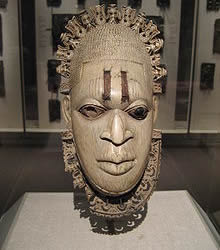
ON Boxing Day the British auction house, Sotheby’s canceled its proposed sale of the looted Benin royal court artifact, Queen Idia Mask, which it proposed to slot for hammer sale at the prize tag of £4.5m on February 17.
The planned auction of the historic artefact, a waist piece worn by the Oba of Benin during vital customary rites, was initiated by a deal between Sotheby’s and the descendants of the the late Lt-Col Sir Henry Lionel Galway, a British West Africa Protectorate military officer who took part in the 1897 looting of the royal palace of Benin Kingdom during which the Britons forcefully evicted the then king of Benin Kingdom, Oba Ovonramwen who later died in exile. During the 19th century operation, tagged ‘Benin Expedition’ in Western versions of African history texts but ‘Benin Massacre’ by African reporters of the same history, Queen Idia Mask and hundreds of other such works were carted away to the western world by the plundering British soldiers. And descendants of those soldiers who embarked in the operation, like Galaway’s, as well as organisations like the British Museum, have ever since lived well on the proceeds the artifacts still bring to their estates.
Against this background, the proposed February 17 auction generated global furore among experts in the arts, humanities and African Studies as well as culture activists since the influential art house, Sotheby’s announced it in October 2010.
Most of the largely Internet-based buzz against the auction were from cultural authorities who condemned the Galway estate’s rationale for selling the carved ivory masterpiece generally known as a product of plunder-under-gunpoint by their fore father (among other culprits). They faulted the Galways and Sotheby’s for setting out on such deal when they, and the global art world are aware that the piece is one of the over 300 pieces involved in the nerve-raking return-of-artefact negotiation which the Benin Kingdom and the government of United Kingdom have been locked in since the 1990s. Issues around the return of such artefacts have also been subject of several UNESCO and International Convention on Museums’ policies positions and even the laws of such countries as United Kingdom, Italy, Ethiopia, China and Austria.
Based on these depth of policy positions about such artefacts the experts deemed Sotheby’s and the Galway’s estate’s current deal an affront. The voices of condemnation of the deal rose to the pitch of hinting racism and deliberate disregard of international conventions. The trailed to deep intellectual issues and blossomed into sharp internet exchanges between pro-African writers and pro-western ones with both ends arguing pro or against the matter in penetrating lines.
Writing in his whistle-blowing article They are Selling Queen-mother Idia Mask and We Are All Quiet blogged, December 23, 2010 on www.museum-security.org, the African American scholar and blogger, Dr. Kwame Opoku stated: “The United Nations, UNESCO, several international conferences and ICOM have urged holders of the Benin bronzes to return some to Nigeria but nobody seems to pay any attention to the pleas of the world organizations.
“Hitherto, many people have thought there was only one Idia hip mask, the one in the British Museum. A few people realized that there was another one in the Metropolitan Museum of Art, New York and one at the Seattle Art Museum as well as one in the Linden Museum, Stuttgart. Now we have the news of a fifth mask that will be sold next year. There is finally, the recently made mask for FESTAC 77.
It will be recalled that the British Museum has arrogantly refused to return to Nigeria, even for a short period, the ivory hip mask of Queen-Mother Idia which had been chosen as symbol for FESTAC 1977 (Second World African Festival of Arts and Culture ) and thus obliged the Africans and Nigerians to produce a new version.
“The possession, selling and buying of Benin artefacts raises questions as to their legality and legitimacy, in view of their obviously violent and illegitimate removal from Benin, and the accompanying arson (burning) and destruction of Benin City for which, as far as I know, no compensation has yet been paid by those responsible for the destruction.
“The legality of the selling and buying of the stolen/looted artefacts has not yet been the object of any judicial investigation and adjudication. The Government of Nigeria and the people of Benin (Edo) reserve their right to challenge the legality and legitimacy of the selling and buying of the looted objects. Incidentally, it is remarkable that many think only the laws of the Europeans are applicable to the question of legitimacy and legality of selling and buying Benin bronzes and other African artefacts. Why should we apply the laws of the British who came thousands of miles away from Europe to steal the properties of Africans? Why apply the laws of the aggressor and ignore the laws of the injured party, especially since the place of the initial wrongdoing is Benin? Has the law of the place of the act less importance that the law of the aggressor?
“Although Britain invaded Benin City in 1897, it never formally declared war on Benin. Thus whatever may have been the rights of victors in wars never applied to the case of Benin. Moreover, since 1815, it had been accepted by European States that cultural objects of enemies were to be protected in case of military conflict and left intact. There was no provision for carrying away the cultural objects of the enemy. Where this was done, it was against the established norms.
“It was never allowed by the laws governing nations on the African continent that one nation could collect wholesale the cultural objects of another nation, whether in peace or at war. These cultural objects are so intimately connected with deepest religious beliefs and practices of a particular people and could not simply be transferred to another people. This would have violated taboos and prohibitions in the cultures of those looting and those in the deprived society. Respect of the culture and religion of the other, was the norm even in war hence many conquered nations kept their own religion and cultural practices.
“The idea of stealing, looting and selling the cultural artefacts of others seems to have been a European invention which was brought to Africa. Indeed, the commodification of cultural objects seems to have developed with European capitalism for it was only when there was a market for the cultural object of others that stealing, looting, selling and purchase made sense.
“Despite United Nations and UNESCO resolutions as well as international conference conclusions and ICOM Code of Ethics, many Westerners, continue to write and argue as if nothing had changed in the world since 1879.”
Online, a group named Nigeria Liberty Forum (NLF) fumed: “They should seek good counsel and refrain from selling the mask,”
Edo state government official, Orobosa Omo-Ojo, granted a media briefing in which in which he urged Sotheby’s to withdraw the intention to sell the piece. Saying: “Anything that makes them ignore this, the Edo state government will use this as a starting point to protect our intellectual properties.”
But the Independent Newspaper of London’s Art Correspondent, Rob Sharp, while hinting that the heat about the piece was over dramatised as, according to him, the number of such looted artefacts in UK are lesser than pro-return activist say they are. “The mask, (is) one of the last great masterpieces of Benin sculpture remaining in private hands,” he wrote in his story, Sotheby’s Cancels Sale of ‘Looted’ Benin Mask: Online Protests Halt Auction of ‘Plundered’ 16th-century Artefact, published, December 29, 2010. He hinted that there was no plunder of the Benin palace in 1897. Rather, “the British confiscated many of the treasures they found, auctioning them off to finance the expedition. Many of the artefacts ended up in the British Museum, which currently holds another of the same group of masks, although some remained in private hands….” And added that Sotheby’s would not be the first art house to put the artifact up on public view. “The mask had previously been on public view in 1947 as part of an exhibition at London’s Berkeley Galleries. It was shown in 1951 in another show at the Arts Gallery of the Imperial Institute in London.”
The debate across continents on the proposed auction was intense, awaking the almost settling reparation of stolen artifacts’ debate of the 1990s through which has seen such European countries as Italy and France return some pieces which their colonial forces looted in Africa to their country’s of origin. Italy returned the obelisks looted by Benito Mussolini’s forces to Ethiopia while France, three years ago returned some plundered statuettes to Egypt.
Hence when, on December 26, 2010 Sotheby’s announced a cancellation of the sale of the Benin mask, the art world took a deep sigh of relief. “The Benin ivory mask and other items consigned by the descendants of Lionel Galway which Sotheby’s had announced for auction in February 2011 have been withdrawn from sale at the request of the consignors,” a Sotheby’s spokesman said.
Director of African and Oceanic Art at Sotheby’s, Jean Fritts hinted that his organisation’s interest in the masterpiece was because collectors love it. “It has an amazing untouched surface which collectors love. Its honey colour attests to years of rubbing with palm oil.”
Though celebrating the news critics of the deal also noted that it has serendipitously opened the window for another phase of the repatriation of stole artefacts campaign.
Reacting to the suspension the over 3000 contributors to the Connoisseurs of Contemporary African Art, the online pro-African art campaign site in myweku.com, on Tweeter cheered the development as victory.
Commenting therein, Kayode Ogundamisi, the petition organiser of NLF stated: “The attention of the Nigeria Liberty Forum has been drawn to the cancellation of the Benin Idia Mask that was due to take place on 17 February 2011., which according to Sotheby’s press release was at the request of the consignor.
“We view this action by the Galway family as a step in the right direction and we look forward to reaching an agreement with the family on how to ensure the mask and other Benin artefacts are returned to the rightful owners, that is, the Benin people of Edo State in Nigeria.
“We can only imagine that this piece of good news is as a result of the collective effort of Nigerians and Africans as a whole, home and abroad. We note in particular the efforts of Facebook campaigns as well as numerous blogs and some mainstream media outlets as well as a number of legal practitioners in the UK.
“This is not to say victory has been achieved as the main objective is the return of the artefacts to the Oba of Benin and his subjects. We are also interested in the return of numerous artefacts of unknown whereabouts.”
One Sinting Sediba on December 27, 2010 noted that the campaign against Idia Mask auction shows that the Internet networking can be a good frontier for the reparation quest which hitherto has been under the control of politicians whose, lack of sufficient knowledge of the issues involved and lackadaisical attitude have largely stalled the steam. It “just goes to show what we can all do if only we band together. It is important not to loose sight of the wider picture. These artifacts all need to be brought back home. If we make it impossibly difficult for anymore to be sold. It will be more likely that those that currently hold them will relent.
“And oh by the way who needs our “sleeping” politicians when we can do these things ourselves?” Sediba quipped.
A contributor, Dan on December adds: “…This shows that if we put aside ethnicity, nationality and class and unite; we shall overcome the challenges face us. This progress should serve as an incentive for us to work even harder. “If we try, we can, because we are the miracle”. AFRICA UNITE.”
But one Jimmy posted a source of worry on December 28, 2010: “The rumor in the antique world is that the family has arranged a private sale so I’m not quite sure how this advances the cause of getting these artifacts returned to Nigeria.”
And another, going by the name Afrikan X, who flagged himself as “Speaking quietly only to those who have ears”commented thus: “It is so interesting to listen to everyone trying to come up with a way to negotiate with thieves. We are actually discussing the sale of stolen property as if it is a legal transaction. We should be pushing the UN and AU on the real issues of law regarding theft. If it worked with Sotheby’s it can work with UN.
“The issue is not about the mask, the issue should be about the theft. Once we move away from the words “artifact” and “estimated value” we can address the real issue.
The Mask is not an “artifact” it is a sacred African symbol like the “Crown Jewels” and it has no value in monetary terms.
“If we focus on the moral high ground we will get it all back, even our people that we have also somehow accepted belong to the thieves.
“Sotheby’s also does very private sales. These people have been selling our “artifacts” quietly among themselves for centuries; the appearance of this mask on the public auction only suggests financial problems in the private collectors group. But I can assure you that after this, all our treasures will go underground and that will be that until someone gets desperate or careless again.
“The moral issues of human trafficking and theft of national treasures are the real issues that we seem to think have a statute of limitation.
“Let’s try to get our house in order instead of chasing crumbs. Crumbs always come with the whole pie.”
Hence experts say the end is yet to be heard on the issues around the Queen Idia Mask.
According to Benin folktale, Queen Idia, wife of Oba (king) Ozolua was the mother of Esigie, the Oba of Benin who ruled from 1504 to 1550. She played a very significant role in the rise and reign of her son. She was a strong warrior who fought relentlessly before and during her son’s reign as the Oba. Stories around Idia are mythical, all referring to her prowess in spirituality and warfare. Hence Benin court artists deified her in the waist pendants that the successors to the Benin Kingdom throne were in ceremonies.
Benin historians state that when Oba Ozolua died, he left behind two powerful sons to dispute over who would become Oba. His son Esigie controlled Benin City while another son, Arhuaran, was based in the equally important city of Udo about 30km away. Idia mobilised an army around Esigie, which successfully defeated Arhuaran, and Oba Esigie became the 16th king.
Subsequently, the neighboring Igala peoples sent warriors across the Benue River to wrest control of Benin’s northern territories. Esigie conquered the Igala, reestablishing the unity and military strength of the kingdom. His mother Idia received much of the credit for these victories as her political counsel, together with her magical powers and medicinal knowledge, were viewed as critical elements of Esigie’s success on the battlefield. Idia became the first Iyoba (Queen Mother) of Benin when Esigie conferred upon her the title and built for her the Eguae-Iyoba (Palace of the Queen Mother). It is reported the Oba Esegie established the Queen Mother title first bestowed on her and instituted the tradition of casting and carving Idia heads in bronze and ivory by court artists. The artefacts are placed on altars while pendants made of the image are worn during vital customary rites for their potent spiritual efficacy. This explains the availability of many versions of the Queen Idia Masks in various notable art collections around the the world.
For many of us, the name Ekpo Eyo has come to stand for excellence and erudition. The first Director-General of the Nigerian Commission for Museums and Monuments, has produced several articles and books of the highest quality on Nigerian art, and his recent book, From Shrines to Showcases: Masterpieces of Nigerian Art, (2010, Federal Ministry of Information and Communication, Abuja) is no exception. It is a masterpiece in its own right.
After an introduction to Nigerian art that gives the historical background of the arts and archaeological art, the introduction deals with accounts of discoveries and examines issues in the preservation and conserving of Nigerian cultural heritage. I enjoyed thoroughly Eyo’s discussion on what art is and the early Western views of African art as well as the topic of primitivism, tribality and universalism:
“What is a work of art and how does one know when seeing one? There are certain concepts in the world that are difficult to define and art is certainly one of them. This is clear from the study of the global history of art because what may be regarded as art in one society may not be so regarded in another. Moreover, a particular definition of art may not be universally accepted even within the same community or scholarly field or local art scene.” (p.13) What distinguishes a work of art from a merely functional object is “The special attention to character and the lavishing of imagination on individual artworks, rather than mass produced items, was what became known as aesthetics – which was ill defined – but nonetheless was seized upon by connoisseurs of Western art as the criterion for good art.”(p.13).
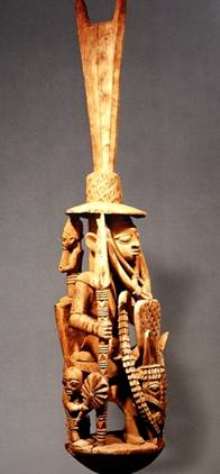
Veranda post, equestrian figure, carved by Areogun of Osi-Ilorin National Museum, Lagos, Nigeria.
Aesthetics then distinguishes artworks from other utilitarian objects. The failure to understand this fact explains why it took so long, until 20th century for many in the West to accept African art as art. Even today, in the 21st century, there is still a need to persuade many that African art addresses aesthetic concerns. Ekpo points out that following Darwin’s theory of evolution, human societies were classified into three stages: the age of savagery, the age of barbarism, and the age of civilization. The Europeans who made this classification, put ancient Greeks and Romans into the age of civilization but all non-Western people were thrown to the bottom of the scale: “It is ironic that ancient Egypt was considered a precursor to Western civilization and, therefore not really “African” despite the simple fact that it actually developed in Africa”.(p.15).
Eyo recalls that the word “civilization” is of relatively recent usage and that Samuel Johnson (1709-1784), originator of the famous Dictionary of the English Language declined in 1772 to include “civilization” in this work. The word came into general use by the time of the Industrial Revolution and the rise of nationalism in Europe and North America. From then on the world was divided by the Europeans into the “civilized” and the “savage.” Those from the West were civilized and those from the rest of the world were savages. Eyo states that: “It became the duty of anthropologists, travellers, explorers and missionaries to spread these ideas wherever they went, and to redeem the God forsaken people they encountered.” (p.16)
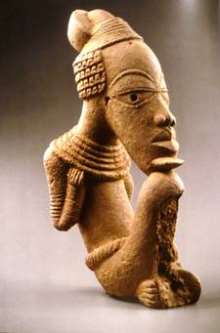
Figure of a seated male. One of the looted Nok terracotta bought by the French, now in the Musée du Quai Branly, Paris, France, with Nigerian post factum consent.
The dichotomy between “civilized” and “savage” was as may be expected, applied in the field of art. Europeans classified all-non Western art as “primitive” because in their view true art could only be made by Western peoples. Explorers who came to Africa took home African works out of curiosity to show to their people that they had been to the land of the primitive people. The missionaries gathered African objects to deprive Africans of what they considered to be the focus of their worship and show Europeans that these were idols. Colonial administrators took artefacts as proof of the backwardness of people whom they had to bring civilization. The anthropologists considered African objects as ethnographic objects of primitive people. None of the above-mentioned groups of European regarded the African objects as works of art. One anthropologist cited by Eyo, Leonhard Adam, stated that “Actually they are not so much works of art as failed attempts to produce on.”(p. 16) The European prejudice about African art was so engrained that as late as 1959, the famous art historian Ernst Gombrich asked an American professor “Is there African art?” When told that there exists African art, Gombrich objected : To be sure there are those who speak of “ primitive art although I do not find it proper to use the term “art” where one is referring to simple shapes used for the building up of different representation. (p.17)” Gombrich, who had seen the exhibition Treasures of Ancient Nigeria Legacy of 2,000 Years,co-curated by Ekpo Eyo, had been “Overwhelmed” by Ife and Benin bronzes. But when asked whether these works qualified as works of art, said “yes” but then asked his interlocutor, “Do you really believe that the Ife and Benin pieces were the work of Africans?” (p.18)
William Fagg who had visited Nigeria several times did not like the term “primitive” and replaced it by the term “tribal”. He identified specific art works with specific tribes and declared that what is not tribal is not African. As may be expected, Ekpo Eyo, objects equally to the term “tribal “ as misleading since it denies statehood to well organized states such as those of the Asante, the Yoruba, the Edo, the Kongo and the Kuba and suggest that there had been no cultural exchanges among African societies and influences from one society to the other. It also creates the impression that there is a specific style for a specific people. Eyo discusses Nok culture and expresses regret that “they have been looted over time to supply the international market. Properly excavated, such pieces might have shed valuable light on Nok culture.” (p.23) The author is very polite and does not mention that some of the looted Nok pieces ended up in Paris, Musée de quai Branly as his catalogue of works clearly show.
At some point in his teen years, Branden Jacobs-Jenkins developed a fear of inviting people over.
His parents’ decor, he’d noticed, tended to unsettle his guests.
“They wouldn’t know what to do,’’ recalled Jacobs-Jenkins, then an honors student at a Catholic prep school in Washington, D.C. “White friends, black friends, Asian friends, everyone. I would welcome them to my house, and they would see these, like — just a wall full of mammies, and they would freak out.’’
The mammy dolls, like the signs saying “Colored Only,’’ belonged to his parents’ collection of what he called “black memorabilia’’: a cache of objects imbued with racist history. To Jacobs-Jenkins, now a 26-year-old playwright with a degree in anthropology from Princeton University, these were the cause of occasional childhood nightmares, but they were also part of his everyday life.
“So I actually feel very comfortable around these images,’’ he said the other day by phone from Berlin, where he recently finished studying on a Fulbright grant.
The images that populated his home and his dreams now populate his play, “Neighbors,’’ which opened last night at Company One. Jacobs-Jenkins, who is black, said that when he wrote it in 2007, he intended it to be “the raciest race play that ever raced’’ and the last play he would ever write about the subject: a piece that poses uncomfortable questions about the labels of blackness and whiteness, about miscegenation, about perception and identity.
A collision of styles, it sets what he described as a “post-August Wilson’’ drama against “the beginning of black theater, which is minstrelsy,’’ a form that emerged in the first half of the 19th century with white performers in blackface makeup. They embodied whites’ degrading notions of blackness, played for laughs. Black minstrels, also wearing blackface, later joined the tradition.
In approaching this sensitive territory, Jacobs-Jenkins doesn’t exactly tiptoe. The script’s first racial epithet — a word this newspaper does not print — is fewer than 20 lines in. Some of the characters speak in the kind of dialect that was Stepin Fetchit’s stock in trade. The majority of the characters’ names, and many of their traits, are borrowed from archetypes steeped in bigotry.
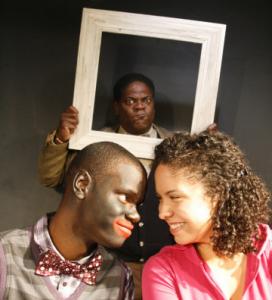
As “Neighbors’’ begins, the Pattersons — Richard, a black professor; Jean, a white stay-at-home mom; and their 15-year-old daughter, Melody — are getting new neighbors, the Crows. Mammy; her three teenagers, Sambo, Jim, and Topsy; and her brother-in-law, Zip Coon, are performers, and their act is called the “Crow Family Coon-A-Palooza.’’
In blackface throughout the play, the Crows are racist stereotypes brought to life, though it is only Richard who is bothered by their close proximity. Zip strikes up a friendship with Jean, whose newfound efforts to discuss race with her husband go nowhere, while Melody falls into an adolescent romance with Jim, the stage manager of his family’s act and the namesake of his late father, Jim Crow Sr.