Art: The Twenty/ Anticipated shows for Fall 2010, New York, NY

Our most anticipated

Publish Post

shows of fall.

MUSEUMS


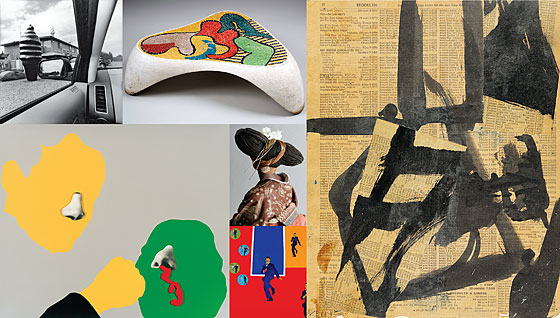
1. “Lee Friedlander: America by Car”
Friedlander, one of the great American street photographers, started shooting this deceptively casual-looking series in 1995, using his rental car’s windows, windshield, and rearview mirrors to frame the sights and people he encountered on his cross-country rambles. Whitney Museum of American Art; Sept. 4–Nov. 28.

2. “Franz Xaver Messerschmidt, 1736–1783: From Neoclassicism to Expressionism”
The artist’s first Stateside exhibition will focus on his “character heads”—wonderfully manic busts of men cringing, shrieking, and smiling (said to have originated after Messerschmidt suffered a breakdown). Neue Galerie; Sept. 16–Jan. 10.

3. “Shifting the Gaze: Painting and Feminism”
A mini-survey of the growing, changing world of feminist painting since the sixties, starring such artists as Hannah Wilke, Lee Lozano, Eva Hesse, and Nancy Spero. The Jewish Museum; Sept. 12–Jan. 30.

4. “Chaos and Classicism: Art in France, Italy, and Germany, 1918–1936”
A studied look at the ways in which European artists (including Picasso and Matisse), architects, and designers returned to classical motifs and imagery (columns, robes, chiseled jawlines) while seeking tranquility between the wars. Guggenheim Museum; Oct. 1–Jan. 9.

5. “The Big Picture: Abstract Expressionist New York”
A sweeping survey of the Cedar Tavern crowd at its zenith. Drawn entirely from MoMA’s supreme permanent collection, which includes the best of the best: Pollock, Mitchell, de Kooning, Rothko. Museum of Modern Art; Oct. 3–Apr. 25.

6. “The Last Newspaper”
Just like the rest of us, the New Museum is trying to make sense of the speed of information. Artwork from the likes of William Pope.L, Wolfgang Tillmans, and Aleksandra Mir will be on view, along with an interactive “newsroom” that actually cranks out a weekly printed paper. The New Museum; Oct. 6–Jan. 9.

7. “Seductive Subversion: Women Pop Artists, 1958–1968”
A new survey that acknowledges the queens of Pop, long considered secondary to the guys. On view: Yayoi Kusama, Martha Rosler, Vija Celmins, Faith Ringgold, and Marisol. Brooklyn Museum; Oct. 15–Jan. 9.

8. “John Baldessari: Pure Beauty”
The first major U.S. exhibition in twenty years devoted to the SoCal legend—from his photo-collages to wonderfully weird videos like his cheerful, tone-deaf Baldessari Sings LeWitt, from 1972. (See YouTube for a preview.) Metropolitan Museum of Art; Oct. 20–Jan. 9.

9. “Grain of Emptiness: Buddhist-Inspired Contemporary Art”
Meditative installations from German conceptualist Wolfgang Laib; Atta Kim’s photographs of a melting Buddha ice sculpture; and Theaster Gates’s short film of African-American Buddhist monks partaking in their morning rituals. Rubin Museum of Art; Nov. 5–Apr. 11.

10. “The Global Africa Project”
A medley of art, textiles, furniture, and clothing made by some 60 African artists and artisans. Look for the show within the show, spotting all the African-born aesthetics that pop up in cutting-edge design. The Museum of Arts and Design; Nov. 17–May 15

To learn more about the other museums lised, click here.

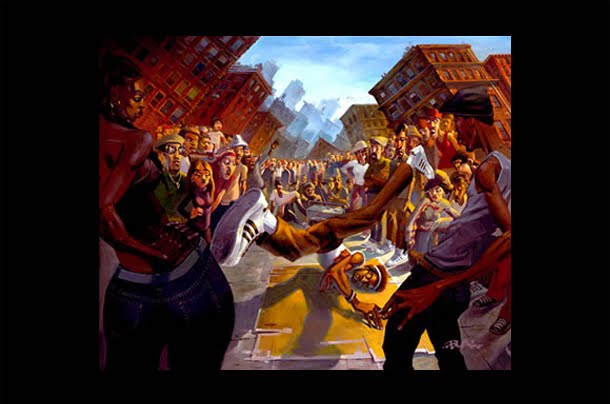
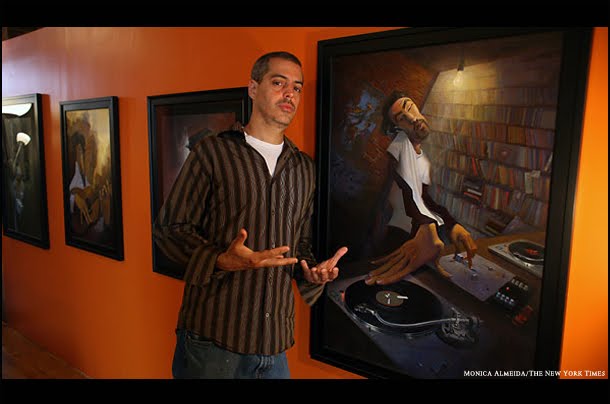
Groundbreaking and Internationally known Artist Justin Bua

Groundbreaking artist Justin BUA is internationally known for his best-selling collection of fine art posters–The DJ being one of the most popular prints of all time. Born in 1968 in NYC’s untamed Upper West Side and raised between Manhattan and East Flatbush, Brooklyn, BUA was fascinated by the raw, visceral street life of the city. He attended the Fiorello H. LaGuardia High School of Music and Performing Arts and complemented his education on the streets by writing graffiti and performing worldwide with breakdancing crews. BUA went on to the Art Center College of Design in Pasadena, California where he earned a B.F.A in Illustration.

Starting in the world of commercial art, BUA designed and illustrated myriad projects, from skateboards and CD covers to advertising campaigns. He developed the look and feel of the opening sequence for MTV’s Lyricist Lounge Show, EA Sports video games NBA Street and NFL Street, and the world of Slum Village’s award winning music video “Tainted” among others. He designed the BUA line of apparel and a limited edition shoe line with PF Flyers that sold out completely. Currently, he teaches figure drawing at the University of Southern California, while continuing to be a leading innovator in both the fine and commercial art worlds. BUA’s energetic and vocal worldwide fan base ranges from former presidents, actors, musicians, professional athletes, and dancers, to street kids and art connoisseurs.

In his first book, The Beat of Urban Art, BUA lays out his unique vision, melding urban rhythms, graffiti, and classical art training. This visually arresting book is about his life, his work, and the birth of Hip-Hop. As we follow BUA through his turbulent youth, navigating the streets and underground worlds of the urban jungle, we recognize the powerful evolution of BUA’s distinct style—“New Urban Realism.” Following in the footsteps of the great masters, BUA represents the lives of both the revered and the marginalized, the heroes and the underdogs of his time—New York City during the 1970s and ’80s. With an autobiographical narrative illustrated with photographs, drawings, sketches, studies, and explanations of how many of his paintings were created, The Beat of Urban Art takes you into the head of the modern-day Toulouse-Lautrec.

To learn more about Justin Bua, click here.

21st Annual Neighborhood to Neighborhood Street Festival, Phildelphia, PA


The West Philadelphia Coalilition of Neighborhoods & Businesses Presents :

21st Annual Neighborhood to Neighborhood Street Festival
Saturday, September 4, 2010
49th to 52nd & Baltimore Avenues
Philadelphia, PA
11:00am to 8:00pm
Hosted by State Senator Anthony H. Williams
For more information click here.

Twin Hicks Presents Their First Book.. "Noah’s Ark"

Written by Robert Richardson – Illustrated by Alan & Aaron Hicks


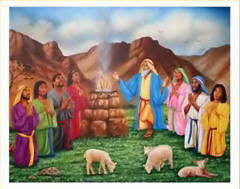
Twin Hicks “Noah’s Ark”, is a unique prospective of the traditional story. It captures the unwavering message of God’s mercy and grace for humanity and Noah’s uncompromising faith.

Although the world had become increasingly wicked, Noah found favor in the sight of God, and God spared him and his family from the great flood. We learn a valuable lesson from Noah and his family, and how they prepared for the signs of the time… They lived in a very corrupt day; however they put their trust and faith into God.

The illustrations in the book are absolutely phenomenal with each page coming to life as the story unfolds. The animals, the ark, the people, and the flood are depicted to the smallest detail, with such vibrant and beautiful colors.


To learn more about this phenomenal illustration book. click here.

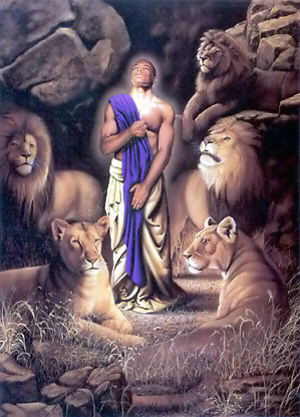
"Daniel’s Faith In God" by Alan & Aaron Hicks

Alan and Aaron Hicks are identical twin brothers from Chicago, Illinois. Not only do they share the same facial features, but the same unique talent as well.

Since the age of eight, the twins shared an intense desire to express their creativity through drawing. Over time, what began as a journey of self-expression through art became a bona fide passion to capture “life” with whatever media God placed in their hands. The only question would be, “which hand?” because Alan paints with his left hand, while Aaron paints with his right.

As the twins matured, the same passion that drove them to create artistically also inspired them to hone their skills within an academic environment. Thus, Alan and Aaron began to further their education and their talent at the University of Illinois in Chicago. In 1985, their perseverance and dedication paid off; the twins received Bachelor of Arts degrees in Biocommunications/Medical Illustrations from the University of Illinois.

Today, they continue to stretch themselves as artists and consistently strive for Godly perfection in their work. Their spiritual and family oriented motifs have been exhibited throughout the country and in numerous publications, such as Ebony, Jet, and Upscale Magazine.

Whether or not Alan and Aaron paint an image together or single handedly produce another stroke of beauty, the results are always the same: they reveal an uncanny ability to achieve outstanding color and detail in every airbrushed image.

To learn more about Alan & Aaron Hicks, click here.

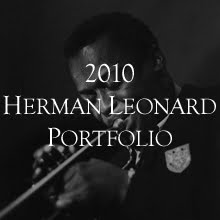
2010 Herman Leonard Portfolio at the Catherine Edelman Gallery in Chicago, IL

Herman Leonard has selected 45 of his favorite images that clients may choose from to create a customized portfolio package of six 11 x 14″ Open Edition silver gelatin photographs. All prints will be signed, titled and dated by Herman Leonard. The prints will be presented in an archival portfolio box, covered and lined in a warm grey fabric, with Herman Leonard’s signature imprinted on the cover. A Certificate of Authenticity will accompany each set. The value of this offer if purchased individually would be $8,400. Our special price for this package of six photographs is $5,750, a savings of $2,650. We can additionally customize your portfolio to include any image in Herman Leonard’s collection.

For additional information or to place your order, please contact the gallery at [312] 266-2350 or by email at juli@edelmangallery.com

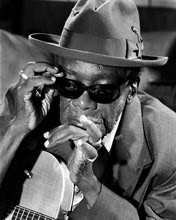
John Lee Hooker, San Fancisco [JLH02] (1998)

Catherine Edelman Gallery

300 W. Superior St.
Chicago, IL 60654

Tuesday through Saturday
10:00 to 5:30 pm

Catherine Edelman, Director
catherine@edelmangallery.com

Juli Lowe, Assistant Director
juli@edelmangallery.com

Trevor Power, Gallery Manager
trevor@edelmangallery.com

p: 312-266-2350
f: 312-266-1967

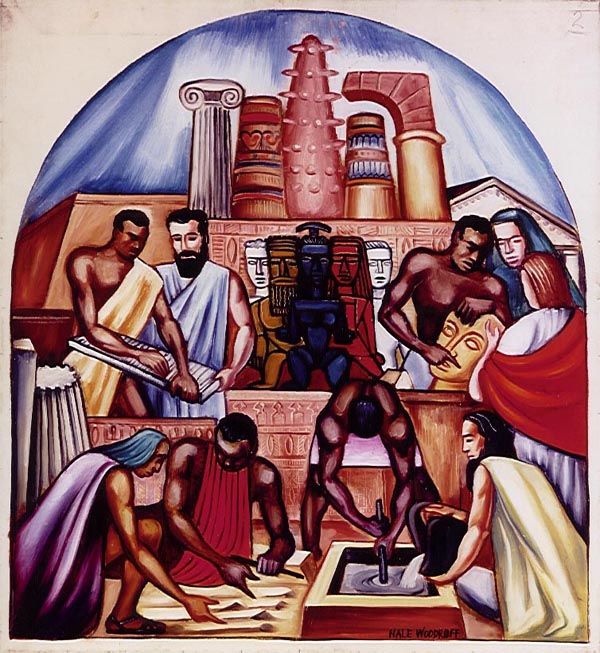
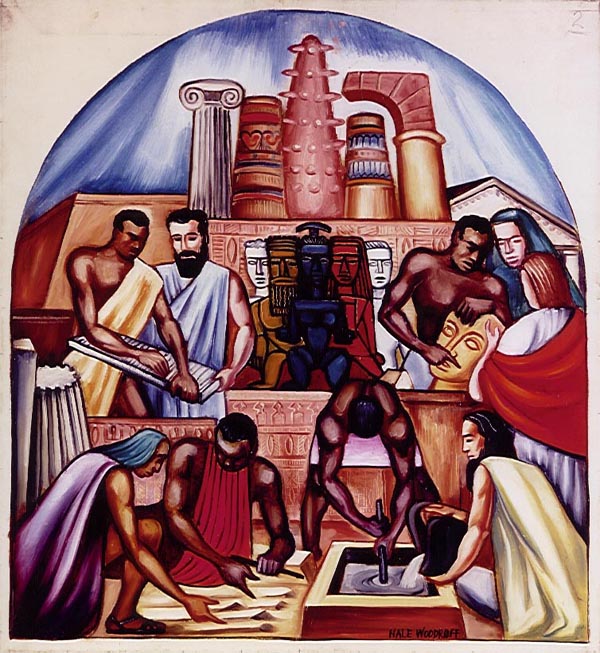
The Art of the Negro: (Study) – Hale Woodruff Murals at Clark Atlanta University – Atlanta, GA

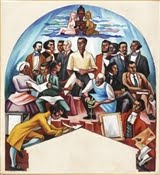
The Art of the Negro murals were painted by Hale Aspacio Woodruff (1900-1980) and consist of six canvas panels housed in the atrium of Trevor Arnett Hall. Woodruff, art professor and founder of the Atlanta University art department and permanent collections painted the series between 1950-1951. Woodruff intended to provide students of an historically black university, and its visitors, with images of black Americans’ cultural past. Referring to his motive for painting the murals, Woodruff stated:

“It portrays what I call the Art of the Negro. This has to do with a kind of interpretive treatment of African art. … I look at the African artist certainly as one of my ancestors regardless of how we feel about each other today. I’ve always had a high regard and respect for the African artist and his art. So this mural, … is for me, a kind of token of my esteem for African art.” – Hale Aspacio Woodruff

To learn more about Art of the Negro, click here.


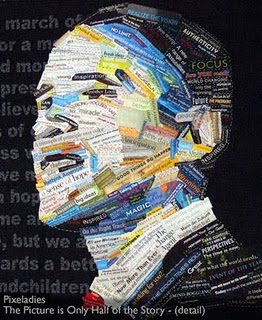
The Journey of Hope in America: Quilts Inspired by Barack Obama, National Afro-American Museum & Cultural Center, Wilberforce, OH

The Journey of Hope in America: Quilts Inspired by Barack Obama
December 18, 2009 Through December 18, 2010
National Afro-American Museum and Cultural Center

The Journey of Hope in America: Quilts Inspired by President Barack Obama commemorates an historic milestone in American history – the election of an African American man as president. The show will open Dec. 18, 2009 and will run through Dec. 18, 2010 before touring the country.

This extraordinary quilt show is curated by internationally known quilt artist, author and historian Dr. Carolyn L. Mazloomi for the National Afro-American Museum and Cultural Center, a part of the Ohio Historical Society. She’s brought together a diverse group of 95 fiber artists representing a variety races, cultures, generations and religions.

The exhibition will explore Obama’s momentous 2008 election by bringing audiences a collection of powerful quilts from a wide range of styles, including art quilts, folk art and traditional quilts. The featured quilts illustrate a broad range of techniques and materials, including piecing, painting, appliqué, embroidery, dyeing, photography, beading and digital transfer, as well as inspirations.

Throughout The Journey of Hope in America, viewers will experience the narrative quilt as an avenue toward expanding understanding the impact of the electing of the first African American president.

Location
The National Afro-American Museum & Cultural Center
1350 Brush Row Road
Wilberforce, OH 45384
(937) 376-4944
(800) 752-2603

Hours
Wednesday-Saturday:
9 a.m.-4 p.m.
Sunday-Monday-Tuesday: CLOSED

Admission
Adults: $4
Seniors: $3.60
Youth, ages 6-18: $1.50
College Students (with student ID): $1.50
School Groups: $25.00 per bus (weekdays only by advance reservation)
Children 5 & under: FREE

*Membership offers unlimited visits to this exhibit and all Ohio Historical Society historic sites and museums.

Annette John-Hall: Still family celebrates 141st reunion in Lawnside Read more

Cruising down Oak Avenue into the historic borough of Lawnside, it didn’t take long to spot the sign. 141st Still Family Reunion: An American First Family.

Can’t argue with the first-family part. The Still family tree may have had its roots in slavery, but has managed to produce quintessential American achievers – abolitionists, preachers, doctors, scientists, professors, composers, Tuskegee Airmen, and professional athletes, among others.

But the festivities going on in Clarence Still’s expansive backyard in the Camden County town over the weekend were anything but still.

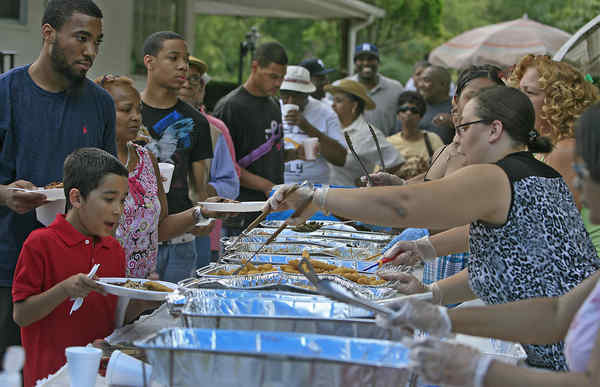
Everybody was moving. Children tumbled in a supersize moon bounce while tables upon tables of family dug into sauce-soaked racks of barbecue ribs and fluffy mounds of potato salad. The ones who weren’t eating were line-dancing – at least trying to – as knots of old men laughed at each other’s tall tales.

Every year, hundreds of Stills gather here from as far away as Arizona to continue family tradition, revel in their storied family legacy, and pass it down.

“We’re proud of it. Very much so,” says Clarence Still, the 81-year-old patriarch and founder of the Lawnside Historical Society. “When you think about American democracy, we played a big part in it.”

Rich history

According to family history, the first Still was a Guinean prince who arrived in New Jersey as an indentured servant in the 1600s.

By the early 1800s, Levin Still, a Maryland slave, had bought his freedom and settled in Indian Mills, Burlington County.

It wasn’t long before his wife, Charity, escaped and joined her husband with the couple’s two daughters. She left two sons behind; one, Peter, escaped and joined his family years later, but brother Levin died enslaved.

Most notable of Levin and Charity’s 18 children are William Still, one of the conductors of Philadelphia’s Underground Railroad, and James Still, an unlicensed doctor and herbalist known around Medford as the “Black Doctor of the Pines.”

Stills come in all varieties. There are Native American Stills, white Stills, and, of course, African American Stills, an overwhelming number of them living in Lawnside, believed to be the first all-black self-governing town in the North.

By any measure, the Still family saga embodies all the values we claim to hold dear – life, liberty, and the pursuit of happiness.

Ursinus College historian Walter Greason, whose new book The Path to Freedom traces black migration to New Jersey, has done research on the Stills.

“When you look at the sanctions imposed on African Americans as property, over and over again we find fathers and mothers escaping to free territory and, one by one, getting the word to family members. And over the decades, this process of freedom has defined family,” says Greason.

“Hundreds of thousands of people took risks running through the woods and along the riverbeds. These are the great untold stories we grapple with.”

All the more reason why the Stills gather – to pass their history on to members of their own bloodline.

Don’t know family history

Marion Still Buck, spry and sharp at 92, sat behind a table selling the family history books. She fretted that the younger generation wouldn’t value the family legacy as much because they didn’t take the time to learn their family history.

“You have to know where you came from to understand where you’re going,” says Buck, who grew up in Moorestown and now lives in Raleigh, N.C.

Yet even some older family members are just discovering that being a Still means more than reuniting with aunts, uncles, and cousins every year.

“A lot of times our ancestors wouldn’t talk about it, because there was a fear of what would happen if they did,” says the Rev. Clifford Still, 53, pastor of the Venice Park United Methodist Church in Atlantic City. “But it’s not just about history, it’s about connectivity. As long as we keep the children around it, they will learn, whether they’re paying attention or not.”

Clarence Still, the fifth in the family to bear the name, has started to pay attention.

“I’ve been thinking about it lately,” says the 23-year-old. “I can see my grandfather slowing down. I know eventually [the reunion] is going to fall in my hands.”

“I’m ready.”

"Save Our African-American Treasures" at Washburn This Weekend

Washburn’s Memorial Union is hosting the 7th in the series of the Smithsonian Museum’s signature program Saturday and Sunday.

WASHBURN UNIVERSITY — The Smithsonian’s National Museum of African American History and Culture will co-host two weekend programs to help northeastern Kansas-area residents identify and preserve items of historical and cultural significance tucked away in the attics, closets and basements of their homes. Presented in collaboration with Washburn University in Topeka, the event will feature presentations, hands-on activities and preservation tips.

Free and open to the public, the event is the seventh in a series from the museum’s signature program “Save Our African American Treasures: A National Collections Initiative of Discovery and Preservation.” It’s being held at Washburn University’s Memorial Union on Jewell, this Saturday and Sunday, August 14th and 15th, from 10am till 4pm.

Participants from all over northeastern Kansas can reserve in advance to bring up to three personal items for a 20-minute, one-on-one professional consultation with experts on how to care for them. The specialists will serve as reviewers, not appraisers, and will not determine items’ monetary values.

Objects such as books, paper and textiles no larger than a shopping bag can be reviewed (furniture, carpets, firearms and paintings are excluded).

Those wishing to have items reviewed must make reservations by e-mailing treasures@si.edu or by calling toll free (877) 733-9599. Reservations are not required for those not wishing a one-on-one consultation. Additional information is available online at Treasures.si.edu.

The “Treasures” program includes the following sessions:


Preservation Presentations: Informal basic preservation sessions will take place during the day. One will focus on textiles, a category that includes cloth dolls, flags, hats, clothing, lace, quilts, needlework and table linens. The session on photographs and paper will inform participants on simple inexpensive techniques to keep their family Bibles, historic pictures and important documents such as diplomas and wedding licenses safe from deterioration.

Hands-on Preservation: Participants are invited to learn how to properly store letters, pack garments and prepare photographs for preservation storage and presentation.

As a companion to the series, the museum has produced a 30-page guidebook African American Treasures: A Preservation Guide will be distributed free to attendees and to individuals, community groups and educators to highlight the importance of proper preservation techniques. The guidebook is part of the “Treasures” kit, a tote bag that will also include white cotton gloves, archival tissue papers and archival documents sleeves to help people keep their personal treasures safe.

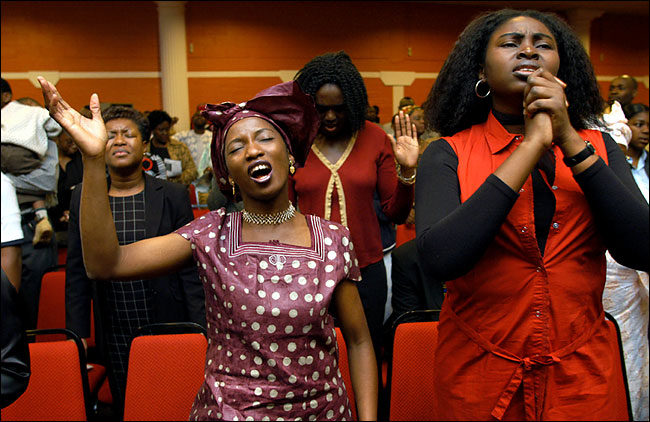
Does the black church keep black women single?

(CNN) — Legs covered in skin-toned stockings, her skirt crisp to the knee, Patty Davis slips on the black heels she has shined for the day.

“Got to look good in the Lord’s house,” she says as she spritzes her neck with White Diamonds perfume and exits her black Lincoln Town Car.

Davis, 46, of Union City, Georgia, has attended African Methodist Episcopal churches since before she could crawl. She sits proudly in the pew every Sunday for service and is among the first to arrive for bible study each Wednesday.

She moves swiftly, with confidence, a weathered Bible clutched in her right hand, the day’s passages dog-eared and highlighted. She’s the type of woman who can recite scriptures with ease, her love of faith evident in her speech.

“Every day is a blessed day for me,” she says. “Jesus is the No. 1 man in my life and any man who wants me must seek me through Him.”

The unmarried Georgia native is a committed follower of the Christian faith, striving to live and breathe the gospel in her daily life. Yet, according to relationship advice columnist Deborrah Cooper, it is this devout style of belief and attachment to the black church that is keeping black women like Davis — single and lonely.

Clinging to the gospel

Cooper, a writer for the San Francisco Examiner, recently made claims on her blog SurvivingDating.com that predominantly black protestant churches, such as African Methodists, Pentecostal, and certain denominations of Evangelical and Baptist churches are the main reason black women are single. Cooper, who is black and says she is not strictly religious, argues that rigid beliefs constructed by the black church are blinding black women in their search for love.

In raising the issue, Cooper ignited a public conversation about a topic that is increasingly getting attention in the black community and beyond. Oprah Winfrey, among others, recently hosted a show about single black women and relationships after a Yale University study found that 42 percent of African-American women in the United States were unmarried.

Big Miller Grove Missionary Baptist Church, a predominately African-American Baptist church in Atlanta, is holding a seminar on the question of faith’s role in marital status on August 20.

“Black women are interpreting the scriptures too literally. They want a man to which they are ‘equally yoked’ — a man that goes to church five times a week and every Sunday just like they do,” Cooper said in a recent interview.

“If they meet a black man that is not in church, they are automatically eliminated as a potential suitor. This is just limiting their dating pool.”

The traditional structure and dynamics of black churches, mostly led by black men, convey submissive attitudes to women, Cooper says, encouraging them to be patient — instead of getting up and going after what they want.

Nearly ninety percent of African-Americans express “certain belief in God” and 55 percent say they “interpret scripture literally,” according to the 2009 Pew Research Center study “A Religious Portrait of African-Americans.”

Dr. Boyce Watkins, a professor at Syracuse University and advocate for African-American issues, responded to Cooper’s article online. Though he applauded Cooper’s courage to voice her opinion , he agreed — and disagreed — with her.

“I don’t think the church keeps black women single,” Watkins says. “But I do agree that some black churches teach women that they must only date a man that goes to church regularly.”

Watkins, who is African-American and whose father is a Southern Baptist minister, described his interactions with southern women who are devout churchgoers. “I am a male and I know that I will treat a woman well, but I have been rejected many times because I don’t thump a bible with me everywhere that I go.”

All in the numbers

One of biggest reasons black women are single, Cooper says, is because of a lack of black men in the church. According to the PEW study, “African-American men are significantly more likely than women to be unaffiliated with any religion (16 percent vs. 9 percent). Nearly one-in-five men say they have no formal religious affiliation.”

Watkins believes the social structure of the church keeps black men from attending. “Those appealing, high-testosterone guys have a hard time getting into the ‘Follow the leader, give me your money, and listen to what I have to say’ attitude.”

“Many of us have a difficult time submitting to the pastor who is just another man.”

The male pastor, Cooper says, is the “alpha male” for many black women. Over-reverence for the pastor – or any religious figure for that matter – creates barriers for the black man, she says, because he feels like he must compete for the No. 1 spot in a black woman’s heart.

“It doesn’t make you more attractive if your life is filled with these ‘other’ men,” Cooper says. “If they feel like they have to compete, you are not going to be interesting because you’re not feeding his ego in the way it needs to be fed.”

Mark K. Forston, son of a black preacher in Forest Park, Georgia, says some black women “put their pastor on this pedestal and have a large amount of faith in him because he is a living source of salvation.”

Sometimes women even focus their romantic feelings on the pastor, says Forston. “Regardless if he’s married or not, sometimes human desires will transcend beyond certain parameters and that’s dangerous territory. Pastors are humans just like anybody else.”

The Rev. Renita J. Weems, a bible scholar who holds a degree in theology from Princeton, strongly disagrees with Cooper about why many black women remain single and says she is reinforcing one message: “It’s the black woman’s fault.”

“To claim that women are sitting in their chair getting heated about watching their preacher strut across the pulpit is illogical,” Weems says. “The black church is not a Sunday morning sex drama.”

Weems, who is African-American and has written several books on women’s spirituality, has her own criticisms of the black church. The literal interpretation of certain scriptures can lead to subjugating women, Weems says. However, positive scripture messages, about love and justice, do exist and can be used to empower women rather than keep them “single and lonely.”

Weems says Cooper fails to examine deeper threads. “What the black church does and what religion does is helps you create core values for your life and allows you to see what you appreciate in others.

“The reason why black women who go to black churches are not married is because they are looking for certain values in a man,” Weems says. “It is not the church that keeps them single, but the simple fact that good values are lacking in some of our men.”

Choose or lose the church

Cooper says her goal is to empower black women. If their strategy for meeting men is failing, Cooper offers two suggestions: Find another church or leave-and go where the boys go: tailgates, bars and clubs.

“Black women need to open their eyes. You want to know the reason why the black man isn’t in church? Because he left church to go to the Sunday football game,” Cooper says. “Going to these sites is discouraged in the black church because these places are seen as places where ‘sin dwells.’ But if women are compassionate, as the bible preaches they should be, then they need to be more open about the men they choose to date and where they might meet them.”

“I’m not against religion, or against the church, I’m against women limiting their choices and putting themselves in a box because they do what their church tells them to do,” Cooper says.

Weems disagrees. “Telling black women that they should spend their two hours on Sunday elsewhere and drive them away to go to the bar to find a date is not helpful to our communities.”

“Black women are the backbones of their community and without them a lot of charitable work would not get done, social justice on the ground would be diminished and outreach to poor people would be severed.”

Patty Davis, the long time churchgoer in Georgia, says all the arguments over what the church preaches miss the point. What truly matters, she says, are women’s motives.

“The real question is: What are you coming to church for?” she says. “To feed your spirit? Or your carnal desires?”

The church’s effect on the romantic lives of black women cannot be gleaned from a mathematical equation or a select bible passage, Davis says.

“It is a woman’s own actions and decisions that will determine the outcome of her love life, not the church’s,” Davis says. “Because the last time I checked, the church ain’t no dating service.”

Struggling for the American Soul at Ground Zero

By Edward E. Curtis IV


Like Gettysburg, the National Mall, and other historic sites, Ground Zero is a place whose symbolic importance extends well beyond local zoning disputes and real estate deals. The recent controversy over a proposal to build a Muslim community center two blocks away from the former World Trade Center shows it clearly: the geography of Lower Manhattan has become a sacred ground on which religious and political battles of national importance are being waged.

After New York’s Landmarks Preservation Commission gave its approval for the demolition of the building now located on 45-47 Park Place in Lower Manhattan, the Rev. Pat Robertson’s American Center for Law and Justice announced that it is suing to stop the project.

Though Robertson’s organization is supposedly dedicated to the “ideal that religious freedom and freedom of speech are inalienable, God-given rights,” it is not primarily concerned with religious rights, at least not the rights of Muslims. It is instead part of a loose coalition of Americans who have identified the presence of Muslims, both at home and abroad, as a primary threat to both the United States and the Judeo-Christian heritage.

Their Muslim-bashing has deep roots in American history. Since the days of Cotton Mather, the New England Puritan minister, many Americans have associated Muslims with religious heresy. In the early 1800s, as the United States waged its first foreign war against the North African Barbary states, politicians, ministers, and authors regularly used themes of oriental despotism, harems, and Islamic violence in political campaigns, novels, and sermons.

Later, when the U.S. failed to quell Muslim revolts during the U.S. occupation of the Philippines in the early twentieth century, U.S. Army Gen. Leonard Wood called for the extermination of all Filipino Muslims since, according to him, they were irretrievably fanatical.

Islamophobia, an odd combination of racism, xenophobia, and religious bias, receded in importance during the 1900s as the specter of communism replaced it as a primary symbol of foreign danger. But with the fall of the Soviet Union, stereotypes about the Islamic “green menace” have once again become a central aspect of our culture.

This time Muslims are fighting back. Their civil rights and religious leaders are challenging this old American prejudice, in part through unprecedented interfaith community activism. Imam Feisal Abdul Rauf, the leader of the group proposing the Muslim community center near Ground Zero, is one of them.

In response to questions about why he wants to build a community center so close to Ground Zero, Rauf has said that he wants the community center to be a source of healing, not division. Rauf also pledged that Park51, as the project is now called, will be a “home for all people who are yearning for understanding and healing, peace, collaboration, and interdependence.”

Rauf has powerful friends–or at least allies. New York Mayor Michael Bloomberg, who choked up defending the right of Muslims to build the community center during a speech in the shadow of the Statue of Liberty, argues that “we would be untrue to the best part of ourselves…if we said ‘no’ to a mosque in Lower Manhattan.”

Those who agree with Mayor Bloomberg represent the other major faction struggling for the American soul at Ground Zero. For them, the American soul is imperiled when its founding ideals are cast aside. In this case, the ideal is the first amendment guarantee of the free exercise of religion. “Of all our precious freedoms,” said Bloomberg, “the most important may be the freedom to worship as we wish.”

Defenders of religious freedom, one of the primary sources of the American nation-state’s moral legitimacy, are fervently backing the community center organizers. They are participants in a civil religion that often places the founding principles of the state above other moral and theological concerns.

For many of them, the situation would be different if the City of New York wanted to put a road or tunnel through Park Place. The right of eminent domain would then be at stake and it would trump the religious rights of Muslims to build a community center and mosque. But to deny a group the right to build a mosque because it offends or even hurts people’s feelings is a different matter.

If Muslims are victorious in this dispute—which looks likely—it will not be because of their growing numbers or lobbying power, but because their interests parallel those who believe deeply and passionately in the state’s obligation to protect freedom of religion.

But this is only one battle in the larger struggle for the post-9/11 American soul. Ground Zero will remain a preeminent site of such religious and political discussion. Americans will continue to debate key questions of war and peace, good and evil on this sacred ground.

Edward E. Curtis IV is Millennium Chair of the Liberal Arts and Professor of Religious Studies at Indiana University-Purdue University Indianapolis (IUPUI). He is the author of several books on Muslim American and African American religious history, including Muslims in America: A Short History. A former National Endowment for the Humanities Fellow at the National Humanities Center, Curtis has also received Carnegie, Fulbright, and Mellon fellowships. You can read his article “Islam has long history downtown: Why the ‘Ground Zero mosque’ belongs in lower Manhattan” in the New York Daily News.

The Art of the Negro: (Study) – Hale Woodruff

Hale A. Woodruff
1900-1980
Located in the:
  • Detroit Institute of Arts
  • The General Motors Center for African American Art
  • 5200 Woodward Avenue
  • Detroit, Michigan 48202
  • Main Line: 313.833.7900
Date
1950/1951
Medium
Oil on canvas
Dimensions
Canvas: 23 x 21 in. (58.4 x 53.3 cm) Framed: 29 1/2 x 27 9/16 x 2 9/16 in. ( 74.9 x 70.2 x 6.5 cm)
Department
African American Art
Classification
Paintings
Credit
Museum Purchase, W. Hawkins Ferry Fund, Richard and Jane Manoogian Foundation, and Friends of African and African American Art

For more information about this click here.