Art for Public’s Sake

The painted pianos that have popped up in public places around the region as part of Cincinnati Public Radio’s Play Me, I’m Yours project have struck a chord with residents, the latest example of a public art project that has sparked conversation and helped shape cultural life in Greater Cincinnati and Northern Kentucky.
Rather than compile a long list of such projects, we picked 10 notable ones that residents have embraced, scorned or grown to love. Which ones are your favorites – or least favorites?

1. Tyler Davidson Fountain, 1871

Downtown’s oldest sculpture is beloved by locals and visitors alike. The 43-foot-high bronze and stone fountain, topped by the smiling Genius of Water, was donated to the city by civic leader Henry Probasco to honor Davidson, his brother-in-law. As their business boomed before the Civil War, the two men talked about giving a “utilitarian and aesthetically pleasing” monument to the city.

When Davidson died in 1865, Probasco sold the business and toured Europe searching for inspiration, finding it at a foundry in Munich. August von Kreling’s fountain was dedicated “to the people of Cincinnati” in 1871.

2. Abraham Lincoln, 1917

Today, the 11-foot-tall bronze sculpture of Abraham Lincoln in Lytle Park is considered one of the best representations of the 16th president, but it drew strong public criticism when it was first displayed in 1917 because it portrayed a beardless Lincoln with oversized hands and feet.

Artist George Grey Barnard was commissioned by the Charles P. Taft family to create the work, which took five years to complete. The statue was dedicated in 1917 by former President William Howard Taft, the younger half-brother of Charles.

3. Law and Society, 1972

Berlin-based sculptor and architect Barna Von Sartory created this sculpture after winning a competition to commemorate the Cincinnati Bar Association’s 100th anniversary. His ceremonial gateway is made up of a huge block of limestone resting on two stainless steel posts to symbolize the balance between nature and technology and the relationship between law and society. Pilloried by the public when it was placed on Fountain Square in 1972, it’s now at Sawyer Point.

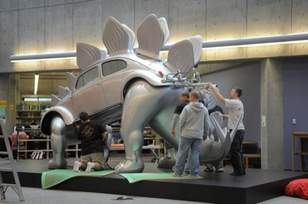
4. Stegowagenvolkssaurus, 1974

During the gas shortage of the 1970s, late Cincinnati artist Patricia A. Renick combined the body of an actual Volkswagen Beetle with the legs and spikes of a stegosaurus to form the 12-by-20-foot “Stego” as a commentary on fuel consumption and how automobiles might meet the same fate as dinosaurs.

First displayed at the Cincinnati Art Museum and then at the Contemporary Arts Center to critical acclaim, the sculpture was damaged during de-installation after an exhibition in Chicago.

After Renick died in 2007 at age 75, her longtime companion and executor of her estate, Laura Chapman, restored the sculpture and loaned it to the W. Frank Steely Library at Northern Kentucky University in 2009.

Other local works by Renick, a University of Cincinnati art professor for 31 years, include the stainless steel “30 Module Sphere No. 1” made of stainless steel at the corner of Brighton Place and Central Parkway.

5. Cincinnati Gateway at Bicentennial Commons, 1988

There once was a time when flying pigs had nothing to do with Cincinnati. When British-born artist Andrew Leicester presented his design for an elaborate entrance to Sawyer Point for the city’s bicentennial, some, including then-Cincinnati mayor Charlie Luken, balked at the idea. The design included four bronze winged pigs emerging from riverboat smokestacks.

After a City Council meeting for which some council members showed up wearing pig snouts, and someone carried in a live piglet wearing paper wings, the pig proponents won out. As Leicester predicted, the city soon went hog wild for the symbol, putting flying pigs on bicentennial merchandise and launching the Flying Pig Marathon in 1999.

6. Metrobot, 1988

For more than 20 years, Nam June Paik’s 26-foot-tall Metrobot stood outside the former location of the Contemporary Arts Center on Fifth Street, presented as a gift from late Heidelberg Distributing Co. owner and philanthropist Albert W. Vontz Jr. in honor of the 200th anniversary of Cincinnati and the 50th anniversary of the CAC.

Paik’s brass-colored sculpture served as an ambassador of the CAC, displaying information about exhibits on its electronic message board arm. It also included a video monitor, a wristwatch clock and a public telephone in its legs. The CAC, now located at Sixth and Walnut streets, took down Metrobot in June 2009 and put it in storage. Its future is uncertain, but there’s some support for putting Metrobot on display again, as evidenced by a “Free Metrobot!” page on Facebook.

7. Big Pig Gig, 2000

Perhaps no public art project has captured the public’s imagination like ArtWorks’ Big Pig Gig, which put porkers on parade throughout Greater Cincinnati and Northern Kentucky from May through October of 2000. Modeled after the international CowParade project, the project featured more than 425 fiberglass pigs designed by artists who gave them punny names such as “Swine Lake” and “Styler Davidson Sow-tain.”

It was called the most successful public art project of its kind in the country after drawing national media attention and an estimated 500,000 out-of-town visitors. After the exhibit, 190 pigs were kept by their sponsors, 170 were sold online and 65 sold at a live auction at Music Hall, raising $839,000 for ArtWorks and other charities.

Some pigs were shipped to other states, but most have stayed in area homes, gardens and building lobbies. The project inspired Glendale to put on a similar project, called the Squirrely Gig, for its sesquicentennial in 2004.

8. Purple People Bridge gateway, 2005

The gateway to the Purple People Bridge on the Cincinnati side of the Ohio River unleashed a flood of complaints over its color, design and price tag. Designed by Cincinnati-based KZF Design, the combination of yellow poles and stainless steel cables cost nearly $400,000. KZF had the last word when it was honored at the ninth annual Cincinnati Design Awards in November 2005 for its contemporary design.

9. Theodore M. Berry International Friendship Park, 2003

The 20-acre park, named for Cincinnati’s first African-American mayor, features several works, including a polished stainless steel piece by German architect Peter Haimerl and a circle of large oak pillars designed by Welsh artist David Nash, unveiled in 2003. An 83-foot-high Crystalline Tower, designed by Miami University fine arts professor Susan Ewing and Czech artist Vratislav Novak was expected to follow in the fall, but a funding fight delayed the project.

Escalating costs drove the final price to $400,000, twice the amount budgeted by the park board; grants and donations made up the difference. The triangular titanium, mica and stainless steel tower, topped by a 30-inch aluminum star sheathed in 24-carat gold leaf on a moving arm, was finally installed in November 2005.

10. Murals

These obvious examples of public art have adorned buildings in Greater Cincinnati and Northern Kentucky for decades. In the early 1970s, art dealer Carl Solway and Jack Boulton came up with a project called Urban Walls: Cincinnati, inviting 10 area artists and designers to create massive paintings to mask the scars left by urban renewal in the 1960s.

The only one remaining is “Allegro” by Barron Krody on the east wall of Willis Music Building on West Seventh Street. Since 1996, ArtWorks’ MuralWorks program has put up 34 murals in 24 neighborhoods.

This year, Los Angeles street artist Shepard Fairey put up 19 propaganda-inspired temporary murals around Greater Cincinnati and Northern Kentucky as part of his solo exhibition at the Contemporary Arts Center. Two were painted over, one in Covington by the building owner and one in Madisonville by someone, never caught.

Whimsical art teaches multiculturalism in the land of Oz

Demographically, Oz was a multicultural society, with creatures of various kinds living in harmony.

Like Dorothy, visitors to the exhibition “Over the Rainbow I and II,” whose title was inspired by the song from the 1939 musical “The Wizard of Oz,” at the Sungkok Art Museum in Jongno District, central Seoul, are invited to explore a fantastic new land while learning about the concept of multiethnicity.

Over the Rainbow I features works that introduce viewers to unfamiliar forms and cultures. Over the Rainbow II offers artworks and performances that blend the cultures of India, China, Mongolia and the Philippines.

“Although Korea has prided itself on its racial purity since its foundation, it must now open itself up to the global melting pot of international cultures,” Kim In-sook, president of Sungkok Museum, told reporters at a recent press tour with several of the participating artists. “It is still early for Koreans to anticipate having a leader like Obama, the Indonesia-educated African American president of the predominantly white United States. However, it is not too late to imagine two children of different colors holding hands on their way to school, as Martin Luther King did in his 1963 ‘I Have a Dream’ speech.”

In the first exhibition room, viewers are greeted by a strange sculpture of a “rabbit” that looks more like a D.J., with antennas protruding out of its head. In this installation, Kim Tae-joong’s seemingly never-ending lines recall the scribbles of Cy Twombly, a contemporary American artist. The painting’s cartoonish figures also evoke images of Hindu statues.

In the adjoining room, called “Dr. Autopoiesis’ Lab,” artist Kim Dong-hyun’s ideas about feminism are expressed through playful figurines and visual projections. In one part of the room, there are Transformers-like figures made of Legos, which Kim referred to as “the real image of women.” Nearby, pigtailed dolls sit woefully in a cage. The walls are decorated with the formula H=MW², a play on Einstein’s mass-energy equivalence equation, meaning that “a human being consists of a man’s attributes and double the proportion of a woman’s,” according to the artist.

In section three, four artists calling themselves Yeop, which means “sideways” in Korean, play with the illusion of two- and three-dimensional space. Their piece is a projection of the monochromic interior of a Chinatown inn.
In the second exhibition hall, black lights by Na In-joo, patterned after the latitudes and longitudes of a cut-out globe, interweave around the four walls, creating the sense that the room is breathing. In the center of the room is a computer monitor, created by Choi Seung-joon, which viewers can use to search for the wizard of Oz. When the viewer sits in front of the computer, an image of the viewer’s face is projected onto the wall and is then fused with the faces of previous viewers to form an amalgamated portrait. The artist said that this shows that Oz can be anyone – regardless of gender, age or ethnicity – and that Oz is essentially oneself, containing many selves within.

The next work consists of five wooden stools that respond to pressure. When the viewer sits, a pair of digital images of mosaic chairs simultaneously light up and play a distinctive melody. When all of the chairs are occupied, a beautiful symphony can be heard. In this piece, Jeon Ga-young’s message is clear: Music is a universal language that becomes richer with more participants.

In the third exhibition room, artist Kim Kyung-ah presents a photo album of herself with “Amu,” a huge, huggable white doll with no features sans two blots for eyes. Amu means anybody in Korean. Looking at the two amorphous dolls in the room, viewers have an opportunity to communicate with their inner selves, the artist said.

The final exhibit was constructed by artist Kim Young-hyeon. Two projectors at each end of the installation show two images – a breezy seaside reconstructed from the artist’s memory and a virtual mountain slope from the game Avatar – that combine to form a single striking image projected onto an installation constructed of five white square panels lined up in a row in the center of the room.

The Over the Rainbow II exhibition in the next building offers more interactive experiences, including a waltz class, a temporary tattoo session and a spice room. These activities have been organized by Salad Theater for Multi-Culti Performing Arts, which is composed of marriage migrants hoping to bridge the gap between Korea’s minority population and native Koreans through art.

Once a week, the group presents a show called “Space Manhol_e_ssay,” which depicts the creation of a global society.

Over the Rainbow I and II awakens one’s senses, challenges prejudices and deepens self-awareness. Most importantly, it will encourage viewers to reflect upon the immigrant cultures of Korea in a dynamic new way.

*Over the Rainbow I runs until Nov. 11 and Over the Rainbow II runs until Sept. 26. Hours are from 10 a.m. to 6 p.m. The museum is closed on Mondays. Admission is 5,000 won ($4.28) for adults and 4,000 won for students. Go to Gwanghwamun Station, line No. 5, exit 7, or Gyeongbok Palace Station, line No. 3, exit 7. For details, call (02) 737-7650 or visit www.sungkokmuseum.com.

Forget the Beaches, Trolley Tour Allows Art Lovers to do the Harlem Shuffle

They had a trolley good time.

Forget the double-decker buses that wind through the crowded streets of midtown. The best way to sightsee in one of the city’s most culturally rich neighborhoods Saturday afternoon was via the ArtCrawl Harlem trolley.

About 100 people ignored the lure of the beach, the park or a casino, opting instead for a four-hour trolley tour of Harlem’s most treasured Renaissance and contemporary art exhibits.

As the tour pulled off from the famed Studio Museum in Harlem on 125th St., tour guide John Reddick began a steady stream of fun facts and local trivia.

One of the first stops was Casa Frela Gallery, housed in a brownstone at 47 W. 119th St.

“I don’t know if any of you have seen Beyoncé’s video, “If I Were a Boy,” but this is the brownstone where that was filmed,” Reddick said.

As the trolley passed the large, green statue of Harriet Tubman at 122nd St. and Eighth Ave., he noted that it is the only statue of an African-American woman in New York.

This was Reddick’s second year as an ArtCrawl tour guide and he finds that tourists feel more comfortable about actually getting off the bus and walking around Harlem.

“The ArtCrawl focuses on cultural interaction in Harlem,” Reddick said. “We want to show everyone the side of Harlem that you don’t get unless you’re apart of the experience.”

Created in 2008 by tour company owner Jacqueline Orange and art gallery proprietor Averlyn Archer to get more foot traffic into Harlem galleries, ArtCrawl Harlem runs three tours a year, in April, August and November.

Most New York bus tours just ride through neighborhoods and past landmarks. Saturday’s tour actually stopped at several galleries, giving riders up to 30 minutes at each stop to explore showrooms and interact with artists.

At Casa Frela, artist and museum curator Ellen Fagan, put on art demonstrations in clay, inviting curious tourgoers to step up and participate in the creation of a new piece.

The colorful gallery also displayed works by artist Jackie Welsh, who uses domestic materials to craft her creations.
“I use mops, rugs, and kitchen and household items such as spatulas for my artwork,” she said.

One stop was Dwyer Cultural Center at 258 St. Nicholas Ave., which touts itself as including several rooms of works by Harlem-based artists.

“Harlem is our focus,” said Grace Aneiza Ali, associate director of programs at Dwyer.

Toward the end of the tour, the trolley stopped at Renaissance Fine Art gallery at 2075 Adam Clayton Powell Jr. Blvd., which featured “The Visual, Wearable and Functional Series” by Anton and Donna Dove. Dominating the exhibit was a live model posed in the middle of the showroom floor.

The ArtCrawl ended with a wine, food and music reception at the Rio Gallery II at 583 Riverside Dr.

Diana Smouha of Sydney was thoroughly satisfied.

“I was looking for something a little more interactive and focused,” said Smouha. “Harlem is just beautiful.”

Iraqi-American Unites Washington with Poetry, Food, Art

Washington – Iraqi-American Anas ‘Andy’ Shallal’s inspiration for uniting communities started when he moved to Washington as an illegal immigrant at age 10.

He left the Arab world during a time of revolution and upheaval – he witnessed the televised killing of his president and the Baath regime takeover – only to enter a country in the midst of major social change in the 1960s.

Shallal recalled the assassinations of civil rights activist Martin Luther King Jr and US president John F Kennedy, the race riots and burning of buildings in Washington.

‘The whole city was in fire. And here we are in the middle of these race riots,’ Shallal, 55, said. ‘We had no idea what was really happening.’

The widespread unrest in Iraq and the United States opened Shallal’s eyes to the volatile parts of the world. For years, he had envisioned a place to connect people from all walks of life and honour contributions of influential world and community leaders.

Also an artist and social activist, he began his dream in 2000 at age 44 with the Peace Cafe, a monthly meeting that brought together Arabs and Jews to discuss the Israeli-Palestinian conflict over dinner.

After decades in the restaurant business, in 2005 Shallal launched Busboys and Poets, a restaurant, bookstore, fair trade market and gathering place where people can discuss issues of social justice and peace. There are now three such restaurants in the Washington area.

The name was inspired by Langston Hughes, an African-American poet who worked as a busboy at the Wardman Park Hotel in the 1930s, before receiving recognition for his writing.

Hundreds of guests – from local residents to celebrities, artists and politicians – flock to Busboys in search of delectable organic cuisine and performances.

Shallal said that as a young man in the US capital he never felt like he belonged, yet he was able to blend in with both white and black groups and hear their gossip about each other.

‘Back then, there was no brown – you were either black or white,’ he recalled.

He described Iraq as ‘a much more homogenous society’ without a history of interracial issues.

‘The separation of the races in this country really became almost an obsession for me,’ Shallal said. Even today he sees a divided, segregated culture in Washington.

‘People tend to not mix very much,’ he said. ‘It’s a city that’s undergoing a lot of changes. It’s a city that is trying to find its identity.’

But he’s doing his best to unite people who live ‘parallel lives,’ as is obvious in the diversity of people – from black to white and all shades in between – at his restaurants.

The road to the first Busboys has been a long one. After graduating from Catholic University in Washington and dropping out of medical school, Shallal waited tables and ‘learned the restaurant business from the ground up.’ He managed other people’s restaurants until opening his first in 1987.

He wanted to combine his passions – theatre, music, poetry, books and food – into one.

‘I wanted a real community place where different types of people with different interests, different backgrounds could all come together and could interact and intersect,’ Shallal said.

The first Busboys in Washington’s U Street corridor, an African- American cultural haven, buzzes with intellectual conversations and soft jazz.

Artists, activists, musicians and playwrights from Howard Zinn and Alice Walker to hip-hop legend Common have performed music and poetry on the velvet-curtained stage. Open-microphone nights invite public participation.

The cozy nook of a bookstore offers works from local writers, and even has a shelf on Haitian literature. The bar serves up organic beer. Prominent politicians such as Hillary Clinton and consumer activist Ralph Nader sometimes sponsor events.

Paintings adorn the lime-green walls depicting people – mostly black women – going about everyday life. Shallal’s own full-wall mural, called the Wall of Peace and Struggle, depicts the faces and words of inspiration of Mother Teresa who started the Missionaries of Charity, Indian independence icon Mahatma Gandhi and former South African president Nelson Mandela – people who ‘have been instrumental in changing the world – in changing how we live today,’ Shallal said.

‘It gives people a sense of hope, a sense of possibilities and a sense of perspective,’ he said. ‘These are people (in the mural) that have given up their lives, some of them, so that others can have peace and freedom.’


For more info about Busboys and Poets visit their website.

Harlem Stage Announces Their September Event Listings

Harlem Stage announces its event listings for September. The three main events offers film, dance, and music for all.

On Wednesday, September 5th, Harlem Stage on Screen presents “I Remember Harlem” by Mill Miles. The film will be at 7:30PM athe the Harlem Stage Gatehouse (150 Convent Ave at W. 135th St.). Tickets are $10.

“I Remember Harlem” is a stunning look at the history of Harlem in a one hour compilation of the award-winning four part documentary that traces 350 years of African American culture. The film offers a glimpse of the dynamic culture of Harlem from the roots to a new day. It will be followed by a Q&A session with the filmmaker and reception. It is part of the Harlem Stage on Screen series and co-presented with the Black Documentary Collective as part of the Harlem Stage Partners Program.

Dance on Harlem Stage presents “Blood Dazzler” from Thursday, September 23rd through Sunday the 26th. There is a Sunday matinee performance at 3PM while all the other days have evening performances at 7:30PM. The event will be at the Harlem Stage Gatehouse. Tickets are $20.

“Blood Dazzler” is a dance/theater work based on the poetry collection by Patricia Smith; Conceived and created by Paloma and Patricia McGregor. Based on Smith’s award-winning book, “Blood Dazzler” embodies Katrina as a troubled, otherworldly woman hungry for fame, destruction and revelation. Katrina defied simple classification and easy analysis. Now, as her aftermath continues to be felt, a group of artists reexamines her origin and impact through a unique convergence of verse, dance, theatre and multimedia, in the hopes of unearthing deeper truth. It is co-presented with Angela’s Pulse as part of the Harlem Stage Partners Program. It will be performed by Cristal Albornoz, Eddie Brown, Rhea Patterson, Alexandra Houston, Tiffany Rachelle Stewart, Lizan Mitchell and Maria Bauman, as well as a special performance by Patricia Smith.

On Saturday, September 25th, Uptown Nights at Harlem Stage presents “WeDaPeoples Cabaret” at 9:30PM at Aaron Davis Hall (150 Convent Ave at W. 135th St.). Tickets are $20 for Cabaret and $35 for both Cabaret and Blood Dazzler.

The show is curated by Carl Hancock Rux and features Toshi Reagon, Helga Davis, Queen Esther, Greg Tate, Roger C. Jeffreys/Subtle Changes Dance Company, Preston Riddick’s drumming ensemble, DJ Phonozone and others. “WeDaPeoples Cabaret” was created in 2006 by Sekou Sundiata for the opening season of Harlem Stage‘s new home, The Gatehouse. In tribute to Sekou and in the spirit of Max Roach and Abbey Lincoln’s collaboration “WE INSIST: Freedom Now Suite,” Rux starts a revolution on the dance floor with a night of art and activism. The evening follows the performance of Blood Dazzler, features a special video presentation plus a dynamo of artists with DJ Phonozone spinning throughout the evening. It is co-presented with the Center for Jazz Studies at Columbia University and the Columbia Harlem Jazz Project with support provided by The America Project.

Harlem Stage is a performing arts center that celebrates and perpetuates the unique and diverse artistic legacy of Harlem and the indelible impression it has made on American culture. They provide opportunity, commissioning and support for artists of color, make performances accessible to all audiences, and introduce children to the rich diversity, excitement and inspiration of the performing arts.

More information about the events, tickets, and Harlem Stage itself can be found at its website: http://www.harlemstage.org/

Stephanie Redcross Brings Vegan to the Mainstream Since

Since I first went vegan in 1995, I’ve witnessed a sea change. What once felt like fringe is now creeping into the global collective consciousness. This has not been an accident, of course. Dedicated activists and green entrepreneurs have been tirelessly toiling to promote plant-based living. One such advocate is Stephanie Redcross, a dedicated vegan (for five years) and the founder of Vegan Mainstream. Using skills like strategic planning, market intelligence, social media, design, search engine optimization, and public relations, Stephanie and Vegan Mainstream are here to “spread awareness for your animal friendly business to both vegan and non-vegan consumers.” They explain: “We want to propel your vegan or vegetarian businesses into the mainstream.”

Here’s more of their game plan:

  • Vegan Mainstream aims to fill a gap in the billion dollar veg/vegetarian U.S. marketplace by exclusively helping small and medium sized veg/vegan businesses not only market to vegan/vegetarians, but the mainstream.
  • Vegan Mainstream is headquartered in La Jolla, California. Its employees work in California and virtually
  • throughout the United States from Connecticut to Seattle.
  • The company launched in October 2009 with one employee. It now has a team of 10 marketers and 15 writers.
  • Nearly 15,000 social media fans from all over the world follow Vegan Mainstream online.

I wanted to know more so I went directly to the source: Stephanie Redcross. “As the founder, Vegan Mainstream provides a space for me to merge my passions, veganism and marketing,” she explains. “Everyday, I get to use my management and marketing training to save animals, save the planet and help vegan business owners succeed. It’s a dream come true!!!”

To read the full Q & A with Ms. Redcross click here.

Naomi Campbell, Nelson Mandela and War Criminals

Naomi Campbell’s testimony at the Special Court for Sierra Leone was the culmination of a decade-long exercise in vulgarity. How the British supermodel ended up in the trial of Charles Taylor, a warlord accused of 11 counts of war crimes and crimes against humanity, troubles me for a plethora of reasons.

This is not about demonizing a supermodel. Despite the maid beating and the driver hitting and the luggage tantrums, there are a lot of things I really like about Naomi Campbell. It’s not just that she was the first African-Caribbean woman to make the cover of French Vogue,but also that she’s been one of the few models to speak out about racism in the industry. Her humanitarian work with survivors of tragedy has gone well beyond the usual celebrity hype.

In February, Campbell staged a catwalk show during London Fashion Week to support the victims of the Haiti earthquake. She’s campaigned to combat AIDS and supported the people displaced from Hurricane Katrina. She has raised money to tackle global poverty and started clothing lines to support children in Brazil. I met her once briefly at a fashion shoot in New York and found her to be (believe it or not) both vulnerable and charming.

I’ve never met Charles Taylor, but I’ve been told that he, too, is quite charismatic. Despots are often amiable, even compelling — it is a useful tool when convincing others to commit atrocity. The difference is that as president of Liberia between 1994 and 2003, Taylor is alleged to have taken diamonds in exchange for arming the rebel Revolutionary United Front in Sierra Leone and in so doing fomenting and prolonging Sierra Leone’s bloody 11-year civil war. Taylor is accused of assisting the RUF in the recruitment of child soldiers, encouraging them — among other things — to hack off the arms of civilian prisoners. Some 200,000 men, women and children were killed in the conflict.

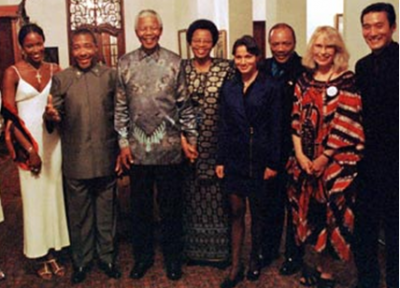
The supermodel and the despot came together the way celebrities and tyrants always seem to do: at a party. Prosecutors allege that Taylor attended a charity dinner at the home of Nelson Mandela (Campbell’s godfather), where other guests included Mia Farrow, actor Tony Leung, Campbell and others. Two witnesses say that later in the evening, men identifying themselves as Taylor’s representatives knocked on Campbell’s door and gave her “a large, rough-cut diamond that [Taylor] had obtained from the RUF/AFRC forces in Sierra Leone.”

What was a low-life like Taylor doing at the home of a man as noble as Mandela? Taylor had recently won an election in Liberia on the campaign slogan, “He killed my Ma, he killed my Pa, but I will vote for him.” Perhaps Mandela wanted to congratulate him or provide advice on the fundamentals of leadership. It is difficult to say, and who is anyone to question Mandela’s judgment — though his future wife, Graça Machel, was said to have disapproved of the invitation. Certainly the presence of the two men in the same room was a study in moral contrast.

Campbell admitted finally to having accepted blood diamonds in the middle of the night, something she has denied on several occasions. What could she possibly have been thinking? In her testimony, Campbell said that she received the “very small, dirty-looking stones” and went back to bed. “I had never heard of Charles Taylor before. I had never heard of the country Liberia before. I had never the term ‘blood diamonds’ before.” Ignorance, more than diamonds, appear to be Campbell’s best friend.

Later she decided to give the stones to a Jeremy Ratcliffe, director of Mandela’s children’s charity. According to Campbell, Ratcliffe did not seem troubled at the prospect of receiving the uncut diamonds.

What nauseates me about the entire affair — beyond Campbell’s lack of judgment — is that a man like Taylor had the kind of access and power to make an after-hours gift stained with death to a celebrity like Campbell. Even more sickening is the fact that this liaison could take place after a charity dinner hosted by Mandela himself.

And why, in any event, did Campbell resist providing testimony to the court for so long? Since May, prosecutors have been attempting to get her on the witness stand. Until recently, Campbell had refused their requests. In the end, her testimony appeared wildly incongruent. In contrast to the testimony of two witnesses, Campbell said the subject of diamonds never came up at the party. That when two men knocked on the door and gave Campbell a pouch with “dirty-looking stones,” she was not certain if they came from Taylor.

But this episode goes beyond the events of a single evening. It is an example of how despots and murderers of African children need third parties to make their death trade in diamonds profitable — people to move them, to appraise them, to store them in bank vaults and, ultimately, to buy them. It takes friends in high places to get the protection you need to keep the game going. And Campbell and Mandela weren’t the only people Taylor had access to.

Taylor unfortunately had plenty of that. Testifying in his own trial, Taylor said that evangelist Pat Robertson was awarded a Liberian gold-mining exploration concession in 1999 and later offered to lobby the White House to support Taylor’s regime. And when the Bush administration asked Taylor to step aside, Robertson defended the man who approved the gold deal. “It’s one thing to say, we will give you money if you step down and we will give you troops if you step down, but just to order him to step down? He doesn’t work for us,” Robertson said. “So we’re undermining a Christian, Baptist president to bring in Muslim rebels to take over the country,” he added.

The ease with which Taylor, a vulgar criminal with a bloodthirsty history, could move in all the right circles is something of which Naomi Campbell has absolute knowledge. If Taylor did indeed offer her blood diamonds, her words could seal Taylor’s fate. It’s good that she came forward with the truth. And it’s shameful that it took her so long to say so little. It’s even more shameful that we live in a world in which our worst elements have access to the highest levels of power and celebrity.

After Broadway, Obamas Turn to Washington Theater

Having shined a White House spotlight on Broadway over the last year, President Obama and First Lady Michelle Obama are turning their attentions to theater closer to home. Arena Stage, the 60-year-old theatrical company in Washington, announced Thursday that the Obamas would be the honorary chairpeople for its inaugural 2010-11 season at its new home, the Mead Center for American Theater, in Southwest Washington. The Obamas will also serve as honorary chairs for an Oct. 25 black-tie dinner to celebrate Arena’s move into the Mead Center.
A spokesman for Arena said on Thursday that it was not known if the Obamas would attend the Oct. 25 dinner, nor was it clear what if anything their honorary designation involved beyond the title itself. The dinner is to feature a performance by the Tony Award-winning actor Brian Stokes Mitchell (“Kiss Me Kate”) on his Monday night off from his new Broadway musical this fall, “Women on the Verge of a Nervous Breakdown.” The fund-raising dinner will celebrate and support Arena’s work at the Mead Center, which encompasses the newly renovated 683-seat Fichandler Stage and the 514-seat Kreeger Theater as well as a new third stage, the 200-seat Kogod Cradle. The inaugural season in the Mead Center will include an Edward Albee Festival featuring two productions, of “Who’s Afraid of Virginia Woolf?” and “At Home at the Zoo,” as well as readings of Albee’s other works, as well as a revival of the musical “Oklahoma!”

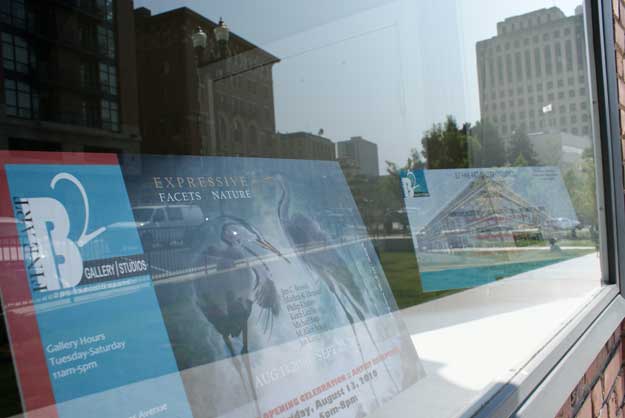
Be There or Be Squared: B2 Fine Art Gallery and Studios set to open in Tacoma

Gary and Deborah Boone could have dropped their new art gallery in the middle of Pioneer Square. But they chose Ledger Square instead. Ledger Square is in Tacoma, by the way. It will soon be home to B2 Fine Art Gallery and Studios. “B2” usually is pronounced “Bee Too”. But in this case, it’s “B-squared”. Like an exponential “B”, which stands for Boone. Two Boones. Got it?

A year in the making, B2 will fill 4,200 square feet of 711 St. Helens Ave. Listening to Gary Boone describe the array of artists, amenities and services soon to be available made me dizzy. Gary is a nice man. He gave me advice for treating the tail end of a cold. He knows about art too. In fact, these people seem to be professional artists. Originally from the East Coast, the Boones moved to Washington 20 years ago and fell in love. Then they fell in love with Tacoma.

“We heard about the work the city of Tacoma was doing relating to art and development,” says Gary Boone. “Living in Seattle and Olympia, we were always curious about Tacoma. We thought about opening our gallery in Pioneer Square. We thought long and hard about it, and decided to open it in Tacoma.”

Boone’s wife Deborah works with notable organizations such as the Pacific Northwest African American Quilters and the Northwest African American Fine Arts Group. Locals may remember some of her quilt work from a 2007 showing of works by Pacific Northwest African American Quilters at the Tacoma Art Museum. Both have worked as arts professionals for the past 25 years.

“I’ve been a collector for more than 25 years,” says Gary Boone. “My mother said that I could find art any place; that art is all around us. She said if you reach out to it, it will reach back to you. That left a big impression on me.”

The Boones also hope to leave an impression on Tacoma’s art scene. Their Tacoma gallery will be an “artist-run, contemporary art gallery and creative space dedicated to bringing an array of the most provocatively, relevant, emerging and established artisans throughout the Northwest, and around the globe.” That’s from the website. The gallery will host work in all media, including painting, drawing and printmaking, sculpture, photography, fiber, film and video. The space is ample, and will present an anticipated eight to 12 exhibitions per year, accompanied by periodic artisan lectures and workshops. By the way, the Boones use the words “artisan” and “artist” interchangeably.

Beyond traditional gallery showings, B2 will be churning out quite a bit of arts business. Want to know how to make money selling art? Copy everything the Boones do. For example, B2 will offer an arts lease and rental program, offering select works for short or long-term stays in select hallways and living rooms. Or offices. Or events. Art rental. Genius. B2 also will offer a full range of promotion and marketing services for local artists. For local corporate types, the Boones will help develop private collections and corporate collections. They’ll also offer framing, installation services, and a couple more things I can’t remember.

Like I said – the Boones’ excitement made me dizzy.

B2 will celebrate its grand opening Aug. 13 with a diverse showing of artists from the Pacific Northwest. Expressive Facets of Nature will display the natural beauty of the Pacific Northwest through the works of seven northwest artist working in mediums ranging from threads to leaves to Chinese brushwork. The one of a kind collaborative debut will be on exhibition for six weeks, closing Sept. 25.

Cops aim to sniff out art vandals

SALEM — Doggone it! Works of art displayed at a dog-friendly park last week were vandalized or stolen.

Salem State College art professor Ken Reker reported the crimes to police yesterday. Police are still investigating.

Budding artists created the works of art, following a week long intensive art course, specifically for Leslie’s Retreat Park, a large public park along the North River canal.

Artists chose the park as their canvas and created works that reflect a particular spot in the park, including a dog digging its way under the fence to the doggie park, three fishing poles dangling over the canal with trash on the lines and a 5-gallon water jug slowly dripping on a suspended metal flower in the park’s gazebo.

Reker told police some works of art were cut down on Wednesday, just one day after the exhibit opened on July 20.

The art was reinstalled but taken down again a day later and thrown in the trash.

On Saturday, half of the eight works were stolen.

The professor said he’s received only positive feedback about the project.

He said a woman at the park reported seeing an “older or retired professor-looking male along with a long-haired male” tamper with the artwork.

‘Art on the BeltLine’


“Art on the BeltLine,” Atlanta’s largest exhibition of temporary art, christens a new public space in the best possible way: with a wide-ranging display of works by a broad swath of Atlanta artists, supported by numerous volunteers and institutions.

The project, which includes performances scheduled throughout its five-month run, was conceived to lure the public to the Beltline (eight miles of it anyway) to discover its pleasures and potential.

To that end, “BeltLine” design director Fred Yalouris opened two very different sections. The East side, urban in character, backs up to old industrial buildings turned into lofts and restaurants and offers great views of the skyline.

The West section, which passes through residential neighborhoods, is densely wooded, in some spots with old-growth pecan trees and tulip poplars or patches of orange day lilies and blue spiderwort. You almost forget you’re in the city.

The project also exposes visitors to the work of 60-plus local artists. The work reflects the varied expertise of its makers — kids, art students, street artists and accomplished pros — and the limitations of time and funds. Most stand on good ideas, but many are rough around the edges.

Dodekapus, an ingenious collective of young artists, made the most of its $100 stipend to build playful tent structures with burlap, bamboo and kudzu. Their makeshift exuberance contrasts with the pristine elegance and meditative tone of Arturo Lindsay’s much bigger-budget structure, “Sanctuary.”

Like these pieces, many works are made to be used. Jeff Mather’s 70-foot-long serpentine picnic table doubles as prop/stage for the Beacon Dance Company. J.D. Koth and David Lougee constructed a domed hut using nearby twigs and branches, a la North Carolina artist Patrick Dougherty. It features an indoor swing and a skyline view.

Sanctuary is a running theme. The Cabbagetown Artists Tribe’s “Pardoned Eden” makes up for its lack of polish with its raucous spirit. It includes junked cars painted to reference dinosaurs (an allusion to the Beltline’s future as a transit corridor), a bevy of birds, some made by Cabbagetown children, and a giant kaleidoscope.

Like the Cabbagetown artists, Jeff Morrison and Staci Stone allude to the Beltline’s transformation. Both turn swords into plowshares, as it were. Morrison constructs his sculpture “Cribbing” with railroad cross ties. Stone planted wildflowers in wooden replicas of tracks for “Even Terrain.”

Katie Hall titled her graceful mosaics on a highway overpass “BeltLine Takes Flight.” For a puckish transformation of Atlanta, see Gregor Turk’s satiric information signs.

Quite a few of the artists made work that responded the Beltline’s history. “The Wanderers,” by the Paper Twins, is one of the show’s stand-outs. A series of painted wood figures evoke the railroad subculture of hobos, loners and other outsiders who might have haunted the area back in the day.

“Art on the BeltLine” is greater than the sum of its parts. The project gives lots of young artists a chance to show their work.

Though hardly a scientific sampling of the art scene, it certainly suggests its vitality. And it shows how broad the term “art” can be. (Lisa Tuttle’s insertion of poems along the trail is a lovely surprise.)

In addition, the show has engaged a broad cross-section of Atlantans. Clients of the Refugee Family Services helped make artwork. Historians did the research for historical markers. Volunteers, including families, spent hours cleaning up the path. And on it goes.

What better way to develop a sense of ownership for the place? Building community should always look, and feel, so good.

SmileyBooks To Host Free Journal Writing Teleclass Celebrating The Latest America I Am Release

Join us on Thursday, August 19, 2010 7:00–8:30 PM EST

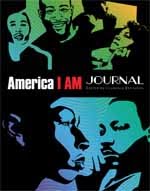
New York, NY (BlackNews.com) — For too long, stories of the lives and journeys of African Americans have been told by others. With the publication of America I AM Journal, edited by Clarence Reynolds (SmileyBooks, Trade Paperback Original; $11.95) African Americans can now take pride in the creation of their own personal chronicles. The award-winning America I AM: The African American Imprint traveling exhibition, now on tour in Cincinnati, traces the indelible imprint African Americans have made on America over 500 years. This inspiring volume reflects the themes of the twelve exhibit galleries and presents over 200 historical and contemporary quotations from the minds of great leaders and everyday history makers, including W.E.B. Du Bois, Harriet Tubman, Frederick Douglass, Madame C.J. Walker, Mary McLeod Bethune, John Johnson, Tony Dungy, and Serena Williams. Each page features a powerful image, a stirring message, and an open invitation to readers to record their own unique life story. An avid journal keeper, Smiley believes that “journaling is a perfect place to develop and refine your vision.”

In celebration of the American I AM Journal, editor Clarence Reynolds and Cheryl Woodruff, president of SmileyBooks, invite aspiring and seasoned journal keepers to participate with them in a LIVE FREE 90-minute audio journal-writing workshop. The August 19th teleclass will offer pointers on the craft, as well as an introduction to the impact of journaling on personal reflection, political action, and family history.

Register here

About SmileyBooks
Founded by media pioneer Tavis Smiley in 2004, SmileyBooks is a general trade book publisher that specializes in quality nonfiction and is distributed by Hay House, Inc. A dynamic company dedicated to the new media landscape, SmileyBooks publishes books by authors ranging from established New York Times best sellers to exciting new voices on topics that appeal to a broad spectrum of readers. SmileyBooks titles are published in hardcover, trade paperback and digital media, offering the widest possible readership and exposure.

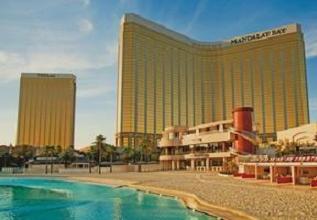
4th Annual Women of Color Conference: Empowering Our Future August 15 – 16, 2010 Mandalay Bay, Las Vegas NV


Who attended:

Women of all ethnicities, professions and social backgrounds were invited to participate.

Attendees included:

• Corporate executives

• Community Leaders
• Professionals

Benefits for attending the event:

Keynote speakers shared their knowledge and experiences, providing opportunities for deep personal growth and development. Each presenter was a catalyst for change, and were committed to advancing and empowering women leaders.

About the conference:

In 2007, Las Vegas was the site of the first-ever Women of Color Conference hosted by the four local ethnic chambers of commerce – American Indian, Asian, Latin and Urban. This historic event attracted more than 500 minority women and men who gathered to participate in workshops ranging from health and wellness to personal finance, beauty and self-esteem, career development and leadership skills.

Debra Nelson, MGM MIRAGE Vice President for Corporate Diversity, Communications and Community Affairs, saw a need for dialogue among minority women in the Las Vegas community. She approached the chambers of commerce with the idea, and they overwhelmingly agreed. From there, a day-long event was created to bring women together from across Southern Nevada and beyond. The goal of the event was to provide leadership, networking and learning opportunities through a variety of workshops. Additionally, event organizers hoped that the success of the event would lead to it becoming an annual event.

A planning committee, made up of representatives of the chambers and presenting sponsors, was formed to oversee the development and execution of the event. The committee included several sub-committees to focus on areas such as finances, logistics, media relations, sponsor relations, and speaker relations. Also, a website was created so participants could review conference information and register online.

The day-long program was developed and included a networking breakfast, morning and afternoon workshops, luncheon, roundtable discussion and a mixer. Panelists that participated in the conference included authors, executives, motivational speakers, community leaders and other various field experts.

The Women of Color Conference received a tremendous amount of positive response.

Surveys were filled out by conference attendees, rating the conference on quality of speakers, timing of events, relevance of discussion topics, etc. Overall, attendees felt informed, inspired and looked forward to future events. The conference attracted participants from around the country, and several attendees have expressed interest in hosting similar events in their local communities.

Women of all ethnicities, professions and social backgrounds from throughout Nevada and across the country participated in the Women of Color Conference. Conference attendees included students, young professionals, seasoned executives and business owners in numerous fields and industries. Perhaps the biggest beneficiary, however, was the Las Vegas community as the conference was a demonstration of the collective power of the local minority chambers of commerce to enact a program that benefited women across the city.

Quotes from participants:

“Thank you for a magical experience. You were so organized and everyone was united- it was a pleasure.”
— Nely Galan, Women of Color Conference Keynote Speaker

“Your breakfast speaker, Consuelo, was truly dynamic! She gave me chills as I watched tears stream from her eyes and made my heart full with her words. Thank you for having her.”
— Wendy Welch, Conference Attendee

“Superb! Fabulous! Insightful, informative and inspirational.”
— Conference Attendee

“I am wonderfully surprised how this conference has made an extreme impact on my life. This is a life changing experience.”
— Conference Attendee

“What an awesome experience! I had a chance to meet so many successful women that I didn’t even know existed. Thank you for the wonderful opportunity.”
— Conference Attendee

For more information click here.

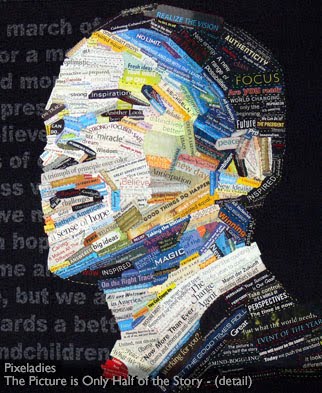
The Journey of Hope in America: Quilts Inspired by Barack Obama, National Afro-American Museum & Cultural Center, Wilberforce, OH

The Journey of Hope in America: Quilts Inspired by Barack Obama
December 18, 2009 Through December 18, 2010
National Afro-American Museum and Cultural Center

The Journey of Hope in America: Quilts Inspired by President Barack Obama commemorates an historic milestone in American history – the election of an African American man as president. The show will open Dec. 18, 2009 and will run through Dec. 18, 2010 before touring the country.

This extraordinary quilt show is curated by internationally known quilt artist, author and historian Dr. Carolyn L. Mazloomi for the National Afro-American Museum and Cultural Center, a part of the Ohio Historical Society. She’s brought together a diverse group of 95 fiber artists representing a variety races, cultures, generations and religions.

The exhibition will explore Obama’s momentous 2008 election by bringing audiences a collection of powerful quilts from a wide range of styles, including art quilts, folk art and traditional quilts. The featured quilts illustrate a broad range of techniques and materials, including piecing, painting, appliqué, embroidery, dyeing, photography, beading and digital transfer, as well as inspirations.

Throughout The Journey of Hope in America, viewers will experience the narrative quilt as an avenue toward expanding understanding the impact of the electing of the first African American president.

Location
The National Afro-American Museum & Cultural Center
1350 Brush Row Road
Wilberforce, OH 45384
(937) 376-4944
(800) 752-2603

Hours
Wednesday-Saturday:
9 a.m.-4 p.m.
Sunday-Monday-Tuesday: CLOSED

Admission
Adults: $4
Seniors: $3.60
Youth, ages 6-18: $1.50
College Students (with student ID): $1.50
School Groups: $25.00 per bus (weekdays only by advance reservation)
Children 5 & under: FREE

*Membership offers unlimited visits to this exhibit and all Ohio Historical Society historic sites and museums.

To learn more about this exhibit, click here.

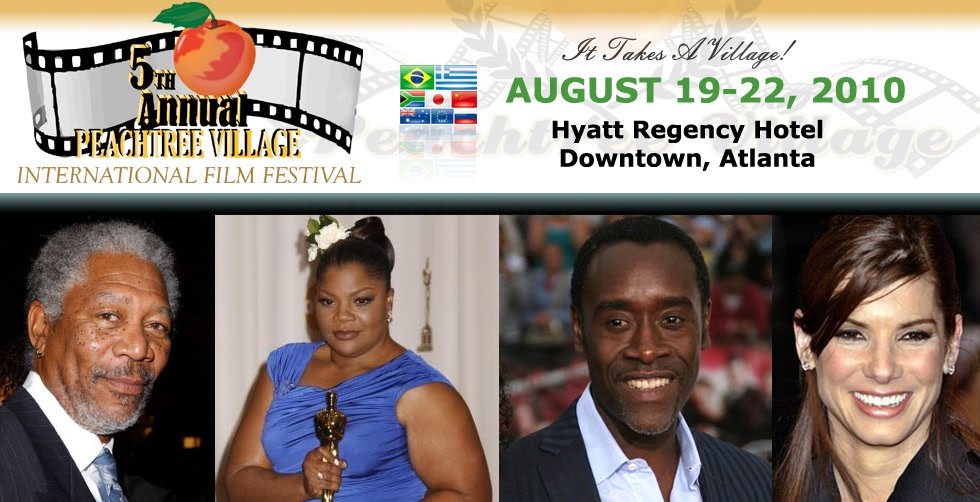
5th Annual Peachtree Village International Film Festival Atlanta, GA

August 19-22, 2010
Hyatt Regency Hotel
Downtown, Atlanta, GA

PVIFF is hosted by The African American Cinema Gallery (AACG) & Gipp. Museums, Inc. PVIFF attracts 5,000+ people each year from around the world. PVIFF was created in 2006 under the previous name (Sweet Auburn International Film Festival) and have served as the launching pad for many successful filmmakers and other artists alike in the film & entertainment industry. This dynamic international film festival showcases feature length films, shorts, music videos, documentaries, and screenplays from around the globe. PVIFF also feature celebrity attractions, innovative workshops, panels, parties, and much more. PVIFF is poised to become one of the most celebrated film events through dynamic programming and a dedication to helping filmmakers excel in their careers. PVIFF’s brand is entrenched in the old saying “It Takes A Village.”

Our vision allows us to create a village atmosphere that provide opportunities not only for filmmakers but for business owners and film enthusiasts. Artists such as Director/Writer Rob Hardy of Rain Forest Films, Producer, Roger Bobb of Tyler Perry Studios, Director, Leslie Small, Casting Director, Alpha Tyler of Tyler Perry Studios, Best Selling Author Omar Tyree, Actor, Bill Nunn, Director, Kenny Leon, Humanitarian, Afeni Shakur and more have all participated in various aspects of PVIFF over the years. In 2006 during PVIFF’s first year the winning short film “Binta & The Great Idea” was nominated for an Academy Award and numerous other projects have received phenomenal acclaim throughout the years as well. With increased exposure, the assistance from the film and business community PVIFF will continue to help ignite opportunities and make dreams to come true for decades to come.

For more information : Click here.