Florida Early Voting Fiasco: Voters Wait For Hours At Polls As Rick Scott Refuses To Budge

Florida Early Voting

Florida Gov. Rick Scott (R) has refused to extend the state’s early voting hours, despite long lines at the polls. (AP Photo/Chris O’Meara)

WASHINGTON — Once again, Florida and its problems at the polls are at the center of an election.

Early voting is supposed to make it easier for people to carry out their constitutional right. Tuesdays are notoriously inconvenient to take off work, so many states have given voters the option of turning out on weekends or other weekdays in the run-up to Election Day.

But in Florida this year, it has been a nightmare for voters, who have faced record wait times, long lines in the sun and a Republican governor, Rick Scott, who has refused to budge and extend early voting hours.

“People are getting out to vote. That’s what’s very good,” said Scott.

People are getting out to vote — but many of them are having to wait in line for three or four hours to do so. One contributor to DailyKos claimed it took 9 hours to vote. In Miami-Dade on Saturday, people who had gotten in line by 7:00 p.m. were allowed to vote; the last person wasn’t checked in until 1 a.m., meaning it took some individuals six hours to cast a ballot.

“We’re looking at an election meltdown that is eerily similar to 2000, minus the hanging chads,” said Dan Smith, a political science professor at the University of Florida.

Miami-Dade attempted to deal with the problem on Sunday by allowing voters to cast absentee ballots in person between 1:00 and 5:00 p.m. However, after just two hours, the Miami-Dade elections department shut down the location after too many people showed up. People outside the locked doors were reportedly screaming, “We want to vote!

They didn’t have the infrastructure,” filmmaker Lucas Leyva, who was among those turned away, told The Huffington Post’s Janie Campbell. “We read the press release and everything that went out this morning, promising we’d be able to get absentee ballots and vote. We got here and there was a line of hundreds of people all being told the same thing, that that wasn’t true anymore. You could drop off [a ballot], but they could not issue one.”

And if getting turned away from the polls weren’t enough of an indignity, some of those 180 people ended up getting their cars towed from the parking lot across the street, according to a Miami Herald reporter.

On Twitter, former Republican governor Charlie Crist — who is now an independent — responded to news of the office’s closing, writing on Twitter, “Let the people vote!

“We had the best of intentions to provide this service today,” said department spokeswoman Christina White. “We just can’t accommodate it to the degree that we would like to.”

About 30 minutes later, a Miami Herald reporter tweeted that the Miami-Dade location was reopening its doors.

Palm Beach, Pinellas, Orange, Leon and Hillsborough Counties also opened up in-person absentee voting on Sunday.

President Barack Obama’s campaign and some of its supporters were attempting to keep people’s spirits up — and discourage them from abandoning the lines — by bringing in food, water and even local musicians and DJs as entertainment.

North Miami Mayor Andre Pierre brought 400 slices of pizza to voters in line at 10:30 p.m. on Saturday night at the city’s public library, according to an Obama official.

While many Democrats viewed it as a victory when a few offices opened absentee balloting on Sunday, the process is not the same as early voting — and could result in more individuals not having their votes counted.

“Absentee ballots have a much higher rejection rate for minorities and young people, if you look at the Aug. 14 primary,” said Smith.

A major reason there are so many problems at the polls is that last year, Florida’s GOP-controlled legislature shortened the number of early voting days from 14 to eight, meaning all early voters are trying to cast their ballots in a shorter window. Previously, Floridians were allowed to vote on the Sunday before Election Day — a day that typically had high traffic.

But losing that final Sunday isn’t the only problem. Smith said that he and Dartmouth professor Michael Herron found that in 2008, voters 65 or older were much more likely to cast ballots in the first five days of early voting than members of other age groups, alleviating some of the pressure at the polls in the remaining days. Those extra days, however, are gone this year, leading to a compression that the system has been unable to handle.

Scott has refused to extend early voting hours, essentially arguing that there is no problem, despite calls from Democrats, independent groups and even a Republican elections supervisor. He is arguing that he can extend early voting hours only when there is a true emergency — like a natural disaster — that warrants it.

“I’m focused on making sure that we have fair, honest elections,” said Scott. “One thing to know, these early voting days and on Election Day, if you’re there by the time the polls close, you get to vote.”

Scott has some of the lowest approval ratings of any governor in the nation. In recent Quinnipiac poll, just 39 percent of Floridians said they approved of the job he is doing. Scott, unlike many other GOP governors, has not hit the campaign trail much on behalf of Mitt Romney.

As Florida Democrats have pointed out, the state’s previous two Republican governors — Jeb Bush and Crist — both extended the hours. A spokesman for Bush didn’t return a request for comment.

A judge extended the hours in Orange County after the state Democratic Party sued for more time. The location was closed for several hours on Saturday when everyone was evacuated due to a suspicious package.

Democrats are traditionally more likely to vote early, which is why many in the party have ascribed political motives to Scott’s restriction of the process. According to a report in the Miami Herald on Saturday, Democrats were leading Republicans “by about 187,000 early in-person ballots cast” as of that morning.

On Election Day, there will be fewer polling precincts this year than in 2008 — due to redistricting and budget constraints — meaning traffic on Tuesday could also be a problem.

Florida is expected to be tight in this election. According to HuffPost Pollster’s average of polls in the race, Romney is now leading Obama in the state by less than one percentage point.

This article was updated with comments from Dan Smith.

President and First Lady Michelle

When Barack Obama won the 2008 presidential election, he also won a long-running debate with his wife Michelle. Contrary to her fears, politics now seemed like a worthwhile, even noble pursuit. Together they planned a White House life that would be as normal and sane as possible.

Nikki A. Greene, PhD

Nikki A. Greene
Mellon Postdoctoral Fellow in Africana Studies and Art

Art historian examining African American and African identities, the body, feminism, and music in twentieth-century and contemporary art.


Favorite Links

I envision my role in the arts and academia as not only providing awareness of artists who have traditionally lacked exposure, but also as demonstrating their significance and value to the larger public. In the Philadelphia area, my interest in community-based research has included enhancing the chronological history of a settlement house-turned-community center and cataloging the African American art collections at the Philadelphia Museum of Art. During my two-year fellowship at Wellesley, I—and my students—will actively engage in the arts community of the greater Boston area.

Music has played a significant role in my research. While I used to sing in choirs and vocal groups, I’ve directed my passion for music into my scholarship. I have investigated the significance of jazz in the work of artists such as Aaron Douglas and Philadelphia-based artist, Moe Brooker. My dissertation, The Rhythm of Glue, Grease, and Grime: Indexicality in the Works of Romare Bearden, David Hammons, and Renée Stout , shows how all three artists use physical, sometimes metonymic, indexical references in order to lessen the negative impact of stereotypes of African Americans. By examining how discourses such as music, literature and visual culture operate in concert with the cultural associations of the materials used by artists, I identify these discourses as noteworthy conduits through which the artists’ metonymic bodily presences prevail.

Building upon these previous investigations into the aural possibilities of the visual, my current book project will treat the art of David Hammons and Renee Stout through the lens of FUNK, the music and its visual aesthetic. In particular, I am analyzing the sounds and style of funk rocker Betty Davis, former wife of Miles Davis. The jazz musician said of her in 1989, “If Betty were singing today she’d be something like Madonna; something like Prince, only as a woman. She was the beginning of all that…” As a result, students who find their way to my office at the Newhouse Center may just be greeted by the music of John Coltrane, Parliamentary Funkadelic, or Jill Scott at any given moment.

Blog: Nikki G Ph.D.

Art Basel Conversations | Public/Private | The Evolution of Museum Missions

Margarita J. Aguilar, Executive Director, El Museo del Barrio, New York
Thelma Golden, Director and Chief Curator, The Studio Museum in Harlem, New York
Madeleine Grynsztejn, Pritzker Director, Museum of Contemporary Art, Chicago
Beatrix Ruf, Director, Kunsthalle Zürich, Zurich
Moderator | András Szántó, Author and Consultant to arts and philanthropic organizations, New York

African American Jeweler Edward Ford (Video)


Starting with $600 and a dream, Edward Ford has made a lucrative career as a jeweler while smashing perceived limits on African American success.


Holst + Lee Comes Colorful With Made-To-Order Rope Jewelry (Browse The Bright Bracelets & Necklaces)


Holst + Lee is a New York City based jewelry brand started by Southern designers Natalie Holst and Rochelle Lee. Each statement necklace and bracelet is made-to-order and features fabric, beads, crystal rhinestones and magnetic closures. The one-of-a-kind pieces have been featured in InStyle, Seventeen, Elle and New York Magazine just to name a few. While the brand counts celebrities like Solange—shot for InStyle February 2012 wearing Holst + Lee layering necklaces—as fans. The colorful, bold bracelets and necklaces might be a little hard to pair with everyday wear, but they’ll definitely boost even your most boring outfit. Do like Solo and wear them with mixed prints and colors or use them to spice up neutral tones and solids. The pieces are so fabulous that they could be worn either way and still look great.

Check out a few of our faves from their 2012 collection below.


Gold Medalists Gabby Douglas, Allyson Felix Are ‘Glamour’ Women Of The Year!

Olympians, Gabby Douglas and Allyson Felix were announced as Glamour magazine’s 2012 “Women of the Year,” along with three other gold medal Olympians and ten other women of distinction. Douglas brought home two gold medals and became the first African American gymnast in history to stand atop the podium. Felix won the 200-meter sprint in track and field.

Both ladies look fabulous in the spread, showing off their gold medals in clean white dresses.

Congrats, ladies!

African American Culture and Heritage

Albuquerque is home to a rich and thriving African-American community.

Albuquerque is home to a rich and thriving African-American community including artists, entrepreneurs, families and individuals all tightly woven within the fabric of the city. The Black presence here reaches back to the first wave of Spanish explorers, and the history of this community includes societal and cultural challenges that, while similar to other cities, is unique to this region.

Perhaps the most infamous name in local Black history is that of Estevanico, sometimes referred to as “Esteban,” or, “Stephen the Black.” Born in 1503, Estevanico was a Spanish Moor from North Africa enslaved at a young age by the Portuguese and sold in 1520 to Andres Dorantes de Carranza, a Spanish nobleman. In 1527, Estevanico and Dorantes sailed from Europe with the explorer Panfilo de Narvaez on an expedition to conquer Florida. This expedition turned into one of the most epic journeys ever recorded and eventually led to Estevanico—the first African known to have set foot on the continental U.S.&mdash:becoming a central figure in the establishment of New Mexico.

In 1539 Estevanico found himself going north on another expedition to find the fabled Seven Cities of Cibola. Sent ahead as an advance scout, Estevanico continued alone to present day New Mexico, one of the first non-Natives to set foot here. Almost as quickly as he arrived, however, Estevanico’s exploits were cut short. As he approached the Zuni pueblo of Hawikuh he was killed by suspicious villagers.

Balloon spectators by raymond watt

The annual Balloon Fiesta is a uniquely family-friendly event.

Fast forward from that auspicious beginning to the 1870s, when Albuquerque saw the first growth spurt of its African American population with the arrival of the Santa Fe Railroad. Black communities became established in the South Broadway and Barelas areas along the railroad corridor. From the 1920s through the 1940s, Black businesses thrived in spite of the discrimination inherent in the pre-civil rights era. Establishments such as the legendary swing club, Chet and Pert’s, catered to the small but growing Black community. Over the next few decades the population of African Americans in Albuquerque grew steadily, with another bump coinciding with the opening of Kirtland military base.

Today, African-Americans comprise just over 3% of Albuquerque’s population. While the community may not be large, its members contribute enormously through the arts and other cultural activities. If you’re interested in exploring Albuquerque’s African American community, there are a number of events, groups and resources that provide an easy entry point

  • If you enjoy sculpture, Fred Wilson, along with wife Kristen, is one of Albuquerque’s premier large format artists. Ike Davis, who does his thing on the western edge of the city, has been an Albuquerque name for more than 20 years.
  • For music, be sure to check out what’s happening at The New Mexico Jazz Workshop, which includes the popular Jazz and Blues series during the summer months at the Albuquerque Museum of Art and History.
  • Information on other music venues and styles can be found at the New Mexico Music Commission website.
  • At the EXPO New Mexico, the Alice Hoppes African American Pavilion puts on events and an art show during the length of the fair, attracting African American artists statewide to sell works inside the African American Art Center. At the African American Performing Arts Center located at EXPO New Mexico, visitors can view the South African Human Rights Exhibit on display in the Exhibit Hall. The 23,000 square-foot facility cost $4.3 million. African American Performing Arts Center brochure
  • The South Broadway Cultural Center, located in the area where Albuquerque’s African American community first set roots, has a revolving schedule of events and exhibits.
  • The Perspective, Albuquerque’s African American publication is a good source for the community. They give special attention to the annual Juneteenth celebration.

A number of organizations and websites offer local or statewide calendars of events:

Article  by Gene Grant
Gene Grant is a twice weekly columnist for the Albuquerque Tribune, as well as a monthly columnist for Albuquerque, the Magazine’s, “ABQ on Film.” He’s also host of the weekly public affairs television program, “The Line,” seen on PBS – KNME 5.

Charles Alston Visual Artist

Born in Charlotte, North Carolina in 1907 Alston’s interest in art began early. He received the art award in Grammar School and was actively involved in the arts throughout High School. In 1925 he enrolled at Columbia University in New York City where he studied art and art history. Upon receiving his undergraduate degree, he was awarded the Arthur Wesley Dow Fellowship, enabling him to earn his Masters Degree in Fine Arts at Columbia’s Teachers College.

He began his career as a commercial artist working on book jackets, record covers and magazines. Alston was a successful commercial artist, working for leading magazines such as Fortune, Collier’s, Mademoiselle and Men’s Wear. However, commercial art demanded compromises and restrictions on his style, eventually driving Alston out of the field in pursuit of a more personal form of artistic expression; stating, “I felt that I could do good painting and that I was selling myself cheap.” In 1950 the Metropolitan Museum of Art held its first exhibition of contemporary art. Along with nearly 4,000 other artists, Alston entered a painting for competition and was one of the few chosen for purchase. He considered this moment “an exoneration or certification . . . the thing that made me feel comfortable with my decision.”

In that same year the Art Students League selected Alston as their first African American instructor. By the mid-1950s the Metropolitan Museum, the Whitney Museum of American Art, the Butler Institute of Art and IBM housed his works in their permanent collections. During this period he also completed murals for the Museum of Natural History and the Abraham Lincoln High School in Brooklyn. In 1969 Alston was appointed a “painter member” of the New York City Art Commission, which approved all designs for city buildings and works of art on city property. He was the first African American to achieve this post.

Alston’s artistic style defies simple categorization and definition. His works range from detailed drawings concerned with realism, depth and modeling to extreme abstraction concerned with simplicity, flatness and pure expression. His art always remained to him an outlet for personal expression and growth, unbound by the restrictions of one particular genera. To Alston, “The whole creative thing is one of exploration of new or different areas,” and in “developing or exploring an idea until you’ve gotten out of it everything you can, and beyond that, looking for unexplored areas.”

The diversity of Alston’s style reflects influences ranging from Egyptian and Oceanic art to more contemporary artistic styles like Cubism and Abstract Expressionism. However, his figures characteristically maintain a sculpture like quality derived from his earlier studies in African sculpture. His subjects, however, were derived mainly from the experiences of his life and time. As such they deal with the toils and triumphs of African Americans in the decades of the 50’s, 60’s and 70’s. Alston states, “As an artist . . . I am intensely interested in probing, exploring the problems of color, space and form, which challenge all contemporary painters. However, as a black American . . . I cannot but be sensitive and responsive in my painting to the injustice, the indignity, and the hypocrisy suffered by black citizens.”

On April 27, 1977 Charles Alston died of cancer. His body of work seeks the universal artistic goal of aesthetically depicting the truth within the prism of his life experiences. In his words he tells us, “Art is the pursuit of truth as an artist perceives it. It can also be a powerful and effective weapon in the struggle for human decency.”

Small but Sumptuous: The Watercolors of Romare Bearden

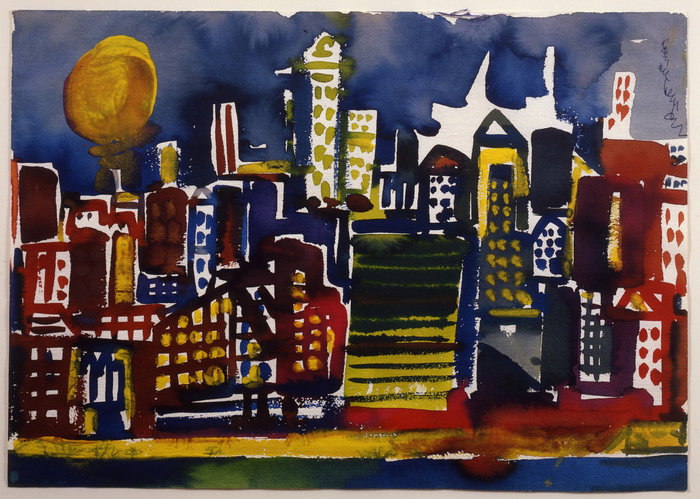
Color is indispensable for realizing pictorial space in all its variety; it is key to Romare Bearden’s watercolors. “City Lights” assembles 18 radiant Manhattan views, almost all painted between 1979 and 1980. Many are from a series of cityscapes commissioned for the opening credits of John Cassavetes’s 1980 film “Gloria.”

Born in Charlotte, N.C., Bearden (1911-88) grew up in Harlem at the zenith of the Harlem Renaissance. His parents were prominent figures among Harlem’s creative aristocracy. Duke Ellington, Langston Hughes, and other well-known artists, writers, and musicians were frequent visitors to the Bearden home. Young Bearden studied at the Harlem Recreation Arts Center, where black students were tutored exclusively by accomplished black artists. It was here that the teen met sculptor Augusta Savage, who let him hang out in her studio and fired his passion for craft.

A creative giant who portrayed the African-American experience in a narrative idiom that extended the range of modernist technique, Bearden started down a very crooked path. He wandered through a brief stint playing professional baseball in the Negro League; rejected an offer to join the Philadelphia Athletics by refusing to “pass as white”; he performed in jazz bands, designed stage sets, and published illustrations in popular magazines. Bearden graduated from New York University with a degree in education in 1935, becoming a caseworker for the New York City Department of Social Services (a position he did not fully relinquish for decades). In the same year, he took night classes at the Art Students League with German émigré painter George Grosz.

After serving three years in the military during World War II, he studied part-time at the Sorbonne on the GI Bill. Home again, his art career in stasis, he took up songwriting, partly as a way to finance his way back to Paris. (His composition “Sea Breeze” was recorded by big-band leader Billy Eckstine and salsa king Tito Puente.) Not until he married in 1954 did he return single-mindedly to his art, dedicating himself to a three-year study of the Old Masters.

Galvanized by the civil rights movement, he co-founded the Spiral Group in 1963, an association of African-American artists who sought ways to further the momentum of civil rights. It was during those years that Bearden devised his signature improvisational collage technique.

Bearden’s magnitude as an artist is evident in the grace of his hand, an artist’s most distinguishing gift. That hand is the enlivening agent of this exhibition. Celebrated as a collagist, Bearden is less well recognized as the master watercolorist that he is. An inherently luminous medium, watercolor is also the most difficult. Painterly impulses undergird his collages, their fluidity informed by a consummate command of watercolor.

His photomontage collage technique re-created the sensuous beauty of liquid color soaking the paper surface. Six of the paintings on view include collage elements, each one worked so seamlessly into the flow of color that they appear part of the same tactile reality.

An untitled image of a nude woman leaning her arms on the back of a wooden chair illustrates the unity of Bearden’s paint and collage method. One arm drapes across the chair back; the other drops downward at a realistic angle. The pendant arm, a separate piece of paper toned to the figure, ends in a hand cut from a color magazine photograph. The tiny hand, appropriately scaled, wears a wedding ring, an anecdotal detail that establishes the domesticity of the nocturnal setting.

“City Lights” is DC Moore’s highlighted season opener, yet the gallery chose to showcase the ensemble in its smaller wing. It was a splendid decision. Grouped as the paintings are by theme and format, the sensation of place — their common possession — is underscored. The subtle play of Bearden’s watercolor techniques, the exquisitely controlled pooling and eddying, invites intimacy. At close range, the eye does not glance over them but sinks into the surface together with the color that animates them.

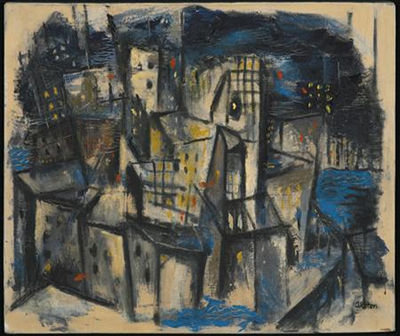
The latticework of “Narrow Sky Line” is a shimmering evocation of slender buildings reaching skyward. Its color and design are visible at a distance. But only up close can the lyricism of it — that delicate threading at the edges, similar to the burr of a drypoint line — be seen and allowed to work its magic. Warm colors, translucent oranges and yellow green, rush upward into the dense ultramarine of a nighttime sky.

Here, and throughout the series, Bearden shifts deftly between graded washes and speckled wet-in-wet effects, between the brush and the sponge. His facility beckons the viewer to come close. “New York, New York,” worked on soaked paper in sumptuous blues and greens, is a miracle of small, spreading accidents that know just when to stop.

Look at “Night Sky” and notice how critical to the composition are the placement and sharp, clean edges of the exposed white paper that signals lighted windows etched into the building facades. While his brush seems to move instinctively, without premeditation, that precision indicates careful deliberation. The paper itself is an active part of the overall design. For added animation, some “windows” were overlaid with a quick splash of color after the initial wash dried.

Analogies between Bearden’s technique and jazz go only so far. Evident in these watercolors is the discipline and obedience to process that prompted Degas’s admission that the appearance of spontaneity requires as much cunning as the commission of a crime. It is Bearden’s color sense that is the freest element of these works. An exemplary colorist, he refreshes the urban scene with the radiant hues of the French Caribbean.

St. Martin was his wife’s ancestral home, and where Bearden lived part of every year in the last two decades of his life. “City Lights” presents a New York electrified by an Antillean current.

Until September 27 (724 Fifth Ave. at 57th Street, 212-247-2111).

Smithsonian, MoMA and the Met shut as storm approaches

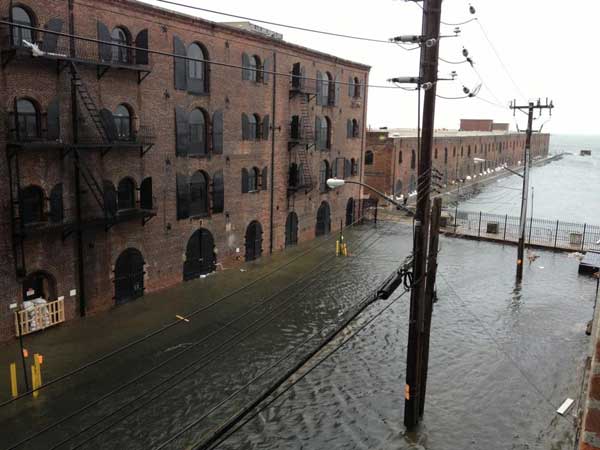
Early flooding in Red Hook Brooklyn, Monday morning, caused by Sandy
As Sandy gathers strength, emergency preparation plans put into action

By Javier Pes. Web only
Published online: 29 October 2012

As Hurricane Sandy barrels up the East Coast of the US, museum staff are battening down the hatches and putting their emergency preparation plans into action. The Smithsonian Institution has closed all of its museums today (29 October) in Washington, DC, and New York, and all events due to be held today and on Tuesday have been cancelled.

New York’s Metropolitan Museum of Art and the Museum of Modern Art (MoMA) are closed today due to the expected impact of the Category 1 storm, which is reported to be getting stronger. The Met cancelled this morning’s press preview for the exhibition “Extravagant Inventions: the Princely Furniture of the Roentgens”. MoMA, which is closed to the public on Tuesdays, says in a notice on its website that it plans to reopen on Wednesday “pending the status of public transportation and impact of the storm”. The Solomon R. Guggenheim Museum is also closed today because of the storm. The New Museum and the Brooklyn Museum do not normally open on Mondays and Tuesdays. The offices of the latter are closed today.

The Smithsonian’s advice to staff who are preparing for a hurricane includes boarding up windows or protecting them with storm shutters or tape, and leaving some slightly open to equalise the pressure. Staff should stay in the building if it is sturdy and on high ground. “Don’t be fooled by the calmness of the ‘eye’,” they are warned. “Remember, the winds on the other side of the ‘eye’ will come from the opposite direction.”

Driven to Showcase America’s Best Black Art

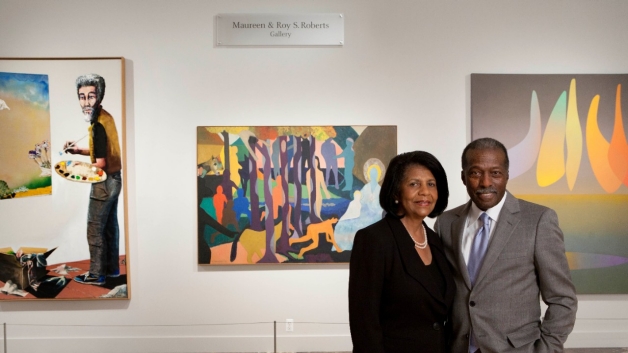
For decades Roy S. Roberts, a 40-year veteran of the automotive industry and former General Motors group president and his wife, Maureen, have shown their love for African-American art and culture with their philanthropy.


This May, in turn, the Detroit Institute of Arts (DIA), the only encyclopedic fine arts museum in the world with a curatorial department devoted to African-American art, displayed its appreciation for the couple. The DIA named its gallery of contemporary African-American art after them.


The Maureen and Roy S. Roberts Gallery features works by luminaries such as Elizabeth Catlett, Benny Andrews, Sam Gilliam, Alvin Loving, William T. Williams, Charles McGee and others.


Roberts spoke of his and his wife’s love of Black art. “We leave this legacy with our children, to whom we’ve instilled the values of education, working hard and giving back,” he said.


Their gifts have gone to a variety of organizations including Detroit’s Charles H. Wright Museum of African American History, the United Negro College Fund, NAACP, Urban League and Western Michigan University.


In 1977, Roberts joined General Motors in 1977 and began a steady climb of increasing responsibilities. Four years late, he was the plant manager of GM’s Grand Rapids Plant #1. In 1983, he became the first African-American plant manager of GM’s assembly facility in North Tarrytown, New York, and upon retirement in 2000 was a company group vice president. Roberts is currently managing director and co-founding member of a private equity investment firm Reliant Equity Investors.


He received a bachelor’s degree in Business Administration from Western Michigan University and completed the Executive Development Program at Harvard Graduate School of Business.


Check out another patron couple of Black art: Bernard and Shirley Kinsey.

(Photo: Courtesy of Detroit Institure of Arts)

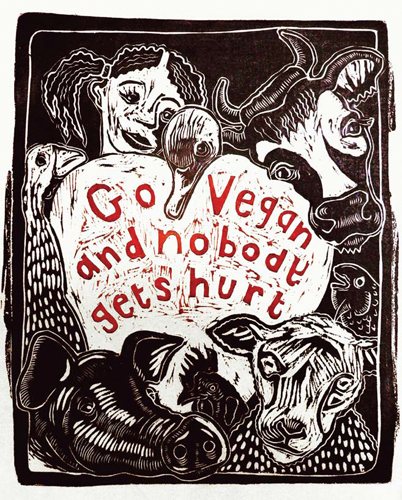
Vegan for Mercy

By Posted 10/17/12

I make vegans,” says Sue Coe, the British American artist widely known since the 1980s for her sociopolitical drawings and prints. She recently published her third book on the meat industry, Cruel: Bearing Witness to Animal Exploitation (OR Books), filled with haunting and empathic illustrations of gaunt, terrified animals being herded to their factory-line deaths and dismembered by downtrodden workers. (Some of these pictures appeared in her show at New York’s Galerie St. Etienne last spring.)

Coe’s images are informed by the history of British caricature as well as by political art from the 1930s and ’40s, particularly that of Käthe Kollwitz. Some are straightforward reportage sketched directly from life in slaughterhouses and on farms. Others are more overt propaganda, such as the drawing of a fat-cat industrialist holding bloody moneybags atop a heap of animal carcasses.

In her accompanying essays, Coe equates the mass killing of animals to the inhumanity of concentration camps and doesn’t draw a distinction between slaughterhouse production and the organic trend of raising free-range animals for food. “Everything to do with breeding animals just to kill them has to go,” she says. “I’m not the vegan police, but I would just hope this book would put people on that journey because we do not need to eat animals to be healthy and well.”

Coe, who lives in upstate New York and sees animal exploitation on farms all around her, grew up in the 1950s in the suburbs of London, adjacent to a hog factory farm and slaughterhouse. She remembers it was guarded and lit up 24 hours a day, and she was terrified of the hog screams and clanging sounds at night. “My parents regarded any questioning about it as childlike. They just said, ‘This is how food is produced,’” says Coe. “It informed me as a child that adults are in denial most of the time.”

Her first stroke of social activism was freeing a tank of guinea pigs and mice that were going to be experimented on in science class. “We had a liberation club, where we all brought food and shared pocket money to feed the creatures, which we kept in garden sheds in secret areas,” she recalls. “That was the beginning of really identifying with other animals. We realized we can do this as a group, and we saw the results. We saved the animals.”

Copyright 2012, ARTnews LLC, 48 West 38th St 9th FL NY NY 10018. All rights reserved.