New works by multimedia artist Mickalene Thomas in Brooklyn Museum exhibition

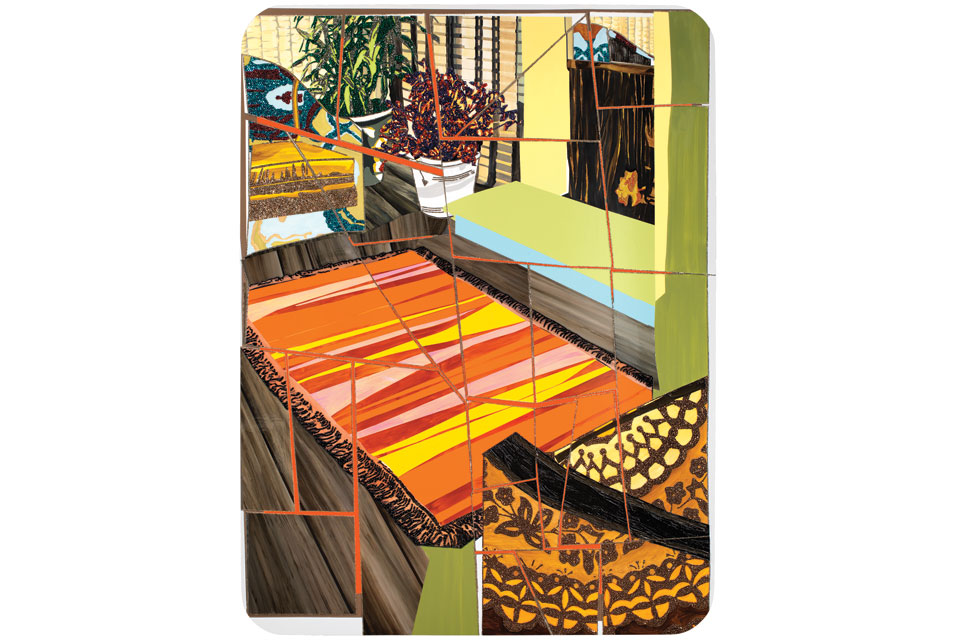
Mickalene Thomas (American, b.1971), Interior: Two Chairs and Fireplace, 2012. Rhinestone, acrylic paint and oil enamel on wood panel, 96 x 72 x 2 in. (243.8 x 182.9 x 5.1 cm). Collection of Pamela K. and William A. Royall, Jr., Richmond, VA. Courtesy of the Artist, Lehmann Maupin Gallery, New York, and Suzanne Vielmetter Los Angeles Projects. © Mickalene Thomas, Lehmann Maupin Gallery, New York, and Suzanne Vielmetter Los Angeles Projects. Photo: Christopher Burke Studio.

BROOKLYN, NY.- Several new works by multimedia artist Mickalene Thomas influenced by her long-standing interest in interior design, including four installations evoking the sets she creates in her studio for photographing models, are featured in the Brooklyn presentation of her first solo museum exhibition. On view September 28, 2012, through January 20, 2013, Mickalene Thomas: Origin of the Universe includes nearly 100 works, among them paintings and collages of domestic interiors and four room installations, inspired by the artist’s childhood memories and her interest in the 1970s.
The rooms created by Thomas include wood paneling, furnishings, textiles, and works of art and are similar to the backdrops that appear in her paintings of african american women, for which she is best known. The artist’s paintings and collages, most of mid-twentieth-century uninhabited modernist interiors, as well as the installations, were also influenced by her investigation of vintage books on modern decor, such as the 1970 eighteen-volume set The Practical Encyclopedia of Good Decorating and Home Improvement.
Thomas‘s oeuvre investigates the body in relationship to interior spaces and the landscape through a pictorial style that transforms past masterworks by re-imagining them in a modern-day idiom. Her interiors draw on a range of historical periods, from the nineteenth century to the present.
Among the paintings and collages of interiors included in the exhibition are works inspired by Thomas’s 2011 residence at Claude Monet’s home in Giverny, France, such as La Maison de Monet and Interior: Fireplace with Monet Tiles, as well as the rhinestone-studded Interior: Striped Foyer, Interior: Blue Couch with Green Owl, and Interior: Green and White Couch.
Thomas’s work grows from a long study of art history, drawing inspiration from the traditional genres of portraiture, landscape, and still life, as well as from popular culture, whose imagery she uses to explore issues of identity and race, as well as beauty and self. Her work, which synthesizes a wide range of artistic and cultural references, presents a complex perspective on what it means to be a woman and expands common definitions of beauty.
Her signature portraits of vibrant black women in photographs, paintings, and collages explore artifice, masking, and costuming. Working with models drawn from her circle of friends and relatives, she outfits them with carefully selected costumes, wigs, and makeup, and then poses them in carefully composed “rooms” carved out of her studio space.
Born in 1971, Mickalene Thomas received a B.F.A. from Pratt Institute and an M.F.A. from Yale University. She has participated in residency programs at the Versailles Foundation, Munn Artists Program, and the Studio Museum in Harlem. Her work has been shown in group exhibitions at the Museum of Contemporary Art Detroit; The Renaissance Society, Chicago; and MoMA PS1, New York. Among the many public institutions whose collections include her work are the Brooklyn Museum; the Museum of Modern Art, New York; the Solomon R. Guggenheim Museum, New York; the National Portrait Gallery, Smithsonian Institution, Washington, D.C.; The Whitney Museum of American Art, New York; the Art Institute of Chicago; and the Museum of Fine Arts, Boston.More Information: http://artdaily.com/index.asp?int_sec=2&int_new=58006&b=african%20american#.UITQn1FQjRY[/url]
Copyright © artdaily.org

American artist Romare Bearden’s “Black Odyssey” debuts at Reynolda House Museum of American Art

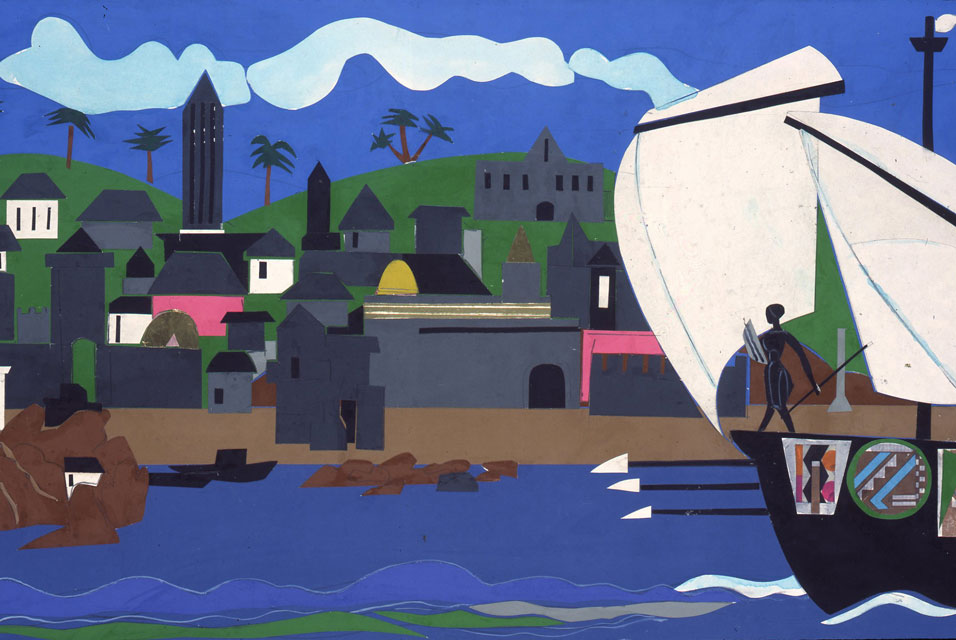
Romare Bearden, Home to Ithaca, 1977, Collage, Courtesy Mount Holyoke College Art Museum, South Hadley, Massachusetts. Gift of the estate of Eileen Paradis Barber (Class of 1929).
WINSTON-SALEM, NC.- The first full-scale presentation outside of New York of Romare Bearden’s “Odysseus Series” debuted at Reynolda House Museum of American Art on October 13, 2012.
“Romare Bearden: A Black Odyssey” will be on view through Jan. 13, 2013. In 1977, Romare Bearden (1911–1988), one of the most powerful and original artists of the 20th century, created a cycle of collages and watercolors based on Homer’s epic poem, “The Odyssey.” Rich in symbolism and allegorical content, Bearden’s “Odysseus Series” created an artistic bridge between classical mythology and african american culture. The works conveyed a sense of timelessness and the universality of the human condition, but their brilliance was displayed for only two months in New York City before being scattered to private collections and public art museums.
A new exhibition organized by the Smithsonian Institution Traveling Exhibition Services (SITES) features 55 Bearden works, including collages from the “Odysseus Series,” and watercolors and line drawings relating to his interest in classical themes. “Romare Bearden: A Black Odyssey” will debut at Reynolda House Museum of American Art before continuing on a seven-city national tour through 2014.

The exhibition is curated by renowned English and Jazz scholar Robert G. O’Meally, the Zora Neale Hurston Professor of English and Comparative Literature and founder and former director of the Center for Jazz Studies at Columbia University.
“In creating a black Odyssey series, Bearden not only staked a claim to the tales of ancient Greece as having modern relevance, he also made the claim of global cultural collage—that as humans, we are all collages of our own unique experiences,” said O’Meally. “Indeed, Bearden does not merely illustrate Homer?he is Homer’s true collaborator, and he invites us as viewers to inherit Homer’s tale and interpret it as our own.”
Born in Charlotte, Bearden moved with his family to Harlem as a young child, part of the Great Migration of african americans from the inhospitable South to greater opportunity in the North. Throughout his career, Bearden created images of the lives of travelers on their way to and from home, a theme no more powerfully explored than in his “Odyssey Series.” Bearden had examined classical themes before, but the “Odysseus Series” expanded his exploration of literary narratives and artistic genres by presenting his own personal reinterpretation of the subject.

More Information: http://artdaily.com/index.asp?int_sec=2&int_new=58317&b=african%20american#.UITO0lFQjRY[/url]
Copyright © artdaily.org

Hyde Collection exhibition pays tribute to Romare Bearden on his centennial celebration

Romare Bearden, American, 1911-1988, Out Chorus, 1979-80, etching and aquatint, 12 3/8 x 16 1/4 in. (image), Edition 200.© Romare Bearden Foundation/Licensed by VAGA, New York, NY.

GLENS FALLS, NY.- The Hyde Collection joins institutions across the country as part of a centennial tribute honoring artist Romare Bearden (1911-1988). The Museum’s exhibition, From Process to Print: Graphic Works by Romare Bearden, is on view in the Wood Gallery from October 6, 2012 through January 6, 2013. Presenting over seventy-five lithographs, etchings, collagraphs, collagraph plates, screen prints, drypoints, monoprints, and engravings, these works were created over a span of thirty years. Together they demonstrate how Bearden, considered one of America’s most important and inventive artists, experimented, innovated, and collaborated on his journey toward mastery of the print medium.
This important exhibition offers an unparalleled opportunity to examine Bearden’s printmaking process revealed through his investigation of a particular image, theme, or technique. He possessed an extraordinary facility for weaving a rich tapestry of literary, biblical, mythological, popular culture, and western and non-western themes in his prints that were also informed by his African-American cultural experiences.

On Sunday, October 21, 2012 at 2pm, Dr. Jo-Ann Graham will speak in the Museum’s Froehlich Auditorium about Bearden and other artists of the twentieth-century in a lecture entitled Abstract Expressionism and the african american Artist. Dr. Graham is former head of humanities at The City University of New York and associate of the Cinque Art Gallery in New York City, co-founded by Romare Bearden. This program is free and open to the public and is made possible through the support of the New York Council for the Humanities’ Speakers in the Humanities program.
The Hyde is among a group of institutions throughout the United States honoring Bearden’s legacy. Hundreds of exhibitions, performances, and programs are being organized to celebrate the centennial. Among them are Amon Carter Museum of American Art, Fort Worth, Texas; Currier Museum of Art, Manchester, New Hampshire; Jazz at Lincoln Center, New York City, New York; Neuberger Museum of Art, Purchase, New York; Newark Museum, Newark, New Jersey; Price Tower Arts Center, Oklahoma City, Oklahoma; and Reynolda House Museum of American Art, Winston-Salem, North Carolina.
From Process to Print: Graphic Works by Romare Bearden was organized by the Romare Bearden Foundation, New York, New York.More Information: http://artdaily.com/index.asp?int_sec=2&int_new=58382&b=african%20american#.UITNwlFQjRY[/url]
Copyright © artdaily.org

MFAH presents the portraits, landscapes and Biblical paintings of Henry Ossawa Tanner

Henry Ossawa Tanner (American, 1859–1937), The Annunciation, 1898. Oil on canvas. Philadelphia Museum of Art, Philadelphia, Pennsylvania, purchased with the W.P. Wilstach Fund, 1899, W1899-1-1
HOUSTON, TX.- A major exhibition of the work of african american artist Henry Ossawa Tanner (1859–1937) concludes its national tour at the MFAH. The son of a former slave, Tanner trained in Philadelphia under Thomas Eakins and went on to achieve international success. On view from October 21, 2012, through January 13, 2013, Henry Ossawa Tanner: Modern Spirit presents more than 100 works, including 12 paintings that have never been shown together and the only two known sculptures that Tanner completed. The exhibition also features Tanner’s famed Resurrection of Lazarus. This career-making canvas, on loan from the Musée d’Orsay, earned Tanner his first international accolade when it was exhibited in 1897, and had never crossed the Atlantic before this exhibition tour.

The exhibition is organized by the Pennsylvania Academy of the Fine Arts, where it opened in January before traveling to the Cincinnati Art Museum in May.

“I am delighted that Houstonians will be able to see the most extensive exhibition of Tanner’s work to date,” said MFAH director Gary Tinterow. “A contemporary of Sargent and Whistler, Tanner is perhaps better known in France than here, so this exhibition will provide the opportunity to appreciate the extraordinary career of this great American painter.”

“Tanner’s journey as an artist took him to Paris, Jerusalem, Cairo and Tangiers, and his work sold to millionaires and museums,” said Emily Ballew Neff, MFAH curator of American painting and sculpture and coordinating curator of the exhibition at the Houston venue. “This large-scale survey includes the artist’s insightful portraits, Southern landscapes, genre paintings of african american family life, epic biblical paintings, landscapes of the Holy Land and beautiful portrayals of life in France at the turn of the last century. Together the show reexamines Tanner’s career in the context of turn-of-the-century modernity and religion.”

Henry Ossawa Tanner: Modern Spirit delves into the life and career of Tanner from his upbringing in Philadelphia in the years after the Civil War; through the artist’s training at the Pennsylvania Academy of the Fine Arts with Thomas Eakins; Tanner’s success as an American artist at the highest levels of the international art world at the turn of the 20th century; his role as an elected leader of an artist’s colony in rural France; his unique contributions in aid of servicemen during World War I through the Red Cross in France; his modernist invigoration of religious painting deeply rooted in his own faith; and Tanner’s depiction of the Holy Land and North Africa. The exhibition also presents the first scientific and technical analysis of his artistic materials and methods.

The most substantial scholarly catalogue to date on Tanner’s life and work accompanies the exhibition. The book includes 14 essays by established and emerging scholars from the United States and France, and it is published by University of California Press.

More Information: http://artdaily.com/index.asp?int_sec=2&int_new=58443&b=african%20american#.UITL7FFQjRY[/url]
Copyright © artdaily.org

Exhibition chronicles the vital legacy of the African American artistic community in Los Angeles

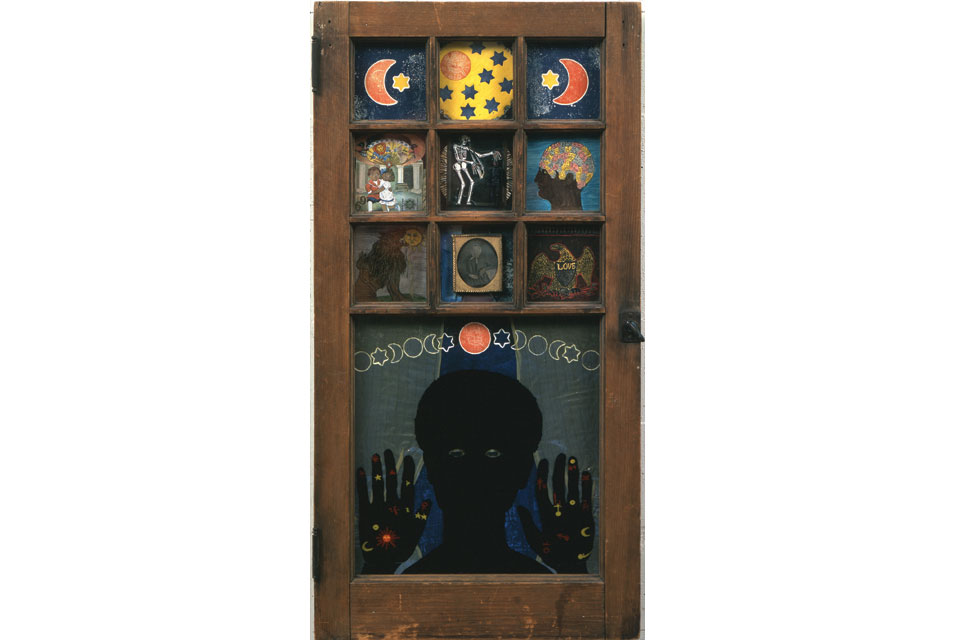
Betye Saar. Black Girl’s Window, 1969. Assemblage in window. 35 3⁄4 x 18 x 1 1⁄2 in. (90.8 x 45.7 x 3.8 cm). Collection of the artist; Courtesy of Michael Rosenfeld Gallery, LLC, New York.

LONG ISLAND CITY, NY.- MoMA PS1 presents Now Dig This! Art and Black Los Angeles 1960–1980, a comprehensive exhibition that chronicles the vital legacy of the african american artistic community in Los Angeles, examining a pioneering group of black artists whose work, connections, and friendships with other artists of varied ethnic backgrounds helped shape the creative output of Southern California. Now Dig This! Art and Black Los Angeles 1960-1980 will be on view in the First Floor Main galleries at MoMA PS1 from October 21, 2012 through March 11, 2013.
Now Dig This! is organized by the Hammer Museum, Los Angeles and was presented there in 2011-12 as part of Pacific Standard Time, a collaboration of more than sixty cultural institutions across Southern California. The exhibition is curated by Kellie Jones, Associate Professor in the Department of Art History and Archaeology, Columbia University, and the presentation at MoMA PS1 is organized at MoMA PS1 by Christophe Cherix, The Abby Aldrich Rockefeller Chief Curator of Prints and Illustrated Books, The Museum of Modern Art, and Peter Eleey, Curator, MoMA PS1, in association with Connie Butler, The Robert Lehman Foundation Chief Curator of Drawings, the Museum of Modern Art. The exhibition presents 140 works by thirty-three artists active during this historical period, exploring the rising strength of the black community in Los Angeles as well as the increasing political, social, and economic power of african americans across the nation. Several prominent artists began their careers in the Los Angeles area, including Melvin Edwards, David Hammons, Maren Hassinger, Senga Nengudi, John Outterbridge, Noah Purifoy, and Betye Saar.
Their influence, like that of all the artists in the exhibition, goes beyond their immediate creative circles and the geography of Los Angeles and is critical to a more complete and dynamic understanding of twentieth-century American art. By illuminating the richness and complexity of this creative community, Now Dig This! demonstrates how these artists were not working in isolation but were instead integral to the developing U.S. art scene during the latter part of the twentieth century. During this important era of artistic and cultural ferment, artists shifted from more traditional formats, such as painting and works on paper, to modes such as assemblage, Finish Fetish (a West Coast movement parallel to Minimal Art on the East Coast), Postminimal Art, Conceptual Art, and performance. EXHIBITION DESCRIPTION Presented in MoMA PS1’s First Floor Main galleries, Now Dig This! looks at the period through several framing categories. FRONT RUNNERS — By the early 1960s the West Coast became highly visible among the international arts community. african american artists such as Betye Saar and Melvin Edwards made some of their earliest important works during this time. Charles White, a veteran social realist from Chicago, arrived in Los Angeles from New York in 1956, energizing the black art community and inspiring many young artists who studied under him at Otis Art Institute. ASSEMBLING — The Watts Rebellion of 1965 was the largest urban riot at that time in U.S. history and had a profound effect on this community of artists. Many began to approach their craft and materials differently, and assemblage emerged as an important artistic strategy. Noah Purifoy and John T. Riddle, for example, made assemblage works from the detritus of the Watts Rebellion, creating formally impressive pieces that were also highly charged politically.
Purifoy claimed that it was the Rebellion that made him a real artist. ARTISTS/GALLERISTS — Lacking representation in mainstream institutions, african american artists opened their own venues in the 1960s and 70s. Spaces such as Gallery 32, founded by painter Suzanne Jackson, and the Brockman Gallery—established by brothers Dale and Alonzo Davis, became sites for cutting-edge work and havens for discussions, poetry readings, and fund-raisers for social causes. Samella Lewis is an amazing one-woman institution, having opened several galleries and a museum, started a magazine, and published some of the earliest books on this cohort of artists. POSTMINIMAL ART AND PERFORMANCE — This section of the exhibition documents the move away from more didactic subject matter toward abstract and dematerialized practices. Fred Eversley was the most visible african american working with the Finish Fetish style of Los Angeles Minimal Art in the 1960s.
In the 1970s artists such as Senga Nengudi, Maren Hassinger, and David Hammons began to experiment with PostMinimal Art ephemerality, and performance. LOS ANGELES SNAPSHOT / FRIENDS — The exhibition also explores the informal relationships between african american artists in Los Angeles and those in Northern California, like Raymond Saunders, as well as artists of varied ethnic backgrounds, such as Virginia Jaramillo, Ron Miyashiro, and Mark di Suvero. These relationships are an important part of fully understanding and contextualizing the work of this generation.

More Information: http://artdaily.com/index.asp?int_sec=2&int_new=58440&b=african%20american#.UITLM1FQjRY[/url]
Copyright © artdaily.org

‘Open Air,’ Rafael Lozano-Hemmer’s Light Show, Will Beam Recorded Words Into Philly’s Skies

AP  |  By
Posted: 09/16/2012 11:59 am Updated: 09/17/2012 8:30 am

PHILADELPHIA (AP) — A new interactive artwork opening in Philadelphia will make light of your words, but it’s probably not what you think.

Montreal-based artist Rafael Lozano-Hemmer is preparing to flip the switch on “Open Air,” an interactive work that will translate voice messages into moving beams of light over a tree-lined parkway named for Benjamin Franklin in the heart of Philadelphia’s cultural district.

Record your soapbox declarations, poems, gripes, wishes and shout-outs of up to 30 seconds on the “Open Air” iPhone app or online, then watch 24 robotic searchlights slowly sweep through the night sky in patterns and intensity determined by your vocal signature and GPS location.

The spectacle starts Thursday and runs through Oct. 14, from 8-11 p.m. each night.

“Philadelphia has traditions of free speech and democracy. … We wanted to take that background and implement technology to visualize it,” said Lozano-Hemmer, who was commissioned about four years ago to create the work. “We wanted to take free speech and make it materially visible in the city.”

On clear nights, the artist’s sky-high vox populi will be visible from 10 miles away. His site-specific installations have been presented worldwide, but “Open Air” is his first outdoor searchlight project in the U.S.

Want to beam yourself up? From anywhere in the world, messages can be recorded through the project’s website (www.openairphilly.net) or after downloading a free iPhone app debuting Sept. 20. Loaners will be available at on-site locations for the non-iPhone crowd.

Messages recorded on the parkway — your smartphone’s GPS gives you away — are automatically bumped to the front of the queue. As the light pattern activates, its originator gets a heads-up on their phone and the canopy of roving searchlights briefly form a dome in the air above the person’s location.

Anyone can simultaneously hear the speakers’ messages through the Open Air app or website or through two low-volume listening spots on the parkway. Or people can choose to simply watch the silent display as it travels through the air.

Organizers expect the inevitable “Yo, Vinnie!” and “Go Eagles!” exclamations but urge participants to take the opportunity to say something meaningful, funny, inspirational, challenging — and appropriate. Online entries will be kept in check by users’ votes; on-site messages won’t be censored, but the light canopy and being visible in the crowd should act to deter offensive comments.

“If you’re on the parkway speaking, we all know where you are, and in a way it’s pretty much like any public space: If you say something that’s moronic, well, other people can see you do that and you self-regulate,” Lozano-Hemmer said. “We need to moderate a little bit more online because of the anonymity.”

Interspersed among the everyday people will be prerecorded messages from past and present Philadelphians including filmmaker David Lynch, late Phillies announcer Harry Kalas, hip hop artist Santigold and classical pianist Andre Watts. All messages and corresponding light designs will also be archived on the project website for posterity.

Bird songs also will contribute to the audiovisual mix, a nod to the fall southern migration that coincides with “Open Air.” Mindful of the thousands of migrating birds that have become confused and trapped within the beams of New York City’s “Tribute of Light” recreation of the Twin Towers, “Open Air” will be periodically turned off to allow any disoriented flyers to continue on the wing.

Another green note: The power used during the entire exhibit will equal less than a football game and run on 50 percent renewable biodiesel, he said.

A key goal was making a work that’s as big as the sky overhead also as personal as each individual message. Lozano-Hemmer is mindful of light’s power to intimidate as well as illuminate and the relationship of searchlights with both celebration and entrapment.

“There is that fine line between seduction of participation and the violence of Orwellian surveillance and tracking and policing of the people,” he said. “The light of enlightenment and the light of blindness.”

There are uncertainties inherent in ambitious projects that rely on public participation, however. Despite all the planning and work, what if people don’t show up? Lozano-Hemmer and Penny Balkin Bach, executive director of the Association for Public Art, which commissioned the work, are confident that won’t be the case.

“We don’t know the results — that’s what so fascinating about this,” Bach said. “We can’t wait to see what will happen.”

Questlove Is Now An NYU Professor

NYU just got slightly more exciting.

Questlove (or ?uestlove, or Amir Thompson), drummer for The Roots (or Jimmy Fallon’s house band), will soon be a professor at New York University. The class he’s teaching? Well, it sounds AWESOME (and we say that as jaded chroniclers of university of classes).

MTV.com has more:

?uestlove and Universal Music’s Harry Weinger are teaching a class called “Classic Albums” at the Clive Davis Institute for Recorded Music at NYU’s Tisch School of the Arts. The class will take an in-depth look at how certain albums were able to stand the test of time, breaking down music, lyrics, production, business aspects, and more.

What might those classic albums be? According to Billboard, “the class is expected to look at albums by Sly & The Family Stone (‘Stand!, There’s A Riot Goin’ On’), Aretha Franklin (‘Lady Soul’), Led Zeppelin (‘IV), Prince (‘Dirty Mind’), Michael Jackson (‘Off The Wall’), and the Beastie Boys (‘Paul’s Boutique’).”

Questlove is not the only celebrity professor. James Franco is teaching a class at the University of Southern California this year, and Todd Rundgren taught for two weeks at Indiana University last year.

Watch Party Presidential Debate Monday, October 22, 2012


Watch Party Presidential Debate
Monday, October 22, 2012
7165 Restaurant
7165 Germantown Ave
Philadelphia, PA 19119
Doors Open 7 PM   Debate Begins 9 PM
215-629-3939

Admission Free

Issa Rae ‘The Michelle Obama Diaries’: Is The Comedian’s New FLOTUS Parody Funny Or Disrespectful?


YouTube comedy darling, Issa Rae, has had a whirlwind year. From a super successful round of fundraising to launch the second season of the uber-popular YouTube series, “Awkward Black Girl,” to joining forces with Shonda Rhimes (Scandal, anyone) for a new comedy series, you can’t deny that Issa Rae’s talent has gotten some robust shine time in 2012.

Recently, Issa released the first installment of a new YouTube series called “The Michelle Obama Diaries,” where she partnered with Lena Waithe and Benjamin Cory Jones to give us a behind-the-scenes glimpse into FLOTUS’ life. While we love FLOTUS and we love Issa Rae, we’re not 100% sure if we love this new series. So we turn to you for your take.

What do you think? Is this parody of our first lady funny or just plain disrespectful? Can we safely joke about our first black first lady without striking a nerve? Are we ready for a FLOTUS parody?

Tell us in the comments what you think of “The Michelle Obama Diaries.”

African-American Pioneer, Bronze Sculptor, and WWI Fighter Pilot Honored by WKU

WKU is set to induct three new members into the school’s Hall of Distinguished Alumni. The Class of 2012 includes the first African-American to enroll in undergraduate classes on the Hill, a renowned bronze sculptor whose works can be seen throughout WKU’s campus, and a Brigadier General and WWI ace fighter pilot.

Friday’s induction ceremony at the Sloan Convention Center in Bowling Green will honor Margaret Munday (’60), Russ Faxon (’73), and Victor Herbert Strahm (’15).

As WKU Public Radio reported in August, Ms. Munday was an unsuspecting, but willing, pioneer as the first African-American student to enroll in undergraduate classes at what was then known as Western Kentucky State College.

Munday, a native of the Logan County town of Auburn, spent her freshman year of college at the all-black Kentucky State in Frankfort. But Munday’s brother told her their mother deeply missed Margaret, and when Margaret heard Western Kentucky State College was opening its doors to black students, Margaret decided she was moving closer to home and her family.

Munday told WKU Public Radio she never intended to be a trailblazer. She said she assumed she would be joined at Western Kentucky State College by other black students from the southern Kentucky area. But when Margaret showed up in the fall of 1956 to register for classes, she was the only African-American there.

Munday excelled at Western Kentucky State College with the support and encouragement of President Kelly Thompson, Librarian Margie Helm and Professors Ivan Wilson and H.F. McChesney. She graduated in 1960 and began a 30-plus year career of musical education, working in every school in the Logan County school system.

Here is more information about the three new inductees into WKU’s Hall of Distinguished Alumni:

Russell Faxon (’73)

Russ Faxon, a renowned bronze sculptor who lives in Bell Buckle, Tenn., grew up in Bowling Green, Ky., and earned his bachelor’s degree in Art Education from WKU in 1973.

After graduation and teaching in Nashville for two years, Faxon traveled to Europe to study and pursue his passion for sculpture. In Italy, he learned the fine art of bronze casting at the Mariani Foundry in Pietrasanta.

In 1979, he moved to Bell Buckle where he established Selah Studio. In his work, Faxon concentrates on capturing the expression, emotion and spirit of the human figure, modeled in clay and cast in bronze through the “lost wax” casting process. Ranging in size from table models to monumental figures, Faxon’s sculptures are designed for specific locations, personal interiors and public spaces in the United States and Europe.

Faxon has three works on the WKU campus — Robert Guthrie at the Guthrie Bell Tower, Coach E.A. Diddle at Diddle Arena and the Red Towel at Houchens Industries-L.T. Smith Stadium. Two additional pieces — WKU mascot Big Red and former WKU Alumni Association Director Lee Robertson — will soon be added.

Some of Faxon’s other life-size bronze sculptures include Minnie Pearl and Roy Acuff at the Ryman Auditorium in Nashville, Tenn.; Chet Atkins at Bank of America in Nashville; John Pemberton, creator of Coca-Cola in Atlanta; Uncle Herschel and Stella at Cracker Barrel Corp. in Lebanon, Tenn.; Gov. Ned McWherter in Dresden, Tenn.; Johnson Memorial Plaza at Nashville’s Belmont University; Bedford County Veterans Memorial in Shelbyville, Tenn.; and the Korean War Memorial for the State of Tennessee at the Legislative Plaza in Nashville.

Faxon has had 26 public commissions to date and has exhibited his work throughout the United States and internationally. He received the Elliot Gantz & Co. Foundry Prize at the National Sculpture Society 75th Annual Exhibition in 2008 and was inducted into the Bowling Green High School Hall of Honor in 1994.

Margaret Munday (’60)

Margaret Munday, a retired music teacher from Auburn, Ky., holds a special place in WKU’s history of diversity as the first African-American undergraduate student to attend classes on the Hill.

Munday attended Auburn Training School and Knob City High School in Russellville. She originally enrolled at Kentucky State College, a historically African-American school but wanted to be closer to home.

On Sept. 15, 1956, after Western Kentucky State College and Kentucky’s other higher education institutions were desegregated, Munday transferred from Kentucky State and enrolled in classes on the Hill.

Munday, a Music major and member of the Western Chorus, received support and encouragement from President Kelly Thompson, Librarian Margie Helm and Professors Ivan Wilson and H.F. McChesney. She successfully pursued her bachelor’s degree despite the sociological aspects associated with her journey into unchartered territory that ushered in an era of social and educational change at WKU and the region.

After her graduation in 1960, Munday taught school at the all-black Johnstown School in Olmstead, Ky. In 1964 she became the first black teacher at Auburn High School and eventually taught at every school in the Logan County, Ky., school system. In 1995, she retired after more than 30 years as a music and chorus teacher.

During her teaching career, Munday received several state and regional music association awards. For 15 years, she was Director of the Union District Youth Choir, which consisted of members from 32 churches. In 1999, she was honored by WKU’s Society of African American Alumni at its Spring Celebration.

She is a member of Macedonia Baptist Church in Auburn, where she has played piano since about age 10.

Victor Herbert Strahm (’15)

Brigadier General Victor H. Strahm was an American hero, an “ace” among World War I fighter pilots with five aerial victories and helped usher in the modern era of aviation.

In 1915, Strahm graduated from Western Kentucky State Normal School where his father, Franz Joseph Strahm, was Director of Music. When World War I began, Strahm enlisted in the U.S. Army Flight Training Program and earned his wings in October 1917.

During 10 months in France, Strahm, who was attached to the 91st Aero Observation Squadron, was credited with five victories and three probable victories. He was awarded the U.S. Distinguished Service Cross with Oak Leaf Cluster, U.S. Silver Star, French Croix de Guerre with Gold and Silver Palms, British Distinguished Flying Cross and Italian Gold Medal for Valor.

After the war, he flew as a stunt pilot in several war movies, participated in National Air Races and was chief test pilot at Wright Field in Dayton, Ohio.

At the beginning of World War II, Strahm was a Chief Planner for the U.S. Ninth Air Force and was promoted to Brigadier General in 1942. Strahm was one of the principal planners in preparations for the air support for the D-Day landings at Normandy on June 6, 1944.

Strahm received the U.S. Legion of Merit with one Oak Leaf Cluster, Polish Legion of Honor Commendation, Companion of the British Empire, French Legion of Honor, World War II Victory Medal Commendation, European-African-Middle East Theatre Ribbon, American Theatre Ribbon, American Defense Ribbon and Asian-Pacific Theatre Ribbon with two stars.

Following WWII, Strahm helped organize the Strategic Air Command and served as commander of the 33rd Air Division at Tinker Air Force Base in Oklahoma City and as base commander at Barksdale Air Force Base in Shreveport, La. He died on May 11, 1957.

‘Romnesia’: Obama Coins Mitt Romney ‘Condition’ (VIDEO)

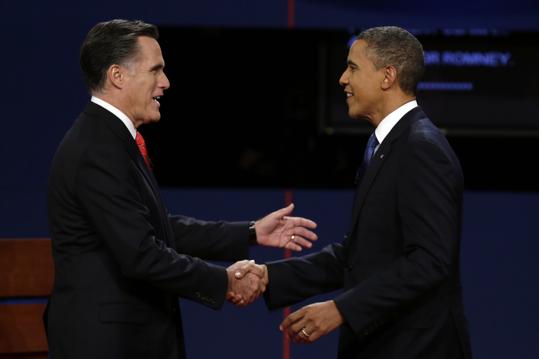
FAIRFAX, Va. — At a misty rally designed to gin up enthusiasm among women voters, President Barack Obama’s strongest riff was a mockery of Mitt Romney’s effort to showcase a more moderate front, coining the tactical shift as a case of “Romnesia.”

From his remarks midday Friday on the campus of George Mason University:

We have got to name this condition he is going through. I think it is called Romnesia. I think that’s what it is called. Now I’m not a medical doctor. But I do want to go over some of the symptoms with you because I want to make sure nobody else catches it.If you say you’re for equal pay for equal work but you keep refusing to say whether or not you will sign a bill that protects equal pay for equal work, you might have Romnesia.

If you say women should have access to contraceptive care, but you support legislation that would let employers deny contraceptive care, you might have a case of Romnesia.

If you say you will protect a women’s right to choose but you stand up in a primary debate and say you’d be delighted to sign a law outlawing that right to choose in all cases, then you have definitely got Romnesia.

Obama went through a number of other so-called cases, including tax cuts and the coal industry. The neologism got hearty laughs and applause, especially as the president informed the crowd that the condition was covered under his health care law.

“If you come down with a case of Romnesia and you can’t seem to remember the policies that are still on your website, or the promises you have made over the six years you’ve been running for president, here is the good news: Obamacare covers pre-existing conditions,” Obama bellowed. “We can fix you up. We’ve got a cure. We can make you well.”

The length of time it took to mock Romney on these grounds is, in part, a reflection of how caught off guard the Obama campaign was by the governor’s shift. The first attack line, following the first presidential debate, was to call Romney a great actor hiding a conservative underside, while the second centered around painting Romney as inherently unserious (cut Big Bird?).

The Romnesia line (the campaign confirmed the spelling) hits Romney as a political opportunist. It contrasts slightly with the months-long effort to paint him as the “severe conservative” he claimed he was in that it implies Romney is devoid of principle. But it doesn’t completely contradict it (you can argue that Romney would revert to his conservative self under the political pressure of congressional Republicans if elected).

The event drew 9,000 people, according to campaign officials. The main effort was to further drive a wedge between Romney and women voters. And Obama did his best to do that outside of the Romnesia riff as well, charging the Republican nominee with being a relic of the 1950s.

“Governor Romney wants to take us to policies more suited to the 1950s,” he said earlier in the speech. “Even his own running mate said he’s kind of a throwback to the 50s. That’s one thing we agree on. But he may not have noticed, we are in the 21st century.”

UPDATE: 1:10 p.m. — The Romney campaign responds, with a statement from delegate Barbara Comstock.

“Women haven’t forgotten how we’ve suffered over the last four years in the Obama economy with higher taxes, higher unemployment, and record levels of poverty,” the statement reads. “President Obama has failed to put forward a second-term agenda – and when you don’t have a plan to run on, you stoop to scare tactics. What is really frightening is that we know a second term for President Obama will bring devastating defense cuts that will cost Virginia over 130,000 jobs, more burdensome regulations, and the biggest tax increase in history on our small businesses and families. Mitt Romney’s plan for a stronger middle class will create 12 million new jobs and provide greater opportunity for women across our nation, including Virginia. Mitt Romney is the candidate in this race who will bring us the real recovery we need.”

UPDATE: 4:24 p.m. — Vice President Joe Biden tossed out the Romnesia reference at a campaign event later Friday. Visibly amused, he told a crowd in Fort Pierce, Fla., that Obama has a term for Romney’s inability to remember his positions on issues.

“He calls it Romnesia. Well, I’ll tell you what, I hope you don’t get Romnesia. It’s a bad disease. And it’s contagious,” Biden said, turning his attention to vice presidential nominee Paul Ryan. “Because all of a sudden, the budget hawk, the guy who introduced a whole budget plan that actually passed the House of Representatives, all of a sudden doesn’t remember it … He doesn’t remember what it actually does. He says it doesn’t cut, it just slows growth.”


Do Black Dancers Have A Place In Ballet? We Say, Yes. (Video)

Economic factors forced the disbanding of the Dance Theatre of Harlem Company in 2004. Now, eight years later, reading the series of pieces about the dearth of black dancers that recently ran in the UK’s Guardian newspaper, it is as if Dance Theatre of Harlem never existed.

With increasing frequency, the scarcity of black dancers on the ballet stage bubbles back to the surface–a sure sign of the need for change. The roving finger of blame identifies a different culprit with each round of discussion, yet because there are multiple factors at work, we are still far from a resolution.

In founding Dance Theatre of Harlem in 1969 at the height of the Civil Rights movement, Arthur Mitchell intended to put the question of whether black dancers belonged in ballet to rest for good. As a founding member of the groundbreaking Dance Theatre of Harlem and throughout my 27 years as a ballerina with that company, we demonstrated that dancers of many hues could not only perform ballet, but do so at the highest level. It was gratifying that, ten years into our existence, a second generation of dancers of color began arriving at our doorstep, ready to claim their place in ballet.

The good news is that we are back. The new Dance Theatre of Harlem Company will make its debut performance at the Kentucky Center in Louisville, KY on October 20. As artistic director, I have selected 18 racially diverse artists who will carry the legacy of Dance Theatre of Harlem forward into the 21st century. The idea at the heart of that legacy is that–given access and opportunity–an individual can create for his or herself a future outside of convention.

Once again a different perspective on the art form will enliven the field, but the absence of role models is not the only reason ballet remains so pale. The high cost of training for a career in ballet (though let us not assume that there are no African Americans of means who can afford to do so) and a literal old guard who prized a cookie-cutter similarity in the dancers they put on their stages stood in the way of diversifying the art form are certainly factors, but there are also systemic aesthetic and political issues that contribute to the exclusion blacks from ballet.

One of them is no doubt the notion of an idealized body. This essential aspect of ballet has often been cited as a reason to exclude black dancers. It hardly needs to be stated how great a mistake it is to assume that one group is uniquely qualified and another uniquely unqualified as it is also a mistake to hold the art form hostage to 19th century ideals of beauty in which pale skin was equated with goodness and dark with evil. No thinking person would allow him or herself to indulge in these kinds of discrimination, but such prejudices persist below the level of thought.

Ballet’s aesthetics have evolved. Compare the slope shouldered wasp-waisted Taglioni perched on the petal of a flower with George Balanchine’s ideal of a small-headed, long legged Amazon capable of fleet, space-gobbling, off-kilter movement. Balanchine himself dreamed of a company equally divided between blacks and whites. And even looking at the company he founded, New York City Ballet, the favored body-type has continued to change. And, as has been pointed out, a new, enlightened generation of artistic directors is broadening the perception of what ballet can look like by bringing dancers of color to their companies.

Beyond the physical look of ballet though, is the notion of what the ballet has come to signify an aspirational ideal. Historically, the classical arts, opera, music, ballet have been seen to convey the highest expression of the human spirit. They were closed clubs whose cachet was exclusivity. On the outside were all of those who did not match a particular set of standards. While ballet is an exclusive form of expression–only the truly inspired, strong and exceptionally gifted can master this rigorous artform, none of the aforementioned is contingent on race, ethnicity or nationality.

One of the opportunities we have now that a more substantive discussion of the role of diversity in the classical arts is arising, is the question, not of whether blacks belong in the art form, but what, exactly is the role of art at this point in human history, and how can that best be fulfilled? We are not living in a colonial world in which culture is a weapon of dominance. It is time to think differently: the art of ballet as a common language that transcends difference that can build unity.

WATCH the Dance Theatre of Harlem perform “Contested Space”: