
‘In Living Color’ To Be Celebrated As Fox’s TV Game-Changer
By LYNN ELBER 04/21/12 01:47 PM ET 

LOS ANGELES — Television networks are masters of self-promotion, so it’s no surprise that Fox is carving out two prime-time hours Sunday to celebrate its 25th year.
But why quibble over the hoopla planned for the 8-10 p.m. EDT showcase? With Ryan Seacrest as ringmaster, let’s give a shout-out to the stars of “Married … With Children,” “The X Files,” “In Living Color,” “Ally McBeal,” “Beverly Hills, 90210,” “House” and “24.”
And, in center stage, the enduring “The Simpsons” and TV’s great game-changer, “American Idol,” are taking a bow.
It’s an impressive showing for a network that’s less than half the age of competitors NBC, CBS and ABC. As analyst Brad Adgate of Horizon Media sees it, Fox hasn’t just met expectations, “it’s exceeded them.”
“Of the major networks, it’s the only one that can bring in younger audiences on a regular basis,” Adgate said. “They have brought out some breakthrough shows … They’ve really done things that the other three networks wouldn’t have done with their programming.”
From a modest October 1986 debut with “The Late Show Starring Joan Rivers” and its first night of prime-time programming in April 1987, Fox weathered industry skepticism and midlife crisis (“Who Wants to Marry a Multi-Millionaire?” and other groaners) to make its case for survival and success.
Fox proved that, yes, there was room for a fourth U.S. broadcast network, three decades after Dumont dissolved in 1955 and left the Big Three networks to slice up an increasingly rich pie.
Yes, a broadcast network could shrink its prime-time lineup to the hours between 8-10 p.m. ET, allowing lucrative local newscasts control of the 10 o’clock hour, and prosper.
Yes, airing outrageously cheeky fare – ranging from clever (“Tracey Ullman”) to exploitive (“Temptation Island”) – would lure the 18-to-49-year-old audience that make advertisers swoon. Fox became profitable after just three years of operation, according to “Outfoxed,” the 1990 book by Alex Ben Block detailing the network’s birth.
That success turned competitors into copycats, extending Fox’s influence across the medium.
The network’s creation was “a real trial by fire for all of us,” said Garth Ancier, Fox’s inaugural programming chief. “My mentor at NBC, Brandon Tartikoff, thought I was crazy, and he was probably right.”
The challenge: “How do we carve the audience in a different way from NBC, ABC and CBS? How do you grab people by their shirt collars and drag them over to an alternative?” Ancier said.
A key answer was development of a stable of reality shows including “America’s Most Wanted” and “Cops,” the latter using portable video cameras to reimagine the scripted police drama.
Rupert Murdoch, the News Corp. media mogul behind Fox, also urged his executives to look outside the U.S. market for ideas, Ancier recalled.
“He’s always been an internationally focused guy and knows what’s working in other countries,” he said.
That global focus helped bring “American Idol” to Fox from the U.K. in June 2002, but not before Fox found itself on shaky ground, said Gail Berman, its programming head from 2000-05.
“When I came in, the network was not in particularly good shape,” she recalled, with then-News Corp. President Peter Chernin cautioning her that she had to boost company morale along with ratings (although Fox had reached No. 1 with teenagers and adults 18 to 34).
“Having been the fourth network, there was a sense that being at the bottom of the barrel was an OK place to be,” Berman said. “We built a great team of people that could really change the culture of `When Animals Attack’ to the culture of `American Idol.'”
In her tenure at Fox, the network also found a new measure of scripted success, with “24” and “The O.C.” among the hits, and new peer respect. In 2005, Fox earned 49 Emmy Award nominations, the most in its history, including 11 nods each for “24” and the critically acclaimed “Arrested Development,” which the year before won the Emmy for best comedy series.
But it was the next wave of reality – “American Idol” and the talent contest genre – that put the ratings into orbit.
Mike Darnell is a key part of Fox’s culture, past and present. Among Fox’s longest-serving executives and currently president of alternative entertainment, with “Idol” part of his portfolio, his network bio proudly lists “previous hits” including “World’s Wildest Police Chases” and “World’s Most Amazing Medical Oddities.”
He hasn’t, and won’t, apologize for that brand of shows. With apparent glee, he recalls how they were routinely branded by critics as “the end of Western civilization, sleazy and low-brow.”
But such programming helped bolster the network in the 1990s, he said, and proved widely influential. After Fox blazed the trail, NBC aired “Fear Factor” and “Dog Eat Dog,” ABC fell into the arms of “The Bachelor” and “Wife Swap,” and CBS turned to “Big Brother.” The progeny of “American Idol” include NBC’s “The Voice” and “America’s Got Talent,” and ABC’s “Dancing With the Stars.”
So far, nobody has done it quite like Fox. While relatively staid CBS is the most-watched network, Fox ended last season with its seventh ratings victory in a row among young adults and with “American “Idol” the most-watched series for the eighth straight year.
In advance of the 2011-12 TV season, Fox brought in $2.2 billion in sponsor commitments which, for all the networks, totaled $9.25 billion, according to AdWeek. Leader CBS, by comparison, had $2.65 billion in early ad buys.
Fox’s future is clouded by the same issues confronting the rest of cable and broadcast TV: an aging audience and a crowded media environment in which the Internet and other options compete for attention.
Even standard-bearer “American Idol,” although still a top-rated show, has seen its eroding viewership drop by 25 percent this year and its median audience age climb to 50, analyst Adgate said. Fox newcomer “The X Factor” is scrambling to revamp its casting after a disappointing first season, while the Jennifer Lopez-Marc Anthony talent show “Q’Viva!” drew paltry ratings and was bumped from prime-time to late-night Saturday.
(Parent News Corp. has its own serious burdens, stemming from the phone hacking scandal involving Murdoch’s U.K. newspaper company News International. More than 100 lawsuits have been filed against the subsidiary and an official British investigation is continuing.)
But Fox isn’t ceding ground. “Glee” and “New Girl” are young viewer draws And this month, in collaboration with Fox Sports, the network launched a new tactic for long-ignored Saturday night, a mix of sports programming that’s set to include NASCAR races, college football and Major League Baseball games and Ultimate Fighting Championship bouts.
“Of course, all networks mature,” Darnell said. “But it’s not about the network, it’s about new programming. It’s our nature to try to reinvent … We usually start it, and someone else imitates us.”
The date-night movies “Think Like a Man” and Gabrielle Union
Solange Knowles Sizzles In High Slit Skirt At Splendid NYC Store Opening
Huffington Post | By Julee Wilson

That’s one smokin’ hot DJ!
Solange Knowles hit the ones-and-twos last night at the Splendid store opening in New York City showing some serious leg. Her black lace trimmed skirt by Maki Oh–though super cute and ultra sexy–was two inches away from a wardrobe malfunction.
But if anyone can pull off such a risque item, it’s Solange. Pairing the sultry skirt with a cool white Splendid t-shirt was genius.
Actresses Brooklyn Decker, Kate Mara and Gretchen Mol–along with fashion insiders, editors and bloggers–were also on hand to fete the event that was co-sponsored by Dylan’s Candy Bar.
Between jamming to Solange’s beats and munching on bottomless dishes of sweets partygoers had the opportunity to shop Splendid’s capsule collection, which 100% of the proceeds benefit the SPCA of Monmouth County.
We love when fashion meets philanthropy!
Check out Solange’s sassy ensemble below–do you love it?
THINK LIKE A MAN – Exclusive Clip
‘Think Like A Man’: Box Office Surprise Stuns ‘Hunger Games’
The Huffington Post | By Christopher Rosen Posted: 04/21/2012 9:54 am Updated: 04/21/2012 3:48 pm

“Think Like A Man,” the new adaptation of Steve Harvey’s best-selling book, earned a muscular $9 million at the box office on Friday, reports THR. That puts the little-discussed film on track to knock “The Hunger Games” out of the top position when final numbers are tabulated on Monday. (Deadline.com’s Nikki Finke was even more bullish on “Think Like a Man,” reporting Friday grosses of $12 million.)
UPDATE: Finke’s estimates were dead-on: “Think Like a Man” earned $12.2 million on Friday, which could push it over $30 million for the weekend.
Directed by Tim Story, “Think Like A Man” has been tracking very well despite little mainstream press acknowledgement. (The film was projected to gross around $17 million this weekend.) Earlier this month, Vutlure reported that “Man” was the “best-testing film in Hollywood,” with screening audiences giving it almost unanimous praise and approval. The romantic comedy stars Romany Malco, Meagan Good, Taraji P. Henson, Michael Ealy and Kevin Hart, who could be “Man’s” not-so-secret weapon. Last year, the comedian’s stand-up film, “Laugh at My Pain,” earned a surprising $7.7 million at the box office.
“Think Like a Man” wasn’t the only film to over-perform on Friday night. Despite negative reviews, “The Lucky One” earned roughly $9 million on its first day of release, which could give it a final tally near $25 million for the weekend.
If those numbers hold, both films will top “The Hunger Games.” The blockbuster is predicted to earn near $14 million after grossing just over $3 million on Friday night. The adaptation of Suzanne Collins’ best-selling book has topped the box office for four straight weeks, the first film to do so since “Avatar.”
Erykah Badu Talks: Hennessy Campaign, New Album, & Life As A Midwife
Erykah Badu’s steadfast pursuit of creativity and inspiration has been an ongoing challenge for the R&B songstress throughout the course of her career. The celebrated soul singer and mother of three recently extended her benevolent aspirations with Hennessy’s “Wild Rabbit” campaign.
During a recent interview with the Huffington Post, the Dallas native opened up on her second partnership with the luxury cognac brand, thoughts on a possible duet with Jay Electronica, and how she balances her career as a midwife.
What attracted you to become a brand ambassador for Hennessy’s “Wild Rabbit” campaign?
This is not my first time being involved in a Hennessy campaign. My first one was a couple of years ago, it was called “Hennessy Artistry: The Art Of Mixing.” It was where Hennessy had given artists [signed along with unsigned artists] a platform to express their art and music. And it was really cool. The Roots curated it and I thought that was a really good fit. Ahmir [Questlove] always does such a good job bringing in artists and doing a musical montage to keep a show going, and they asked me to do that this year. And I was more than pleased to do that. This year’s campaign is called “The Chase: Following Your Wild Rabbit.” It promotes never giving up, unshakably following the thing that guides you.
What would you consider to be your Wild Rabbit?
After they asked me to be a part of it they asked me what would my wild rabbit would be, and I didn’t have to think about it, I knew it would be my heart, making decisions in my life based on that. Including art and music, or love. And that’s why I’m involved, I get to put together some shows, speak to young people about their passion and their drives, never settling, and conquering their fears.
You also have a Hennessy cocktail that is inspired by you. Did you have any involvement in the creation?
That’s not my area. [Laughs] They are certain people who put those things together, because of course the object is to sell Hennessy. I wasn’t even aware that I had a drink until a couple of weeks ago. I don’t drink.
In terms of your performance sets, are you doing anything special or performing any new songs?
I’m doing a mixture. My shows are just going to be my shows; I didn’t do anything different or special for it. I think that’s one of the reasons why they choose me is because it’s going to be who I am in whatever venue that I’m in. Whether it’s new, or catalog, or impromptu.
Are you working on any new music projects or groups?
I just had a project come out called Rocket Juice and the Moon, with myself, Tony Allen [the drummer from Fela!], Flea [bass player from the Red Hot Chili Peppers], and Damon Albarn [from the Gorillaz]. I also have a group called The Cannabinoids, which consists of myself and eight other musicians on stage with me — actually, they’re not musicians they’re producers. And we create music live on the spot. I created the group so it could keep me creative, and it also keeps me connected to my roots. All of the producers in the group are a part of my history. We have an album coming out in the last quarter of this year. My solo album also comes out in the last quarter.
Do you have a working title for your solo project?
I don’t have a title yet. That always comes last after I put the body of work together and sequenced it, found the right photos and artwork. Then usually the title comes to life.
On the album, can fans expect a collaboration between yourself and Jay Electronica?
Perhaps. We’ve done a lot of songs together, but sometimes you don’t like it or it doesn’t feel quite cohesive yet , but we’ve been working on it. We don’t have any plans, that kind of stuff just happens … He’ll have an idea and then I come in and put something down. And sometimes something comes, sometimes nothing ever comes. But we have a collection of those songs that we didn’t quite love.
With you being a midwife how do you balance your career between being an artist and providing care for expecting mothers?
That keeps me really, really busy because I never know when a mom is going to go into labor. So that means if I’m at a show and I get a page then I got to go. [Laughs] Or if I’m at the studio and I get a call then I have to go.
How do you factor that scheduling into touring across the country or overseas?
If I know that I’m going overseas, I usually know that a year in advance. I wouldn’t take a mother as a client until I get back. And I usually take two moms at a time. And we start generally around four or five months, and work throughout the pregnancy. And then after the baby is here we work up until when they feel they have a good grasp on being a mom.
Are you working on any philanthropic events?
I have a DJ camp coming up. This season is going to include DJing, teaching the history of Hip Hop, learning how to scratch with records. Learning how to DJ without Serato, and then learning how to work Serato. I think it’s important in my community because it’s a means of supplementary income to young people who are really interested in music. And we just wanted to offer that through my non-profit organization, B.L.I.N.D.
Wishing Hollywood a happy 4/20
Wishing Hollywood a happy 4/20
Independence key to happiness?
As Araina Bond’s marriage came apart, she felt — in a word — “clueless.” Then she discovered the very thing that had been missing from her relationship: a sense of independence.
Americans ‘Secret Heroes’
Paul Martin has collected the stories of 30 Americans left out of the history textbooks in his new book, “Secret Heroes: Everyday Americans Who Shaped Our World.”
VIDEO: Africa Beats: Ahmed Soultan
Moroccan sings of West’s ignorance and African roots
“Give me silver or give me gold/though they are dangerous to our soul /27 July 1840″ – Dave (slave potter) Edgefield, SC

Dave, the African American Slave Potter
Posted by Charlotte Hutson Wrenn on October 31, 2009
Living in South Carolina, with an ear open to authentic local craft and art, one hears often of the Edgefield District, known for its distinctive traditional stoneware. South Carolina is rightfully proud of her two native crafts, the carefully woven Sea Grass baskets, made in the traditional style by the Gullah people, African Americans, who were formerly enslaved on the coastal Sea Islands, and also for its stoneware pottery, which is most significantly, tied to a slave named Davewho inscribed his massive pots with poetry. Dave’s legacy has grown not only because of his superlative technical skill but also because he dared to write poetic couplets on his pots, and to sign his name, which was bold, brave, and daring. His pots now fetch six figures in the antiques market.
The Charleston Museum, was, in 1919, given the first inscribed jar by Dave, by a contributor named Stoney. The massive forty gallon jar so inspired the director at the time, Paul Rea, that he wrote, a few months after it arrived, that “the jars should be collected…to prepare a history of the old potteries.” That did not happen until Laura Bragg, subsequent director of the Charleston Museum, visited the Edgefield area in 1930, learning about the one legged potter who worked in the area all his life, from 1834 to about 1870. The Edgefield pottery collection at the Charleston Museum is a testament to Bragg as a preservationist. Bragg offered an article about the history of the South Carolina jug and pottery for International Studio, which had previously printed her work, but the pottery piece was never published.
Dave they say, lay on the railroad tracks when he learned he was to be sold and relocated to a plantation to the west. The train severed his leg, making him less valuable to the buyer who then refused him. Dave, now one legged, continued his work as a potter, working with am able bodied companion, named ‘Baddler”: the latter works, which can be seen at the Charleston Museum, were signed “Dave and Bladdler”. The great potter stayed and worked in South Carolina all the days of his life. He continued to produce pots – large, great pots, inscribed with short phrases of poetic wisdom, and bravely inscribed in his hand and signed with his name, a testament to an undaunted spirit.
The following couplets are some of the poetic inscriptions, on the pots of Dave, the slave potter, of Edgefield, South Carolina.
I made this jar for cash
Though it is called lucre trash
22 August 1857
I made this for our Sott
it will never – never – rott
31 March 1858
This noble jar will hold 20
fill it with silver then you’ll have plenty
8 April, 1858
When you fill this jar with pork or beef
Scot will be there to get a peace
(on the other side)
This jar is to Mr. Seglir
who keeps the bar in orangeburg
for Mr Edwards a gentle man
who formerly kept Mr Thos bacons horses
21 April 1858
The Art Institute of Chicago’s collection of African American art
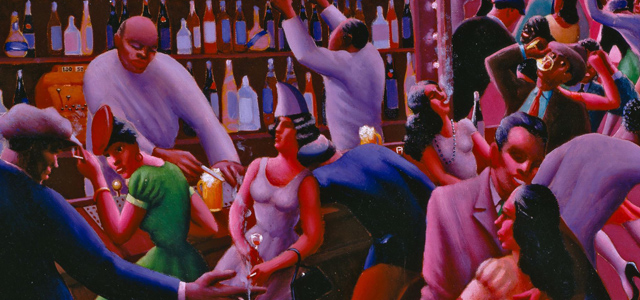
The Art Institute of Chicago’s collection of African American art provides a rich introduction to over 100 years of noted achievements in painting, sculpture, and printmaking. Ranging chronologically from the Civil War era to the Harlem Renaissance and from the civil-rights struggles following World War II to the contemporary period, these works constitute a dynamic visual legacy.
Archibald John Motley, Jr. Nightlife, 1943. Restricted gift of Mr. and Mrs. Marshall Field, Jack and Sandra Guthman, Ben W. Heineman, Ruth Horwich, Lewis and Susan Manilow, Beatrice C. Mayer, Charles A. Meyer, John D. Nichols, and Mr. and Mrs. E.B. Smith, Jr.; James W. Alsdorf Memorial Fund; Goodman Endowment.
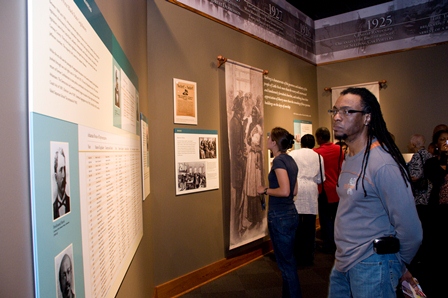
The Mosaic Templars Cultural Center in Little Rock, AR
Museum Hours
Tuesday through Saturday 9 am to 5 pm
Admission is Free
The Mosaic Templars Cultural Center is located at 501 West Ninth Street in downtown Little Rock. Click here for Map and Directions to the Museum. Parking is available in the parking lot to the west of our building or on Arch Street. The museum is open on the State Holidays listed below:
- Martin Luther King, Jr.
- President’s Day
- Memorial Day
- Independence Day
- Labor Day
- Veteran’s Day
The museum is closed New Year’s Day, Thanksgiving Day, Christmas Eve, and Christmas Day.
Visitors can take a self-guided tour of the 1st and 3rd Floor. Self-guided tour maps are available at the museum front desk and are free of charge.
All exhibit videos and interactives are closed captioned for the hearing impaired. Descriptive guided tours are available for people with visual impairments but must be scheduled in advance so a trained staff member will be available.
Groups of 10 or more can schedule a guided tour. Please contact the museum’s Education Department at 501.683.3592 two weeks in advance to schedule your tour.
The Mosaic Templars Cultural Center also offers tours, programs, and workshops for students and teachers.
Twenty Years After the Flames: The Rodney King Beating Verdict and the L.A. Riots Part 1

by Earl Ofari Hutchinson
For two fateful days at the end of April and the first day of May 1992, I ducked around police cordons and barricades, and cringed in fear at the cackle of police gunfire. I choked, and gagged on and was blinded by the thick, acrid smoke that at times blotted out the sun and gave an eerie surreal Dante’s Hell feel to Los Angeles. I watched many Los Angeles Police Department officers stand by virtually helpless and disoriented as looters gleefully made mad dashes into countless stores. Their arms bulged with everything from clothes to furniture items. I watched an armada of police from every district throughout California and the nation, National Guard units and federal troops drive past my house with stony, even scared looks on their faces, but their guns at ready.
I watched buildings, stores and malls that I shopped at and frequented instantly disappear from the landscape in a wall of flames. Several friends that lived outside L.A. and were concerned about my safety implored me to leave my home in the middle of the riot area and stay with them until things blew over. I thanked them but I decided to stay put. As an award-winning journalist, I felt bound to observe and report first-hand the mass orgy of death and destruction that engulfed my South Los Angeles neighborhood during the two fateful days of the most destructive riot in U.S. history.
The warning signs that L.A. was a powder keg were there long before the Simi Valley jury with no blacks acquitted the four LAPD cops that beat Rodney King. There was the crushingly high poverty rate in South L.A., a spiraling crime and drug epidemic, neighborhoods that were among the most racially balkanized in the nation, anger over the hand slap sentence for a Korean grocer that murdered a black teenage girl in an altercation, and black-Korean tensions that had reached a boiling point. And above all, there was the bitter feeling toward an LAPD widely branded as the nation’s perennial poster police agency for brutality and racism.
This year, on the 20th anniversary of the King verdict and the L.A. riots, many still ask the incessant question: Can it happen again? The prophets, astrologers and psychics couldn’t answer a question like that with absolute certainty. But there are two hints that give both a “yes” and no answer to the question. The yes is the repeated questionable killings of young unarmed African Americans by police and quasi-authority figures, such as Trayvon Martin and Kendrec McDade, nationally and in L.A. County. This continues to toss the ugly glare on the always fragile, tenuous, and at times openly hostile relations between African Americans and the police. The other cause for wariness is conditions in South L.A. and other urban communities.
In the two decades after the riots, South L.A. and the many other South L.A.s of America have been written off as vast wastelands of violence and despair. Many banks and corporations, as well as government officials, reneged on their promises to fund and build top-notch stores, make more home and business loans, and provide massive funding for job and social service programs in the poorest of the poor, Black, inner city areas. Many business leaders still have horrific visions of their banks and stores going up in smoke or being hopelessly plagued by criminal violence.
The National Urban League, in its annual State of Black America reports every year, grimly notes that Blacks have lost ground in income, education, healthcare and their treatment in the criminal justice system compared to whites. They are more likely than any other group in America to be victimized by crime and violence. African American flight has also drastically diminished Black political strength in Los Angeles and statewide.
In the past two decades, the number of African Americans in the California legislature has shrunk, and there is the real possibility that blacks could lose one, possibly two, of their three Los Angeles city council seats in the next few years.
On the fortieth anniversary in 2005 of the other L.A. riot that ripped the nation, namely the Watts riots in 1965, the L.A. chapter of the National Urban League and the United Way issued an unprecedented report on the State of Black L.A. The report called the conditions in South L.A. dismal, stating that Blacks still had higher school drop-out rates, greater homelessness, died younger and in greater numbers, were more likely to be jailed and serve longer sentences, and were far and away more likely to be victims of racial hate crimes than any other group in L.A. County. The report has not been updated, but even the most cursory drive through the old riot areas still shows that for many residents little has changed.
On the other hand, there’s the hint of a “no” that it can’t happen again. There is the election of President Obama, the unprecedented expansion and prosperity of black middle class, the major reforms imposed on the LAPD through consent decrees, commissions, and command changes implanted by the LAPD to improve police-community relations, outreach and diversity, and reduce the use of force. The LAPD is no longer seen by many as an occupying army in the ghetto. There’s the sharp reduction in crime and gang violence, and the alleviation of black-Korean tensions in South L.A. These are cautious, but hopeful signs for the present and the future.
The L.A. riots are no longer the national and world symbol of American urban racial destruction, neglect and despair. But it’s is still a cautionary tale; a warning that despite the political hope and positive changes in South L.A., the poverty, violence and neglect that made the L.A. riots symbolic may not have totally evaporated twenty years after the flames.
Part Two: Twenty Years After the Flames: The LAPD How Far Has it Come?
Earl Ofari Hutchinson is an author and political analyst. He is a weekly co-host of the “Al Sharpton Show ” on American Urban Radio Network. He is the author of “How Obama Governed: The Year of Crisis and Challenge.” He is an associate editor of New America Media. He is host of the weekly Hutchinson Report Newsmaker Hour heard weekly on the nationally network broadcast Hutchinson Newsmaker Network.
Follow Earl Ofari Hutchinson on Twitter: www.twitter.com/earlhutchinson