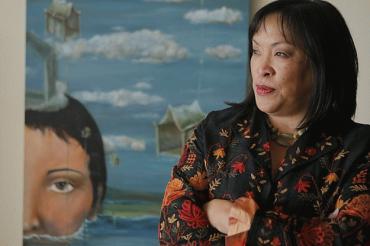
Artist Cynthia Tom’s journey to find her past

With her back toward the viewer and her right arm outstretched, a woman wearing a wheat-colored ballerina dress cups a billowy cloud edged with a crimson ribbon. Facing a desert landscape bordered with mountains, she gazes in the direction of three women, each connected to individual clouds via similar, scarlet-hued ribbons and positioned across the terrain.

This acrylic on canvas work, “Circus Series: The Cloud Walkers” (2011), is one of at least 10 in her Circus Series, including “Circus Series: Vivian and Her Synchronized Sea Plants” (2011) and “Circus Series: Cloud Walkers Rest Area” (2011), that reflects the magical realm in which surrealist painter and mixed-media artist Cynthia Tom’s imagination dwells.

She will exhibit 25 larger paintings, 30 smaller works and prints, re-envisioned secondhand shoes and more in her studio during the Mission Artists United “Spring Open Studios in the Mission” this weekend.

“It all starts with a quirky, slightly sick sense of humor that runs in my family,” says Tom of the beginnings of the Circus Series. “My dad is the impetus. One of the things that tied us together was watching ‘Monty Python’s Flying Circus’ as a family way back when.”

Born in San Francisco in the early 1960s, Tom still lives in the city. Her paintings depict powerful Chinese women in vibrantly hued, dreamy environs. Tom is also board president for the Asian American Women Artists Association. However, she didn’t grow up learning about her ancestry. Her father, Richard Tom, left Chinatown in the 1950s with his wife and child and moved to the Portola neighborhood.

“We were the only Asians out there at the time. My neighborhood was Greek, Italian, Anglo, Latin and African American,” she says. “I didn’t identify race. Everyone looked different because that was what people with different names and different families looked like, but not because of any myth their racial stereotype may have suggested. We were definitely all working-class kids and were always outside playing.”

Tom didn’t befriend any Asian American children until age 13, when she met Linda Leong and began working at a day camp at the Salvation Army in Chinatown.

“There are much more underlying reasons why my grandmother and parents didn’t teach too much about heritage; but the main one, I believe, is that they were all victims of trafficking one way or another. My father was sold (in China) to Chinese Americans and brought here at age 1,” she says. “My mother was traded by my grandfather for opium from 9 to 12 years of age. My maternal grandmother was sold as a second wife to my grandfather and treated more like a servant. When he died – leaving his family without any funds – his family, with funds, shunned my grandmother. She had to raise seven children on her own in Chinatown.”

Her artistic endeavors provoked Tom to research her family history. Maintaining a studio in Hunters Point Shipyard between 1990 and 2005, she initially based her paintings on found images from daily life and runway fashions, but her work lacked focus.

“JoeSam was a neighboring artist at Hunters Point Shipyard, an African American artist of great note. He became a mentor for my ethnic artistic path,” Tom says. “JoeSam told me that I would never be at my best if I didn’t explore my identity with my work; and he, of course, was right. It has led to the creation of art around my grandmother, mother and father, learning their history and in the process gaining a deep understanding of my motivations and emotional sludge, which I have since overcome.”

This spurred her designs of custom fabrics utilizing photographic images, including those of slave girls in Chinatown’s Bagnio District taken by Arnold Genthe in the early 1900s and of her infant father, then sewing them into pillows.

These evolved into “Discard & Variances,” a visual arts series about her family and the larger issue of human trafficking. The Yerba Buena Center for the Arts displayed the first installment in 2011. The second installment, “Discards & Variances: A Look at Human Trafficking,” is part of a group exhibition “Remnants: Artists Respond to the Chinese American Experience” at the Chinese Historical Society of America Museum.

“I understood Chinese New Year, but not much else. I’ve since learned some things, but I’m third generation,” she says. “Yet it is the exploration of my grandmother’s journey in the creation of my art that conjured forth my staunch feminism and advocacy for women and social justice.”

Cynthia Tom: “Spring Open Studios in the Mission.” Noon-6 p.m. Sat.-Sun. 1890 Bryant Street Studios, Suite 302, S.F. www.cynthiatom.com, www.1890Bryant.com, www.missionartistsunited.org. “Remnants: Artists Respond to the Chinese American Experience”: Opening Thurs. Chinese Historical Society of America Museum, 965 Clay St., S.F. www.chsa.org.

Stephanie Wright Hession is a freelance writer. datebookletters@sfchronicle.com

This article appeared on page F – 1 of the San Francisco Chronicle

De la Isla: Mexico nurtured U.S.-born artist Elizabeth Catlett

Mother and Child by Elizabeth Catlett

By Jose de la Isla
Posted April 11, 2012 at 4:38 p.m.

MEXICO CITY — Elizabeth Catlett died April 2 at age 96 in Cuernavaca, 80 miles south of this capital city.

Most accounts of the U.S.-born artist simply referred to her as an African-American who became a Mexican citizen. A few typecast her as an “important African-American” artist to typify her work in sculpture and printmaking.

She was much more than that.

Mexico’s National Council for Culture and the Arts has described Catlett as an artist who always demonstrated in her art a profound interest “in social justice and the rights of black people and Mexican women.”

An obituary in the Los Angeles Times noted the U.S. government had labeled her an “undesirable alien” in 1959. It mentioned she was briefly held in a roundup of ex-patriots living in Mexico who were suspected of Communist activity. She was denied a U.S. visa throughout the 1960s.

The same obituary quoted her as once telling a St. Petersburg Times journalist that “there’s a different attitude toward art in Mexico. As an artist, you’re greatly admired rather than looked at as something strange.”

Catlett’s best-known prints include “Sharecropper” (1952) and “Malcolm X Speaks for Us” (1969), expressing her lifelong commitment to art as a tool for social change, often incorporating the slogan “Black is beautiful.” Her better-known lithographs include posters of Angela Davis.

Catlett had said she wanted to show the history and strength of women: urban, country, working and great women of history.

Her sculptures include “Dancing Figure” (1961), “The Black Woman Speaks” and “Target” (1970). “Black Unity” (1968) shows a mahogany fist on one side and two African visages on the other. The sculptures “Homage to Black Women Poets” and “Homage to My Young Black Sisters” (both 1968) are red-cedar abstracts of a woman with raised head and fist.

Her biography reveals how, in a sense, that one’s life and work fuse the same way nationality, ethnicity, identity, life mission and talents do.

Elizabeth Catlett was born in 1915 in Washington, D.C., the granddaughter of freed slaves, a math-professor father and truant-officer mother. In the 1930s, she earned her undergraduate degree from Howard University in Washington, D.C.

She was exposed to the work of Mexican muralists Diego Rivera and Miguel Covarrubias, both of whom had worked extensively in the United States.

Covarrubias, as an illustrator for The New Yorker and other national magazines in the 1920s and ’30s, had introduced to millions the image of sophisticated jazz-age Negroes and Harlem.

Catlett preferred doing semiabstract sculptures after studying the form as a graduate student at the University of Iowa, earning a master’s in fine art in 1940. She sculpted “Negro Mother and Child” for her graduate thesis and won first prize in the 1940 Columbia Exposition in Chicago.

That same year, she chaired the art department of New Orleans’ Dillard University. Later in the 1940s, she moved to Mexico City to study ceramics. She added struggles of Mexican workers to her commitment to African-American causes. She referred to “my two people,” even blending their physical features in her art.

She found like-minded spirits in the Taller de Grafica Popular, a collective known for mass-producing posters supporting populist causes. She met renowned artist Francisco Mora here and married him. He died in 2002.

In Mexico, Catlett gained an acceptance she had not known at home, the same as other U.S. artists, writers and musicians such as composer Aaron Copland have experienced. She continued championing black causes even after becoming a Mexican citizen in 1962.

Perhaps this has to do with artists having a responsibility, like that of writers, to show the quest for justice, catch individual temperament and mood, and expose their color and shape.

Jose de la Isla is a columnist for Hispanic Link News Service. Email him at joseisla3@yahoo.com.

Iconic American Ballet Dancer Comes to Russia Again

Mitchell, 78, first came to Moscow in 1962 as a dancer. His most recent visit saw him give a master class.

“The fallacy was that black people could not do classical ballet,” American ballet dancer Arthur Mitchell explained recently to an audience at the American Center Library. “So I said — ‘I’ll change it.'”

Arthur Mitchell became the first African-American to dance with George Balanchine’s New York City Ballet in November 1955, an unprecedented accomplishment in the race-divided America of that time. In 1962, Mitchell traveled with the company to Moscow, becoming, he says, the first ballet dancer of color to perform for Russian audiences.

In 1969, Mitchell co-founded the Dance Theatre of Harlem, which became one of the most prominent performing ensembles in the country. In 1988, the dance ensemble was invited to perform in Russia. Mitchell is currently visiting as a featured speaker for American Seasons, a cultural exchange set up by the U.S.-Russia Bilateral Presidential Commission.

Q: You visited Moscow with the New York City Ballet in 1962. What was your experience like as an American in Russia during the Cold War Era?

A: Things were so different back then. You couldn’t just go and walk out. We were on pins and needles because none of us had been to Russia before. The company had tremendous success. I had an extremely successful tour because they had never seen a black man dance ballet before.

Q: What were people’s reactions to your performance?

A: It was incredible. I would step on the stage and hear all around “That’s Arthur Mitchell. That’s Arthur Mitchell.” One of my great heroes was [Vakhtang] Chabukiani, the Georgian dancer. He was an older man at that time, but he came out of retirement and danced with me. Khrushchev was in power [at the time], and wherever I went, they would seat me in his box. The young lady I was with was from Denmark, so the people would say “Othello and Desdemona! Come Othello!” It was really kind of amazing.

Q: What was it like to return in 1988 with the Dance Theatre of Harlem?

A: People came to me with dance programs I had signed in 1962. Once the Russians accept you as an artist, they never forget you — particularly dancers. There was always a great love and respect. You’re revered here. The love of art here, particularly dance, is unparalleled. Dance is one of their favorite art forms. Everyone seems to know it and love it.

Q: How has Russian dance changed since the fall of the Soviet Union?

A: Even this trip now, we’re amazed at how much contemporary dance there is here. It’s very popular. Everyone wants to be a modern dancer. They have been doing classical ballet for centuries and want to try something new. We just went to a school, and they did a variation on Alvin Ailey’s “Revelations.” These little kids — it was really amazing. It’s still very new, but it’s something that I never thought would be very popular here, and it seems that everyone wants to do it.

Q: What sort of a relationship do you have with the Russian artistic community?

A: Great love and respect. So many of the Russian dancers are very good friends of mine, and all of my teachers were Russian. [George] Balanchine, [Anatole] Obukhov, [Pierre] Vladimiroff, Madame [Felia] Doubrovska. They are all great dancers of Russia who were living in America. They were teachers of mine. The more current generation — [Rudolf] Nureyev, [Mikhail] Baryshnikov, Nina Ananiashvili from Georgia, Natalia Makarova. The arts world is much different from the regular world. You always run into people.

There’s an interchange between Russia and America that I don’t think has ever happened before. Artistically, I’m not speaking politically now. The exchange of cultures is very, very popular. The Bolshoi has hired their first American principal dancer. That’s unheard of. And the Kirov has just hired a young American girl. That’s something you would never think of, hiring an American to be one of their leading dancers, because their tradition, their syllabus, their training is so specific.

Q: Given the chance, would you come back a fourth time?

A: That’s what we hope will happen. This initiative is a collaboration between the President of America and the President of Russia. They wanted this cultural exchange. What is interesting is it’s based on what Diaghilev did when he took Russian music and dance to Paris so that the world would see what Russian art was like. This is the initiative that is happening through the American Embassy here: American Seasons. As an artist you get a chance to travel the world and see things that you normally wouldn’t. You get a feeling for people much better than a businessman or a politician could get.

Two new independent films court African American ticket buyers

By John Horn Los Angeles Times10:20 p.m. CDT, April 11, 2012

Movies aimed at African American moviegoers are typically the province of bigger-budget comedies and dramas — the kinds of stories told by Tyler Perryor produced by Screen Gems. But this weekend, two independently financed productions are courting that same audience.The two films — “Life, Love, Soul” and “Woman Thou Art Loosed: On the 7th Day” — couldn’t be more dissimilar.

The first film is a small, self-distributed drama about fatherhood and family, a passion project from first-time filmmaker Noel Calloway with a cast of newcomers. The second movie, a kidnapping drama starring Blair Underwood, was produced and is being released by Codeblack Entertainment, the company behind last year’s Kevin Hart concert movie, “Laugh at My Pain,” which grossed more than $7.7 million in domestic release.

Yet the two productions both hope to draw moviegoers that their filmmakers feel are hungry for content and can be reached without expensive national television advertising.

“It is a very, very underserved audience,” Jeff Clanagan, the president and chief executive of Codeblack, said of African American patrons, whom he estimated would make up more than 90% of the film’s audience.

Calloway’s path to the screen was not easy.

He wrote the “Life, Love, Soul” script in 1997, soon after graduating from high school in Harlem. “At my graduation, I looked out at the audience and saw mostly mothers and grandmothers,” Calloway said. He struggled raising money to finance his tale of a young man raised by a single mother who has to move in with his estranged father, and his lead investor pulled out halfway through filming in 2007. Calloway, who himself was raised by a single mother, wasn’t able to resume production for two years and only now has brought the movie to theaters; the film is opening in a handful of markets across the country.

“Woman Thou Art Loosed” is a sequel of sorts to the 2004 movie of the same name, based on the novel by Dallas minister T.D. Jakes, who serves as an executive producer on the new film. The movie will premiere in about 100 screens in more than a dozen cities nationally.

While Clanagan said the film could struggle generating big returns in some markets, he was optimistic “Woman Thou Art Loosed” will do well in Atlanta, Baltimore and Washington. “Our target audience is not going to see ‘The Three Stooges,’” he said of 20th Century Fox’s wide-release comedy.

Like “Life, Love, Soul,” Clanagan is using very targeted marketing to reach African American ticket buyers, relying heavily on word-of-mouth screenings and social media. “We’re not buying a lot of network television shows, but we did buy ads on VH1’s ‘Basketball Wives,’” Clanagan said of the cable television reality series.

Calloway hopes his film can find a broader audience. “It isn’t a black story,” the filmmaker said. “It’s about people, it’s about family, it’s about overcoming challenges.”

This article first appeared at LA Times.

No Joke – Five African American Films Debut on the Big Screen in April

St. Petersburg African-American Issues Examiner

When Friday the 13th  creeps on the calendar this month, it will mark a lucky day for black cinema.

Why?

Because five – that’s right, five – films will hit theaters in April that were produced by, for or about African Americans.

Bishop T.D. Jakes kicks things off with a follow-up to his 2004 movie, Woman Thou Art Loosed, starring Kimberly Elise.

Jakes’ latest installment in the Loosed franchise is titled, On the Seventh Day, and is a psychological thriller about a serial killer who murders children on the Sabbath, hence the film’s title.

When the killer abducts a young girl, an investigation into the crime uncovers secrets about her parents that could determine whether she lives or dies.

The subject matter is timely considering African Americans comprise 14 percent of the nation’s population yet account for more than 40 percent of all missing persons cases.

TV One, a cable network, sheds light on the subject in their new series, Find Our Missing, that highlights cases of missing blacks.

Blair Underwood delivers a powerhouse performance as the chid’s distraught father. His Box Office credits include, Set it Off, Just Cause and Asunder.

The film also stars blaxploitation film legend Pam Grier and relatively newcomer, Sharon Leal (Why Did I Get Married).

Not your cup of tea?

Then wait, there’s more!

Actor/Director Mario Van Peebles also has a movie debuting on Friday.

Dubbed, We the Party, the movie is a coming of age comdey set on a fictious college campus and stars Peebles, rapper Snoop Dog and actor Michael Jai White.

Three other films with predominately black casts also debut this month. They are:

  • Think Like a Man, which will be released on April 20th and is a dramedy based on the relationship book by comedian Steve Harvey. It features Hollywood’s A-listers Taraji P. Hall, Michael Ealy and Gabrielle Union.
  • Kevin MacDonald (Last King of Scotland) will release his long anticipated feature documentary about Reggae legend Bob Marley on April 20th.
  • Andrew Dosunmu round things off with Restless City, a film about an African immigrant trying to survive New York City‘s mean streets. It hits theaters on April 27th.

Little Known Black History Fact: The New Howard Theatre

The Howard Theater was called the country’s “Largest Colored Theater in the World.”

Date: Wednesday, April 11, 2012, 5:09 am
By: Erica Taylor, The Tom Joyner Morning Show

The Howard Theater in Washington, DC opened its doors in 1910. Nestled on DC’s “Black Broadway” the Howard Theater was the country’s “Largest Colored Theater in the World.” The Howard Theater was where the Supremes first made their debut in 1962 and where the winner of the featured amateur night was a young singer named Ella Fitzgerald.

Other legends that started their careers at the Howard Theater include: Duke Ellington, Billy Eckstine, Billy Taylor, Roberta Flack and Pearl Bailey. The venue was also an oratory auditorium for Booker T. Washington and many keynote speakers. Comedians Petey Greene, Dick Gregory, Redd Foxx and Moms Mabley entertained the Howard Theater’s vast audience. Howard Theater hosted VIP’s like President Franklin D. and Eleanor Roosevelt, who dropped in to see the superstars of vaudeville and jazz. Truant officers often raided the theater, knowing that students cut class to see the top performers. During the Great Depression, the theater served as a church before returning to Jazz under Duke Ellington’s band.

But in the later part of the 1960’s, the historic Howard Theater took a back seat to the civil rights movement and a downward shift in the neighborhood. The theater was the center of the 1968 race riots after Dr. King was assassinated. The Howard Theater was declared a national landmark in 1974 but remained empty for 30 years.

Recently, investors like the Ellis Development Group took an interest in restoring the theater to its original prestige. After a $29 million renovation, the Howard Theater is once again ready to open its doors to the public.

With 12,000 square feet of entertainment space, the Howard Theater now has room for 1,000 standing customers and up to 750 for supper-club events. It features a new surround-system, sizable TV screens and VIP sections. The Howard Theater’s grand opening this week will feature performances by Smokey Robinson, Savion Glover, Al Jarreau and Martha Reeves.

Black passengers add another facet to Titanic story

Dawn Turner Trice

April 9, 2012

In preparing his 1997 movie “Titanic” for 3-D, James Cameron reportedly reshot a scene because an astronomer told him that the position of the stars was wrong in the original movie.

Christine LeBrun, 35, of Palatine, said there’s another historical inaccuracy in Cameron’s original blockbuster that she wishes he’d corrected for the new “Titanic 3D”: He didn’t include any mention of Joseph Laroche, a Haitian-born, French-educated engineer traveling with his family who is believed to be the only black man among the passengers on the Titanic.

LeBrun recently found out that Laroche is a distant relative.

The 100th anniversary of the Titanic’s sinking is April 15, and LeBrun says that despite the many accounts about the ill-fated cruise liner, very few have featured Laroche.

How she came to know about her ancestor is a story that begins in a hair salon in 2000.

“About 12 years ago, my uncle Robert’s wife was in a beauty salon looking through (an Ebony) magazine,” said LeBrun, an alumni relations director for a Catholic high school. “She came across a photo and said, ‘Oh, my gosh, that man looks just like my husband.'”

The photograph accompanied an article about an exhibit on the Titanic that had opened at Chicago’s Museum of Science and Industry and featured Laroche, 26, his pregnant wife, Juliette, 22, and their two daughters. The family was leaving France and moving to Haiti because Laroche couldn’t find work in his profession.

Laroche’s mother had sent the family first-class tickets to travel on the French liner France. But just before departure, the Laroches learned that the ship wouldn’t allow them to dine with their children. Out of concern about the younger daughter, who was sickly, they traded their tickets for second-class tickets on the Titanic.

LeBrun’s aunt took the magazine home and showed Laroche’s photograph to her husband, Robert Richard. He wasn’t certain whether the picture looked like him, but he did recognize the last name.

“He said, ‘My real last name was supposed to be Laroche, but because my father never married my mother, we never took his name,'” LeBrun said. “He called (his daughter) and told her he might be related to Joseph and she started to do research.”

LeBrun said her cousin Marjorie Alberts, who lives in California, learned that Laroche grew up in a well-to-do Haitian family. When he was 14, his parents sent him to France to study engineering. There he met Juliette, who was white and whose father owned a winery.

“It’s puzzling, considering the times, that her father did not take issue with his daughter dating a black man,” LeBrun said. “They eventually married and gave birth to Simonne in 1909. She was fine, and it was a normal birth. But when they gave birth to Louise in 1910, she was premature and had lots of problems.

“Joseph (Laroche) at that point had been trying to find work in France, but nobody would give him work because he was black. Coming from a position of privilege in Haiti, he wasn’t used to this and he decided to move his family to Haiti, where his uncle was the president and his job prospects would be much better.”

The family boarded the Titanic on the evening of April 10, 1912, at Cherbourg, France. According to the museum exhibit, the family spent most of their time enjoying the British luxury liner. But some crew members did make disparaging comments to Laroche and his daughters, believing they were Italian or Japanese because of their darker skin.

On the night of April 14, Laroche was in the smoking parlor with other men traveling second class when he felt the ship hit the iceberg. He ran back to his room to check on his wife and daughters.

When the ship began to sink, Laroche placed the family’s money and valuables in a coat and draped it around his wife’s shoulders. (The coat was later stolen.) He then placed his family in a lifeboat and stayed on the ship helping get other women and children to safety.

He told his wife he would meet her in New York. But he didn’t survive and his body was never found.

LeBrun said Juliette Laroche, their two daughters and unborn son survived, and when they eventually returned to France, her father had lost his winery during World War I. The family lived in poverty for a few years until she won a settlement from the Titanic disaster.

“They led a seminormal life,” LeBrun said. “Juliette never remarried, and the girls never married. Some people believe she was overprotective of them. But their son did lead a normal life and he married a woman named Claudine and they had two sons and a daughter.”

Alberts said it took her several years to figure out how they were related to Laroche. His grandfather Henri Cadet Laroche was married 11 times. Joseph Laroche was born from the union between the grandfather and his 11th wife. Alberts and LeBrun’s family members are the descendants of the union from Henri Cadet Laroche and his first wife.

LeBrun said she just happened to find all of this out last month after she read a Facebook post by Alberts, an actress and writer who’s working on a screenplay about Laroche. The cousins hadn’t been in contact for nearly two decades.

LeBrun said that while she enjoyed Cameron’s tale of two young people from different social classes falling in love aboard a doomed ship, it’s not a complete story.

“For me, the real love story is between Joseph and Juliette,” LeBrun said.

Alberts said it’s important to correct the historical record.

“I want everybody to know that the Titanic was going to Haiti, and there was a black man onboard who wasn’t a slave or waiter or servant,” Alberts said. “I remember seeing the movie with my father in 1997 and I had goose bumps. It means even more now.”

dtrice@tribune.com

NOTED AFRICAN-AMERICAN SCULPTOR’S WORKS ON VIEW AT READING PUBLIC MUSEUM

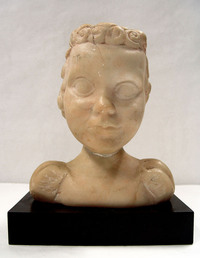
Selma Burke, Young Girl, marble (Reading Public Museum)

Reading , Pennsylvania — 10 April 2012

(ArtfixDaily.com) Two works by noted African-American sculptor, Selma Burke, are on display in the Reading Public Museum’s newly renovated and expanded Cohen Gallery of Modern and Contemporary Art. The pieces — a marble bust of a young girl and a wooden mother and child — are on a two-year loan to The Museum courtesy of Anselene Morris and Frederick Toone Bacon.
Born in 1900 in Mooresville, North Carolina, Selma Burke’s work was never fully acknowledged. As a child, she liked to whittle and model in clay but her mother insisted she get an education for a “career.” She was educated at Slater Industrial and State Normal School, now Winston-Salem State University; St. Agnes School of Nursing, Raleigh; and Women’s Medical College, Philadelphia.


In 1924, she moved to New York where she worked as a nurse. But art was her calling, and she continued to work as an artist. Her accomplishments were so great that in 1935, she earned a Rosenwald Foundation Fellowship, and in 1936, a Boehler Foundation Fellowship. Both awards allowed her to travel to Europe where she studied ceramics with Povoleny in Vienna and sculpture with Maillol in Paris.


In 1941, Burke completed a Master of Fine Arts degree at Columbia University. At the age of 70, she completed a Doctorate in Arts and Letters at Livingstone College, Salisbury, North Carolina. Selma was influenced by, among others, Henri Matisse, painter, and Frank Lloyd Wright, architect.


In 1944, President Roosevelt posed for the artist and her completed bronze plaque was unveiled by President Harry S. Truman in 1945. It can be seen at the Recorder of Deeds Building in Washington, D.C.; the image was also used on the American ten cent piece (dime). Since the coin bears the initials of the engraver, John Sinnock, Selma Burke has never received proper credit for the portrait.


In 1949, she married Herman Kobbe and moved to New Hope, Pennsylvania where she continued to work on her sculpture and tutor artists. Selma was a great lover and supporter of the arts. In 1968, she was the founder of the Selma Burke Art Center in Pittsburgh, and remained an administrator there until 1981, when she returned to her home and studio in New Hope.


Burke was an honorary member of Delta Sigma Theta Sorority, a non-profit Greek-lettered sorority of college-educated women who perform public service and place emphasis on the African American community. She received many other awards and honors. Other examples of her work can be viewed in the Metropolitan and Whitney museums.


At the age of 80, in 1980, Burke produced her last monumental work, a statue of Martin Luther King, Jr., that graces Marshall Park in Charlotte, North Carolina. She died in 1995 in Newton, Pennsylvania. She had been working to complete a sculpture of civil rights activist Rosa  Parks.
The Reading Public Museum is located at 500 Museum Road, Reading, PA. Admission per day is: $8* adults (18-64), $5 children/seniors/college students (w/ID) and free to members and children three years old and under. Hours are Tuesday through Saturday 11 a.m. to 5 p.m. and Sunday noon to 5 p.m. Web: www.readingpublicmuseum.org


*Special exhibition surcharge may apply.


About Reading Public Museum:

The Reading Public Museum is located at 500 Museum Road, Reading, PA 19611. Hours are Tuesday – Saturday 11 a.m. to 5 p.m. and Sunday 12 to 5 p.m. Admission to the Museum is: $8 adults (18-59), $6 children/seniors/students (w/ID) and free to Members and children three years old and under. Web: www.readingpublicmuseum.org

Press Contact:

Michael Anderson
Reading Public Museum
610-371-5850 x231

Why Everyone Suddenly Cares About Nail Art

Rihanna shows off a manicure.

It’s been popular for ages in African-American communities. But now that nail art has gone high-fashion, everyone’s suddenly discovered it.

Fashion’s “it” things inspire obsessions and frantic longings in consumers. There was the “it” bag, which made way for the “it” shoe, which made way for the latest “it” thing: nail art. Pop stars are analyzed almost as much for their nails as they are for their clothes; designers obsess over the perfect nail hue for models to wear in their runway shows; and women across America are rushing into drug stores to pick up the latest line of Minx. But of all the recent, extensive coverage of nail trends, including last week’s 1302-word piece in the “Times,” one piece of background information is consistently left out: black women have been experimenting with nail art for decades.

“Nail art really isn’t a budding trend. It’s something that’s been around forever in the black community,” says Aja Mangum, a freelance beauty and market editor who spent a decade at “New York” magazine. “You used to associate it with being a little ‘hood’ or ‘ghetto fab.’ Now white women are tricking out their nails and it’s not seen that way.” Mangum says she’s one of “very few” black editors in the fashion world — which is at the heart of the issue, she argues.

When mainstream fashion magazines and other media fail to mention the roots of a fashion trend in the black community, it’s mostly just a matter of ignorance, Mangum believes. To her white friends and colleagues, most of whom she says have few if any other black friends, black beauty trends and common practices are foreign. “They ask why I wrap my hair up at night or why I grease my scalp,” she says.

When it comes to beauty treatments commonly practiced by black women at home, it’s more understandable that lots of white women don’t know about them. But when it comes to nails? As Mangum puts it, black women have long embraced rhinestones and lots of other nail “bedazzlement” for years.

Sophia Panych, Associate Editor at “Allure,” traces the popularization of nail art trends – and their inclusion in spreads in the magazine – back to the runway and celebrities. “We started seeing it on a lot of rock and hip-hop artists. Beyoncé had a big part in it,” she says, adding that high fashion runways seized on the trend at the same moment. “Chanel started by making a [nail] color a fashion accessory. The color they use on the runway usually becomes the trendiest of the season.”

In this case, Mangum suggests, editors and writers may be reluctant to delve into a trend’s roots in the black community out of fear of backlash for explaining it wrong and coming across as racist.

Daily Beast and Newsweek fashion critic Robin Givhan, who’s written extensively on the issue of race in fashion, agrees that the nail trend “crossed some kind of threshold” that’s brought it into the consciousness of the mainstream media, but suggests that may be related more to class than race: “Maybe it crossed some class line, as opposed to having crossed a racial line.”

In fact, she says that ascribing a trend’s origins to a certain race or group can actually be damaging.

“You have to be very careful in claiming that any group of people owns a look, or claiming that you have to pay homage to them,” she says. “I think it depends on what the story is. If you’re writing about the popularity of nail art, I don’t know that it is mandatory that you trace the lineage of it, unless that’s the kind of story you are writing.”

source….


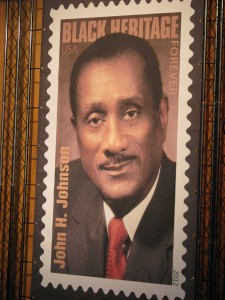
John H. Johnson Honored with Black Heritage Forever Stamp


Pioneering entrepreneur and publisher John Harold Johnson received one of the U.S. Postal Service’s highest honors on Jan. 31 when he was commemorated with this year’s Black Heritage Forever Stamp.

Johnson, the founder of the Johnson Publishing Company, which publishes Ebony and Jet magazine, now joins the 34 other honorees in the Postal Service’s Black Heritage Stamp series since 1978.

Johnson was born on Jan. 19, 1918, and died of heart failure on Aug. 8, 2005, at the age of 87.

Johnson made the decision to first publish the horrific details and photos of the open casket funeral of 14-year-old Emmett Louis Till, a Chicago youth who was murdered in Mississippi by two white racists for whistling at one of their wives in August 1955.

You can see a video of Residents’ Journal’s coverage of the Johnson Publishing Company’s involvement in the memorial service on the 54th anniversary of Till’s death at: http://youtu.be/7CBfolmW1bM.

The Johnson “Forever Stamp” was designed by art director Howard E. Paine and is equal in value to the current First Class stamp, 45 cents each or $9 a sheet.

Against All Odds Foundation Social Entrepreneur Provides Hope to New Jersey Youth

The odds were stacked against her – abused, neglected, and homeless after the loss of both parents to substance abuse and AIDS, Christine Carter became just another ward of the child welfare system. As she grew into adulthood, she had a choice: define the terms of her own life, or become another statistic. Her choice was clear. Not only would she be the first in her family to graduate from college earning her bachelor’s degree, summa cum laude in social work from Norfolk State University, and her master’s degree in business administration at the young age of twenty-four, she would found a non-profit multi-service agency serving at-risk children and families throughout the state of New Jersey and nationally.

Seven years later, the Against All Odds Foundation maintains a full-time staff of 12 and a part-time staff of over 150 employees. Under her leadership, the organization has provided free services to numerous families in New Jersey. It has earnings of over $1 million in unrestricted revenue and has secured contracts from a range of institutions, including state and local governments, other non-profit organizations and business entities. Christine’s success has made her a leader among her peers in the non-profit, social service and educational arenas. She is also a public speaker, writer and role model for young women.

Newark Mayor Cory Booker shared about Christine, “We are proud of [Carter] who gives hope, empowerment and love to our beloved brick city.” In addition to overseeing the day-to-day operations of the Against All Odds Foundation, Christine consults both non-profits and business leaders on successful program strategies from development, implementation and expansion.

In observance of Black History Month, Christine appeared on the Wendy Williams show to kick off Procter and Gamble’s My Black is Beautiful campaign. The campaign celebrates the diverse collective beauty of African American women.  To learn more about Against All Odds Foundation, visit http://againstalloddsnj.org/.

Celebrating the Works of William H. Johnson

SOURCE U.S. Postal Service

African-American Artist Honored on Forever Stamp

BALTIMORE, April 10, 2012 /PRNewswire-USNewswire/ — The following is being released by the U.S. Postal Service:

What: First-Day-of-Issue dedication ceremony of William H. Johnson Forever stamp.

Who: Ronald Stroman, deputy postmaster general, U.S. Postal Service
Dr. David Wilson, president, Morgan State University
Dr. Leslie King-Hammond, Graduate Dean Emerita/founding director, Center for Race and Culture
S. Marquette Folley, project director, Smithsonian Institution Traveling Exhibition Service
Marcellus Shepard, radio personality, WEAA-FM 88.9

When: 11 a.m., Wed. Apr. 11, 2012

Where: Murphy Fine Arts Center – Gilliam Concert
Morgan State University
2201 Argonne Drive
Baltimore, MD 21251

Background: Flowers, an oil-on-plywood painting dated 1939-1940, depicts a vase of boldly rendered, brightly colored blooms on a small red table. Johnson is recognized as a major figure in 20th century American art. He is known for his colorful, folk-inspired scenes of African-American daily life as well as his dramatic Scandinavian landscapes. The Postal Service honors William H. Johnson, through the 11th issuance of the American Treasures series as a sheet of 20 self-adhesive Forever stamps. The stamps go on sale nationwide April 11.

The Postal Service receives no tax dollars for operating expenses, and relies on the sale of postage, products and services to fund its operations.

A self-supporting government enterprise, the U.S. Postal Service is the only delivery service that reaches every address in the nation, 151 million residences, businesses and Post Office Boxes. The Postal Service receives no tax dollars for operating expenses, and relies on the sale of postage, products and services to fund its operations. With 32,000 retail locations and the most frequently visited website in the federal government, usps.com, the Postal Service has annual revenue of more than $65 billion and delivers nearly 40 percent of the world’s mail. If it were a private sector company, the U.S. Postal Service would rank 35th in the 2011 Fortune 500. In 2011, the U.S. Postal Service was ranked number one in overall service performance, out of the top 20 wealthiest nations in the world, by Oxford Strategic Consulting. Black Enterprise and Hispanic Business magazines ranked the Postal Service as a leader in workforce diversity. The Postal Service has been named the Most Trusted Government Agency for six years and the sixth Most Trusted Business in the nation by the Ponemon Institute.

Follow the Postal Service on Twitter @USPS_PR and at Facebook.com/usps

©2012 PR Newswire. All Rights Reserved.

William H. Johnson “Flowers” stamp debuts


William H. Johnson “Flowers” stamp debuts
By Jacqueline Trescott

With the flower stands now bursting with spring color, it is beneficial to study how famous artists arranged blooms and contrasted the bright and delicate shades.

The U.S. Postal Service is making that easy Wednesday with its release of William H. Johnson’s “Flowers” on its latest “Forever” stamp. Johnson, who lived from 1901 to 1970 and whose painting of “Flowers” is at the Smithsonian American Art Museum, drew realistic scenes of African-American life. He also ventured into other subjects. The painting shows a vase of flowers, ranging from daisies to abstract blossoms.

An exhibition of Johnson’s work, organized by the Smithsonian Traveling Exhibitions department, is currently at Morgan State University.