The Corcoran Displays Contemporary African American Art in “30 Americans”

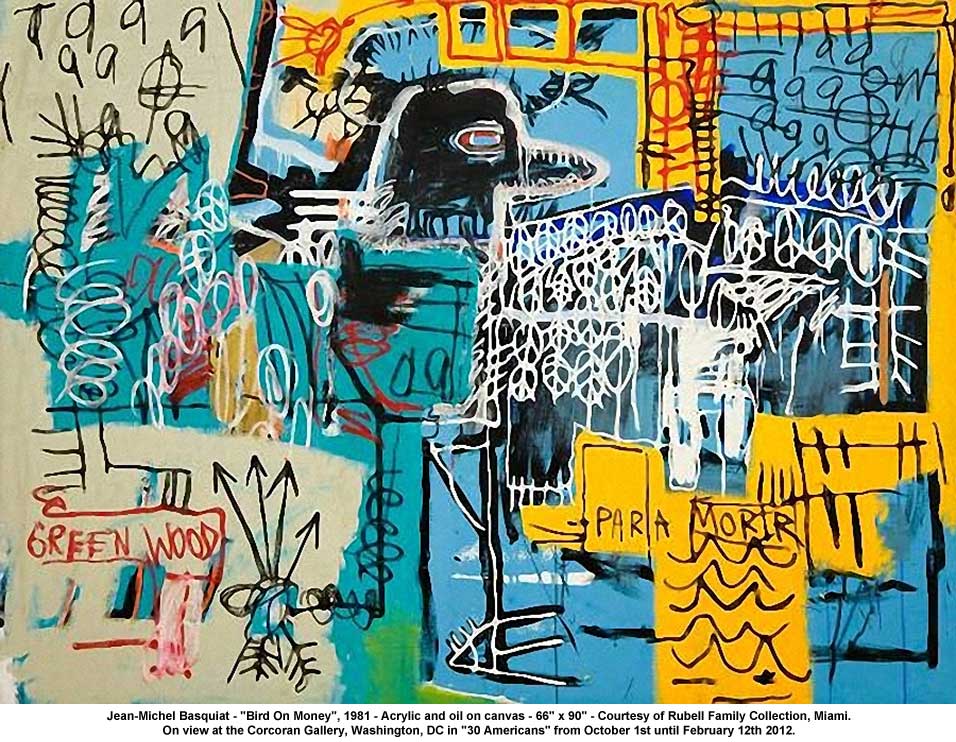
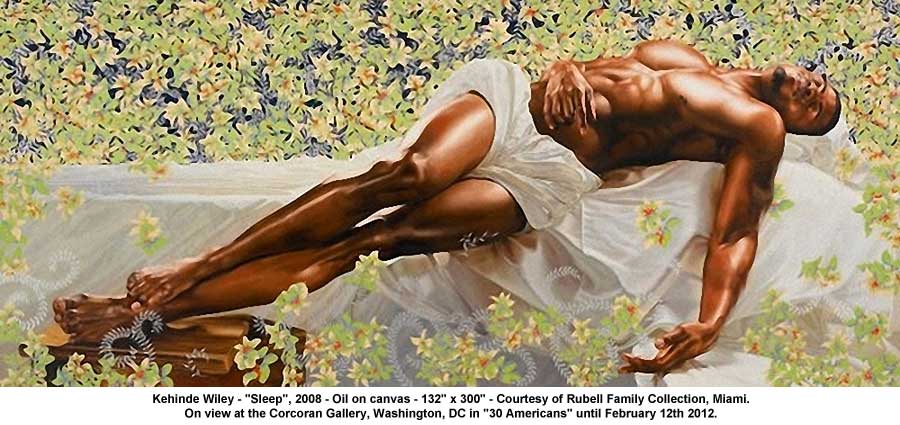
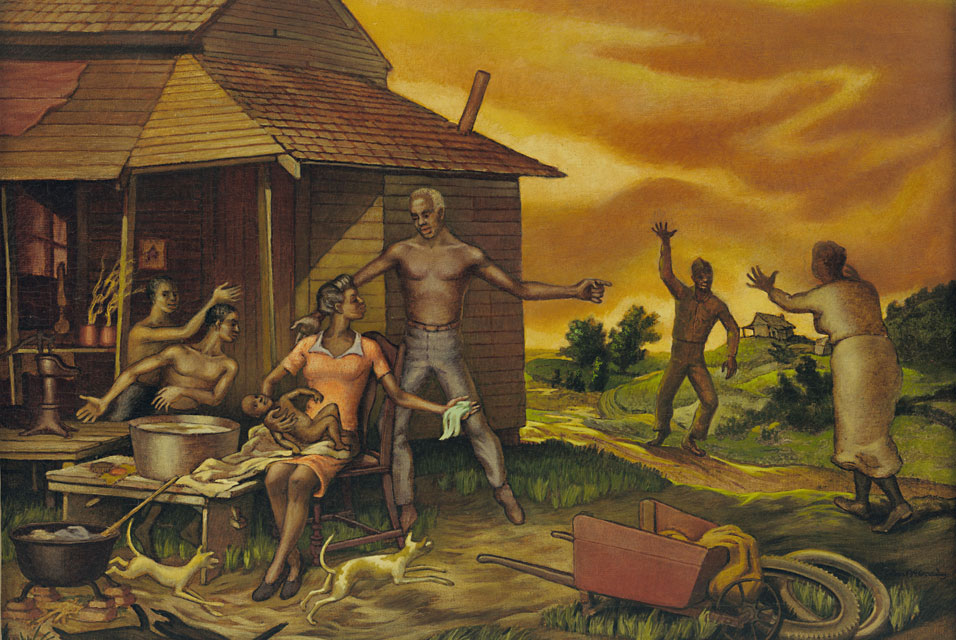
Washington DC.- The Corcoran Gallery of Art and College of Art + Design is proud to present “30 Americans”, a wide-ranging survey of works by many of the most important African-American contemporary artists of the last three decades. By bringing seminal artistic figures together with younger and emerging artists, the exhibition explores artistic influence across generations and sheds light on issues of racial, sexual and historical identity. Often provocative and challenging, “30 Americans” at the Corcoran explores ideas central to the American experience. “30 Americans” is on view at the gallery from October 1st through February 12th 2012.

Artists included in “30 Americans” include Nina Chanel Abney, John Bankston, Jean-Michel Basquiat, Mark Bradford, iona rozeal brown, Nick Cave, Robert Colescott, Noah Davis, Leonardo Drew, Renée Green, David Hammons, Barkley L. Hendricks, Rashid Johnson, Glenn Ligon, Kalup Linzy, Kerry James Marshall, Rodney McMillian, Wangechi Mutu, William Pope.L, Gary Simmons, Xaviera Simmons, Lorna Simpson, Shinique Smith, Jeff Sonhouse, Henry Taylor, Hank Willis Thomas, Mickalene Thomas, Kara Walker, Carrie Mae Weems, Kehinde Wiley, and Purvis Young. First shown  at the Rubell Family Collection in Miami, Florida, “30 Americans” has been reconceived for its presentation in Washington. At the Corcoran, the exhibition is organized around ideas of identity as well as artistic community and legacy, highlighting relationships between artists across generations. The exhibition explores the ways in which a foundational figure‘s ideas and formal innovations ripple through contemporary practice: Robert Colescott‘s investigations of the narratives of art and history in relation to African-American culture echo through the grand portraits of Kehinde Wiley and the cut-paper silhouettes of Kara Walker; the innovations of  Jean-Michel Basquiat‘s graffiti-based paintings of the urban environment find current form in the work of Mark Bradford and Shinique Smith; while David Hammons‘s wry investigations of language, meaning, and race provide a starting point for  the conceptualism of Glenn Ligon and Lorna Simpson.

The Corcoran Gallery of Art stands as a major center of American art, both historic and contemporary. Founded “for the purpose of encouraging American Genius,” the Corcoran’s extensive collection of 18th, 19th, and 20th century American art represents most significant American artists. The Corcoran possesses a fine collection of European art as well. While continuing its efforts to represent historic American works, the gallery also encourages modern European and American artists by showing and purchasing their work, paying particular attention to artists in the Washington area. The permanent collection includes works by Rembrandt, Eugène Delacroix, Edgar Degas, Thomas Gainsborough, John Singer Sargent, Claude Monet, Pablo Picasso, Edward Hopper, Willem de Kooning, Joan Mitchell, Gene Davis, and many others. There are always several exhibitions on display, regularly featuring contemporary work on the second floor with modern and early American work on the first floor. The Corcoran is the oldest and largest non-federal art museum in the District of Columbia. Its mission is to be “dedicated to art and used solely for the purpose of encouraging the American genius”. Visit the museum’s website at … www.corcoran.org


Harlem Renaissance Artist Catlett Dies At 96

April 5, 2012

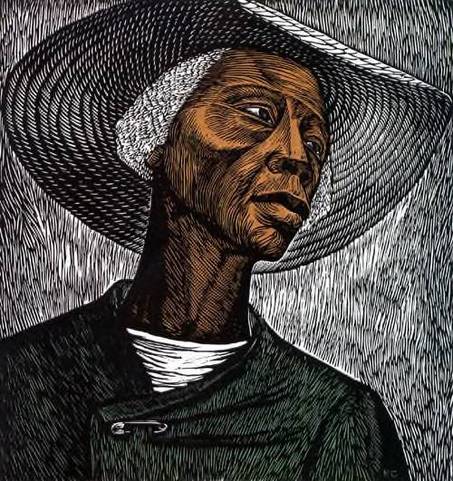
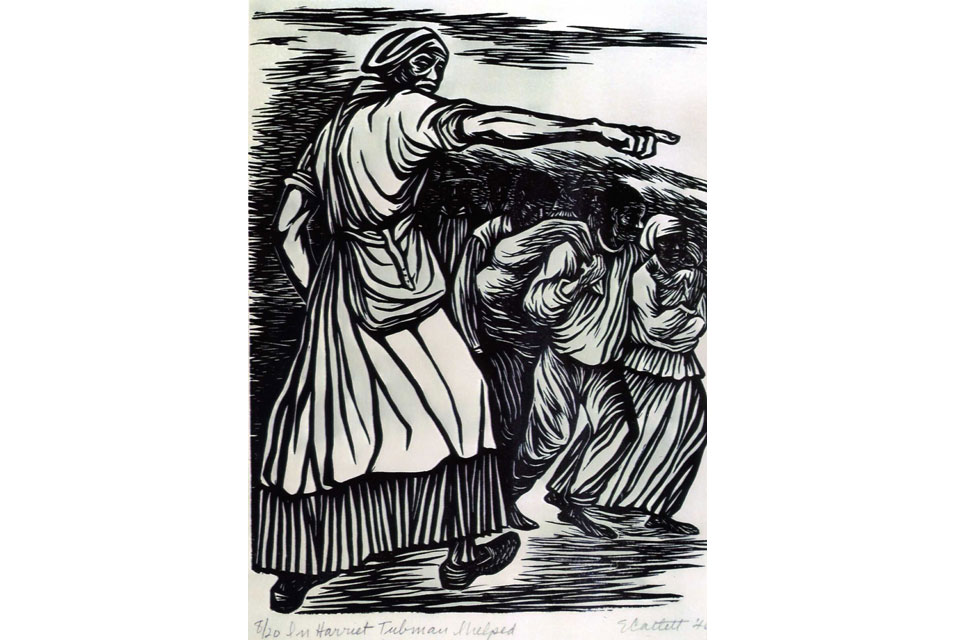
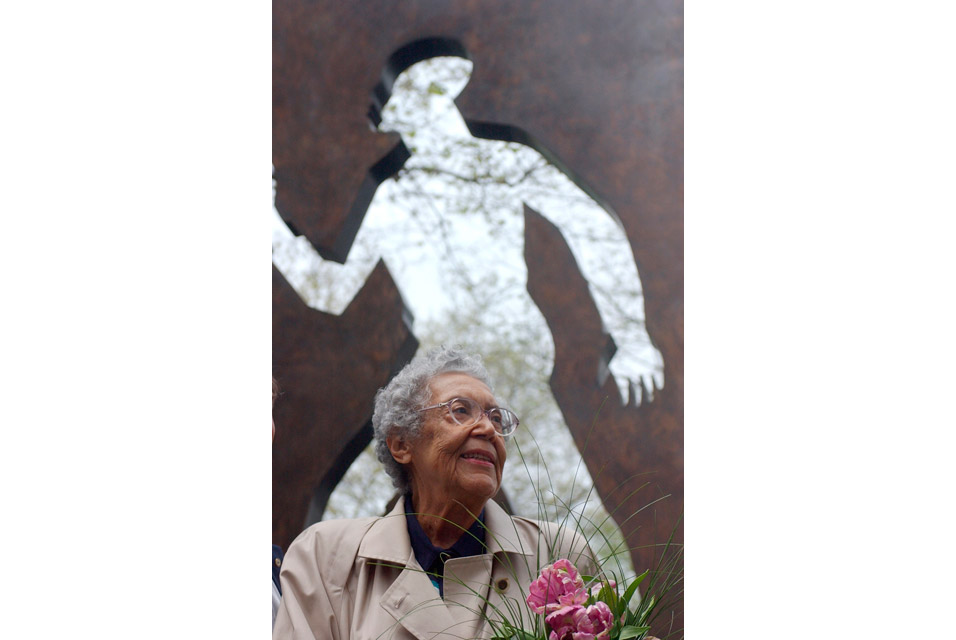
Sculptor Elizabeth Catlett was one of the most important African-American artists of the 20th century and one of the last living links to the Harlem Renaissance. She died Monday at the age of 96.

Copyright © 2012 National Public Radio®. For personal, noncommercial use only. See Terms of Use. For other uses, prior permission required.

RENEE MONTAGNE, HOST:

And we remember now an African-American artist whose sculptures helped defined the modernist style while offering pointed commentary on divisive issues like race. Elizabeth Catlett was 96 when she died. NPR’s Allison Keyes has this story.

ALLISON KEYES, BYLINE: Strength and power shout from the raised fist of the brown sculpted female figure in Elizabeth Catlett’s 1968 piece “Oh-Mage TO My Young Black Sisters.” Haunting Afro-centric eyes gaze compellingly from many of her creations. You can see them in her 1939 sculpture “Mother and Child,” and in her 2003 seated figure, a bronze of a woman, head tilted skyward as if to look at the sun.

ISOLDE BRIELMAIER: You can really see life and history unfold in her work.

KEYES: Isolde Brielmaier curated an exhibition of Catlett’s work last year at the Bronx Museum of the Arts. It was called “Stargazers,” after a striking 2007 Catlett sculpture.

BRIELMAIER: It was sort of inspired for Elizabeth after Harriet Tubman.

KEYES: The black marble reclining woman somehow exudes the same power as the raised fists in some of Catlett’s other works. Brielmaier thinks of the sculpture as looking toward the future.

BRIELMAIER: There’s something about this beautiful kind of languid female form that’s sort of firmly and boldly grounded gazing up at the stars, gazing up at the universe.

FRANCISO MORA CATLETT: The art form makes you feel something.

KEYES: Catlett’s oldest son, Franciso Mora Catlett.

CATLETT: It alerts or awakens something in you, that’s the important thing about it.

KEYES: Mora Catlett says when his mother was putting up an exhibition, she made sure to ask regular folk what her work made them feel.

CATLETT: She was very keen in watching people’s reaction on her work, because it was for people that she was working for.

KEYES: From work such as 1969’s “Negro Es Bello,” to her involvement in progressive education and social causes, Catlett’s love, compassion and work ethic come through in her art.

CATLETT: I believe it’s the reason why so much of her work is so powerful.

KEYES: Though much of her early career was ignored by the mainstream art world, Catlett’s work is now collected by museums all over the world. Still, the artist said it was too much when NPR told her last year that she had been described as the matriarch of modernist sculpture.

(SOUNDBITE OF ARCHIVED RECORDING)

ELIZABETH CATLETT: I’m not the matriarch. I don’t know who the matriarch is. I know it’s not me.

KEYES: Yet scholars and admirers alike say Elizabeth Catlett’s unique vision will influence artists concerned with the social issues that affect the world for years to come.

Allison Keyes, NPR News.

Art poised for eager crowds


It was not exactly a twist-and-shout moment when The Dance came off the wall at the Barnes Foundation in Merion.

Nearly two decades ago, amid incessant legal skirmishing, Matisse’s 34-foot-wide triptych mural on canvas was maneuvered from the wall it had been made to fill, and traveled to Washington, Paris, and the Philadelphia Museum of Art for exhibition.

It was a tense, court-approved voyage, but The Dance waltzed through it, finally returning to its newly renovated Merion home in 1995.

Last year, amid even more legal skirmishing over plans to move the entire Barnes collection, The Dance again came down from its perch, this time permanently, and it has been reinstalled in its new home at the soon-to-open Barnes gallery on the Benjamin Franklin Parkway. Foundation officials decline to discuss the moving or reinstallation of the collection, citing security concerns.

Timed tickets to see The Dance and the rest of the Barnes Foundation’s renowned collection of early modernist works go on sale Thursday to the general public.

The $150 million gallery officially opens May 19, and tickets have been moving briskly to Barnes members since Feb. 1. In fact, memberships, too, have been selling well, foundation officials say: In March 2009, membership totaled 390; today, there are about 15,000 members. Package prices begin at $90. Without membership, adult tickets are $18.

Because of the modest size of the foundation’s gallery spaces – the Philadelphia gallery interiors mimic those in Merion – timed tickets are necessary. Gallery hours will be 9:30 a.m. to 6 p.m. Wednesdays through Mondays, with Friday hours extended to 10. A maximum of 150 visitors will be admitted per hour.

During the last phase of its life in Merion, the Barnes was open six days a week, with a visitor limit of 450 per day (up from the previous limit of 400). Annual attendance never came close to 100,000, the foundation reported.

Barnes officials now expect a shade more than 200,000 visitors in 2012. In 2013, admissions should be roughly 350,000, said Peg Zminda, Barnes executive vice president and chief operating and financial officer.

Visitation will be driven, for a time, she said, by curiosity; numbers will likely dip in 2014.

The operating budget for 2013, the first full year at the new site, is projected at about $14 million, Zminda said. About 56 percent of that will come from earned income – admissions and other sales.

John Jones Visual Artist

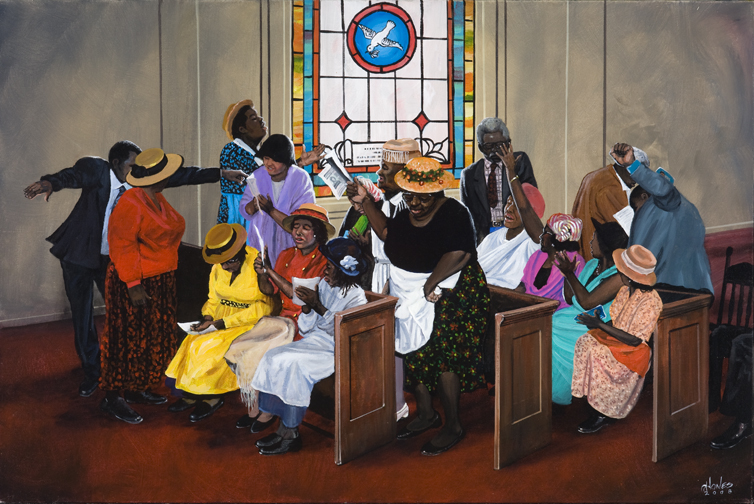
Camp Meeting by John W. Jones

For Sale $125

Born May 11, 1950 in Columbia, S.C. Jones has been a freelance artist and illustrator for more than 25 years. His former clients include Time Life Books, IBM, Westinghouse, Rubbermaid, NASA, Gadded Space and Flight Center, and the U.S. Postal Service.

Jones explores life through art. This multi-talented artist uses oils, acrylics and watercolors for his painting. Striving for detail in light and reflection, he meticulously draws each painting first, and then layers it with color, resulting in very realistic interpretations of everyday life and landscapes, as well as historical insights into our past.

Jones’ goal is to paint the African American experience starting with the slave trade in Africa, through the Middle Passage and pre-civil war era, and contrast it with African Americans today.

Mr. Jones is the artist and author of the book and traveling exhibition, Confederate Currency: The Color of Money, Images of Slavery in Confederate and Southern States Currency.

In addition to the “Confederate Currency: The color of Money” series, he has painted a series on the Buffalo Soldiers, the 54th Massachusetts regiment and African Americans in the Military. He is currently working on a project that puts focus on the everyday lives of the Gullah people and the struggles and issues they face in trying to sustain their culture in modern day America.

His work is represented in several private and public collections including the Charleston Metro Chamber of Commerce, the City of Charleston, Benedict College, The College of Charleston, and The Martin Luther King, Jr., National Historic Site. His recent published works include “The cover of the Charleston Area Visitors guide”, and “the Charleston Farmers Market”. His paintings are available at the Rita Smith Gallery in Columbia, SC and Gallery Chuma in Charleston, SC.

Jones has received several awards, including merit awards for his works in the 1998 and 1999 Piccolo Spoleto Festival Art Show.

Jones, who graduated from high school in 1968 and self-taught, has been drawing since early childhood. Drafted into the U.S. Army in 1970, Jones served in the Vietnam War, where he also took illustration classes in military School.

Jones has lectured widely as an artist, activist and motivational speaker at various universities and colleges, conferences and corporate events.

His current traveling exhibition, Confederate Currency: The Color of Money has been featured in several well-respected and top media outlets, including The New York Times, Time Magazine, San Francisco Chronicle, The Boston Globe, CNN and National Public Radio and The Post and Courier.

Eclectic treasures trace 200 years of Louisiana history at Capitol Park Museum

BATON ROUGE, LA.- After two years of planning, a milestone exhibition by the Louisiana State Museum traces two centuries of Louisiana history and culture with displays of rarely seen artifacts, documents and works of art. Our Louisiana: Celebrating 200 Years of Statehood opens March 20 at the Capitol Park Museum in Baton Rouge. “
Our Louisiana will help commemorate Louisiana’s 200th birthday by showing off some of our state’s most interesting artifacts,” Lt. Governor Jay Dardenne said. “The curatorial staff did a great job choosing pieces from the Louisiana State Museum collection to highlight Louisiana’s colorful history.”
From 450,000 artifacts in the Museum’s holdings, curators chose about 150 for exhibit in Our Louisiana. These include paintings, prints, photographs, clothing, textiles, industrial and scientific equipment, furniture, decorative arts, maps, books and manuscripts.
From 450,000 artifacts in the Museum’s holdings, curators chose about 150 for exhibit in Our Louisiana. These include paintings, prints, photographs, clothing, textiles, industrial and scientific equipment, furniture, decorative arts, maps, books and manuscripts. “
To develop this important show marking the Bicentennial of Louisiana statehood, curators looked for objects that had not been exhibited publicly for many years—if ever—that showcase the scope and depth of the Museum’s collections and illustrate our shared heritage in fresh and surprising ways,” Dawn Deano Hammatt, director of curatorial services, said.
Several large objects serve as focal points, including two fascinating relics of Louisiana political history—the magnificently restored horse-drawn catafalque used in Jefferson Davis’ funeral procession in New Orleans in 1889, and Huey Long’s deathbed and other original furnishings from the hospital suite at the old Our Lady of the Lake Hospital in Baton Rouge where he was brought after being shot.
Several large objects serve as focal points, including two fascinating relics of Louisiana political history—the magnificently restored horse-drawn catafalque used in Jefferson Davis’ funeral procession in New Orleans in 1889, and Huey Long’s deathbed and other original furnishings from the hospital suite at the old Our Lady of the Lake Hospital in Baton Rouge where he was brought after being shot. “
Visitors will find an eclectic treasure trove of Louisiana heritage,” Hammatt said. “Each object tells a story about what makes our Louisiana so special.”

More Information: http://www.artdaily.com/index.asp?int_sec=2&int_new=54314&b=african%20american[/url]
Copyright © artdaily.org

“Making History: Twentieth Century African American Art” opens at the Virginia Museum of Fine Arts

RICHMOND, VA.- Making History: Twentieth Century african american Art offers a fascinating glimpse at artistic production and patronage associated with the renowned Barnett Aden Gallery, operating in Washington, D.C., from 1943 to 1969. Opening March 31 and running through June 10, the exhibition features more than 50 paintings, sculptures, and works on paper by 23 artists. It includes the work of celebrated artists such as Richmond Barthé, David Driskell, Norman Lewis, Charles White, and Hale Woodruff, among others. A cross-section of art by the internationally acclaimed Elizabeth Catlett anchors the exhibition.
The Barnett Aden Gallery – founded and managed by Professor James V. Herring and Curator Alonzo J. Aden of Howard University – provided crucial exhibition opportunities for emerging black artists at mid-century. Representing the work of white artists as well, this pioneering gallery nurtured diversity in an era of strict segregation. In place of sales commissions from exhibitors, Herring and Aden welcomed gifts of art for their personal collection. Following their deaths in the 1960s, the collection was dispersed; the majority of it is owned today by Robert L. Johnson, founder of Black Entertainment Television (BET). A smaller segment entered private hands and remained out of sight for nearly four decades – until its debut in this exhibition.
In recent years these exceptional artworks – in deteriorating condition and facing an uncertain future – were acquired by Margaret and John Gottwald, longtime VMFA friends and patrons. Meg Gottwald describes her unexpected stewardship of the collection as “an extraordinary combination of happenstance, providence, synchronicity, perseverance, and passion – with a little bit of midlife crisis thrown in.” Aided by her friend Diana Adams, Meg organized, researched, and oversaw the restoration of the art with care and sensitivity. Finding the works compelling – both individually and collectively – she came to believe that they should be returned to public view.
As her knowledge of the art and artists grew, Meg was inspired to complete her Master of Arts degree at Virginia Commonwealth University, writing her thesis on Catlett’s important I Am the Negro Woman linocut series (1946-1947), which figures prominently in the collection. She also brought the artworks to the attention of VMFA, along with the exciting idea that graduate students in VCU’s Art History department might curate an exhibition. Making History is the result of this innovative collaboration.
Under the direction of Dr. Margaret Lindauer, VCU associate professor and coordinator of museum studies, the exhibition and accompanying catalogue essay were developed during a fall 2011 seminar by graduate students Andrea Alvarez, Grace Astrove, Kristie Couser, Elizabeth Fuqua, and Meredith Hertel. Several VMFA staff members – including Dr. Elizabeth O’Leary, associate curator of American art and Dr. Sylvia Yount, chief curator and Louise B. and J. Harwood Cochrane curator of American art – helped facilitate exhibition planning.

More Information: http://www.artdaily.com/index.asp?int_sec=2&int_new=54308&b=african%20american[/url]
Copyright © artdaily.org

Sculptor Elizabeth Catlett dies in Cuernavaca, where she had lived since 1976

MEXICO CITY (AP).- Sculptor and printmaker Elizabeth Catlett, a U.S. expatriate renowned for her dignified portrayals of African-American and Mexican women and who was barred from her home country for political activism during the McCarthy era, has died. She was 96.
Maria Antonieta Alvarez, Catlett’s daughter-in-law, said the artist died Monday in a house in Cuernavaca, Mexico, where she had lived since 1976.
Born in Washington, D.C., Catlett moved to Mexico in 1946, became friends with great Mexican muralist Diego Rivera and others in his circle, and married Mexican artist Francisco Mora.
She became known for her commitment to winning greater rights for blacks, women and workers in the United States and her adopted country. Catlett witnessed almost every important artistic and social movement of the 20th century and traveled in some of the same illustrious circles as the great American artist Jacob Lawrence and poet Langston Hughes.
She was arrested during a railroad workers’ protest in Mexico City in 1958 and in 1962 the U.S. State Department banned her from returning to the United States for nearly a decade because of her political affiliations.
Working in wood, stone and other natural materials, she produced simple, flowing sculptures of women, children and laborers, and prints of Mexicans and black Americans that she used to promote social justice.
Catlett, born on April 15, 1915, was raised by her mother, a teacher, because her father, who was also a teacher, had died little before she was born. She said she knew from age 6 that she wanted to be an artist.
She attended Howard University where she graduated with a bachelor’s degree in art and then got her master’s at the University of Iowa where she was student of Grant Wood, painter of iconic “American Gothic.” Wood told his young student to make art about what she knew best.
Catlett took his advice to heart and began making images of strong and beautiful black women, making signature issues of racial identity, family dynamics and social and political struggle.
Studying ceramics at the Art Institute of Chicago, she met her first husband, painter Charles White in the early 1940s.
Samella Lewis, author of a book about Catlett, was a student of hers around the same time at Dillard University in New Orleans who was inspired by her activism.
“It was my first time meeting a real aggressive woman in my life,” Lewis said. Lewis, who has a sculpture of Catlett made with wood from Senegal, recalled how the artist had pushed for her and her students to be let in an exhibit of cubist Pablo Picasso at a museum in a park where blacks were not allowed. She said the artist helped her stay in school and got her a full scholarship to transfer to Hampton University in Virginia. “My mom used to tell me ‘you listen to Miss Catlett, because she knows what she is talking about,'” Lewis said.
In 1946, Catlett moved to Mexico City and met muralist Diego Rivera and other friends of him. Soon after, she joined a workshop of leftist printmakers and met her husband, Francisco Mora, who was also in the group.
The Mexican National Council for Culture and Arts said that throughout her career Catlett demonstrated “her interest in social justice and the rights of black and Mexican women.”
With its formal beauty and universal themes, Catlett’s artwork drew much of its dynamic form and emotional energy from her investigation of racial and ethnic identity. Catlett says famed abolitionist Harriet Tubman and singer/civil rights advocate Paul Robeson inspired her.
The smooth, stylized faces she sculpted were less about individual people and more about the dignity and nobility of universal man, woman and child — sculpture that’s meant to comfort, uplift and inspire.
Her prints expressed her lifelong commitment to use art as a tool for social change, often incorporating the slogans (“Black Is Beautiful”) and revolutionary heroes (Angela Davis and Malcolm X) of the civil rights and black power movements.
Catlett is survived by three sons, 10 grandchildren and six great-grandchildren, her family said.
The family said her remains would be cremated in a private ceremony in Mexico. ___ E. Eduardo Castillo and Michael Weissenstein contributed. Copyright 2012 The Associated Press.More Information: http://www.artdaily.com/index.asp?int_sec=2&int_new=54571[/url]
Copyright © artdaily.org

In Honor Of Maya Angelou


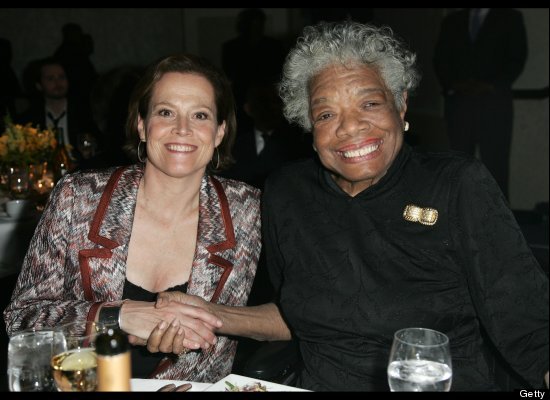
Actress Sigourney Weaver and poet Maya Angelou attend the 2009 Straight for Equality awards at the Marriott Marquis.

Today (April 4) marks the 84th birthday of world renowned poet and author, Dr. Maya Angelou. For decades Angelou has not only penetrated through African-American culture with her enduring works of poetry, she has also earned a long list of accolades including three Grammy Awards.

Phenomenal Woman

Pretty women wonder where my secret lies.
I’m not cute or built to suit a fashion model’s size
But when I start to tell them,
They think I’m telling lies.
I say,
It’s in the reach of my arms
The span of my hips,
The stride of my step,
The curl of my lips.
I’m a woman
Phenomenally.
Phenomenal woman,
That’s me.

I walk into a room
Just as cool as you please,
And to a man,
The fellows stand or
Fall down on their knees.
Then they swarm around me,
A hive of honey bees.
I say,
It’s the fire in my eyes,
And the flash of my teeth,
The swing in my waist,
And the joy in my feet.
I’m a woman
Phenomenally.
Phenomenal woman,
That’s me.

Men themselves have wondered
What they see in me.
They try so much
But they can’t touch
My inner mystery.
When I try to show them
They say they still can’t see.
I say,
It’s in the arch of my back,
The sun of my smile,
The ride of my breasts,
The grace of my style.
I’m a woman

Phenomenally.
Phenomenal woman,
That’s me.

Now you understand
Just why my head’s not bowed.
I don’t shout or jump about
Or have to talk real loud.
When you see me passing
It ought to make you proud.
I say,
It’s in the click of my heels,
The bend of my hair,
the palm of my hand,
The need of my care,
‘Cause I’m a woman
Phenomenally.
Phenomenal woman,
That’s me.

Maya Angelou

What is Black Art?

Greg Perkins, President and Founder of AAE


Definition and Overview

Black art constitutes a very diverse legacy, although many observers have a habit of generalizing what black art is.  We are talking about a continent that is filled with civilizations, people, and societies, each of which has a special culture.  Defining black art also requires that you take into consideration the art of the African Diasporas, which includes the art of African Americans.

Thematic elements

Despite all the diversity, there are some artistic themes that are unifying in nature when you are considering the totality of the African continent from the visual culture.  Black art contains 5 thematic elements as follows:

Emphasis on the human body – the human body has always been the focal point of most African art.

Emphasis on the performing arts – much of traditional African art that you find is crafted for use in performing contexts instead of static ones.  It is an extension of the three- dimensionality and utilitarianism of traditional African art.

Emphasis on sculpture – African artists have always favored three-dimensional art forms over two-dimensional ones.

Nonlinear scaling – oftentimes, a small portion of an African art design will be similar in appearance to a larger one.  This is also described in fractal geometry terms.

Visual abstraction – rather than favoring naturalistic representation, African art tends to favor visual abstraction.  This is because black art generalizes stylistic norms.

Black art history

Black art has been influenced by cultural backgrounds of Africa, Europe, and the US.  The more common or traditional black art of the African-American community includes:

  • woodcarving
  • quilting
  • pottery
  • plastic arts
  • paintings
  • basket weaving

Black art has been a vital contribution to US art and has played a significant role in it from its early origins in the slave community to the end of the 20th century.

From the 17th to 19th century in the US South, black art came in a wide diversity of forms including the following:

  • ceramic vessels
  • quilts
  • small drums
  • wrought-iron figures

Most of these black art pieces displayed the characteristics and similarities of Central and West African crafts, the primary areas of the continent where many skilled African artists were captured as slaves and brought to the US.  During the slavery period, white slave owners purchased these African artisans.

Artists such as the Baltimore portrait painter Joshua Johnson and the New England engraver Scipio Moorhead created black art that displayed Western European overtones.  Many slave owners allowed these artists to keep some of the wages they earned from their crafts.  In many cases, they were able to save enough money to buy their own freedom as well as the freedom for their children and spouses.

Black Art in Print

African American Expression offers a wide selection of Black art depicted on a variety of products and greeting cards.

Get tips for finding Black art and start collecting today.


African American Expressions, the largest black-owned greeting card company in America, began by selling three designs of African American Christmas cards, featuring African American art. AAE now sells over 2,500,000 cards annually of over 250 original designs, featuring black art and celebrating black history. Read more..

Lois Mailou Jones: An Artist, and a Life, of Color

As I stated in a previous post about African-American masters, I love me some North Carolina artists…

The Mint Museum of Art in Charlotte, NC is currently holding an exhibit for the renowned black artist and painter Lois Mailou Jones. The exhibit is entitled (appropriately enough) Lois Mailou Jones: A Life in Vibrant Color and runs until just about the end of next February (2010).

Technically, the late Ms Jones was not native to this state – she was born and grew up in Boston, MA. However, she did establish the arts department at the (now defunct) Palmer Memorial Institute near Greensboro.

If you read my previous article, you’ll know that I also will not pass up a chance to stock and to promote the products of any famous artist who has done this state proud. Our store’s Les Fetiches poster (”Les Fetiches,” in French, meaning spiritual/religious items or charms believed to possess special powers) is based on Lois Mailou Jones’ oil painting of the same name. That original work was created by her in 1938, and now resides in the Smithsonian American Art Museum (as you can see from the poster’s image).

For a bigger, better, and badder representation of Ms Jones’ Les Fetiches painting, as well as her other artwork, go to negro artist .(I really can’t recommend this site enough for lovers of African American art.) Since approximately 70 of her pieces will be exhibited at the Mint Museum, most, if not all, of the pictures at this website will likely be on display in Charlotte.

To hearken back to my past entry on black artists one more time, Lois Mailou Jones is coincidentally one of the feature artists being profiled in the Art of the Masters exhibit – which will be running concurrently in North Carolina (in Fayetteville) along with her aforementioned solo exhibit. And, as with Romare Bearden, if you’re worthy enough to be in the Masters exhibit, you’ve got to be in the (beware another Tarheel-based product shout, and a shameless plug) African American Masters Wall Calendar. In the additional image on that product page, see if you can spot the painting that is hers…

source….

No African-American senators likely in near future


By Lisa Desjardins, CNN Radio Senior Correspondent

Washington (CNN) – Few might realize it, but Tuesday’s primary elections might have quietly sealed the racial and ethnic makeup of the U.S. Senate for a couple of more years.

On Tuesday, C. Anthony Muse, thought to be the strongest black candidate for U.S. Senate this year, lost his Democratic primary race in Maryland, coming in a distant second to Sen. Ben Cardin, the incumbent. CNN found only one other African-American on a Senate ballot, a Florida candidate who isn’t getting much attention among a wide field of contenders.

Out of 100 U.S.  senators, two are Latino, two are of Asian or Pacific Islander ancestry, but none are African-American. Tuesday’s primary losses mean a Senate body with relatively little racial or ethnic diversity will likely continue to have no black members for two more years.

“When I tell this to people, most of them are shocked and don’t understand how in America that could be the case,” said Muse, a Maryland state senator and preacher.


There have been 1,931 members of the Senate, the chamber historian’s office said. Six African-Americans have served in the U.S. Senate, Muse said, and that includes Roland Burris of Illinois, who was appointed to President Barack Obama’s former seat and served less than a full term.

Six Latinos have held the title of U.S. senator.

“There does seem to be a ceiling,” University of Mississippi political science professor Marvin King said. “People are used to electing minority office holders. There are plenty of blacks in every state legislature, but going beyond that to winning statewide races seems to be a ceiling.”

Part of it might be simple math. Minorities, by definition, represent less than the majority of a population.

The same math might be affecting how African-Americans in the House of Representatives transition to the Senate, too. There are currently 44 black House members, a record-high number.

“How come minority members of the House have not transitioned to the Senate the way you see white members transition?” King asked. “One of the answers is the districts they represent tend to be different from the state as a whole. They tend to represent urban districts with high minority populations.”

Conservatives, such as Cuban-American Sen. Marco Rubio, R-Florida, see the lack of minority representation as a straightforward reflection of who’s on the ballot and whom voters chose.

“We have elections in this country,” Rubio said. “Obviously, we’d like to see more people running for all offices in this country. I don’t know why it’s been the way it’s worked out. I think that will change over time.”

Most senators who were asked about the low number of minorities in the Senate admitted or implied the issue was not something on which they focused.

Sen. Bill Nelson, D-Florida, whose state is embroiled in discussions about race after the death of teenager Trayvon Martin, didn’t have an answer when asked about the lack of diversity.

“Minorities in the Senate?” he asked. “Call the office and we’ll talk about that, because that deserves a thoughtful answer.”

His office later sent a written reply that the senator believes “the Senate would benefit from more closely resembling America’s diversity.” His aide theorized that Nelson was probably in a hurry to get to his next meeting and that’s why he could not answer on the spot.

The lack of specific responses from across the Senate didn’t surprise Sen. Bob Menendez, D-New Jersey, the other Latino in the chamber.

Diversity in the Senate is “not at all” a discussion among members, he said.

“I don’t think they think about it necessarily,” Menendez said. “It’s not as if they’re averse to being helpful or supportive, but they’re not thinking about it.”

So does it even matter if the Senate has low numbers of minorities?

King, the University of Mississippi professor, said the effect might be more indirect than direct.

“My research has found that on all but a handful of issues in Congress … the voting of black Democrats and white liberals is nearly identical,” he said. The issues where he sees separation are housing, urban development and civil rights.

King and other researchers said they believe the effect of low minority representation is less on votes taken than issues presented.

“Where you might see a difference is in the agenda of the individual members of Congress, what bills they chose to introduce and where they put their energy,” he said.

Before he lost his U.S. Senate primary race, candidate Muse gave a list of issues he felt were overlooked, including infant mortality, the criminal incarceration rate, housing and urban health care.

Now he’s returning to the Maryland state Senate, vowing that he will keep pushing for a seat in Washington.

SF Vietnamese American Poetry And Art Festival Takes Place April 28

By

AsianWeek Staff

April 4, 2012Posted in: Art, Arts-Entertainment, News

Andrew Lam

The Diasporic Vietnamese Artist Network (DVAN) and the Asian Pacific Islander Cultural Center (APICC) present the Third San Francisco Vietnamese American Poetry & Art Festival, a premiere showcase for Vietnamese American writers and artists. The event is scheduled for Saturday, April 28 at the African American Arts and Culture Complex from 7-9 pm.

Hosted by Andrew Lam (NPR commentator), the festival features nationally recognized writers and artists from around the United States. They include spoken word artists Bao Phi (National Poetry Slam finalist), Fong Tran and Sahra Vang Nguyen; legendary poet Nguyen Do with Paul Hoover, and famed writers Andrew Pham (“Catfish and Mandala”) and Aimee Phan (“We Should Never Meet”). Bao Phi will be reading from his new book of poem Song I Sing and Aimee Phan from her new novel The Reeducation of Cherry Truong. The program will conclude with a performance by Cai Luong artist Quang Chanh.

A reception will follow the reading featuring artworks by Binh Danh, Christine Nguyen, Truong Tran, Trinh Mai and Khoi Nguyen.

Cost: $10 for students and $15 for general public

Asian Pacific Islander Cultural Center (APICC), founded in 1996, supports and produces multi-disciplinary art reflective of the unique experiences of Asian Pacific Islanders living in the United States. DVAN, an epicenter of professional Vietnamese American artists, writers, and academics, aims to promote artists from the Vietnamese Diaspora.

For additional details and information please contact the festival organizers Isabelle Thuy Pelaud (ipelaud@sfsu.edu), Thang Dao (thangdao@usc.edu) or Rebekah Chung (rebekahc@mail.sfsu.edu).

The festival is hosted and sponsored by the Asian Pacific Islander Cultural Center, the Diasporic Vietnamese Artist Network and co-sponsored by the Cesar E. Chavez Institute and the Asian American Studies Department at SF State University.

Reflections on the 44th Anniversary of the Assassination of Dr. King

Forty-four years ago today, my beloved friend and America’s soul and conscience, Martin Luther King, Jr. was assassinated while standing on a balcony of the Lorraine Motel in Memphis. The night before, April 3rd, 1968, during s speech at the Mason Temple, Church of God in Christ, in Memphis, he said:

“We got some difficult days ahead. But it doesn’t matter with me now. Because I’ve been to the mountain top … Like anybody, I would like to live a long life. Longevity has it place … I just want to do God’s will. And he’s allowed me to go up to the mountain. And I’ve looked over. And, I’ve seen the promise land. I may not get there with you. But, I want you to know tonight, that we, as a people will get to the promise land.”

Forty years after Memphis, America elected its first African-American as president of the United States. Less than four years after this historic election, George Zimmerman killed Trayvon Martin in Sanford, Florida.Is the shooting of 17-year-old Trayvon Martin under disputed circumstances part of the “promised land” of which Dr. King only got a glimpse as he looked over from his “mountain top”?
Is the wanton gun violence perpetrated by blacks principally against other blacks in several of our major urban communities throughout the United States also part of what Dr. King saw from his mountain top?

Most important of all, other than appropriately protesting the killing of Trayvon Martin, for those fortuitously blessed with longevity, what are we, in real-time, doing about materially changing the landscape of gun violence that may or may not have been visible from Dr.King’s mountain top?

Yes, it is important that public pressure be maintained to insure that the circumstances surrounding the death of Trayvon Martin are fully and impartially investigated, disclosed; and, that any action, justified by the facts of an investigation, be initiated immediately. However, the incident in Sanford, FL does not obscure nor diminish our continuing moral responsibility to the legacy of Dr. King, whose assassination we pause and remember today.

Part of that continuing moral responsibility requires that, whatever events are factually confirmed in the Trayvon Martin case, white America must pause in a moment of “reality reflection” and ask itself, today on April 4th, 2012: If George Zimmerman had been a 40-year-old black man, 100 pounds heavier than Trayvon Martin and shot an unarmed 17-year-old white boy, do you think Zimmerman would have been released by the Sanford police without an arrest?

Also, 44 years ago today, Senator Robert Kennedy was campaigning for president in the Democratic presidential primaries of Gary, Indiana. The almost exclusively black audience assembled to hear his speech did not know yet that Dr. King had been assassinated earlier that evening. Senator Kennedy announced the news to them. His words on that occasion spoke to the conscience of our nation at that time. They are worth recalling today. Among other things, he said:

“I have some very sad news for all of you, and I think sad news for all of our fellow citizens, and people who love peace all over the world, and that is that Martin Luther King was shot and was killed tonight in Memphis, Tennessee.For those of you who are black — considering the evidence evidently is that there were white people who were responsible — you can be filled with bitterness, and with hatred, and a desire for revenge.

We can move in that direction as a country, in greater polarization — black people amongst blacks, and white amongst whites, filled with hatred toward one another. Or we can make an effort, as Martin Luther King did, to understand and to comprehend, and replace that violence, that stain of bloodshed that has spread across our land, with an effort to understand, compassion and love.

For those of you who are black and are tempted to be filled with hatred and mistrust of the injustice of such an act, against all white people, I would only say that I can also feel in my own heart the same kind of feeling. I had a member of my family killed, but he was killed by a white man.

But we have to make an effort in the United States. We have to make an effort to understand, to get beyond these rather difficult times.”

Dr. King would sometimes quote the 18th century dramatist and hymnist, William Cowper, “The Lord works in mysterious ways and has wonders to perform. He plants his footsteps in the sea, And rides upon the storm.”

Maybe the confluence of events in Sanford with this anniversary of Dr. King’s murder is a “mysterious way” in which we, as a nation, are given another providential unique opportunity for America to heal itself from the disease of racism. Perhaps we must now, once and for all, confront and no longer ignore the 800-pound gorilla in every household, office, corporate, state, and federal agency; and every religious and educational institution, in every community throughout our country: the absence of any forthright and frank discussion about race relations in America and the continuing systemic impact of racism, 24/7 in our daily lives 44 years after Dr. King’s assassination.

There are some, I am sure, who prefer to remain in a state of comfortable denial and contend that such an issue is not worthy or necessary of our immediate attention and discussion. After the institution of slavery and our Civil War, our country never had the benefit of a domestic equivalent to the Race and Reconciliation Commission created by Nelson Mandela in connection with the ending of Apartheid in South Africa. Its National Commission enabled the people of South Africa to make a peaceful transition from the racial segregation and white racism under an Apartheid government to a multiracial society.

The closest analogy to South Africa’s Race and Reconciliation was the era of Reconstruction, 1865-1877, following the assassination of Abraham Lincoln and the Civil War. It was congressionally intended to deal with the consequences of and the transition from previous decades of the institution of slavery in our country to a democratic society. It did not succeed. Instead, it left a legacy of years of bitterness between white America and descendants of former slaves.

A constituent part of that failure has been an institutional unwillingness to openly and frankly talk about the relationship between white and blacks in our country; and specifically, during the 20th and 21st centuries, the relationship between the black community and institutions of white power, such as the police in various communities throughout the United States. This is especially so in those states in the South, but not limited to them.

It still may not be too late, in memory and tribute to Martin Luther King, Jr and now, Trayvon Martin, and all the other Trayvon Martins killed by gun violence in the United States for America once and for all to summon the courage to confront the 800-pound gorilla of unspoken frank conversations about race in America.

This issue is substantive on its merits. Moreover, contrary to the call of some African-American civil rights leaders, a successful initiative to get our nation to confront the issues of race does not require or depend upon President Obama assuming or asserting special national leadership on this issue, at this time. To do so during a presidential election year will most likely be characterized as divisive by his political opponents, and potentially take our attention and focus off of the need for us to assume, in our respective communities, the leadership necessary to address the issues of race, racial profiling, and gun violence involving young black men, with or without a hoodie.

In short, what’s important is not what the president does, but what are we, as nation, going to do through our leadership and community institutions across the nation to stop 24/7 gun violence which on many weekends in Oakland, Chicago, New Orleans, Los Angeles, New York City, just to mention a few, result in nothing less than “black killing fields.”

Based upon the 39 years of his unique personal journey and experiences during his life, Dr. King’s optimism was justified at the time of his death. His observation of the “Promised Land” from the mountain top that God had allowed him to see was prophetic and reasonable.
But, he was deprived of the additional 44 years of insight and experience that could have enhanced and sharpened his view from “the mountain top.” We, however, have not been so deprived of additional years of learning longevity.

Those persons alive today, part of that successor generation following April 4th, 1968 still have the opportunity and moral responsibility to say, now 44 years later, with the added death of Trayvon Martin and so many other young black men in America: Enough! Enough! Stop the violence!

It is time for the current generation to end our continued participation in the denial of the reality of racial profiling of young black men by the police and para police and wanton gun violence perpetrated by many of those same young black men against one and other. Our silence and inaction makes us enablers of the continued hypocrisy about race in America.

Regrettably, on Monday, April 2nd, 2012, our Supreme Court, in a 5-4 decision, in the case of Florence v. Burlington County (New Jersey) ruled that law enforcement officials may strip-search people arrested for any offense, however minor, before admitting them to jails even if the officials have no reason to suspect the presence of contraband! The case arose from the arrest of Albert W. Florence, an African-American man in New Jersey. In 2005, Mr. Florence was in the passenger seat of his BMW when a state trooper pulled his wife, April, over for speeding. A records search revealed an outstanding warrant for Mr. Florence’s arrest based on an unpaid fine. (The information was wrong; the fine had been paid.)

Cases like that of Albert Florence contribute to the belief and perception among wide segments of the African-American community that little progress has been made since the findings of the 1968 Kerner Commission Report: “Our Nation Is Moving Toward Two Societies, One Black, One White — Separate and Unequal.” The Report noted that:

“The police are not merely a ‘spark’ factor. To some Negroes police have come to symbolize white power, white racism and white repression. And the fact is that many police do reflect and express these white attitudes. The atmosphere of hostility and cynicism is reinforced by a widespread belief among Negroes in the existence of police brutality and in a ‘double standard’ of justice and protection — one for Negroes and one for whites.”

Forty-five years ago, yesterday, April 3rd, 1967, Dr. King delivered a powerful speech at Riverside Church in New York City, publicly voicing his opposition to the continuation of the Vietnam War. The caption of his address was “Time to Break the Silence.”

The time is now overdue for America to break its silence on the continued consequences of our failure to confront forthrightly and publicly the continuing issue of race in the United States, once and for all. We can no longer ignore the presence of the 800-pound gorilla in every American household. I respectfully suggest that this is how we should reflect upon the 44th Anniversary of the assassination of Martin Luther King, Jr.

Finally, no reflection about Dr. King would be complete without remembering what he would often remind those of us who worked closely with him: That he was a Minister of God, before he was a “civil rights leader.” As a Minister of God he genuinely believed in the commandments of his Christian religion — love thy enemies. He believed in the redeeming power of love. He would quote to us from Proverbs and Corinthians in the Bible:

Proverbs 10:12 tells us “Hatred stirs up strife, but love covers all offenses.”

Love is patient and kind; love does not envy or boast; it is not arrogant or rude. It does not insist on its own way; it is not irritable or resentful; it does not rejoice at wrongdoing, but rejoices with the truth. Love bears all things, believes all things, hopes all things, and endures all things. Love never ends. (1 Corinthians 13:4-8)

Dr. King would want us to remember that “only love can enable forgiveness, redemption and reconciliation”; all indispensable for our long-term survival in 2012 and beyond.