Hughie Lee-Smith Painting

Hughie Lee-Smith Painting

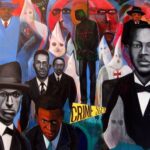
DETROIT, MI.- Two Figures and Landscape, a 1954 painting from renowned artist Hughie Lee-Smith (1915–1999), recently joined six other works by Lee-Smith in the Detroit Institute of Arts’ (DIA) “New Art for a New Self-Awareness” gallery in its suite of African American art galleries. The painting, which shows a couple on a rocky shore with a calm sea beyond them, is on loan from Warren’s Fitzgerald Public Schools, and its route to the DIA is an unusual one.

The painting was purchased by the 1954 graduating class at Fitzgerald High School in Warren and, as was customary, given to the school district as a gift from the class. It had been hanging in a break room at the school for decades, unrecognized as a work by a famous artist. When a former student came across an article about Lee-Smith, it jogged his memory of the painting. He contacted Fitzgerald Public Schools Superintendent Barbara van Sweden to let her know the high school had a treasure in its midst.
“We were very excited to learn that our district held a painting by a well-known artist,” said Van Sweden. “It made sense to loan our Hughie Lee-Smith painting to the DIA so it could enhance the collection by this notable artist and be appreciated by visitors to the gallery. Since our discovery, we have learned that Fitzgerald High School graduating classes from 1953 through the mid-1980s donated works of art by Michigan artists to the district. We will be on the lookout for other art work by well-known artists.”More Information: http://www.artdaily.com/index.asp?int_sec=2&int_new=53961&b=african%20american[/url]
Copyright © artdaily.org


Faith Ringgold Visual Artist


.

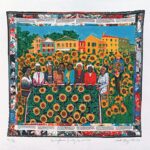
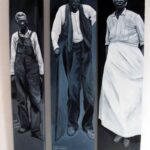
Faith Ringgold was born in 1930 in Harlem, where she was influenced by the artists of the Harlem Renaissance. After receiving a degree in art from the City College of New York, she taught art in the New York City Public School system for 18 years.

Ringgold is best known for her vibrant story quilts, where she paints a complex scene on a quilt, then surrounds the action with words to tell the story, such as in her “Tar Beach” and “Tar Beach II” quilts, or to add meaning, like in her “Freedom of Speech.” Her first book, Tar Beach was a Caldecott Honor Book and winner of the Coretta Scott King Award for Illustration. Ms. Ringgold currently works as a Professor of Art at the University of California in San Diego.

Edwin Lester Visual Artist


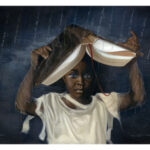
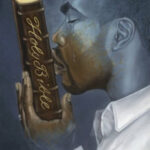
This self taught artist from Philadelphia has been well accepted in the art community in his first year. Expressing his acceptance in Christ and some political issues has taken many by surprise wondering what is to be expected in 2004.

When ask if he considered himself a spiritual or concept artist he replied, “I paint images which are a part of my everyday life. God, love, simply living trying to be the best I can at what ever I am trying to accomplish that day. I just love what I do and when I walk out into the world each day, there is so much to see, so much to paint. For tomorrow is not promised. So today I will say what I can, do as I must and paint what I can even if it’s just one stroke.”

Varnette Honeywood


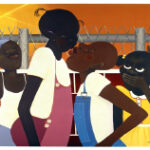
Varnette Honeywood is a nationally recognized artist who has successfully owned and managed a mail order art business “Black Lifestyles” for 15 years, marketing her paintings, limited and open edition prints and note cards and several other African American artists. She has illustrated several books and provided artwork for book covers. Her work has been used in numerous television sets, most notably “The Bill Cosby Show”. She is collected by established art collectors in North America and was a much sought after speaker, as she inspired a new generation of artists. Honeywood held a Masters of Education from the University of Southern California.

Varnette Honeywood Foundation

Pay Me Like You Pay for New Shoes

Pay Me Like You Pay for New Shoes – “It is not bad to be rewarded for your efforts. You need money to buy new shoes! It is also about respect. Respect for the time and effort it takes to produce art. Respect for the money artists spend to purchase materials. Respect for the thousands of dollars some artists pay to get their training in traditional, and other art programs. Artists travel to learn, go to workshops and art centers that cost money. Why shouldn’t we expect a return on our investment to develop our skills as a doctor or a chef would?”

Joyce Owens, artist

The Art of Joyce Owens


Artist Statement

I believe in hard work and play!
Specifically transforming unlikely materials and art media to produce my art, and employing a variety of techniques including assemblage that requires basic wood working, jewelry making, printing and stamping, collage, sgraffito, etc., makes every new work a new investigation and puzzles I have to solve. As with a Google search, the elements I use can change the responses, sometimes dramatically. I like to work in series tending more towards 20 expressions on one visual or theoretical idea, but rarely isolated one-of-a-kind works.

I take, seemingly, unrelated expeditions that lead me to other ideas. I choose a chaos-to-order approach when I work, mostly enjoying not anticipating the exact results. Landscape is a re-occurring part of my paintings. I observe and photograph the land extensively; so far I have not shown the photos as stand alone art works.

Race issues are critical to my work; I measure my responses so the conversation does not accuse, but rather reminds and informs. Teaching is a natural instinct for me, lecturing about how artists addressed beauty, personal pain and injustice, religious beliefs and love.

I don’t have the luxury to not address race, an issue that constantly touches my life and the lives of my family and friends, and is still a national dilemma. Gender issues are significant and are addressed in my art and in writing on my blog.

I never wonder what is next when it comes to my art practice. I never run out of ideas. I never feel that art making is a chore. It is my enduring passion and, my family aside, the love of my life.

The list of artists who have influenced my work is extensive.

visit www.joyceowens.com

Artist Booker T. Williams, Jr.

Art by Booker Williams

Born on March 3, 1949 in Seattle, Washington, Booker T. Williams, Jr. displayed his artistic talent at a very early age,…. sketching and drawing virtually anything and everything. However at around age 13, Booker became smitten with the saxophone bug and his artwork became a secondary consideration. After attending Washington State University and the University of Washington for several years, he set out for NYC in 1974 to further “chase the music”, with a passion for art still reverberating in his being.

n late 2005, while giving saxophone lessons, one of Booker’s students gave him a Photoshop 6 disc.
Being a total novice, Booker began exploring the wonderful possibilities of  Photoshop. Mind you, his
artistic prowess of drawing and sketching was never out of reach.

During early 2006, Booker experienced a season of insomnia. It was during this restless period that Booker had some amazing breakthroughs with Photoshop and his art chops. He found himself thrust into a “magical” world with an indescribably, unique style of rendering his art. Booker categorizes his art as DIGITAL PAINTINGS with BOLD TEXTURES and COLORS that “jump right off the canvas and into your heart”.

Lionel Richie Star Shots

Lionel Richie performs at the SXSW Music, Film + Interactive Festival in Austin, Texas. He had audience members saying it was one of the best live shows they’ve ever seen! Listen to on iHeartRadio March 15, 2012/Photo: WireImage

via Star Shots.

Visual Artist Kelvin Henderson

Art of Kelvin Henderson


Hailing from Henderson, NC, Kelvin started painting at an early age. After over 20 years of service with the federal government, he resigned to pursue a full-time career as a fine artist. He established FRUITS OF THE SPIRIT Fine Art in 1995 as a distributor of artwork and to do custom framing. With over 10 successful years, it has evolved into a publishing and advertising company exclusively for Kelvin’s works. read more…….


Spread the Word! The Evolution of Gospel from Chicago to the World

Spread the Gospel At Dusable Museum


Spread the Word! The Evolution of Gospel from Chicago to the World

This exhibition developed by The DuSable Museum celebrates the rich history and contributions to Gospel Music and is centered primarily on gospel’s Chicago origins. With Chicago being the “home” of Gospel, Spread the Word!: The Evolution of Gospel from Chicago to the World, recognizes some of the greatest Gospel singers of all time, included are legends such as: Mahalia Jackson, Albertina Walker, Thomas Dorsey, James Cleveland, Sallie Martin and many others. Legendary Chicago choirs, such as Reverend Milton Brunson and The Thompson Community Singers, along with Dr. Charles G. Hayes and The Cosmopolitan Church of Prayer Choir (aka The Warriors) “testify” with the “First Families of Gospel,” The Yancy Family and the Staple Singers. Additionally, the renowned “singing “ preachers such as Reverend Clay Evans and Pastor Maceo Woods “minister” right next to award-winning soloist such as Mahalia Jackson and Albertina Walker, while contemporary artist such as Darius Brooks share the spotlight with Joshua’s Troop.

‘Spread the Word!’
When: Through May 20
Where:
The DuSable Museum of African American History, 740 E. 56th Place
Hours:
10 a.m. to 5 p.m. Tuesday through Saturday and noon to 5 p.m. Sunday; closed Mondays
Admission: Adults $10, students and seniors $7, children ages 6 to 11 $3, children 5 and under free (discount for Chicago residents); additional contributions accepted
More information: dusablemuseum.org

“Chicago Tribune spreads the word…”


Ladysmith Black Mambazo: How we inspired Mandela

From Jessica Ellis,CNN
February 28, 2012 — Updated 1301 GMT (2101 HKT)

Editor’s note: Every week CNN International’s African Voices highlights Africa’s most engaging personalities, exploring the lives and passions of people who rarely open themselves up to the camera.


South Africa’s singing sensation

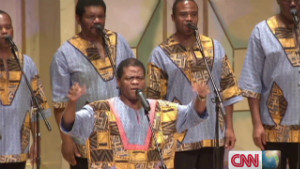
(CNN) — With their soulful voices and traditional Zulu dance moves, South African acappella singing sensation Ladysmith Black Mambazo have been blending vocal harmonies to take audiences on a musical journey for nearly half a century.

The legendary male choral group has sold millions of albums worldwide, collaborated with music icons such as Paul Simon and counts Nelson Mandela as one of their faithful fans — the venerable Nobel Peace Prize winner has described the group as “South Africa’s cultural ambassadors.”

It’s all a far cry from when young farmer-turned-factory worker Joseph Shabalala formed the band in 1964, hoping to use music as a vehicle to unite people in a country suffering from social divide and conflict.

“The music is for the people, we must take this music to the people,” recalls Shabalala, one of the two remaining original members of the nine-piece group.

Already successful in their homeland, the band’s international breakthrough came in 1986, when American singer and songwriter Paul Simon featured them on his album “Graceland.” Simon also took them on tour with him and produced the band’s “Shaka Zulu” album, which won the 1988 Grammy Award for best traditional folk album.

Since then, Ladysmith Black Mambazo have won two other Grammys and have received a total of 16 nominations.

Long Flight by Leroy Campbell

Long Flight by Leroy Campbell


“As years go by, I see my art as a celebration of Black lifestyles. I try to capture the richness of the culture — the dance and music. I call it old spirit art, it represents a past, reflective of the African-American experience.”

Leroy Campbell’s newest series, “Black Eye Peas,” portrays a different view of Southern life than his previous work. Based on the life of a sharecropper, it is a painful yet noble study of the quiet strength and gripping tenacity of farmers in relentless pursuit of “a dream deferred.”

A self-taught artist, he is influenced by his birthplace, Monk’s Corner, South Carolina. Campbell revisits the rural South in his “Neck Bone” series, inhabited by Joe-Neck Bone, Joe Neck Bone, Jr., and Grandma Corrie. His subjects, proud, God-fearing, and self-reliant, are the backbone of the African-American community.

In addition to having his work shown at Phillip Morris and the Chemical Bank in New York, the Brooklyn, New York, artist has created commissioned pieces for Bacardi Rum, Seagrams, and Honey Entertainment Records

Lil’ Guitar Man by Maurice Evans

Lil’ Guitar Man by Maurice Evans


Original Acrylic on Canvas

Within a few years, Maurice Evans has established himself as a major force in the field of Black Art. Heavily influenced by music, his series of paintings entitled, “The Colour of Jazz”, although contemporary, tends to remind the viewer of a time when jazz was paramount. No matter the subject or whether the works are executed on paper, wood or canvas – the texture, intense colors, strong emotion and unusual, exaggerated perspectives, are what define a Maurice Evans painting.


Does Jazz Need to Be Renamed?

Philadelphia Inquirer columnist Annette John-Hall examines the debate surrounding the push by a small group of artists who want to change the name of jazz to Black American Music, or BAM. Their reason? The genre died in 1959 and needs to be revitalized.

Saxophonist Sonny Rollins with President Obama (Alex Wong/Getty Images)


It’s lunchtime in East Mount Airy, and pianist Orrin Evans is working on a killer salad complete with boiled eggs, nuts, and colorful produce — a garden bounty. Healthy eating keeps his blood pressure down, Evans says.


So I’m guessing I’m not helping much when I bring up Evans’ life’s work, the African American classical music he is passionate about — jazz.

See, these days, just uttering the word jazz is bound to get some people’s pressure up. That’s because Evans, 36, along with a small group of multiracial, multigenerational artists led by New Orleans trumpeter Nicholas Payton, want to deep-six jazz — the name, not the art form — and resurrect it as Black American Music (BAM).

Why? Because “jazz died in 1959,” blogged Payton last year. “Jazz was a limited idea … Jazz is only cool if you don’t actually play it for a living. Jazz musicians have accepted the idea that it’s OK to be poor.”

Ask any musician why they advocate BAM, and the reasons are as varied as a Sonny Rollins solo.

“The fact people find an acknowledgment of black music hard to swallow says a lot,” says Ben Wolfe, a white bassist who is one of Evans’ closest friends. “The music I play is black American music. It’s something to celebrate.

“Why isn’t that good news?”

The musicians pretty much agree that marketers have managed to hijack the name to define music that is anything but jazz.

Read Annette John-Hall’s entire column at the Philadelphia Inquirer.