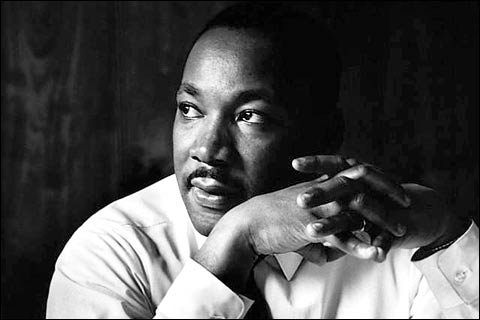
Martin Luther King’s ‘I have a dream’ speech was written in Liverpool

Liverpool tourism officials have claimed that African American civil rights leader Martin Luther King’s ‘I have a dream’ speech was written at a city centre hotel.

The claim has been made in a guide to a major art event entitled ‘Liverpool Discovers’. A map in the guide shows over 20 locations where famous people were born along with places associated with celebrities and events in their lives.

“Martin Luther King visited his supporters in Liverpool three times, and the first draft of his famous ‘I have a dream’ speech is alleged to be written on Adelphi Hotel headed notepaper,” The Telegraph quoted the guide, as proclaiming.

A Liverpool Discovers spokesman said that all facts have come from a public consultation, where they asked people to submit what they knew about Liverpool.

“They are not official; they are just things about Liverpool that many people may not know. As you will appreciate it is sometimes difficult to prove historical facts, and we have run the map by local historians to best verify what appeared,” the spokesman said.

King’s biographer, Godfrey Hodgson, however said the suggestion did not fit facts. “I just don’t believe it to be true. If he had gone to Liverpool there would have been substantial coverage, as he would have been a big figure by then,” Hodgson said.

“Dr King did visit the UK on a number of occasions, but he was not in Britain around the time of this famous speech in 1963,” he added.

The ‘I have a dream’ speech is 17-minutes long and was delivered in August 1963. King used the speech to call for racial equality and an end to discrimination.

The speech, from the steps of the Lincoln Memorial during the ‘March on Washington for Jobs and Freedom’, was a defining moment of the American civil rights movement.

Delivered to over 200,000 civil rights supporters, the speech was ranked among the top American speeches of the 20th century by a 1999 poll of scholars of public address.

Fort Worth play likely delights artists and historians

It has been said by artists and historians alike that art serves as a time-capsule for history. The Jubilee Theatre in downtown Fort Worth, TX proved just that with their production of “The African Company Presents Richard III,” a play that chronicles the beginning of African American theatre.

The play is set in 1821 and tells the story of the first black theatre company in America as they battle against the forces of class, race and tradition in order to stage a production of Shakespeare’s “Richard III.” Throughout the play, the audience learns of the hardships that each character has been through because of their race and how they dealt with it in a predominately white society. They discover that those hardships are what drive the characters forward in their lives every day.

In the play, the manager of a wealthy theatre that is in the process of producing their own production of “Richard III” learns that the African Company of New York is producing the same show. To solve this so-called “problem” he has the theatre shut down through underhanded social connections. Instead of bowing at defeat, Billy, the manager of the black theatre, strikes back hard by staging the “black” production of “Richard III” in a hotel ballroom next door to the wealthy theatre. Although the show has a tragic end, where the members of the black theatre are thrown into jail, the show leaves audience members with a feeling of hope and inspiration due to the incredible message this play exudes.

The artistic director of the Jubilee Theater’s production of this show stated it best when he said that the overall message of this story is the message of people lifting themselves up through art so that they too can feel like kings and queens.

The overall production of this show was impressive. The Jubilee Theatre created a piece of moving art that pushes the audience through an emotional catharsis and allows them to actually feel the struggle it took for the African Company of New York to find solace in art.

Although successful in getting the message across and drawing emotion from the depths of the audience’s souls, this show was lacking in a very important area of theatre. The year this play is set in is 1821 but a combination of accents, costumes and set design make the show feel as if it is set several decades later. Despite the lack of attention to the time period, which could be critical in other shows, the mix up did not affect the overall effectiveness of this particular show.

Through the hard work of the Jubilee Theatre, audience members will leave “The African Company Presents Richard III” feeling not so lost in the shadows, but will, instead, feel like they’ve been lifted into the light. Remember, we can all feel like royalty through true art.

Brentwood Spring Art Show: Decorative, Derivative and Executed by Dilettantes

Navigating the twice-a-year Brentwood “Art” Show is a jovial experience for the most part. Baby strollers compete for space with dogs, but the most dangerous area is always the congregation of cyclists pounding caffeine of one sort or another by Peets.

This year the creative offerings were at best weak–and at worst decorative, derivative and executed by dilettantes.

“Art” (and you will notice the repetition of the sarcastic quotation marks) is a term that is used loosely and inclusively. Craft populates over half the street fair with jewelry, candles and tsochkes of all manner available every 50 feet over the three blocks on the south side of San Vicente from Barrington to Saltair.

There were a couple of glimmers of originality though.

Grant Searcey had a modest booth of paintings that showed a facile use of medium. He’s certainly developed a style and a voice of his own.

Strongly influenced by a graphic novel aesthetic, the paintings of hybrid animals and plants have a wit and charm. Turtles, sea horses and frogs occupy the artist’s iconography. Kudos to the artist as well for not offering countless variations in all manner of digital prints as well.

The style most reminds me of the animation on the music video for Feel Good Inc. by the band Gorillaz. [See video.] There are also overtones of Sam Keith’s artwork done for the comic book called The Maxx in the early nineties. Good stuff.

I was also surprisingly charmed by the artwork of Kicheka Sykes. The paintings predominantly depict African-American women stylized with patterned veils and dresses.

She has a nice ability to define form through the use of silhouette and an attractive palette of colors. She does traffic in reproductions a lot though, which unfortunately lessens the originals on display.

That said, she has a voice that offers a strong and flattering portrait of a community, which diverts any hint of cliché that might creep in. In a world of artists who try to tailor their offerings to what they think people will want, Skyes paints what she wants. This authenticity was on display.

Most heinous award goes Adam Stone Studios with a display of gaudy compositions that is left of velvet painting and just right of dogs playing poker.

Meet Charles McGee, artist

One of Detroit’s most protean and recognizable artists, McGee remains active in his 80s. His works are on permanent display at the Detroit Institute of Arts, the Charles H. Wright Museum of African American History, the Broadway Street People Mover Station and several hospitals.

One of Kresge’s eminent artists, he makes paintings, sculptures and mixed-media assemblages, marrying modernist and primitive impulses in mostly abstract works that pop with exuberant patterns, jazz rhythm, color, humor and a spiritual ecology that connects people, animals and the natural world.

Age and residence: 86, Detroit.

At Art X: “Spirit Renewal,” a newly commissioned outdoor sculpture 22 feet long and 8 feet tall, will become a permanent addition to Midtown. More than 50 interlocking black and white shapes form a syncopated work made from materials such as a decorative aluminum composite.

• Public unveiling at 4 p.m. Wednesday, Horace H. Rackham Educational Memorial Building, Northeast Lawn.

• McGee and Marilyn L. Wheaton discuss McGee’s new sculpture, 3 p.m. April 10, Virgil H. Carr Cultural Arts Center.

Quote: “I think Art X Detroit is a beautiful idea, and I feel happy that I’ve lived long enough to see it, because Detroit has been a stagnant place of the acceptance of art. It’s always been a good place for making art. Kresge’s contribution is mammoth; it’s joyful, elucidating and uplifting.”

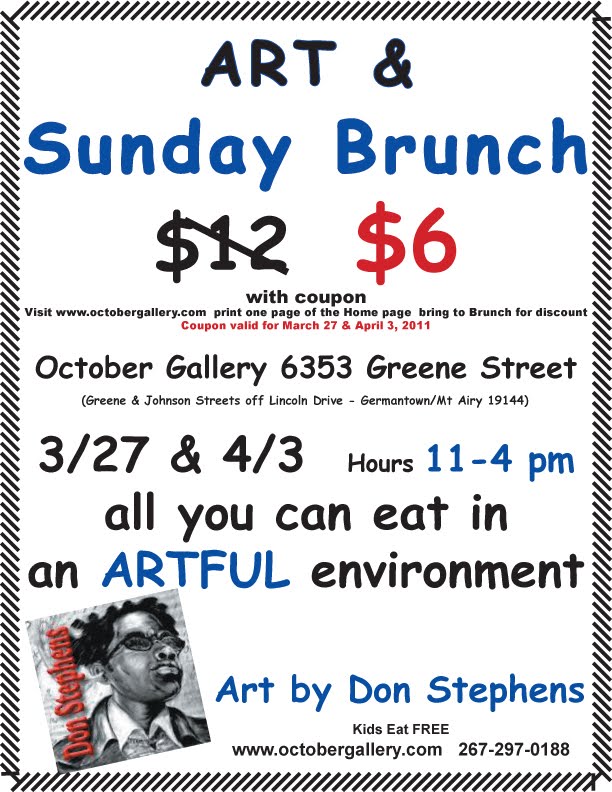
EXTENDED HOURS — THIS SUNDAY, APRIL 3….Sunday Brunch and Art ….11 to 5 pm Special $6

Sunday, April 3 · 10:00am – 5:00pm

6353 Greene Street, Phila, PA 19144

Live Painting Demonstration…Meet the artist … See their new art work …

Art, music, fellowship, network and relax.

Brunch Served NOW ONLY $6 with coupon

Hours 11am – 4pm

VISIT http://www.octobergallery.com/ PRINT OUR PAGE OF THE HOME PAGE BRING TO BRUNCH FOR DISCOUNT. Coupon Valid for April 3, 2011 (only)

For more info call October Gallery 215 629-3939

Host Your Next Event At October Gallery

Wireless available

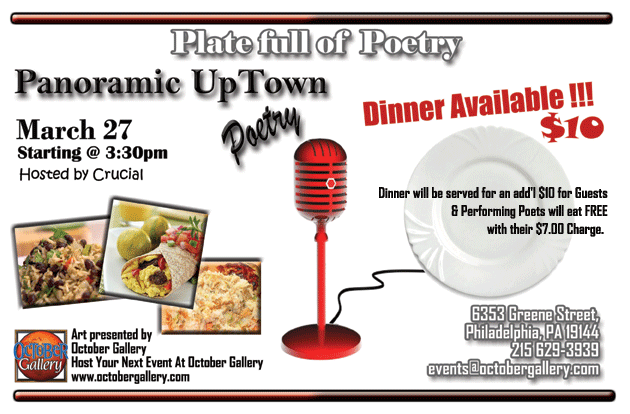
THIS SUNDAY, APRIL 3… 3:30PM at 6353 Greene Street… JOIN US!

The 1st & Last Sunday of every month

Price: $10 for Guests & $7.00 for Poets

REGISTER NOW!!!

Dinner will be served for an add’l $10.00 for Guests & Performing Poets will eat FREE with their $7.00 Charge.

Also “ALL PERFORMING POETS” must be in attendance by 3:45pm, or RISK NOT BEING ALLOWED TO PERFORM!!!

Panoramic UPTOWN Poetry will be held at6353 Greene St, Philadelphia, PA 19144

Spots are going quickly so please reply soon. To get on the list to read at upcoming Panoramic Poetryhttp://www.panoramicpoetry.com/

THIS SUNDAY, APRIL 3….Sunday Brunch and Art ….11 to 5 pm Special $6

Live Painting Demonstration…Meet the artist … See their new art work …

Art, music, fellowship, network and relax.

Brunch Served NOW ONLY $6 with coupon

Hours 11am – 4pm

PRINT OUR PAGE OF THE HOME PAGE BRING TO BRUNCH FOR DISCOUNT.

Coupon Valid for March 27 & April 3, 2011 (only)

For more info call October Gallery 215 629-3939

Host Your Next Event At October Gallery

Wireless available

NC Museum of Art opens exhibit titled "30 Americans," featuring works by contemporary blacks

The North Carolina Museum of Art is opening an exhibit of 75 works by many of the most significant contemporary African-American artists of the last three decades.

The exhibit is titled “30 Americans” and opened Saturday at the museum in Raleigh. The 75 works come from the Rubell Family Collection of Miami, an internationally known collection of contemporary art. The exhibit features both established and emerging artists, including Jean-Michel Basquiat and David Hammons.

Tickets are required for the exhibit, which closes Sept. 4. Tickets range in price from $10 for adults to free for children ages 6 and under.

They’re telling stories in Dallas

“Tales Through Time: A Storytelling Event” will take place from noon to 3 p.m. Saturday at the Gaston County Museum of Art & History.

The free program, sponsored by a grant from the United Arts Council, will feature an afternoon of storytelling from distinguished storytellers, including Chief Donald Rodgers, Chief of the Catawba Indian Nation; Chetter Galloway, an African and African-American folktale storyteller; and Orville Hicks, a traditional Appalachian Jack Tales storyteller.

Here’s a closer look at the featured storytellers:

Chief Donald Rodgers, traditional Catawba Indian stories, noon. The Catawba Indians, aboriginal to South Carolina, and their pottery tradition may be traced to 2,400 B.C. The name Catawba was designated to a small tribe living along the Catawba River between North and South Carolina. However, the origin and meaning is unknown as the Indians called themselves yeh is-WAH h’reh, meaning “people of the river,” or i-yeh yeh meaning “people.” When Hernando de Soto visited the Catawba Nation (then Cofitachique) in 1540, he found a sophisticated Mississippian Culture. After the founding of Charleston in 1670, the Catawba population declined. Throughout subsequent demographic stress, the Catawba supported themselves by making and selling pottery. They have the only surviving Native American pottery tradition east of the Mississippi. Chetter Galloway, African and African American folktale storyteller, 1 p.m. Galloway first experienced storytelling at the Colonial Williamsburg Foundation in Williamsburg, Va. He honed his craft at East Tennessee State University’s Master’s in Storytelling program. He is a Young Audiences Artist and affiliated with the South Carolina and Tennessee Arts Commission.

Chetter has released three storytelling recordings, “Evil Knows Where Evil Sleeps,” “Fresh Squeezed Carrot Juice,” and “A Story, A Story, Let It Come, Let It Come.” Orville Hicks, traditional Appalachian Jack Tale Storyteller, 2 p.m. Winner of the Brown Hudson Folklore Award, Hicks comes from a long line of storytellers and is perhaps the last in his family to carry on the folk tradition. His specialty is the “Jack Tales,” whose title character (from “Jack and the Beanstalk”) is usually “a lazy rascal,” but a goodhearted hero whose family is always trying to take advantage of him. The tales have noticeably English and German folktale roots blended with Appalachian mountain customs.

The Gaston County Museum is at 131 W. Main St., Dallas. For more information, visit www.gastoncountymuseum.org or call 704-922-7681 ext. 105.

Visions of Life, Built From Bits and Pieces

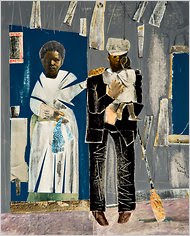
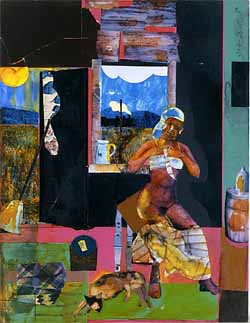
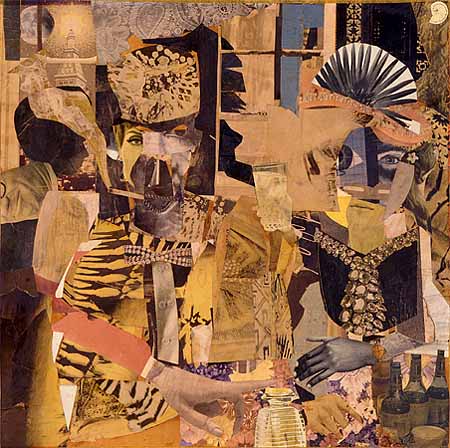
Romare Bearden (1911-88) spent more than 30 years striving to be a great artist, and in the early 1960s, when he took up collage in earnest, he became one. A small exhibition at the Michael Rosenfeld Gallery, organized to celebrate the centennial of Bearden’s birth, delivers this message with unusual clarity. It contains only 21 collages, all superb, in an intimate context that facilitates savoring their every formal twist and narrative turn, not to mention the ingenious mixing of mediums that takes them far beyond collage.

The works at Rosenfeld were made from 1964 to 1983. Some are not much larger than sheets of typing paper; others are more than four feet on a side. Their suavely discordant compositions involve both black-and-white and color photographs and occasional bits of printed fabric; almost all depict some scene of black life, past or present or imagined. Their varied subjects include jazz musicians bent over their instruments; rural families cooking or eating dinner; and a dressmaker who, with the nude figure of her client changing clothes, offers a wry variation on the artist-with-model theme. There is also a radiant storybooklike rendition of the fall of Troy, with black-skinned soldiers. And amid the prevailing, exquisitely nuanced complexity there are moments of utter and serene simplicity, like “La Femme de Martinique,” on her way to market, all but filling a narrow strip of masonite with her regal Egyptian stance. The colors in these works are sometimes bright and flat in the manner of Matisse’s papier-collés, which were a clear influence. Sometimes they have been sanded away, distressed in ways that conjure both the urban poverty Bearden frequently depicted and the fading Italian frescoes he so loved. And sometimes, as in a worn and rosy work titled “The Tenement World” (1969), crumbling architecture, frescoes and Matisse all come to mind. As historical shows go, this one feels unusually of-the-moment. For one thing the improvisational cross-fertilizing of art mediums that Bearden helped pioneer via collage is more and more the norm; for another, paper has probably never been more popular as an art material, for work in both two and three dimensions. Most obviously the scaled-up version of collage that he favored and his propensity for pieced-together, abstraction-infused figures have many echoes in the work of contemporary artists, from Mark Bradford to Anya Kielar to Matthew Monahan. Bearden took up collage sometime in the late 1950s, after a relatively fallow period during which what little painting he made was mostly abstract. A trip to France and Italy with his wife in 1961, to see many of the museums and churches he had visited 10 years before while studying painting on the G.I. Bill of Rights, may have reconnected him to figuration. In 1963 he helped organize Spiral, a group of African-American artists interested in finding new ways to portray black life in America. Bearden suggested that the group collaborate on collage, an implicitly collaborative medium. This didn’t happen, but evidently he found his métier in the process of demonstrating the possibilities. Read More >>>>>

Artist listens to music for creative inspiration

When Debora Oden paints, she often listens to music by Erykah Badu or Ella Fitzgerald, finding creative inspiration that takes her own art to a higher level of expression.

“Often, in my studio, I listen to the same albums over and over,” she said. “As I work, I lock myself into a familiar rhythm and body of lyrics that let me lose myself in my visual work.”

Defined by a glorious sense of gilded decay, Oden’s ink and gold leaf paintings are featured in “ArtSounds,” a group show on display at Indigo Sky Community Gallery in Savannah through April 9.

Designed to coincide with the Savannah Music Festival, “ArtSounds” celebrates the visceral, kinetic and creative power of music and features original works by 16 local artists.

Artist Jerome Meadows, who serves as the creative force behind Indigo Sky Community Gallery, says it’s not uncommon for visual artists to be inspired by music in the studio and beyond.

“Music can help you get in tune, feed you and inspire creativity,” he said. “It’s about connecting to an energy flow and tapping into creative energy.”

“ArtSounds” showcases a wide range of media, styles and approaches, from Lind Hollingsworth’s colorful tribute to Jimi Hendrix to Amiri Farris’s cosmic portrait of Savannah jazz bassist Ben Tucker.

Richly layered or elegantly spare, the art on display encourages the viewer to understand that music, like art, is an intensely personal expression. “ArtSounds” successfully conveys a sense of music’s passion, power and influence through a wide range of media including painting, sculpture, photography and mixed media experiments.

Painter Betsy Cain believes music shares an intimate, essential creative connection with art. “Painting holds its own music,” she explained. “It may be internal, but it is there, audible. A good painting plays its music for you.”

In a clever trio of paintings devoted to the creative expression of a sound, Cain invokes a dramatically different color palette and uses radically different brush strokes to illustrate a single ebbing, throbbing musical note in compositions by Thelonius Monk, Muddy Waters and Brian Eno.

Savannah artist Mary Hartman exhibits a series of mixed media paintings inspired by the Arcade Fire song, “We Used to Wait.” Using a light acrylic wash on canvas, Hartman creates loose, dreamy abstract work that delights the eye.

From Judy Mooney’s lifelike sculpture of an African-American musician playing the harmonica to Imke Lass’s high-res nature photography, each of the artists in “ArtSounds” attempts to capture the rhythm, motion and energy of music in his or her own way.

“I love the variety of the work in the show,” said Meadows. “There are very different styles. The idea was to present a diversity of aesthetics.”

SAAAC continues to succeed with First Saturday Art Tour


by Marichal Brown

Sacramento, CA– Every first Saturday, the Sacramento African-American Art Collective (SAAAC) hosts a self-guided art tour exhibiting the works of established and emerging African-American artists. In addition, a wealth of talent by poets, musicians and other artists in various disciplines will be showcased. Participating artists are predominately from the greater Sacramento region and surrounding communities.

Art lovers will be able to view creative works in all media at over 10 venues throughout the city. People of all ages are encouraged to come out and enjoy this family-friendly event. The First Saturday Art Tour is free and open to the public from 12noon-9pm. Reception times for “Meet the Artist” opportunities are listed on the SAAAC Facebook page (www.facebook.com/SAAAC).

Art patrons may choose to go to some or all of the venues. The self-guided tour guides viewers from location to location ending at a Point of Destination closing reception. The Point of Destination spotlights, and is hosted by, a venue included in the tour. Artists and business owners from all the venues will be present. For the month of April 40 Acres Art Gallery 3428 3rd Avenue (Historic Oak Park) Sacramento, is the Point of Destination. This free event starts at 6:30pm.Seating is limited and guests are encouraged to arrive early.

Fine artist and cultural activist, Milton “510” Bowens presents “Food Stamps, Free Lunch and Fine Art” A Self Portrait. Join us as we artistically flash back to the sixties, seventies and eighties in a celebration of music, poetry and memory. A live DJ will spin old school hits and a select ensemble of the Sacramento area’s finest spoken word artist will perform. The evening will include a silent auction with proceeds benefiting Mr. Bowens’ Civil Arts Project.

read more>>>>>>>>>>>>>>>>>>>

David Driskell Prints, Part II


By ROGER CATLIN

It’s the season of David C. Driskell in Connecticut museums.

In New Haven, a student-chosen exhibit “Embodied: Black Identities in American Art from the Yale University Art Gallery,” which includes Driskell’s 2002 screenprint, “Dancing Angel,” continues through June 26 at the Yale gallery. It was curated by students from Yale and from the David C. Driskell Center for the Study of the Visual Arts and Culture of African Americans and the African Diaspora at the University of Maryland in College Park, where the exhibit originally was shown. It opened at Yale last month with a lecture from Driskell, who is known as much as an educator, curator, scholar and collector as he is an artist.

But the big Driskell event has been happening at the Amistad Center for Art & Culture at the Wadsworth Atheneum Museum of Art in Hartford. The massive show of his prints over a half century, “Evolution: Five Decades of Printmaking,” with its 75 pieces, proved too large for the center, so it was broken into two parts. The first, which opened back in October, ran through early this month. The concluding half opened last weekend and runs through August.


A run of more than nine month makes “Evolution” in its two parts one of the longest-lasting shows in the state, and at more than nine months in length, the longest in Amistad history.

And yet, it is also one of the most popular exhibits in Amistad history, according to Alona C. Wilson, assistant director and curator for the Amistad Center.

Driskell is recognized as one of the most respected names in African American art and culture. His curating of the 1976 exhibit “Two Centuries of Black American Art: 1759-1950” laid the groundwork for the field of African American Art History.

He’s become a cultural advisor to stars including Bill Cosby and Oprah Winfrey, who consult with him on buying African and African-American works. He was also chairman of the Department of Art from 1978-1983 at University of Maryland, where he is now professor emeritus.

Driskell was given a National Humanities Medal by President Bill Clinton in 2000 and was elected National Academician by the National Academy in 2007. And yet for all these accomplishments, he still turns out an amazing array of art work.

read more>>>>>>>>>>>>>>>>>>>>>>>

Poets and Painters Complement, Combine at Downtown Columbia Art Exhibit


By David Greisman

The obvious, cliched route in starting off an article about a gallery exhibit featuring artwork and poetry alongside each other would be to begin with the familiar refrain of a picture being worth a thousand words.

The obvious, cliched route is not always the right route to take.

Artwork, on its own, has meaning. So, too, does writing. And when placed side by side, artwork and poetry not only can complement each other, but can combine to have new meaning.

This is what one finds while scanning the “Poets and Painters” exhibit at the Artists’ Gallery in downtown Columbia.

“It is a collaboration of the image and the word,” said Diane Dunn, a member of the artists’ cooperative who has two photographs and one painting in the show.

“When I saw them hanging there with a poem next to them, it made me think about the work in a whole new way, things I wasn’t necessarily thinking about when I created them,” Dunn said.

Some of the pairings at the exhibit are a product of the poets and artists getting together and seeing whether any of their writing or artwork there with something others had done. Others, meanwhile, found inspiration and created new works.

Linda Joy Burke wrote “Listening to One Black Bird” in response to Deborah Maklowski’s color pencil piece, “Blackbird,” according to Dunn. And Tara Hart saw Debbie Hoeper’s painting, “The Plains,” and decided to rework an old poem into “Plain of Gladness.”

“The most exciting thing about a show like this is the synergistic effect of reading a poem alongside a piece of artwork,” Dunn said.

“Whether the poem was written specifically for a painting, or whether the artist created a work in response to a poem, or whether poets and painters just found one another’s work and decided to put them together for the show, it makes both poem and painting something more than when experienced alone.”

read more>>>>>>>>>>>>>>>>>>>

ROMARE BEARDEN: COLLAGE


By Culturekiosque Staff


NEW YORK, 27 MARCH 2011 — The American artist Romare Bearden’s oeuvre of more than 2,000 known works in many media reveals the diverse influences of earlier Western masters ranging from Duccio, Giotto, and de Hooch to Cézanne, Picasso, and Matisse, as well as his fascination with African art (particularly sculpture, masks, and textiles), Byzantine mosaics, Japanese prints, and Chinese paintings. They also reveal the places where Bearden lived and worked: the rural south; northern cities, principally Pittsburgh and New York’s Harlem; and the Caribbean island of St. Martin. They also reflect his wide range of interests and explore often overlapping themes of religion, ritual practice, everyday life, jazz clubs, brothels, history, mythology, and literature.

On view until 21 May 2011, the Michael Rosenfeld Gallery in New York presents its second solo show of Bearden’s work and the first to focus exclusively on collage, the medium through which Bearden arrived at his mature style. Created between 1964 and 1983, the twenty-one works in the exhibition exemplify Bearden’s exceptional talent for storytelling as well as his mastery of the medium’s fragmentation of form and space.

While Bearden’s early work consisted of figural paintings inspired by the social realism that dominated the 1930s, a trip to Paris in 1950 inspired him to move closer to abstraction. In the early 1960s, he turned to collage in “an attempt to redefine the image of man in terms of the black experience.” Cutting and pasting photographs, paper, fabric, newspaper, and magazines, Bearden often added gouache, ink, pencil, and oil to his kaleidoscopic surfaces, creating dazzling compositions that focused on themes as expansive as his own talent. He redefined the image of humanity not in terms of “the black experience,” but black experiences — rural and urban, African, American, and Caribbean. Timed to coincide with the hundredth anniversary of Bearden’s birth, Romare Bearden: Collage, A Centennial Exhibition offers a thrilling array of histories, identities, activities, and locations — from the African kingdoms referenced in King and Queen of Diamonds (1964), to the migration north evoked in Sunset Limited (1974), to the multiple city lives that appear in The Tenement World (1969).

Romare Bearden was born in Charlotte, North Carolina, the seat of Mecklenburg County, on 2 September 1911. About 1914, his family joined in the Great Migration north, settling in New York City, which remained Bearden’s base for the rest of his life. Hr studied at Boston University before receiving his BS in Education from New York University in 1935. The following year, he attended the Art Students League, where he studied with George Grosz.

From 1933 to 1937, Bearden also worked as a cartoonist, publishing drawings in The Crisis (the journal of the NAACP) and the Baltimore-based Afro-American. During World War II, he served in the U.S. Army and then used funding from the GI Bill to study art history and philosophy at the Sorbonne in Paris. Bearden’s achievements as an artist were matched only by his energy as a scholar and arts activist at a time when art history was defined almost exclusively in terms of whiteness. He was a founding member of Spiral group (1963), a co-founder with Norman Lewis and Ernest Crichlow of the Cinque Gallery (1969) — a non-profit organization dedicated to the promotion of work by artists of color — and an active founding member of the Studio Museum in Harlem (1968). In 1970, Bearden became one of the fifty founding members of the Black Academy of Arts and Letters, established to “define, preserve, promote, and develop the arts and letters of black people.”

His many awards and honors include the National Medal of Arts he received from President Ronald Reagan in 1987, one year before he died in 1988.

read more>>>>>>>>>>>>>>>>>>>>>>>>