Speak, Memory Symposium: October 28-30, 2010 @ Townhouse Gallery, Cairo

The Townhouse Gallery in Cairo is organizing an international symposium on archival initiatives and other strategies for the preservation and (re)activation of cultural memory.

Borrowing from the title of Vladimir Nabokov’s classic autobiography1, Speak, memory is a three-day event structured around presentations, panel discussions, screenings, and artist talks exploring the rich array of methodologies that can be adopted to unearth, revisit or reactivate past artistic practices.

Recently, the Middle East has seen the emergence of a series of archival and historiographic endeavors focused on a local and regional history of modern and contemporary art.

In response to the scarce and scattered art historical documentation of the region’s most recent past, a growing number of researchers, curators and artists have begun collecting documents and recording the oral histories of artistic practices and exhibitions that have seemingly been forgotten, misinterpreted or dismissed.

As these research projects gain momentum, private collectors and newly created museums are also slowly acquiring artists’ archives, magazines and other remnants of the region’s 20th century cultural history.

These developments are not unique to the Middle East. A similar phenomenon has been taking place in Latin America, where private collectors, foreign museums and universities have been buying and exporting privately held archives related to artistic production of the 60’s and 70’s2.

The current situation calls for a critical discussion between institutions, collectors, artists, curators, and researchers interested in reactivating recent cultural memory in a way that enables the creation of a multiplicity of narratives and ready access to these histories.

Speak, memory seeks to instigate an informed debate on the challenges and strategies for the preservation of modern and contemporary art histories, focusing on those that have been scarcely documented or are underrepresented in dominant art historical narratives.

In addition, the symposium will present archival initiatives that stand out for their successful organizational model, accessibility and discursive potential, as well as online platforms that are already providing possibilities for collaboration.

Rather than being a one-time event, the symposium aims to create a network of archival initiatives and broader historiographic endeavors that can facilitate a series of ongoing conversations and collaborations.

Invited speakers include, among others:

  • Susan Meiselas (photographer, New York)
  • Beatrice von Bismarck (curator and writer, Leipzig and Berlin)
  • Kristine Khouri (writer and researcher, Study Group on the History of Arab Modernities, Beirut)
  • Adam Broomberg and Oliver Chanarin (artists, London)
  • Vasif Kortun (curator and director, Platform Garanti, Istanbul)
  • Clare Hsu (director, Asia Art Archive, Hong Kong)
  • Barnaby Drabble (curator, writer and co-founder of Curating Degree Zero Archive, Zurich)
  • Farah Wardani (director, Indonesian Visual Art Archive, Jakarta)
  • Negar Azimi (writer and editor, Bidoun and Arab Image Foundation, New York and Beirut)
  • Yasmine Eid-Sabbagh (researcher, Arab Image Foundation, Beirut)
  • Heba Farid (photographer and researcher, CULTNAT, Cairo)
  • Lucie Ryzova and Hussein Omar (researchers, Downtown History and Memory Project, Cairo)
  • Celine Condorelli (artist, London)
  • Jesús Carrillo (director of public programs, Museo Nacional Centro de Arte Reina Sofía, Madrid)
  • Miguel López (curator and writer, Red Conceptualismos del Sur, Lima)
  • Sean Dockrey (AAAArg.org and The Public School, Los Angeles)
  • Ashok Sukumaran and Sebastian Lütgert (Pad.ma, Berlin, Bombay, Bangalore)

Program updates will be posted on the website www.speakmemory.org.

Speak, memory will take place at the Rawabet Theater by the Townhouse Gallery in Cairo on October 28-30, 2010 and will coincide with the exhibition of the Bidoun Library Project3 in the First Floor Gallery.

The language of the symposium will be English and simultaneous translation into Arabic will be provided.

Due to limited seating, registration is required4.

To register for the symposium, please send an email to info@speakmemory.org by September 15, 2010. Places will be allocated on a first come first serve basis.

This project is generously supported by the Bohen Foundation, Arts Collaboratory, Goethe Institut, the Spanish Embassy and Pro Helvetia.

1) Speak, Memory (1951) is an autobiographical memoir of Vladimir Nabokov’s childhood in Russia at the beginning of the century and twenty years of subsequent exile.

2) This resulted in the creation of the Southern Conceptualisms Network (Red Conceptualismos del Sur), which has been supporting, instigating and connecting archival projects of experimental and conceptual art practices from the 1960’s- 80’s in Europe and South America that were sidelined by authoritarian regimes.

3) An ongoing project, Bidoun’s Library Project is a collection of rare books, catalogues, journals, and artists’books that traces contemporary art practices and particular moments in the various arts scenes of the Middle East.The project space allows visitors to explore, research, and map connections through innovative materials that are generally unavailable.

4) Due to financial restrictions, a registration fee of 80 Euro will be charged to symposium participants coming from abroad.The registration fee will be used towards covering the cost of meals, printed materials and other administrative costs related to the organization of the symposium. Individuals living in Cairo can attend the presentations in Rawabet Theater free of charge but will not have access to the meals unless they pay the registration fee.

Zimbabwean Art Legacy Firmly Secure

The country’s art legacy is truly secure in the custodianship of the current crop of the young and upcoming artists who never seize to amaze when it comes to creativity.

They have the nerve and conviction to uphold the international success and legendary excellence of executing the reputation that the country’s modern art has been riding on long before donkeys lost their horns.

It has since continued to be a thread of inspiration invested in today’s young master practitioners who undoubtedly are highly alert that dismounting is not an option.

The high recommendations that one hears from across continents where Zimbabwean artists have graced is incredible. In Zimbabwe art is very serious, it is survival, it is a career of choice that allows what is inside to rise to the surface and what is felt to be revealed.

Making a work of art should be something the artists want and are compelled to do, something which can be done in “that uncertain time before the morning” when blood sugar and the conscious mind are at their lowest ebb.

Their work will be used as a point of reference in the future to tell Zimbabwe’s story through the artists’ eyes. For years art has played an integral part in creating harmony and encouraging reflections on social identity.

That’s the mind set of today’s young generation of contemporary artists who are to jealously guard the legacy that has been left behind by their old masters.

Benin Art 1897

For the People of Benin Kingdom, the Year 1897 Remains Significant. It Was the Year the British Invaded Their Land And Forcefully Removed Thousands of Their Bronze And Ivory Works From the Palace of Oba Ovoramwen. In the quest to address the issue of restitution that has been raging in recent times, artist and art lecturer, Peju Layiwola, is out with a travelling exhibition that goes with the title, Benin1897.com: Art and the Restitution Question.

Layiwola explains the concept behind the title of the exhibition. According to him, Benin1897.com refers to the British punitive expedition ad represents an artist’s impression of this cultural rape of the Benin Kingdom. It seeks to reconceptualise the activities of the British that year. In dealing with colonial imperialism and the exploration of Africa by Europeans, it takes its starting point from 1884 to 1885, the period of the Berlin Conference when Africa was partitioned among colonialists.

She also explains that the concept is .com, refers to an Internet domain name, which means commercial. “The whole motivation for the 1897 rape of the kingdom of Benin was based on economic interest. It is the same economic interest that continues to hold sway in these foreign museums. When Europeans view Benin objects in their museums, they have no cultural connections to them. What they appreciate is the artistry and commercial value of the works.”

Early in the month of May, the exhibition was staged in the main auditorium gallery of the University of Lagos (UNILAG), Nigeria. From Ibadan, the showing will go through Abuja and Benin till the end of the year.

Benin1897.com: Art and the Restitution Question consist of multiple assemblages of ancestral portraits, symbols, and texts that are imbued with Benin histories and memories. On one of the works in the exhibition, Ezuzu Maidens can be seen as a portrayal of the moral standing of the people of Benin Kingdom, before modernisation came into play.

The exhibition not only seeks to find answers to questions, but is also aimed at commemorating Nigeria at 50, while serving as a Post-inaugural Exhibition in honour of Professor Dele Layiwola, immediate past Director of the Institute of African Studies, University of Ibadan, Nigeria. To be declared open by the President of the Nigerian Bar Association (NBA), the exhibition opens August 20 and runs till October 10 at the Museum, Institute of African Studies, University of Ibadan, Oyo State, Nigeria.

The accompanying publication for the exhibition features essays by authorities in the art world like Kwame Opoku, Commentator on Cultural Affairs; Folarin Shyllon, Former Dean of Law, University of Ibadan; Professor Sylvester Okwunodu Ogbechie, University of California, Santa Barbara, USA; Professor Freida High, University of Wisconsin-Madison, USA; Mimi Wolford, Director, Mbari Institute for Contemporary African Art, Washington DC, USA; Sola Olorunyomi, University of Ibadan, Nigeria, co-editor and curator as well as Professor Mabel Evwierhomaof the University of Abuja among others.

The project is supported by Centre for Black and African Arts and Civilisation (CBAAC), the Edo State Government, the National Commission for Museums and Monuments, Abuja, the University of Lagos and the University of Ibadan.

The exhibition attempts to highlight major issues of historical significance in an attempt to put the record straight and counter the distortion of the history of the people of the Kingdom. “Benin1897.com is not only about showing finished works, but also about revealing processes of production, a very significant aspect of knowledge transfer considered vital to establishing continuity and further experimentation. The issues raised in this exhibition border on vital,” Layiwola says.

The history of the Benin Kingdom cannot be written without mention of the role played by the mother of Oba Esigie. Known as Queen Idia, she is represented in history books as a fierce warrior. She played a very significant role in the rise and reign of her son. She was a strong warrior, who fought relentlessly before and during her son’s reign as the Oba of the Edo people.

When Oba Ozolua died, he left behind two powerful sons to dispute over who would become Oba. His son, Esigie controlled Benin City while another son, Arhuaran, was based in the equally important city of Udo about twenty miles away. Idia mobilised an army around Esigie, which successfully defeated Arhuaran, and Oba Esigie became the 16th king.

Oba Esegie, who ruled from 1504 to 1550, was the first Oba to speak any language other than the native language. As the great warrior who fought to maintain the empire, the Queen is represented in one of the works of Layiwola titled Queen Idia Going To War. She fought like a man, was brave and powerful. She is also seen as a symbol of woman’s liberation.

The history of the Benin Kingdom cannot be written without mention of the role played by the mother of Oba Esigie. Known as Queen Idia, she is represented in history books as a fierce warrior. She played a very significant role in the rise and reign of her son. She was a strong warrior, who fought relentlessly before and during her son’s reign as the Oba of the Edo people.

When Oba Ozolua died, he left behind two powerful sons to dispute over who would become Oba. His son, Esigie controlled Benin City while another son, Arhuaran, was based in the equally important city of Udo about twenty miles away. Idia mobilised an army around Esigie, which successfully defeated Arhuaran, and Oba Esigie became the 16th king.

Oba Esegie, who ruled from 1504 to 1550, was the first Oba to speak any language other than the native language. As the great warrior who fought to maintain the empire, the Queen is represented in one of the works of Layiwola titled Queen Idia Going To War. She fought like a man, was brave and powerful. She is also seen as a symbol of woman’s liberation.

The people of Benin take great pride in their art, as the artistry of the people does not end with bronze making. Furniture making is one other highpoint of the people in terms of creativity. Early accounts by explorers speak of the artistry of the local craftsmen. 1897 is a historic marker for Benin.

The exhibition also becomes handy in the sense that it comes at a time when the clamour for an unconditional return of all looted African works of art is being treated with disregard by the looters and their collaborators.

Several requests have been made to foreign museums where the Benin works are domiciled, but none of such requests have been answered favourably. In 1938, some form of reparation was made to the Benin monarchy when part of the regalia of Oba Ovoramwen found in a private collection in UK was returned to Oba Akenzua II.

In writing the history of the people, historians have always used the pillaging that took place in the kingdom over a decade ago as an identification symbol. Among the objects captured is an exquisitely crafted ivory pendant mask now at the British Museum. In 1977 Nigeria requested the loan of the ivory mask for a pan-African cultural festival centred in Lagos, and which had chosen the mask as its emblem. The British Museum initially requested an insurance bond of £2million for the mask, but then argued that it was too delicate to be moved from its carefully controlled environment. In the event the mask was not lent and this led to controversy. Also, in order to build up the collection of the national museum in Benin, then in its early stages of opening, the Federal government had to buy back some of the Benin pieces in the 1960s.

Over the years, Peju Layiwola has been experimenting with forms and media ranging from terracotta, copper, bronze and gold, among others. The current exhibition could as well be taken as an assemblage of all her medium of specialisation.

source >>>>>>>>>>>>>>>>>>>>>>>>>
Black Art Is Buried Treasure

In an overheated market, works by African American painters are a bargain — for now

For art collector John Axelrod, the epiphany came a dozen years ago at a New York gallery show of works by African Americans. The Boston lawyer, now retired, was stunned. “My feeling was, these are not African American artists, these are great artists from the country and period I collect in, and I don’t know about them.” Today about 90 of the 320 pieces he owns are by African Americans.

That, in a nutshell, is what many black collectors think will happen as more white collectors become familiar with the paintings, collages, sculptures, and photographs of African Americans. Wealthy African Americans are usually heavy buyers at the National Black Fine Art Show (Feb. 2-5 at the Puck Building in Manhattan), in part because they want to support work they believe doesn’t get enough attention. But in an art market where prices seem badly inflated, collectors have economic reasons to be buying, too. “There isn’t much else to collect that hasn’t been overexploited,” says David Driskell, the art professor emeritus at the University of Maryland who helped Bill Cosby and his wife, Camille, amass their collection. Predicts Atlanta art dealer Jerry Thomas Jr.: “In the next 10 years we’re going to see a very significant appreciation in the price of African American work.”

ON THE PROWL
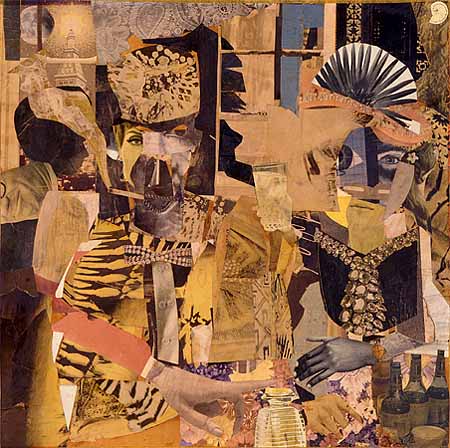
There are already long waiting lists of collectors eager to pay a fortune for works by Chicago’s Kerry James Marshall, New-York-based Kara Walker, and Jean-Michel Basquiat, who died in 1988 at the age of 27. But Driskell contends that prices still lag badly for African American masters such as Henry Ossawa Tanner (1859-1937), Romare Bearden (1914-88), Jacob Lawrence (1917-2000), and Elizabeth Catlett, 90, because they remain under-represented in mainstream galleries and museums. Indeed, even after a major Bearden retrospective organized by the National Gallery of Art in 2003, the artist’s pioneering collages still can be purchased for well under $100,000. “Bearden is the most undervalued artist in America right now,” says Miami collector Donald Rubell.

Prices for those artists’ works seem likely to rise. E.T. Williams, a retired banker and real estate investor who is on the board of the Brooklyn Museum of Art, says “a major catch-up” is under way as mainstream museums give African American artists more wall space and new museums such as San Francisco’s Museum of the African Diaspora (which just opened in December) are built. That’s already giving a boost to older artists, such as abstract painter Sam Gilliam, 72, the subject of a retrospective organized by Washington’s Corcoran Gallery that will be moving on to museums in Louisville, Savannah, Ga., and Houston. The Art Institute of Chicago is running a major Catlett show through Apr. 23.

NBA PICKS
Meanwhile, a new generation of collectors is scouting talent. Professional basketball star Grant Hill, 33, who has built a museum-quality collection of black old masters (you can see it at granthill.com), plans to focus on younger living artists after he retires. Two of his friends, retired NBA player Elliot Perry, 36, and Darrell Walker, 44, an assistant coach with the New Orleans Hornets, are already purchasing pieces from emerging mixed-media artists such as Whitfield Lovell, 46, and Radcliffe Bailey, 37.

These collectors haunt galleries such as D.C. Moore, Michael Rosenfeld, and Bill Hodges in New York and G.R. N’Namdi (which has locations in Detroit and Chicago as well as New York). They also track shows by hip curators at institutions such as the Studio Museum in Harlem and get to know the artists. “We know that one day we’ll go down in history as collectors,” Walker says. It may pay to follow their lead.

Gallery Spotlight: Little Black Pearl

By Chicago Art Magazine on Jul 20, 2010 in Featured, Reviews

Gallery Spotlights are posts about randomly selected* art venues in Chicago

Anna Schier

Born in a Basement:

From the moment of its birth in the basement of an abandoned building, Little Black Pearl Art and Design Center has enthusiastically enriched the Kenwood/Oakland community. 10 years later, the south side youth center continues to thrive and grow under the steady hand of founder and Executive Director, Monica Haslip .

Haslip’s passion for her work is clear. “I always wanted to create an avenue to introduce African American youth in particular to the arts as a potential career path,” she states. “I met a number of kids that lived in the neighborhood and I talked to them about art and many of them had some really short visions for what was possible. Creating an environment where kids who didn’t normally have access to art could have a place where they did have access had the potential of changing their lives and giving them more hope and possibility.”

What began a decade ago has grown tremendously. The 40,000 square foot space, formerly a liquor store and Little Black Pearl’s residence of three years, is home to an astounding array of facilities, including a metal studio, wood studio, computer lab, mosaic studio and one of only two glass blowing studios in Chicago. It is the perfect place to discover art’s power to educate and inspire.

From Artisans to Entrepreneurs:

Haslip teaches her students that creativity need not be synonymous with frivolity. By incorporating business skills as a critical element of its art program, Little Black Pearl has crafted a successful marriage of artistry and practicality.

“They learn about the importance of pricing, they learn about the market that they are selling to, they learn about quality control,” Haslip explains.

The students at Little Black Pearl, ranging from elementary-aged to late teens, don’t simply learn these concepts in theory, either. They implement them, crafting pieces commissioned by a wide range of clients, including the University of Chicago, the Quad Communities Development Corporation and the Illinois Department of Transportation, as well as small businesses, community members and collectors.

Haslip notes, “They [the students] have to really understand the importance of being efficient and dealing with the client’s interests and needs. When they move forward either to college or to start businesses or in the workforce, they already know some of the basic business principles that are required to be successful.”

While students are busy constructing pieces to be sold in the art center’s store or for clients, participants in Little Black Pearl’s Workforce Development Program gain valuable professional skills and job experience.

The program, aimed at young adults aged 19 to 35, offers jobs and internships in everything from studio work to administration. After 6 months in the program, interns are either shifted to full time positions at Little Black Pearl or the art center tries to find them another placement, providing professional opportunities for many young community members.

Creating Art, Creating Community:

Little Black Pearl provides local youth with the opportunity to learn how to succeed in the art industry. But Haslip’s programs also offer students something else: a voice.

“Some of the stuff now that we’re going through in the city, violence and youth violence — a lot of our kids really didn’t feel like they had a voice in these issues,” explains Haslip. “Because those things are impacting our community, we really are using art as a vehicle for our youth to have a voice.”

Little Black Pearl’s Summer Program, in particular, encourages participants to address social issues through painting, poetry, dance and theater. This summer’s theme, Collateral Damage: Creating Legacies of Boundless Peace, is part of an ongoing year round project at Little Black Pearl.

The highlight of Little Black Pearl’s summer of social awareness will take place on August 21st. The art center will host Pearl Fest , an event that will include health screenings, local artists and musicians. Haslip explains that the festival “is our way of bringing the resources that we’ve developed over the year through our relationships with other partners back to the community.”

Little Black Pearl’s community outreach doesn’t end with the summer. Come September, the center continues to give back with an in-school program. Primarily catering to alternative schools, the art center educates students while visually improving their schools.

“We’ll design workshops so students can participate in producing murals and other public installations for the school,” says Haslip.

Little Black Pearl refuses to be limited to educating only the students enrolled in its programs. Rather, the instructors and administrators reach out to the surrounding neighborhood, actively engaging with south side residents, offering programs catering to seniors and adults, artisan residency, academic tutoring, a gallery, and a cafe with free wifi.

Says Haslip, “We use art as an avenue to get youth and adults engaged in much broader issues. One of the things that makes this organization unique is that we really do believe that art has a place in community development and economic development. Hopefully in the future we’ll continue to be at the table where those discussions are taking place, making sure that art is being considered a very important aspect of community.”

Little Black Pearl Art and Design Center is located at 1060 East 47th Street. It is open from 10 am to 6 pm Monday through Friday. Pearl Fest will take place in Mandrake Park on August 21st from 10 am to 10 pm. Admission is free.

*Gallery spotlights are chosen based on a lottery, which we document by videotape, in order to be transparent and truly random. 10 were chosen out of a pool of 350.

source >>>>>>>>>>>>>>>>>>>>

About the SCLC Magazine

The SCLC Magazine, which has been published five times annually since 1971, serves as a vital educational and informational link between SCLC’s national headquarters and our constituency throughout the country. It is distributed through its chapters, affiliates and membership nationwide with an estimated readership of 400,000.

As America’s most respected civil rights voice, The SCLC Magazine serves as a major vehicle for leading corporations to enhance their visibility and sales among 30 million black consumers. Sent to universities, state and junior colleges, primarily in minority communities, it has become a viable recruiting tool for companies interested in hiring qualified minority applicants. It has been widely used in major libraries and research centers throughout the country. In addition, it is distributed to both local and national elected officials, government agencies, civil rights organizations, Fortune 500 companies as well as to our advertisers and supporters across the country.

The publication’s editorial content, by focusing on national and international events and issues which shape the lives of minorities in particular, provides information to its readership of SCLC’s struggles in the civil rights arena.

Articles pertinent to these efforts are submitted for publication by a diverse group of educators, politicians, economists, activists, and an involved citizenry. In addition, the private business sector is encouraged to submit for publication, by means of feature stories, gains it has made in employment and social services, which would enhance their corporate image in the minority community.

visit >>>>>>>>>>>>>>>

Exploring African American Heritage at the Smithsonian

The Smithsonian Institution, the largest museum complex in the world, is made up of 19 museums and galleries and the National Zoo, in Washington, D.C., area and New York City. It also is an important research organization, with facilities and projects worldwide.

This brochure, offered as a companion to “Go Smithsonian,” provides details on exhibitions and objects on display that reflect the contributions of African Americans to the history and culture of the United States. Details on exhibitions and objects in the collections and on view that reflect the life and art of the peoples of Africa are offered as well. Programs and activities for young African American visitors also are noted.

On December 16, 2003, President George W. Bush signed legislation to create a National Museum of African American History and Culture within the Smithsonian Institution. This new museum will be devoted to the documentation of African American life, art, history and culture. The museum will be built on the National Mall in Washington, D.C.

Information subject to change. Please call (202) 633-1000 (voice) or (202) 633-5285 (TTY) to verify dates and other information. Send e-mail requests to info@si.edu, or visit the Smithsonian’s Web site at www.smithsonian.org.

Mark Bradford on class and identity in South Central LA

As his solo show opens at the Wexner Center in Columbus, the Los Angeles artist talks to us about the dynamics of community, working with children and making art in post-Katrina New Orleans…..

Standing 6ft 8in tall, the elegant and engaging Los Angeles-based artist Mark Bradford cuts a striking figure. His mural-sized abstract collages and installations are assembled from signage, advertisements and posters which he layers with paint, twine, and glue, and then repeatedly sands down. An LA native, his installations, sculptures and videos both celebrate and critique the communities of South Central Los Angeles. In 2009 the 49-year-old artist won the prestigious MacArthur Foundation “genius” grant, propelling his career to greater heights. A major 10-year survey of his work debuts this month at the Wexner Center for the Arts in Ohio before embarking on a four-city national tour.

The Art Newspaper: Your early paintings incorporate supplies from your mother’s hair salon like hair dyes and permanent-wave end papers. Why did you move away from this subject matter?

Mark Bradford: My early works used socially loaded material but I was always interested in abstract painting. So my first gesture was to combine the two. Later I learned that I didn’t have to combine them on the same pictorial surface.

TAN: Can you describe your working process?

MB: I use secondary advertising and found printed matter from the streets, things that have some use value. I am drawn to ways of working that are very tactile with a certain physicality. I tend to obliterate the canvas with paper so it becomes opaque, almost like a wall, and then I begin to build. Between the first layer and the final surface layer of paper is where all the action happens.

TAN: Is it true that you and your assistants wear uniforms, placing official-looking plastic cones on the ground before you take down paper signage from fencing and plywood construction boards in your neighbourhood?

MB: It’s quasi-illegal for these advertising companies to paste the posters on the plywood barricades, and its quasi-illegal for me to take them down, so my actions exist in a real grey area. Once a year, city services come and take the advertising down. I appropriate the role of a city worker and I perform their job for them, and this way I don’t have any problems. I have gone to multi-million dollar buildings during the middle of the day and they assume that I’m on a certain side of the law.

TAN: You entered the California Institute of the Arts (CalArts) in 1991 at the age of 30. What were you doing before you entered school?

MB: I was working at a hair salon, travelling to places like Europe, Africa and Mexico, and going to clubs and dancing. I didn’t know that at 30 I’d be sitting with 18-year-olds straight out of high school. That was an adjustment.

TAN: Did you always know you wanted to be an artist?

MB: I didn’t come from an art background. Being an artist was really a class thing and it wasn’t a conversation we had in my house. We were self-employed, working-class people and although we were very dynamic and creative we were geared toward making a living.

TAN: You have mentioned that at CalArts you were immersed in art theory, but what part of your experience had the most practical and meaningful impact on your career?

MB: When I was growing up I didn’t know anything outside of the mainstream. So when I got to CalArts, I learned that there were liberal, alternative and non-traditional ways of thinking which was really new for me.

Don’t forget I was going back and forth every day from traditional black America. I could relate to Foucault’s ideas about how one’s subjectivity moves through territory. It meant that I could go to the hair salon and back to CalArts as one whole person and not compartmentalise my being.

TAN: Your mother owned a beauty salon and you come from several generations of self-sufficient merchants. Can you talk a bit about why you collect and use posters in your work?

MB: I only collect posters that represent self-run businesses. These posters are about fringe economies and I’m always fascinated by things that fall between the cracks of the middle-class. The middle class shuffles along, but the lower and the higher classes are dynamic—both are irreverent and are risk-takers.

TAN: You seem to bury cultural ideas and documents under layers of abstraction that the viewer can never see.

MB: I think that the idea of accretion or accumulation is no different than modern day Rome, where archaeologists have found layers of ancient cities. In my work, often the viewer can only see the top layer which is not translucent, but the weight and the energy of what’s underneath there will pulsate.

TAN: Your video Niagara (2005) portrays an African American male wearing shorts and a tank top sashaying down the street in South Central Los Angeles. Can a person be openly gay on the streets of South Central LA?

MB: It’s complicated but no. He was performing the gesture with his body on one of the main thoroughfares of the black community and one of the toughest streets in the neighbourhood. That space was inscribed with a very particular power dynamic and it made me think about the fragility of the body in public space. The only other time I would see this type of fragility is when I would see a young boy in the wrong part of the community wearing the wrong colours and then you would see his vulnerability and desperation because he was trying to get to a place where he wouldn’t be harmed.

TAN: Would you say your work is both a celebration and a critique of the dynamics of community?

MB: Absolutely—it’s not some romanticised view of community. It’s a very complex conversation and there is no closure. I think the conversation is what’s interesting.

TAN: In your video Practice (2003) you are dressed in an antebellum hoop-skirt stitched together from Los Angeles Lakers’ basketball team uniforms. As a 6ft 8in African American man, one would think that you have to dispel several stereotypes.

MB: I have no public privacy. I’ve always been vulnerable in public space; because of my size people feel like they can step into my private world at any moment and ask me how tall I am.

People say that I look like a player but what does that mean? Basketball is religion and the high priests are the players. When you tell people you don’t play, they say what a waste, like it’s almost a sin against the body that I was born in.

TAN: Do you feel that you or your work has also been stereotyped or misrepresented in some way?

MB: I think that with artists of colour, often people are looking for the real story connected to the image. Here’s the funny thing: in the art world I was first described as the black hairdresser from South Central, then I became urban black from South Central, but now I’m a 2009 MacArthur winner—that’s my new moniker. It’s another type of branding.

TAN: One of the most celebrated and poignant pieces at the 2008 New Orleans Biennial Prospect. 1 was your sculpture Mithra (2008)—a monumental 70ft-long ark built on site in the devastated Lower Ninth Ward. How was your interest in community and history realised in New Orleans?

MB: It wasn’t my community; I was definitely an outsider. I was a biennial artist and I never tried to be “we the people”. My actual father, who I’ve never met, is from New Orleans, and people kept trying to make a connection between me and the city. But I don’t feel any special connection because of my DNA. By being engaged and open I built some interesting relationships that I still have with Keith [Calhoun] and Chandra [McCormick] of the non-profit art centre L9. They really embraced the work. I went from door to door to introduce myself. My people skills come from working at a hair salon. My mother used to always say nobody wants to feel overlooked.

TAN: In 2008 you painted the words “HELP US” on the rooftop of an LA gallery. The work conjures up images of stranded survivors during Hurricane Katrina. What is this work about?

MB: I painted the words on the roof of a building across the street from a new wing at Los Angeles County Museum of Art from where viewers could look down onto it. At that time I was thinking something doesn’t feel right about the art world. It just didn’t feel right to me that people were kicking down doors at art fairs and buying everything, and I thought something was going to break.

TAN: Does the art world feel better now?

MB: I don’t know that it feels better, but at least artists are not being so blindly led. We’re becoming more independent, and we are more involved in our careers. The commercial space of the gallery is just one thing that we do, but it’s not everything that we do.

I just finished a project for the Getty called “Open Studio” where I invited artists like Carrie Mae Weems, Catherine Opie, Kerry James Marshall and Michael Joo to create lesson plans that teachers can download for children in grades kindergarten through 12. I’m working more and more with kids, and I’m interested in how we move art education away from craft projects with macaroni and glitter to a conversation about the world that they live in.

TAN: Can you talk about your latest commissioned installation Pinocchio Is on Fire, which looks at South Central Los Angeles from the 1980s to the present?

MB: Pinocchio Is on Fire is a mythological character that I created to talk about black culture in South LA at a time of flux and fluidity in the late 1980s when it was changing from an older narrative of family toward a “Boyz in the Hood” hip hop moment. And now the ground is shaking again, hip hop is receding and immigration has changed the landscape. The work is a sound piece using my voice and music. It came very naturally to me.

By Charmaine Picard | From issue 213, May 2010
Published online 7 May 10 (Features)

source>>>>>>>>>>>>>>>>>>

Unreleased MJ Songs Due Nov. from Sony

*Rolling Stone is reporting that new material from the late Michael Jackson is coming to stores this fall courtesy of Sony Music.

Ten previously-unreleased songs are due in November, which will be the first in a 10-project, seven-year, $250 million deal the Jackson estate signed with Sony Music in March 2010. The pact also includes reissues of Jackson’s classic albums, greatest hits sets and a DVD collection.

The magazine said Jackson is believed to have left hard drives filled with unheard music, much of it recorded during his 1980s peak. Jackson’s manager Frank DiLeo said he estimates that the King of Pop’s vaults contain more than 100 completed and unreleased songs, including collaborations with artists Akon, Will.i.am and Ne-Yo.

“There are a couple of songs we recorded for the Bad album that we had to cut that are just sensational,” DiLeo said.


more>>>>>>>>>>>>>>>>>>

8th Annual Community Festival & Walk For Peace Philly

Friday, Aug 6th 1pm-9pm

J&R GRASSROOTS YOUTH SUCCESSFEST
All Children Eat Free 1pm – 5pm College App Fee Waived for 100 Students sponsored by EduIncOnline Zakee Z. Abdur Rahman Scholarship Award Ceremony: in honor of the life of Nicetown businessman and entrepreneur, Zakee Z. Abdur Rahman. Though his life was taken by senseless violence, his legacy lives on to honor and recognize youth who have accomplished outstanding achievements despite facing extraordinary life challenges.
(For more info see flyer or call (215) 726-7178)

August 7th 1pm-9pm
A SOULFUL SATURDAY

11AM – Line up for Walk For Peace; 11:45AM Walk For Peace begins
1PM – Mainstage Opens
Patti LaBelle accepts the Vision of Life Award – Blaqmel Ushers In Jeane CCarne & Miki Howard

more>>>>>>>>>>>>>>>>>>

Jennie C. Jones Works

NEW YORK, NY.- Sikkema Jenkins & Co presents Electric, an exhibition of new works by Jennie C. Jones, on view from July 8 through August 13, 2010.

Jennie C. Jones works at the intersection of art history and black history. She layers the formal language of modern art—abstraction, minimalism—over the conceptual and technical strategies of avant-garde jazz. Jones’ work in audio, sculpture and drawing extends the parallel legacies of experimentation, wit and riff of these radical cultural forms. The new work brought together in Electric continues the artist’s exploration of cultural confluence, hybridization, and a more complicated and historically inclusive form of modernism.

In her new audio work Slowly, In a Silent Way—Caged Jones digitally slows a section of Miles Davis’ In a Silent Way (using tempo changes and cross-fading) to match the length of John Cage’s pivotal work 4’33”. In Jones’ edit, the time frame Cage set aside for ‘silence’ is filled by Davis’ measured hypnotic instrumental score (his characteristic trumpet is absent from the edited section). The result is a meeting of two notions of silence.

The installation of this work is carefully integrated with the architecture of the gallery: it is set for playback on a loop that alternates between the side front galleries. When its speaker is ‘dead’ the Cage piece is recreated as the sound of its listeners, the space itself filling the rest of the void. This is a mediated version of Cage’s work: the speaker has replaced the live musicians.

In the main space, Jones presents a new series of collage and ink drawings based on the packaging of music. The “Song Container” series focuses on the compact disc box, transforming the commonplace collateral of listening into a minimalist art form. We are clearly still in the territory of the formal language of analogue but a new metaphor emerges in the reference to the ‘emptiness’ of the digital realm. Jones’ reconfigured containers—shells that once held something as ephemeral as sound—are shown with display racks and other objects that evoke the formal language of minimalism.

In the same space, a series of sculptural ‘drawings’ made from instrument cable are plugged directly into the gallery wall. The medium of these works—instrument cable—is part of the electrical apparatus used in the capture and editing of the music featured in this exhibition. Miles Davis’ performance of In a Silent Way featured a full-blown electric set-up and is regarded as the first of his fusion recordings. John Cage was a well-known electronic music pioneer. But by plugging into the non-conductor surface of the gallery wall these wall works bring us back to the idea of silence. In the same way, the artist playfully questions the title of the exhibition.

Jones attended Rutgers University, Mason Gross School of the Arts where she received her MFA in 1996. Prior to that she attended The School of the Art Institute of Chicago, receiving a BFA in 1991. Over the past decade she has participated in numerous prestigious artists residency and fellowship programs, both nationally and international. In 2008 she was a fellow at the Rockefeller Foundation’s Bellagio Study Center as well as a Visiting Artist at The American Academy in Rome, Italy. Her awards include a Creative Capital grant in 2008, The Rema Hort Mann Foundation Award, in 2006, and a Pollock-Krasner in 2000. Jones was the 2008 recipient of the William H. Johnson Prize awarded to one emerging african american artist a year. Upcoming exhibitions include a major solo shows at The Yerba Buena Center for the Arts, San Francisco and LAXArt, Los Angeles in early 2011.

more>>>>>>>>>>>>>>>>>>>

Galleries: An artist doing edgy, exhilarating things with color

Since his last show at Bridgette Mayer Gallery, Mark Brosseau seems to have thrown caution to the wind and the results are mostly exhilarating. His paintings of four years ago – eccentric, charming compositions that brought distant views of old-fashioned amusement parks to mind – have given way to more expansive, fluid, and abstracted visions of the scenes that catch his eye.

The window composition, a staple of Sir Howard Hodgkin’s paintings, is a framework in several of Brosseau’s recent paintings. But while the British artist’s windows seem to frame a lingering appreciation of something seen or experienced, and offer a powerful whiff of the exotic, Brosseau’s appear to catch a view of architecture – and unexpectedly at that, in a snapshot, drive-by fashion. At times, different sections of his abstracted views seem to zoom out and in. Merging (2010) looks like apartment buildings as glimpsed by the driver of a car, a quick impression that captures the essence of fast seeing, but thoughtfully reimagined in paint.

Brosseau’s obvious affection and eye for vivid color stood out before this show, but his juxtapositions of colors have become edgier.

Somehow, he’s managed to make hot pinks, life-jacket oranges, parrot greens, and sunny yellows straight out of Lilly Pulitzer fabrics look a little ominous together in Parading (2010). (I can remember some scary Lilly moments, come to think of it.)

A group of small, entirely abstract paintings in the back gallery seems tangential to Brosseau’s show, but I liked this indulgence and the deliberate untidiness of these works. Here, in similar palettes of Chinese red, ultramarine blue, and lemon yellow, Brosseau communes with Kandinsky, Gorky, Stuart Davis, and maybe even our own Arthur B. Carles. You sense he is enjoying a fling with these uncharacteristic (for him) strokes and colors.

As with a few other shows at Mayer, when an artist has been given the entire gallery and the Vault space to fill, the latter’s gloomy environs are not made the most of. Two of Brosseau’s long, accordion-style notebooks are mounted on the wall parallel to each other, and although they provide an interesting insight into his working process, they don’t command the space. And they would have been easier to see in good light, on a table in one of the two galleries.


Bridgette Mayer Gallery, 709 Walnut St., 10 a.m. to 6 p.m. Tuesdays through Saturdays. 215-413-8893 or www.bridgettemayergallery.com. Though July 31.

Philadelphia’s Third Street Gallery offers ‘Building Violence,’ a photo exhibition by Michael J. Dalton II

Building Violence,” an exhibition of work by Michael J. Dalton II at Third Street Gallery, reveals the unfolding of this young Brooklyn photographer’s artistic vocabulary and vision.

Two years before his 2008 graduation from New York’s School of Visual Arts, Dalton already had embarked on chronicling the theme he cares so deeply about: how, as a landscape evolves, a certain violence must occur, whether through destruction, construction, or just letting it lie fallow. His childhood experience, shuttling back and forth between his separated parents, prompted him to begin documenting the constant change taking place in the industrial and commercial Northeast Corridor.

Those early memories of seeing dockyards and factories being demolished by developers stayed with him. So, as an art-school grad needing a job that would support his work as a photographer, he became a construction-site laborer and joined Laborers’ Union 731 in New York. He now works at some of the same locations he photographs.

Reflecting the dramatic changes he has seen around him are 13 featured images of landscapes, buildings, and people, chosen from 40 photos he has made so far in the series with his 8×10 camera. These he prints himself on 30-by-40-inch chromographic photographic paper, then mounts on Plexiglas.

Everything here is imbued with a curious air of anxiety, except Dalton’s fellow construction crew members and his shop steward, Ray. And oh yes, the odd concrete “tree brace” at Brooklyn Botanic Gardens’ subway stop, which looks menacing but actually rescued a threatened tree.

Finally, it’s left up to viewers to decide whether the “evolution” of land Dalton pictures is good or bad for the community.


Third Street Gallery, 58 N. Second St. To Aug. 4. Wednesday through Saturday, noon-5 p.m. Free. 215-625-0993.

The ‘new Caravaggio’ probably not one at all

ROME – It seemed too good to be true: the discovery of a new painting by Caravaggio during celebrations marking the 400th anniversary of his death. It turns out, it probably was.

Scholars unveiling the painting Tuesday concurred that Martyrdom of St. Lawrence did not look like a Caravaggio, but rather like the work of one or more of his followers. This week, the Vatican newspaper, which first suggested the canvas could be the work of Caravaggio, shot down its own report and retracted the claim.

The work will still be subjected to analyses to ascertain its attribution. But experts held out little hope of its authenticity.

“It’s a very interesting painting but I believe we can rule out . . . that it’s a Caravaggio,” said Italy’s art superintendent, Rossella Vodret, moments before unveiling the painting in the Jesuit church where it has been for years.

The 72-by-51-inch oil on canvas is dominated by the figure of St. Lawrence being grilled to death before his three executioners. The painting features the dramatic chiaroscuro – high-contrast light and dark – typical of Caravaggio and his school.

The Vatican newspaper L’Osservatore Romano set the art world aflutter last week with a front-page article headlined “A New Caravaggio.” The article made clear that no certain attribution had been made and that further tests were required. But the definitive-sounding headline and the fact that the claim was made on the day marking the 400th anniversary of the master’s death had raised expectations.

The newspaper reversed itself Monday with an article by the Vatican’s top art historian shooting down the claim. Under the headline “A New Caravaggio? Not really,” museums chief Antonio Paolucci wrote that the work was not of Caravaggio’s quality and termed it “modest” at best.

Scholars said the painting is uneven artistically, with some beautiful elements and some parts they didn’t hesitate to call “very poor” and even “embarrassing.” This suggested that two different people may have worked at it, though it is not certain.

Experts believed the work may have been done by a follower, likely in Naples, Sicily or Malta – places where the painter, who rarely signed his paintings, spent time during his tumultuous life. A notorious brawler, he died at 38 in a Tuscan coast town in 1610, in mysterious circumstances

Artists in residence

Krista Peel and Zak Starer live what they call “the perfect life.” Until eight months ago, that meant handing over their West Philadelphia apartment to complete strangers every two weeks while they stayed with friends. These days, the young married couple still share their space with others – only now, they don’t have to leave home to do so. As founders and codirectors of the Philadelphia Art Hotel, Peel and Starer run a rent-free artist studio and residency out of their spacious East Kensington rowhouse. In return for two to six weeks of housing and studio space, the artists need only donate some of their work to the house, making an already vivid interior color scheme abundantly rich. (The bright yellow window frames of the Art Hotel already stand out on the city block.) But during the six months of the year when they host their carefully chosen pool of 12 to 16 national and international artists, Peel and Starer also reap other, intangible benefits. “When I think about my perfect day, it includes making art a part of my lifestyle,” said Peel, 36. “Zak and I are both artists, so we wanted to be connected to other artists and talk about artwork on a regular basis. But we didn’t want to run a gallery – we wanted a more private space.” Hoping to model the program after residencies in which they had both participated, Peel and Starer started looking for property in 2007 near where they were living in San Francisco, but couldn’t afford the square footage they wanted. They moved to Philadelphia two years ago and found what they call “a thriving undercurrent of people in the local art scene.” In that West Philadelphia apartment, the couple still didn’t have the space they needed to comfortably host other artists. But they did it anyway. “We’re definitely of the mind-set of just finding some way to start rather than wait for the situation to be perfect,” said Starer, 28, originally from Philadelphia. “There’s never going to be enough money, time, space, or any of those luxuries, so we decided to just dive right in and get started.” After a year of providing residencies in West Philadelphia (and having to camp out elsewhere every time they did), Starer and Peel were able to buy their house, aided by the first-time homebuyers tax credit, for about $151,500, according to Philadelphia tax records. Today, the house is divided into separate living areas – the upstairs holds a kitchen and three living and studio spaces, each named after the color of the brightly painted walls. Peel and Starer live in a modest first-floor area. The couple use their own funds to sustain the Art Hotel (they clean in between visits and provide sheets and towels), while artists pay for transportation and food. Peel teaches jewelry-making classes part time at a senior-care facility in West Philadelphia and sells artwork on the handmade-sales website Etsy, while Starer works at Moore College of Art & Design as a photo, video, and printmaking tech. They don’t receive any grants or other funding, which necessitates “being resourceful, reusing materials, and keeping things simple,” Starer says. Both are fairly handy, and the utility bills during the warm months – when artists stay – are not significant. For visiting artists, the opportunity to change scenery for next to nothing is enticing. That was one of the things that attracted Caleb Lyons, 28, who works in painting, sculpture, video, and performance art, and found out about the Art Hotel from a friend who attended Temple University’s Tyler School of Art. “It’s hard for me to picture paying to go to another studio – that could be gratifying if you’re making enough money to afford that, but that hasn’t been the situation I’ve been in so far,” said Lyons, of Des Plaines, Ill., who lived at the Hotel until July 17. “But it’s important to get out of your studio and see things differently. “There’s a saying that ‘the true artist is never on vacation,’ although,” he says, grinning, “it can easily be flipped to say that ‘the true artist is always on vacation.’ ” Peel and Starer also encourage artists to interact with the Kensington community through lectures and collaborations. Lyons and Kathryn Scanlan, a writer and video artist, along with the Art Hotel’s other July artist, Elana Mann, presented a collaborative video screening in mid-July in a vacant lot. But while Scanlan prepared, she was approached by neighbors who were curious about what she was doing. “This has been a really interesting neighborhood to stay in,” Scanlan said. (Next up is an artist talk with the newest artist-in-residence, Danielle Rante from Dayton, Ohio, at 7 p.m. Aug. 5 at Coral Street Arts House, a nearby exhibition and event space.) All are committed to a full-time artist’s lifestyle. Mann, 29, of Los Angeles, a video and performance artist, teaches part time and has received several grants to fund her collaborative art-making. Scanlan, 30, and Lyons used to run a gallery out of the basement of their Chicago apartment. “We’re pretty poor and we just kind of scrape by, but we do what we need to,” Scanlan said. She and Lyons currently run an informal conceptual-art residency program from their house in Des Plaines, and say they dream of someday starting a commercial gallery and running it “as artists, not as typical gallery owners or dealers.” Other programs in Philadelphia offer some combination of residency and studio space for free, but few are as flexible as the Art Hotel. The 40th Street Artist-in-Residence program in University City offers five artists free studio space for one year, but does not provide living quarters (and artists must live west of the Schuylkill). Others, like Kensington-based gallery collaborative FLUXspace, provide limited artist-in-residency options on an as-needed basis, but don’t yet have a formal program set up. The Art Hotel provides the widest range of options for artists who want to combine living and studio space. “We’re kind of the middleman,” said Starer. “We don’t do this for money and will probably be doing something like it ad-hoc for the rest of our lives, so I guess you could say it’s a romanticized notion of providing a place for pure art-making.” An Art Hotel residency can also result in new connections and a new outlook on art as a lifestyle. “In art school, you learn about the gallery track, but that’s very different than living an artist’s lifestyle,” Peel said. “I just hope through this residency program I can help make it known that there are other options for doing art.” Starer says their 10-year plan is constantly evolving as they carve out their own niche in the local art scene. “You can’t ask much more than that from an art practice.”