The Reginald F. Lewis Museum of Maryland African American History and Culture

The Reginald F. Lewis Museum of Maryland African American History and Culture opened on June 25, 2005 and is named after Reginald F. Lewis (1942-1993). Born in Baltimore, Lewis was an entrepreneur and philanthropist who served as chair and chief executive officer of TLC Beatrice International, the largest U.S. company owned by an African American during his lifetime.

Mission
To be the premier experience and best resource for information and inspiration about the lives of African American Marylanders.

General Facts
The largest African American museum on the East Coast, the Reginald F. Lewis Museum brings
Maryland to the world through its extensive permanent collection, and the world to Maryland through its educational programs and special exhibitions. The 82,000 square-foot facility accommodates over 13,000 square feet of permanent and temporary exhibition space, a two-story theater, resource center, museum gift shop, café, classrooms, meeting rooms, an outdoor terrace, and reception areas spaces, including the upper lobby reception area, are available for special events and meetings. The museum provides dynamic educational programs for both children and adults and is especially proud of its partnership with the Maryland State Department of Education. The museum’s education department has developed curricula and provided teacher training to reach more than 850,000 students and 50,000 teachers. The museum allows for a substantial increase in the number and quality of objects collected, and encourages the study and enjoyment of collections by scholars, students, and the general public.
The museum provides an important venue to share Maryland’s African American history two
blocks east of one of the state’s most popular attractions, the Baltimore Inner Harbor.

Permanent Exhibition
The Reginald F. Lewis Museum has three permanent galleries on its third floor that highlight ordinary and extraordinary African American heroes in Maryland.

They include:
• Building Maryland, Building America explores three major types of work in which free and
enslaved people of African descent engaged: work on the water, tobacco cultivation, and iron
working. These endeavors were essential to building the colony, and later, state of Maryland.
• Things Hold, Lines Connect shows how African American families and community
organizations provided comfort and support in the face of oppression, while creating
environments in which resistance to oppression could be planned and nurtured.
• The Strength of the Mind features stories about the creative spirit of Maryland African
Americans by focusing on their accomplishments in the arts and education.

more>>>>>>>>>>>>>>>>>>

The Penn Center, South Carolina

Tucked in the heart of the South Carolina Sea Islands between glimmering marshes and deep water, nestled beneath the silvery moss draped limbs of massive live oaks, you will find the Penn Center – the site of one of the country’s first schools for freed slaves and one of the most significant African American historical and cultural institutions in existence today.

Located on St. Helena Island, one of the most beautiful and historically distinct of the South Carolina Sea Islands, Penn Center sits at the heart of Gullah culture, on the 50 acres of the historical campus of Penn School. Designated a National Historic Landmark in 1974, it is a part of the Penn School Historic District which is comprised of nineteen buildings related to and used by Penn School–Brick Church, Darrah Hall, one of the oldest buildings on St. Helena Island, old burial grounds, Gantt Cottage where Martin Luther King Jr. lodged, a Nature Trail, Chowan Creek, acres of pines, native flora and fauna.

On behalf of the Penn Center Board of Trustees and the Sea Island Community, we welcome you to our family and look forward to your visit. For, in the words of the Gullah people—“when oonuh dey yuh, oonuh dey home”—when you are here, you are home.

Penn Center’s Mission

The Penn Center’s mission is to promote and preserve the history and culture of the Sea Islands. We serve as a local, national and international resource center, and act as a catalyst for the development of programs for self-sufficiency.

Penn Center operates the History and Culture Program, the Land Use and Environmental Education Program, the Program for Academic and Cultural Enrichment(PACE) and partners with the University of South Carolina—Beaufort to offer the Early Childhood At Risk Initiative.

Programs

The History and Culture Program collects, documents, preserves and disseminates information related to the cultural heritage of the Sea Island and Lowcountry African American culture. To meet these needs, the Program develops and implements public programs such as the Annual Penn Center Heritage Days Celebration, operates the York W. Bailey Museum and Gift Shop, and maintains the Laura M. Towne Archives and Library.

Penn School National Historic Landmark District
P.O. Box 126, St. Helena Island, South Carolina 29920

Phone: (843) 838-2432
Fax: (843) 838-8545

more>>>>>>>>>

Great Granddaughter of Booker T. Washington To Lead Oakland/Bay Area Youth In Historical Journey…

Across Country, Following His Footsteps From Slavery To Freedom

“The highest test of the civilization of any race is in its willingness to extend a helping hand to the less fortunate. A race, like an individual, lifts itself up by lifting others up.” — Booker T. Washington

San Leandro, CA (BlackNews.com) — When President Obama was elected he asked Americans to help restore the country. Oakland, California native, Sarah O’Neal Rush, great-granddaughter of Booker T. Washington, has not forgotten her pledge to do just that. Rush is the founder and executive director of Booker T. Washington Empowerment Network (BTWEN), a 501(c)(3) nonprofit corporation. From July 30, 2010 – August 7, 2010 she will lead eight youth and three mentors on a Freedom Journey, a rite of passage, following the footsteps of her great-grandfather from slavery to freedom.


Rush comments, “To break generational cycles of destruction among young people across America, we must tell them who they are, and where they come from. I know from personal experience that there is power in their history that will move them forward – from self-destruction to self-love, and empower them to respect their lives, their culture, education, and their community.”

Last year Oakland, California started the year off as the focus of national attention with the tragic murder of a young African-American male, Oscar Grant, followed by the grievous murders of four Oakland Police Officers, and their killer, another young African-American male. The year ended with 124 homicides.

Stories like these cast a dark shadow over the city where Ms. Rush grew up. In response BTWEN plans to add a beacon of hope in inner cities across America, beginning in her hometown, through the Up from Freedom Project, a pilot program for youth 16 – 19-years-old, that meets weekly in East Oakland, California.

Up from Freedom Project connects the past to inspire the future. When participants come to the program, many will have self-imposed limits on their hopes and dreams, if they have hopes and dreams at all. As they progress through the program they will become empowered and prepared to approach the world from a new, healthier perspective. They will also be prepared to go on the Freedom Journey.

The journey begins on the plantation in Virginia, where Booker T. Washington was born a slave. From there they go to West Virginia where he worked in the coal mines as a boy after slavery ended. Then it’s on to Hampton University, where he received his education. From there the group goes to Washington, D.C. where he was the first black invited to dine in the White House. While in D.C. they are scheduled to meet with Congresswoman Barbara Lee, and have lunch with Congresswoman Diane Watson. A request has been made to meet President Obama. The last stop of course will be Tuskegee University, in Alabama, the school Booker T. Washington founded for former slaves and their descendants. Each stop along the Freedom Journey is a national historic site.

“I am excited about the trip and watching my history come alive. I have never even been on an airplane before.” Those are the words of 18-year-old Rhyan, one of the youth participants who recently transitioned out of foster care. As a requirement of the Up from Freedom Project, Rhyan is reading Booker T. Washington’s best-selling autobiography, Up from Slavery. “It’s making me very anxious to get to Tuskegee,” Rhyan said.

The group plans to kick off the Freedom Journey with its first annual walk-a-thon around Lake Merritt in Oakland, on Saturday, July 10, 2010 at 9:00 a.m. For more information about the walk, or to learn more about the Up from Freedom Project, visit www.btwen.org. To help inner-city youth through BTWEN, interested ones may make a tax-deductible donation in any amount to BTWEN, and mail to P.O. Box 3311, San Leandro, CA 94578, or visit www.btwen.org, and click on the donation button.


PRESS CONTACT:

Anthony W. Rush, Public Relations

washingtonwisdom@btwen.org

source www.blacknews.com

Rounded, organic shapes soften a bathroom’s style


(ARA) – The Kitchen and Bath Industry Show (KBIS) is not only the launching pad for a number of new kitchen and bath products; it’s also the place where key trends are announced. At this year’s spring event in Chicago, the National Kitchen and Bath Association (NKBA) held its annual design competition, at which 10 key trends were revealed. A major concept unveiled this year in bath design was “soft geometry” – using rounded, organic shapes in room structures and products to soften a bathroom’s style. Learn how you can use this top trend, as well as others, in your next remodeling project.

Soft geometry

“We started seeing the introduction of softened geometries over the last few years. It actually began with soft modern products, and has evolved from products to overall room architecture,” says Judy Riley, vice president of design at Moen. “Soft geometry can be seen in the edge of a counter, an arch over an entryway or in the lines of a light fixture or other bath product. It’s really about softening the angular features of a room, which are especially prevalent in bathrooms.”

To incorporate the soft geometry concept in your bath decor, Riley suggests beginning with products that are traditionally very linear – such as faucets, bath accessories and lighting. Moen has a new bath collection, which launched at KBIS and falls directly into the soft geometry trend. Blending clean lines and soft curves, the Method suite makes a modern statement with its minimalist styling, available in either a single- or two-handle faucet option. To complete the look, the Method collection also has a number of coordinating accessories – including towel bars, robe hooks, a pivoting paper holder and even a toilet tank lever – which feature the same soft geometry styling as the faucets.

Scaling of elements

Another trend introduced at the show is all about scale. Scale is an important consideration in the overall composition of a kitchen or bath. Shapes, textures (both actual and implied) and thoughtful placement of fixtures are all elements that can be used to create focal points, functionality and visual appeal, according to the NKBA.

The bathroom is the perfect room to test the “scaling of elements” trend, even if you’re not in the midst of a remodeling project. Experiment by placing traditional objects in non-traditional places. For example, instead of placing a single towel ring or bar next to the sink, create a visual display of three towel rings, placed at uneven heights, on the wall directly across from the sink. Not only will it allow you to inexpensively create a focal point in the room, but it also gives you a spot to display beautiful hand towels – and change them with the seasons, or as often as a new color or pattern strikes your fancy.

Color with energy

Gone are the days when neutral tones and muted shades ruled bathroom decor. Instead, NKBA reports that bold colors are creating a vibrant splash in room palettes for 2010, with rich blues, purples, greens and citric yellows making confident appearances. Try using bold colors that act not merely as a passive backdrop for the room, but bring life to the space through lighting, wall colors and wood tones.

Incorporating bold colors is simple to accomplish in a bathroom, since it is typically a smaller place where colors can really pop. Try accent colors first – with vibrant vases, candles and hand towels. If you have a bit more time on your hands, use paint and wallpaper to quickly add a brilliant splash of color to the room.

Art integration

Finally, another trend outlined by NKBA is “art integration” – the concept of personalizing your bath space as a reflection of your own personal style to create an immediate sense of intimacy and originality. According to NKBA, many of today’s designs start with one piece – perhaps a framed painting or an antique sculpture – which becomes a springboard for colors, fixtures, finishes and theme elements.

“We’ve seen this concept quite a bit, as well – it’s a macrotrend we call ‘fingerprinting,'” says Rebecca Kolls, senior director and consumer strategist of home and garden at Iconoculture, a global consumer research and advisory company. “It’s all about self-expression and being empowered to make your own personal statement in your home decor. That might mean anything from shopping garage sales and on Craigslist to attending in-store design classes or working with virtual interior designers.”

And using art-inspired items doesn’t have to be expensive. Today, more and more homeowners are turning to artisans on websites like etsy.com, where you can select hand-made items that often have more character and style than similar store-bought items. From glassware and art to paintings and photographs, etsy has something for virtually every taste.

For more information about the Method collection from Moen, call (800) BUY-MOEN (800-289-6636) or visit moen.com. Additional information on the 2010 NKBA trends can be found at NKBA.org.

Courtesy of ARAcontent

Just married? How to reconcile your decorating differences

(ARA) – After the “I dos” are exchanged and the reception is over, couples find out that the realities of cohabitation do not always make for smooth sailing, especially when it comes to blending different tastes and styles. While newlyweds find themselves saying “I do” at the altar, that phrase frequently turns into “I don’t” when the couple begins combining two unique decorating styles into a single household.

“It’s never easy to incorporate two divergent ideas of design and comfort into one home,” says Christopher Prebel, senior product manager at Pratt & Lambert Paints. “The man likes modern. His new wife likes flea-market chic. If you pick only one style, it’s not going to feel like a ‘married’ home. The question, then, is, ‘How can you blend both and be satisfied?'”

This might take some time, but no one says you have to decorate an entire house overnight.

First, de-clutter. Both of you have baggage that you could stand to dump, donate or list on eBay. Sit down together and negotiate what stays and what goes, and then stick to your plan.

Next, spend time looking at decorating publications and websites and watching decorating shows on TV to decide what sort of style you both like. Talk about what you see, what you love and what you don’t. The husband might hate feminine, floral prints. And, the wife might cringe at preppy plaid. But maybe they both prefer slip-covered sofas and daring wall colors. And once you find that common ground, you can start formulating your decorating strategy.

Paint is one of the easiest and most cost-effective ways to start personalizing any living space, and it all comes down to color. Color possibilities are endless, so chances are you’ll be able to find something you both like.

Visit your local paint dealer and collect color chips or actual inexpensive paint samples that you can put on the wall to compare options. Most paint companies have helped simplify the color selection process. Pratt & Lambert Paints, for example, has a color display that features pop-out color chips that let you evaluate color by overlaying chips against existing furniture and design elements. Additionally, various color cards provide you with suggested color combinations to give you further inspiration.

If you’re the kind of couple who likes to remain en vogue with your decor choices, consider researching the latest color trends. A variety of design industry groups develop color forecasts each year, and paint manufacturers prepare palettes to echo these predictions. Hot directions for 2010 include:

Nurture – Colors inspired by sustainability, balance and making an impact on the greater world. Try gray on your walls and accent with shades of palm green, nutmeg, browns and yellows.

Symbol – Colors in this palette seek inspiration from architectural and historical symbolism – rich, complex and even moody hues, such as tobacco, bay leaf green, maroon and warm reds.

Sense – Hues in this palette not only please the eye but also stimulate the other senses by echoing tactile wonders with colors like that of an artichoke.

Sojourn – Inspired by the sights of global travel, the colors in this palette combine an eclectic mix of cultural references, blending camels and honeyed lights with rich, artistic reds, slate blues and plums.

Color is the biggest hurdle in any decorating decision – and once you cross that challenge off your list as something you’ve accomplished together, the rest should fall easily into place. Some other helpful tips to keep in mind while you’re creating the perfect first home include the following:

* Mix it up, don’t match it perfectly. It’s fine to be eclectic. A home that is perfectly “matchy-matchy” lacks character. Your home is about you, and it should carry a bit of both of your personalities vs. looking like you copied a picture in a magazine.

* Cleverly blend items from the past with new things in every room. You both had a life before you got married – let your history reflect into your present. Yes, it might involve compromise, but that’s what relationships are about, isn’t it?

* Buy big items, such as furniture, window treatments, flooring upgrades and appliances, together. Shopping as a team gives added cohesiveness to the overall look and allows you both to have a say in major purchases.

Marriage is “for better or for worse.” A little creativity and compromise will ensure that at least your decor is for “the better.”

Courtesy of ARAcontent

Dr. J, Bill Russell and Mercer A. Redcross III Do the Auction Thing.

Auctions and Fundraisers are good ways to help others and brand October Gallery.

mercer-dr.jFrom left to right: Auctioneer Mercer Redcross III, Julius “Dr J.” Erving, a Converse representative
and Bill Russell at the Dr. J Foundation auction.

FREE Michael Jackson 3D Poster 4th of July Weekend

Michael Jackson 3-D Lenticular Poster
Paper: 26 1/2 x 18 1/2 Retail Price $35

FREE FREE FREE FREE FREE
This 4th of July weekend.

October Gallery ArtNic (Art Picnic) Saturday and Sunday July 3 and 4, 2010. Noon to 6pm.

Admission Free. Free Food. Free Fun & Art.

To RSVP for the Free Print make a comment (below) as to why you think Michael Jackson was the King of Pop. No fees. No purchase necessary. Just make a comment. Print your comment and bring to the ArtNic Saturday or Sunday 7/3 or 7/4 for FREE Print.


THIS IS A 3D Print. It actually moves. IT IS FANTASTIC !!!

October Gallery 6353 Greene Street Philadelphia, PA 19144 267-297-0188

Michael began his musical career at the age of 5 as the lead singer of the Jackson 5 who formed in 1964. In these early years the Jackson 5, Jackie, Jermaine, Tito, Marlon and lead singer Michael played local clubs and bars in Gary Indiana and moving further afield as there talents grew and they could compete in bigger competitions. From these early days Michael would be at the same clubs as big talented stars of there days, such as Jackie Wilson and would be learning from them even back then.


Paul Goodnight – Visual Artist

Paul Goodnight’s vibrant and emotional work has often been a reflection of his life–from the demons he faced during the Vietnam War to the time he was incarcerated “I’ve learned that art is making me, rather then me creating it.” His creative efforts are nurtured and inspired by several local artists, like Allan Rohan Crite and Dana Chandler. Goodnight had a close relationship with Master African-American artist and mentor John Biggers (1924-2001), who carved the path many contemporary black artists now travel.

Goodnight has developed his own unique aesthetic philosophy to document the humanity of people around the world. He often incorporates African themes and symbols to provide depths of history and culture. He has studied and traveled extensively to different parts of the world, living among the people of Russia, China, Haiti, Nicaragua, Africa and Brazil.

Goodnight’s images have appeared in television and film since 1984: Seinfeld, Arliss, Jackie Brown, The Cosby Show, Fresh Prince of Bel Air, and the Hughleys to name a few. Paul has been featured in numerous publications such as Architectural Digest, Ebony, Essence, People Magazine and the Boston Globe. His works are amongst the collections of such notables as Maya Angelou, Wesley Snipes, Samuel Jackson, Angela Basset, Judith Jamison, Victoria Rowell, and NBA hall-of-famer Isaiah Thomas. His work has been exhibited in the Museum of Fine Arts, The Museum of the National Center of African American Artists and the Smithsonian. He has been the recipient of many achievements and awards such as receiving a commission for the 1996 Olympics, The U.S. Sports Academy Artist of the Year Award in 1997, and the World Cup Soccer Poster of 1998.

Some of Goodnight’s achievements include being commissioned by Geovision for Mass Dept. of Public Health Minority Adult Male Anti Smoking Campaign; American Airline, Don Coleman Advertising and Top Artist, Inc. to do a commemorative piece for Black Enterprise 30th Anniversary and the Urban League of Eastern Massachusetts Award. He was commissioned to do a piece to raise funds for the African American Research Library in FL which auctioned for $32,500 and was commissioned to do a piece by The Valley Inc. in NY which auctioned for $51,000. His works were showcased at the Schomburg Center in NY sponsored by Toyota and Essence Magazine for the Essence Awards 2000, the 2000 African American Achievement Award, WILD local radio station 21st Century Award and the Mass College of Art May 1999 Honorary Masters Degree. He was commissioned to design a ceramic mural for the entrance of the Orlando Airport, a commission to create an original work for the cover of the Official 2000 souvenir magazine of The Boys Choir of Harlem, and featured in the Official Souvenir Magazine of Alvin Ailey for the 1999/2000 season. Paul artwork entitled “What Your Heart Hears” was auctioned for $70,000 at the Andre Agassi Grand Slam for Children in Las Vegas in October 2007.

View Paul Goodnight Artwork>>>>>>>>>>>>>

Cal Massey – Visual Artist

About the Artist:
MOORESTOWN-Cal Massey said that the wonderful images that appear on his canvases come to him during his daily meditations. He jots them on notecards and stores them in a filing cabinet that stands near the easel in his studio. “Everything in my work is spiritual,” the 80-year-old artist said. Entering the artist’s home/gallery studio on Dawson Street is almost a spiritual experience in itself. Messiah, a rendition of a black Christ as one with the earth, standing between the galaxies and the oceans, is the first painting a visitor notices. Near it hangs “Angel Heart”, which Massey considers one of his most popular works, inspired in part by the lack of black angels in traditional artwork. The angel’s hair, styled in a full Afro, is a tribute to the natural beauty of the black woman, Massey said. For years, Massey’s work has represented the black community in the art world. Now the artist, whose work already hangs on the walls of Congress members and rock stars, will see his work hang from the necks of Olympians. Massey was one of 13 artists from around the world chosen to design a commemorative medal for the 1996 ,Summer Olympics in Atlanta. His design, The High Jump, depicts a young black woman – her back arched slightly, her knees bent – as her thighs begin to top the bar. He said his is the only medal that features an athlete of color. “I’m proud to be a role model,” Massey said. The High Jump will be cast in sterling silver and run two inches in diameter. The medals will go on sale in late March or early April, and remain available until after the Games end. The Olympic Committee expects to raise more than $20 million through the sale of the commemorative medals. Massey, a former Franklin Mint designer and sculptor, designed the mint’s first commemorative medal -a Mac arthur Memorial Medal- and went on to design more than 200 medallic designs for the mint. He began drawing at age 4, when he traced newspaper comic strips by holding them up to a window. Growing up with his mother and four siblings in Morton, Delaware County, the young artist used pen and paper to communicate with the world around him. One of his brothers communicated with sound. Once, Massey joined his musician brother at a jazz band rehearsal in the city, and found himself sketching John Coltrane and other greats of that era. After graduating from the Hussian School of Art in Philadelphia in 1950, Massey went into the comic book industry. There, he drew everything from science fiction tales to so many war stories “that I got battle-fatigued.” But without that experience the artist said, he doesn’t think he’d be where he is today. “As a comic book illustrator, I drew blood and guts all the time, but you got to do what you got to do,” Massey said. “Comic strips are behind all these works here today.” It’s hard to see that as one examines the paintings hanging in the artist’s home and gallery. The colors Massey uses are soft ones- pinks, greens, and yellows – that gently blend into each other, not the bold red and blues of the strips. The subject matter is different, too. A supernatural of a different kind is being appreciated in Massey’s work now. His “Genesis” series featuring orbs of orange fire and blue ice, are strong, spiritual works. The faces staring out from Massey’s canvases aren’t all unfamiliar. He used his grandson’s face as a model when he illustrated “My First Kwanzaa Book” a few years ago. A neighborhood girl modeled for the painting “African Woman in Bondage”, and it is his wife’s figure striking a proud pose in “Ashanti Woman”. The Olympic committee invited Massey to submit work to its competition after seeing a sculpture he did for the Statue of Liberty’s renovation project in the mid-1980’s.Massey’s bas-relief plaque showed two women arriving on Ellis Island from the French West Indies. As now, Massey’s work in the show was the only one depicting individuals of color. Although friends tell him it’s time to retire, Massey believes that age is a matter of arteries.” Besides, he can’t stop now: “I still have 200 more paintings to do” he said, gesturing to his filing cabinet.


View Cal Massey Artwork>>>>>>>>>>>>>>>>>>>

Andrew Turner – Visual Artist

Andrew Turner was born in l944 in Chester, Pennsylvania. He was a graduate of Temple University’s Tyler School of Art. Andrew’s work has been widely acclaimed, with many solo exhibitions and participation in group exhibitions. He has taught art in grades K-1 2 in the Chester, Pennsylvania Public Schools and in correctional centers. His appointments include Artist-in-Residence and Curator, Deshong Museum, Chester, PA; Lecturer, Widener University; Lecturer, Institute of Contemporary Art, University of Pennsylvania, Philadelphia, PA; and, he toured and lectured in The People’s Republic of China. Collections which hold Andrew’s paintings include Woody Allen, Dr. Maya Angelou, ARCO Chemical Company, Bell Telephone Company, Dr. Constance Clayton, Mr. and Mrs. Bill Cosby, Edie Huggins, Eric Lindros, Mr. and Mrs Louis Madonni, Moses Malone, Penn State University, the artist formerly known as Prince, Mr. and Mrs. Harold Sorgenti, Swarthmore College, Mrs. Marilyn Wheaton, and Widener University Deshong Museum, just to name a few. He has been featured in numerous solo exhibitions and group exhibitions in the United States and abroad. His Philadelphia commissions include: WDAS FM (1996); Marco Solo, (published by J. Schwinn and G. Harlow, illustrated by Andrew Turner) Reverse Angle Productions, Inc. (I 995); and Robin Hood Dell, Fairmount Park (1985).

“My paintings combine the drama inherent in seventeenth century Dutch painting with the brush work and the economy of the Impressionists. However, I look to the jazz idiom more so than to other contemporary visual artists for guidance and inspiration. I tend to measure the success of my pieces by how they stand up technically, emotionally and innovatively to a Coltrane solo or whether I’ve captured the spirit of the occasion, a la Ellington. The subject matter, sometimes nostalgic recollections of my days as a young tough, covers a myriad of common folk activities. The setting usually my native Chester, is a beehive of creative stimulation or a deteriorating ghetto depending on my state of mind. At the very least, hopefully, these vignettes of experience will help to provide insight into some African American lifestyles and serve as an inspiration to my students and others to continue the legacy of African American participation in the arts.”

Andrew Turner 1944 – 2001


View Andrew Turner’s Artwork click here

Benny Andrews – Visual Artist

Born in 1930, one of 10 children in a Georgia farming family, Benny Andrews grew up desperately poor. After serving in the U.S. Air Force, he studied at the Art Institute of Chicago on the G.I. Bill. He differed from his fellow students, mostly Abstract Expressionists, by going off to jazz clubs to draw. In 1958, he moved to New York, where his artist friends included Red Grooms, Bob Thompson and the Soyer brothers. For two years (1982-84), he served as director of the Visual Art Program for the National Endowment for the Arts, after which he returned to full-time painting.

Two kinds of influence coexist in Andrews’s art. The first is an exuberant regionalism that takes into account the lives of the poor; Andrews sees a precedent in the work of Thomas Hart Benton. The second is the narrative impulse of much African-American painting, including that of outstanding modernists such as Romare Bearden and Jacob Lawrence, who invested their renderings of black life with dignity and pathos. It is possible to see Andrews as continuing to work in the vein of storytelling. However, his art is also about the ongoing project of exploring what it means to be American. Andrews, who sees himself as an inheritor of several cultures, has said, “It bothers me not being seen as a complicated individual. It’s much easier [for people to typecast me] as regional or representational or Southern or black.”

Andrews’s paintings celebrate daily life. Among the 33 works, all dated 2002, in his ACA show was Living Room Dancing, in which a slender black man in a colorfully striped jacket dances to a tune on the radio. The scene is depicted in 1950s style. The dancer’s delight is clearly communicated, and the painting’s strong compositional balance pushes the work beyond appealing illustration. In his oil and collage paintings of art receptions, Andrews captures the talking heads engrossed in their exchange as they stand before the paintings. In Love offers a couple in wedding attire standing in front of several works of art; a wedding cake and bouquet of flowers are prominent. In a complex work titled Museum Maze, we see people gazing at a number of objects, an oversize sculpture of a general and an all-black abstract painting among them. There is the sense here that Andrews appreciates the way art can move people, the way it can convey the experiences and dignity of ordinary life.

Selected Museums and Public Collections

The Metropolitan Museum of Art, New York,New York
The Museum of Modern Art, New York,New York
The Studio Museum in Harlem, New York,New York
Hirshhorn Museum and Sculpture Garden,Washinton,DC
Wadsworth Atheneum, Hartford,Ct.
Brooklyn Museum,Brooklyn,New York
Carlos Museum,Emory University,Atlanta,Georgia
Chrysler Museum of Art,Norfolk,Virgiania
Art Institute of Chicago,Chicago,Illnois
Arkansas Arts Center,Little Rock,Arkansas
Detroit Institute of Arts,Detroit,Mich.
High Museum of Art,Atlanta,Georgia
National Museum of African Art, Smithsonian Institution,Washington,DC
New Jersey State Museum,Trenton,New Jersey
Philadelphia Academy of Fine Art, Philadelphia, PA
Butler Institute of American Art, Youngstown,Ohio
The John and Mable Ringling Museum of Art, Sarasota, Florida

The Association of African American Museums (AAAM)

The Association of African American Museums (AAAM) is a non-profit member organization established to support African and African American focus museums nationally and internationally, as well as the professionals who protect, preserve and interpret African and African American art, history and culture.

Established as the single representative and principal voice of the African American museum movement, the Association seeks to strengthen and advocate for the interests of institutions and individuals committed to the preservation of African-derived cultures.

The services provided by AAAM enhance the ability of those museums to serve the needs and interests of persons of African ancestry and those who wish to know more about the art, history and culture of African-derived cultures.

Established as the voice of the African American Museums Movement, the Association of African American Museums (AAAM) is a non-profit membership organization dedicated to serving the interests and needs of Black museums and cultural institutions nationwide. Membership is comprised of museums, museum professionals, institutions, and individuals that share an interest in African American art, culture, and history. Through training opportunities and member services, AAAM supports the goals of African American museums and museum professionals.

AAAM works as an advocate for the interests of institutions and individuals committed to the support of African and African derived cultures. It defines a relationship for the body of such institutions within the national museum community, and seeks to strengthen such institutions through improved communication, shared resources, training, annual conferences, technical aid and assistance, and through fund raising guidance. The Association also provides, through newsletters, placement bureaus, etc., services supportive for the professional needs of its membership.

The Association of African American Museums includes cultural organizations, historical societies and museums which not only collect, preserve, and exhibit objects valuable to art, history and science, but also educational institutions, research agencies and cultural centers.

AAAM seeks to advance all of the agendas of our member institutions. The membership shares a common core of knowledge, sense of purpose, and code of ethics that enhance their educational and scholarly attainments.

AAAM supports opportunities for sound professional preparation and provides outlets for research and publications as well as foster the continued improvement of the profession through the development and observance of high standards and ethics.

more….

I’VE KNOWN RIVERS: PRESENTING AFRICAN AMERICAN ARTS, CULTURE & HISTORY

Hosted by the August Wilson Center for African American Culture, Pittsburgh, PA

I’VE KNOWN RIVERS: PRESENTING AFRICAN AMERICAN ARTS, CULTURE & HISTORY

“I’ve known rivers, ancient as the world and older than the flow of human blood in human veins.” Langston Hughes, 1921

The Association of African American Museums invites you to attend the 2010 Annual Conference to be held August 4-7, 2010 in Pittsburgh, Pennsylvania, hosted by the August Wilson Center for African American Culture.

Inspired by renowned poet Langston Hughes, I’ve Known Rivers: Presenting African American Arts, Culture & History explores efforts by metropolitan museums and cultural institutions to preserve and present the ancient through contemporary African American history and arts. Whether large or small, these institutions have been the catalyst for cultural and historical preservation throughout their regions.

As we move further into the twenty-first century, we are challenged by the question of whether metropolitan institutions, such as museums, cultural arts centers and archives can sustain and impact the growth and development of regional culture in this tough economic climate. I’ve Known Rivers: Presenting African American Arts, Culture & History has sessions planned which will address several questions that pertain to the strategies for survival in metropolitan centers. How have recent exhibitions managed to combine new and existing historical research with an ever-changing technology, while maintaining the integrity of the individual, the story and the craft? African American museums often bear the responsibility of balancing best museum practices with the need to preserve and interpret vital historical and cultural events.

Join us in Pittsburgh as your colleagues share innovative approaches to interpreting regional arts, history and culture, while highlighting the roles of metropolitan museums and cultural institutions on the cultural horizon.


Download the 2010AAAM Annual Conference Registration form by clicking here. Early Bird registration ends July 26!

Pica Mertvago: "Langston Hughes" – Sculpture Other, 2001

Sculpture offers me an opportunity to impose my aesthetic sense on the world around me, to give spontaneous expression to my feelings and ideas in a palpable three-dimensional form. The human figure is the natural embodiment for such feelings and ideas as they spring from the human heart and mind, and my figurative works seek to incarnate this. I interpret the reality I observe through the prism of what is pleasing to me. This is especially true for me when executing portraits, because portraits must be more than a mere reflection of a person’s external appearance. To succeed, they must reveal the subject’s underlying character and psyche, both of which have together molded the individual’s recognizable features and personality.

Further Information

more….

Shinique Smith transforms piles of garments destined for export into eye– and thought–provoking installations

Shinique Smith transforms piles of garments destined for export into eye– and thought–provoking installations

In an industrial building near the Brooklyn Navy Yard, Shinique Smith maintains an extremely tidy studio, with her new canvases lining the walls and a collection of fabrics of every hue neatly folded on metal shelving in the center of the space. It is somewhat unexpected to find such an orderly arrangement, in light of the exuberant chaos of many of this artist’s best works: towering piles of discarded clothes tied into rectangular bales, and expressionistic curlicues of calligraphy spilling across museum walls. Smith defies the label of hip–hop artist that critics sometimes use to pigeonhole her creations.

“I am blown away by Shinique Smith’s sensitivity toward material, how she brings materials of such different qualities together and works with them in almost a painterly manner,” says Christoph Heinrich, the new director of the Denver Art Museum. When Heinrich was the museum’s curator of modern and contemporary art, he invited Smith to participate in “Embrace!,” a program in which 17 artists were asked to respond to the new and unusual Daniel Libeskind–designed museum building. Smith chose a particularly tall niche adjoining one of the gallery spaces for her site–specific installation Twilight’s Compendium. “A more predictable artist would say this space was a mistake,” Heinrich remarks, “but Smith was interested in the funny corner that shoots up like a chimney.” The exhibition is on view through April 4.

Smith, who looks more like a fashion designer than an artist, sports a haircut that immediately calls to mind Josephine Baker. Soft–spoken, almost lyrical in her use of language, she is very different from the teenage graffiti artist she once was. The artist grew up in Baltimore as the daughter of a single mother and was arrested at age 15 for possessing cans of spray paint. She was asked to leave the prestigious Baltimore School for the Arts because she belonged to the graffiti group TWC (The Welfare Crew) and wound up at Frederick Douglass High School.

“My foray into tagging was very brief, and it was over 20 years ago,” says the 38–year–old artist. Last spring Smith created Like it Like that, an installation covering four walls of the Project Space at the Studio Museum in Harlem. A collage of clothing, photographs, paint, and drawing, her huge scrawl was in some ways reminiscent of both graffiti and Abstract Expressionism. “Graffiti still influences my work, but in a nostalgic way, reminding me of my youth and the brash, fearless way you have as a teenager. Creating art re–creates that energy for me.”

While Smith never downplays the impact of growing up in urban Baltimore—”the hood,” as she calls it—other aspects of her upbringing were equally influential. Her mother was a fashion designer, and Smith was raised by her grandmother in a fairly strict, education–oriented household. “I wasn’t allowed past my front porch until I was 13. If I was rebelling against anything, it was probably that and school in general.” She studied ballet throughout her high–school years, attending performances of The Nutcracker, and at one point aspired to a dance career, until a knee injury interfered.

She attended the Maryland Institute College of Art on a scholarship, where she studied anatomy and assemblage and made several video pieces. After graduating, in 1992, she took a few years off from art. During that time she founded an African American film festival in Seattle and worked on screenplays in Los Angeles, but she ultimately decided movie production was not her vocation. In 2000, to qualify for teaching jobs, she enrolled in the arts–education program shared by Tufts University and the School of the Museum of Fine Arts in Boston. A year later, she returned to the Maryland Institute, studying Japanese calligraphy and creating performance pieces in which she bound herself in layers of fabric and photographed the results. She graduated in 2003, the same year she got a fellowship to the Skowhegan School of Painting and Sculpture in Maine.

“I definitely see the influence of dance and motion in the way I use my body on my canvases,” says Smith, pointing to the swirl of black lines that decorates one of her paintings. She remains very interested in music today; frequenting dance and karaoke clubs is among her favorite pastimes. When asked how her five years in the film industry informed her visual art, she says, “I am addicted to all those Jane Austen adaptations—costume dramas—and superhero movies, for sure.” Her appreciation of the way clothing can communicate a character and a time period is certainly reflected in her work.

As an emerging artist, Smith experimented with three–dimensional constructions, making cutouts of her calligraphic strokes and assembling them in accumulations that spilled off the surface of the paper and onto the wall and the floor. She then began to make work that involved layering fabric on the wall, forming a kind of unstitched quilt. One day, she read a magazine article about companies shipping cast–off garments from the United States to West Africa. “The article described the journey of a single T–shirt from a woman on the Upper West Side to the African man who bought it,” says Smith. “The idea of the transference of the shirt across the Atlantic was really attractive to me.” Inspired by the way people bundle recyclables, as well as by the way the homeless—whom she refers to as “urban bedouins”—carry their belongings with them, she began to stack materials and bind them together with colored cords. “These different shapes came out, and I explored them as much as I could,” she says.

Smith came to New York in 2003 on a residency with the Lower Manhattan Cultural Council and was soon exhibiting in group shows at alternative spaces around the city, including Art in General, the Bronx River Art Center, the Longwood Arts Gallery, and Triple Candie. An early video piece was included in the exhibition “Veni Vidi Video II” at the Studio Museum in Harlem in 2004. The following year, Smith made her breakthrough presentation at that museum, in the show “Frequency,” the ambitious exhibition of new trends in African American art that launched the careers of many artists. At this time, she was supporting herself by working in the office for the Armory Show in New York, and then as a studio assistant for the artist Kehinde Wiley. “I even went for an interview to work as a personal assistant for comedian Chris Rock, but I realized I would be giving up everything, so I didn’t take it,” she recalls.

Christine Kim, now associate curator at the Los Angeles County Museum of Art, selected Smith to participate in “Frequency” in 2004, when Kim was a curator at the Studio Museum. “We had several conversations about the trajectories of clothing and fabric distribution in different areas of New York City—the East Village, Williamsburg, Fort Greene, where she lived,” Kim says, “and how what you find at the Salvation Army on 125th Street in Harlem would be different than donation centers in other parts of the city.” For the show, Smith created her first mature sculpture, titled Bale Variant No. 0006—a tall assemblage of clothing and accessories that looked very much like the bales of fabric shipped abroad.

“I didn’t have a studio at the time, so most of the piece was made in my living room, and then on–site at the museum,” says Smith, who adds that an actual bale of clothing like the ones that inspired her piece would weigh more than 800 pounds.

Smith’s bale weighed about 400 pounds and was built in pieces around a hollow form. “My doorway was only 36 inches wide,” the artist says, “so I made it in sections, each piece weighing about 100 pounds.” She incorporated her own clothes, her grandmother’s, and even blankets that came off her bed. Explaining her choice of materials, she says, “Our bodies are imprinted onto the fabric that we wear, and as such it moves around into different communities and gets reformed and reused and reconstituted in these different contexts. It seemed clear to me that this form, the bale, was the ideal space for articulating these ideas.”

New Museum curator Laura Hoptman chose Smith’s work Bale Variant No. 0011 (2005) for the 2007—8 exhibition “Unmonumental: The Object in the 21st Century.” Hoptman points out, “On the one hand, it is a very colorful assemblage of discarded clothes; on the other, it is a very telling take on minimalist sculpture.” Hoptman views Smith as part of the generation following the ’90s conceptual artists, such as Mona Hatoum and Felix Gonzalez–Torres, who intentionally select found objects with social implications or historical meaning, but who do not neglect the importance of visual impact. “She doesn’t deny visual pleasure,” Hoptman emphasizes, “and there is a definite narrative in the material—in this case, the way discards from wealthy nations are shipped to less well–off countries and sold by the pound.” In that way, says Hoptman, “it is vaguely political, but it is also a commentary on modern monumental sculpture and geometric abstraction.”

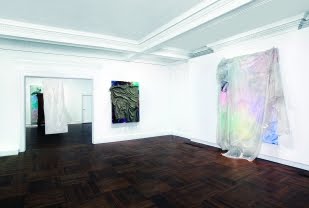
By 2007, Smith had expanded her vocabulary beyond bales of clothing, making three–dimensional works that blurred the boundaries between painting and sculpture. In her solo show “ALL PURPOSE,” at Moti Hasson Gallery in Chelsea, she presented works such as Thank You Come Again (2007), which incorporated old socks and an ex–boyfriend’s yellow–and–black–striped T–shirts. She affixed the articles to a wood panel attached to a wall tagged with black paint marks and drips; on the floor beneath it was a pile of old clothes.

Smith’s talent for tailoring her work to an architectural space was evident in her installation No Thief to Blame (2007—8), which appeared in the National Portrait Gallery’s 2008 show “RECOGNIZE! Hip Hop and Contemporary Portraiture.” Smith was commissioned to respond to a poem by African American writer Nikki Giovanni, titled “It’s Not a Just Situation: Though We Just Can’t Keep Crying About It (For the Hip Hop Nation That Brings Us Such Exciting Art).” The poem was broadcast into the gallery where Smith’s work appeared. Framing a corner of the room, the installation wove together references to dead hip–hop artists Tupac Shakur, Aaliyah, Jam- Master Jay, and Lisa Lopes with a swooping calligraphic line that incorporated lyrics from rap songs and words from Giovanni’s poem. “This piece in particular,” Smith says, “honors the warrior women who have fueled me with their distinctive cries.”

Last summer, Smith gave New York a double dose of her work—an installation at the Studio Museum in Harlem followed by the show “Ten Times Myself” at Yvon Lambert Gallery in Chelsea, where her prices ranged from $20,000 to $50,000. The centerpiece at Yvon Lambert, which now represents her, was Bale Variant No. 0017 (2009), a tall rectangular mass of clothing, transitioning bottom to top from shades of black and indigo to bright white. The new canvases there reflected a meditative state of mind, featuring an increasingly complex use of calligraphy punctuated by swatches of fabric, as in works like And the world don’t stop and Mandala (both 2009).

But the artist’s sense of humor also came through in Untitled (Whistler’s Mother), 2009. This work is a riotous assemblage of clothes bundled around a stuffed satin pig, which takes the form of a human sitting on a chair and wears a bright yellow skirt that brushes the floor. “My relationship to my subjects and the materials is very personal, like the feeling when you are a kid alone making toys from whatever is available,” she says. “You put a towel on your head to make hair, or an empty film canister becomes Barbie’s side table.” It’s that sense of play that continues to animate Smith’s elegant and unruly accumulations.

Barbara Pollack is a contributing editor of ARTnews.