Andrew Turner – Visual Artist

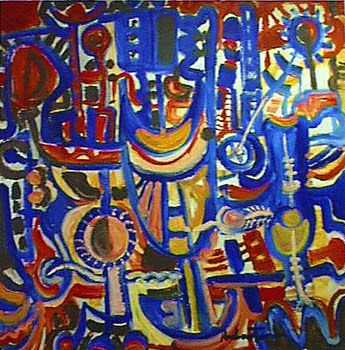
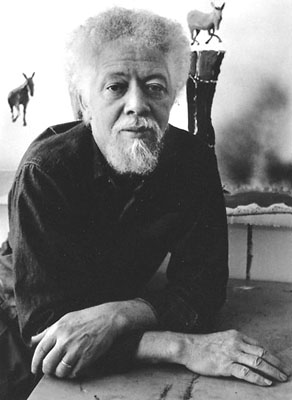
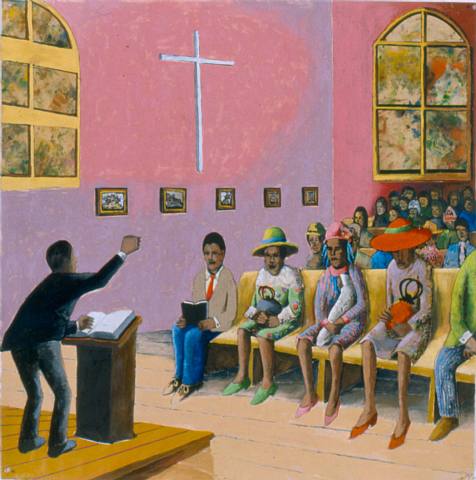
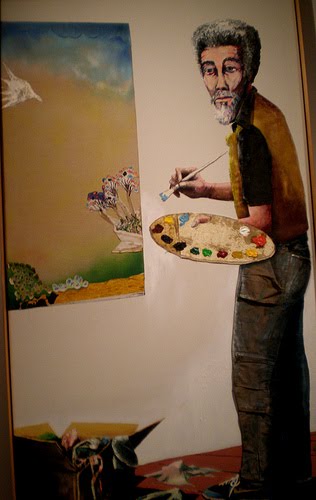
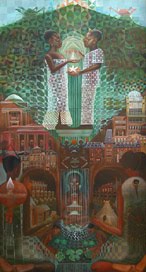
Andrew Turner was born in l944 in Chester, Pennsylvania. He was a graduate of Temple University’s Tyler School of Art. Andrew’s work has been widely acclaimed, with many solo exhibitions and participation in group exhibitions. He has taught art in grades K-1 2 in the Chester, Pennsylvania Public Schools and in correctional centers. His appointments include Artist-in-Residence and Curator, Deshong Museum, Chester, PA; Lecturer, Widener University; Lecturer, Institute of Contemporary Art, University of Pennsylvania, Philadelphia, PA; and, he toured and lectured in The People’s Republic of China. Collections which hold Andrew’s paintings include Woody Allen, Dr. Maya Angelou, ARCO Chemical Company, Bell Telephone Company, Dr. Constance Clayton, Mr. and Mrs. Bill Cosby, Edie Huggins, Eric Lindros, Mr. and Mrs Louis Madonni, Moses Malone, Penn State University, the artist formerly known as Prince, Mr. and Mrs. Harold Sorgenti, Swarthmore College, Mrs. Marilyn Wheaton, and Widener University Deshong Museum, just to name a few. He has been featured in numerous solo exhibitions and group exhibitions in the United States and abroad. His Philadelphia commissions include: WDAS FM (1996); Marco Solo, (published by J. Schwinn and G. Harlow, illustrated by Andrew Turner) Reverse Angle Productions, Inc. (I 995); and Robin Hood Dell, Fairmount Park (1985).

“My paintings combine the drama inherent in seventeenth century Dutch painting with the brush work and the economy of the Impressionists. However, I look to the jazz idiom more so than to other contemporary visual artists for guidance and inspiration. I tend to measure the success of my pieces by how they stand up technically, emotionally and innovatively to a Coltrane solo or whether I’ve captured the spirit of the occasion, a la Ellington. The subject matter, sometimes nostalgic recollections of my days as a young tough, covers a myriad of common folk activities. The setting usually my native Chester, is a beehive of creative stimulation or a deteriorating ghetto depending on my state of mind. At the very least, hopefully, these vignettes of experience will help to provide insight into some African American lifestyles and serve as an inspiration to my students and others to continue the legacy of African American participation in the arts.”

Andrew Turner 1944 – 2001


View Andrew Turner’s Artwork click here

Benny Andrews – Visual Artist

Born in 1930, one of 10 children in a Georgia farming family, Benny Andrews grew up desperately poor. After serving in the U.S. Air Force, he studied at the Art Institute of Chicago on the G.I. Bill. He differed from his fellow students, mostly Abstract Expressionists, by going off to jazz clubs to draw. In 1958, he moved to New York, where his artist friends included Red Grooms, Bob Thompson and the Soyer brothers. For two years (1982-84), he served as director of the Visual Art Program for the National Endowment for the Arts, after which he returned to full-time painting.

Two kinds of influence coexist in Andrews’s art. The first is an exuberant regionalism that takes into account the lives of the poor; Andrews sees a precedent in the work of Thomas Hart Benton. The second is the narrative impulse of much African-American painting, including that of outstanding modernists such as Romare Bearden and Jacob Lawrence, who invested their renderings of black life with dignity and pathos. It is possible to see Andrews as continuing to work in the vein of storytelling. However, his art is also about the ongoing project of exploring what it means to be American. Andrews, who sees himself as an inheritor of several cultures, has said, “It bothers me not being seen as a complicated individual. It’s much easier [for people to typecast me] as regional or representational or Southern or black.”

Andrews’s paintings celebrate daily life. Among the 33 works, all dated 2002, in his ACA show was Living Room Dancing, in which a slender black man in a colorfully striped jacket dances to a tune on the radio. The scene is depicted in 1950s style. The dancer’s delight is clearly communicated, and the painting’s strong compositional balance pushes the work beyond appealing illustration. In his oil and collage paintings of art receptions, Andrews captures the talking heads engrossed in their exchange as they stand before the paintings. In Love offers a couple in wedding attire standing in front of several works of art; a wedding cake and bouquet of flowers are prominent. In a complex work titled Museum Maze, we see people gazing at a number of objects, an oversize sculpture of a general and an all-black abstract painting among them. There is the sense here that Andrews appreciates the way art can move people, the way it can convey the experiences and dignity of ordinary life.

Selected Museums and Public Collections

The Metropolitan Museum of Art, New York,New York
The Museum of Modern Art, New York,New York
The Studio Museum in Harlem, New York,New York
Hirshhorn Museum and Sculpture Garden,Washinton,DC
Wadsworth Atheneum, Hartford,Ct.
Brooklyn Museum,Brooklyn,New York
Carlos Museum,Emory University,Atlanta,Georgia
Chrysler Museum of Art,Norfolk,Virgiania
Art Institute of Chicago,Chicago,Illnois
Arkansas Arts Center,Little Rock,Arkansas
Detroit Institute of Arts,Detroit,Mich.
High Museum of Art,Atlanta,Georgia
National Museum of African Art, Smithsonian Institution,Washington,DC
New Jersey State Museum,Trenton,New Jersey
Philadelphia Academy of Fine Art, Philadelphia, PA
Butler Institute of American Art, Youngstown,Ohio
The John and Mable Ringling Museum of Art, Sarasota, Florida

The Association of African American Museums (AAAM)

The Association of African American Museums (AAAM) is a non-profit member organization established to support African and African American focus museums nationally and internationally, as well as the professionals who protect, preserve and interpret African and African American art, history and culture.

Established as the single representative and principal voice of the African American museum movement, the Association seeks to strengthen and advocate for the interests of institutions and individuals committed to the preservation of African-derived cultures.

The services provided by AAAM enhance the ability of those museums to serve the needs and interests of persons of African ancestry and those who wish to know more about the art, history and culture of African-derived cultures.

Established as the voice of the African American Museums Movement, the Association of African American Museums (AAAM) is a non-profit membership organization dedicated to serving the interests and needs of Black museums and cultural institutions nationwide. Membership is comprised of museums, museum professionals, institutions, and individuals that share an interest in African American art, culture, and history. Through training opportunities and member services, AAAM supports the goals of African American museums and museum professionals.

AAAM works as an advocate for the interests of institutions and individuals committed to the support of African and African derived cultures. It defines a relationship for the body of such institutions within the national museum community, and seeks to strengthen such institutions through improved communication, shared resources, training, annual conferences, technical aid and assistance, and through fund raising guidance. The Association also provides, through newsletters, placement bureaus, etc., services supportive for the professional needs of its membership.

The Association of African American Museums includes cultural organizations, historical societies and museums which not only collect, preserve, and exhibit objects valuable to art, history and science, but also educational institutions, research agencies and cultural centers.

AAAM seeks to advance all of the agendas of our member institutions. The membership shares a common core of knowledge, sense of purpose, and code of ethics that enhance their educational and scholarly attainments.

AAAM supports opportunities for sound professional preparation and provides outlets for research and publications as well as foster the continued improvement of the profession through the development and observance of high standards and ethics.

more….

I’VE KNOWN RIVERS: PRESENTING AFRICAN AMERICAN ARTS, CULTURE & HISTORY

Hosted by the August Wilson Center for African American Culture, Pittsburgh, PA

I’VE KNOWN RIVERS: PRESENTING AFRICAN AMERICAN ARTS, CULTURE & HISTORY

“I’ve known rivers, ancient as the world and older than the flow of human blood in human veins.” Langston Hughes, 1921

The Association of African American Museums invites you to attend the 2010 Annual Conference to be held August 4-7, 2010 in Pittsburgh, Pennsylvania, hosted by the August Wilson Center for African American Culture.

Inspired by renowned poet Langston Hughes, I’ve Known Rivers: Presenting African American Arts, Culture & History explores efforts by metropolitan museums and cultural institutions to preserve and present the ancient through contemporary African American history and arts. Whether large or small, these institutions have been the catalyst for cultural and historical preservation throughout their regions.

As we move further into the twenty-first century, we are challenged by the question of whether metropolitan institutions, such as museums, cultural arts centers and archives can sustain and impact the growth and development of regional culture in this tough economic climate. I’ve Known Rivers: Presenting African American Arts, Culture & History has sessions planned which will address several questions that pertain to the strategies for survival in metropolitan centers. How have recent exhibitions managed to combine new and existing historical research with an ever-changing technology, while maintaining the integrity of the individual, the story and the craft? African American museums often bear the responsibility of balancing best museum practices with the need to preserve and interpret vital historical and cultural events.

Join us in Pittsburgh as your colleagues share innovative approaches to interpreting regional arts, history and culture, while highlighting the roles of metropolitan museums and cultural institutions on the cultural horizon.


Download the 2010AAAM Annual Conference Registration form by clicking here. Early Bird registration ends July 26!

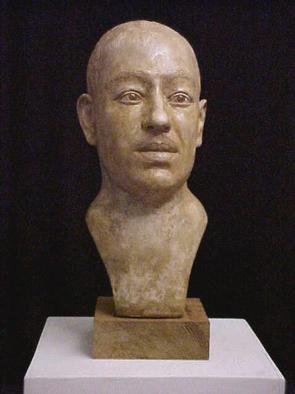
Pica Mertvago: "Langston Hughes" – Sculpture Other, 2001

Sculpture offers me an opportunity to impose my aesthetic sense on the world around me, to give spontaneous expression to my feelings and ideas in a palpable three-dimensional form. The human figure is the natural embodiment for such feelings and ideas as they spring from the human heart and mind, and my figurative works seek to incarnate this. I interpret the reality I observe through the prism of what is pleasing to me. This is especially true for me when executing portraits, because portraits must be more than a mere reflection of a person’s external appearance. To succeed, they must reveal the subject’s underlying character and psyche, both of which have together molded the individual’s recognizable features and personality.

Further Information

more….

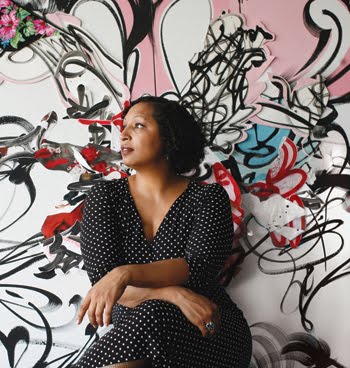
Shinique Smith transforms piles of garments destined for export into eye– and thought–provoking installations

Shinique Smith transforms piles of garments destined for export into eye– and thought–provoking installations

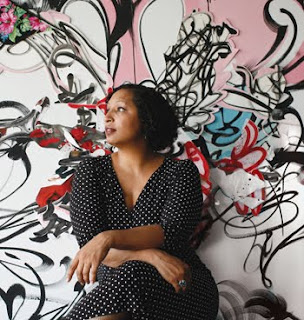
In an industrial building near the Brooklyn Navy Yard, Shinique Smith maintains an extremely tidy studio, with her new canvases lining the walls and a collection of fabrics of every hue neatly folded on metal shelving in the center of the space. It is somewhat unexpected to find such an orderly arrangement, in light of the exuberant chaos of many of this artist’s best works: towering piles of discarded clothes tied into rectangular bales, and expressionistic curlicues of calligraphy spilling across museum walls. Smith defies the label of hip–hop artist that critics sometimes use to pigeonhole her creations.

“I am blown away by Shinique Smith’s sensitivity toward material, how she brings materials of such different qualities together and works with them in almost a painterly manner,” says Christoph Heinrich, the new director of the Denver Art Museum. When Heinrich was the museum’s curator of modern and contemporary art, he invited Smith to participate in “Embrace!,” a program in which 17 artists were asked to respond to the new and unusual Daniel Libeskind–designed museum building. Smith chose a particularly tall niche adjoining one of the gallery spaces for her site–specific installation Twilight’s Compendium. “A more predictable artist would say this space was a mistake,” Heinrich remarks, “but Smith was interested in the funny corner that shoots up like a chimney.” The exhibition is on view through April 4.

Smith, who looks more like a fashion designer than an artist, sports a haircut that immediately calls to mind Josephine Baker. Soft–spoken, almost lyrical in her use of language, she is very different from the teenage graffiti artist she once was. The artist grew up in Baltimore as the daughter of a single mother and was arrested at age 15 for possessing cans of spray paint. She was asked to leave the prestigious Baltimore School for the Arts because she belonged to the graffiti group TWC (The Welfare Crew) and wound up at Frederick Douglass High School.

“My foray into tagging was very brief, and it was over 20 years ago,” says the 38–year–old artist. Last spring Smith created Like it Like that, an installation covering four walls of the Project Space at the Studio Museum in Harlem. A collage of clothing, photographs, paint, and drawing, her huge scrawl was in some ways reminiscent of both graffiti and Abstract Expressionism. “Graffiti still influences my work, but in a nostalgic way, reminding me of my youth and the brash, fearless way you have as a teenager. Creating art re–creates that energy for me.”

While Smith never downplays the impact of growing up in urban Baltimore—”the hood,” as she calls it—other aspects of her upbringing were equally influential. Her mother was a fashion designer, and Smith was raised by her grandmother in a fairly strict, education–oriented household. “I wasn’t allowed past my front porch until I was 13. If I was rebelling against anything, it was probably that and school in general.” She studied ballet throughout her high–school years, attending performances of The Nutcracker, and at one point aspired to a dance career, until a knee injury interfered.

She attended the Maryland Institute College of Art on a scholarship, where she studied anatomy and assemblage and made several video pieces. After graduating, in 1992, she took a few years off from art. During that time she founded an African American film festival in Seattle and worked on screenplays in Los Angeles, but she ultimately decided movie production was not her vocation. In 2000, to qualify for teaching jobs, she enrolled in the arts–education program shared by Tufts University and the School of the Museum of Fine Arts in Boston. A year later, she returned to the Maryland Institute, studying Japanese calligraphy and creating performance pieces in which she bound herself in layers of fabric and photographed the results. She graduated in 2003, the same year she got a fellowship to the Skowhegan School of Painting and Sculpture in Maine.

“I definitely see the influence of dance and motion in the way I use my body on my canvases,” says Smith, pointing to the swirl of black lines that decorates one of her paintings. She remains very interested in music today; frequenting dance and karaoke clubs is among her favorite pastimes. When asked how her five years in the film industry informed her visual art, she says, “I am addicted to all those Jane Austen adaptations—costume dramas—and superhero movies, for sure.” Her appreciation of the way clothing can communicate a character and a time period is certainly reflected in her work.

As an emerging artist, Smith experimented with three–dimensional constructions, making cutouts of her calligraphic strokes and assembling them in accumulations that spilled off the surface of the paper and onto the wall and the floor. She then began to make work that involved layering fabric on the wall, forming a kind of unstitched quilt. One day, she read a magazine article about companies shipping cast–off garments from the United States to West Africa. “The article described the journey of a single T–shirt from a woman on the Upper West Side to the African man who bought it,” says Smith. “The idea of the transference of the shirt across the Atlantic was really attractive to me.” Inspired by the way people bundle recyclables, as well as by the way the homeless—whom she refers to as “urban bedouins”—carry their belongings with them, she began to stack materials and bind them together with colored cords. “These different shapes came out, and I explored them as much as I could,” she says.

Smith came to New York in 2003 on a residency with the Lower Manhattan Cultural Council and was soon exhibiting in group shows at alternative spaces around the city, including Art in General, the Bronx River Art Center, the Longwood Arts Gallery, and Triple Candie. An early video piece was included in the exhibition “Veni Vidi Video II” at the Studio Museum in Harlem in 2004. The following year, Smith made her breakthrough presentation at that museum, in the show “Frequency,” the ambitious exhibition of new trends in African American art that launched the careers of many artists. At this time, she was supporting herself by working in the office for the Armory Show in New York, and then as a studio assistant for the artist Kehinde Wiley. “I even went for an interview to work as a personal assistant for comedian Chris Rock, but I realized I would be giving up everything, so I didn’t take it,” she recalls.

Christine Kim, now associate curator at the Los Angeles County Museum of Art, selected Smith to participate in “Frequency” in 2004, when Kim was a curator at the Studio Museum. “We had several conversations about the trajectories of clothing and fabric distribution in different areas of New York City—the East Village, Williamsburg, Fort Greene, where she lived,” Kim says, “and how what you find at the Salvation Army on 125th Street in Harlem would be different than donation centers in other parts of the city.” For the show, Smith created her first mature sculpture, titled Bale Variant No. 0006—a tall assemblage of clothing and accessories that looked very much like the bales of fabric shipped abroad.

“I didn’t have a studio at the time, so most of the piece was made in my living room, and then on–site at the museum,” says Smith, who adds that an actual bale of clothing like the ones that inspired her piece would weigh more than 800 pounds.

Smith’s bale weighed about 400 pounds and was built in pieces around a hollow form. “My doorway was only 36 inches wide,” the artist says, “so I made it in sections, each piece weighing about 100 pounds.” She incorporated her own clothes, her grandmother’s, and even blankets that came off her bed. Explaining her choice of materials, she says, “Our bodies are imprinted onto the fabric that we wear, and as such it moves around into different communities and gets reformed and reused and reconstituted in these different contexts. It seemed clear to me that this form, the bale, was the ideal space for articulating these ideas.”

New Museum curator Laura Hoptman chose Smith’s work Bale Variant No. 0011 (2005) for the 2007—8 exhibition “Unmonumental: The Object in the 21st Century.” Hoptman points out, “On the one hand, it is a very colorful assemblage of discarded clothes; on the other, it is a very telling take on minimalist sculpture.” Hoptman views Smith as part of the generation following the ’90s conceptual artists, such as Mona Hatoum and Felix Gonzalez–Torres, who intentionally select found objects with social implications or historical meaning, but who do not neglect the importance of visual impact. “She doesn’t deny visual pleasure,” Hoptman emphasizes, “and there is a definite narrative in the material—in this case, the way discards from wealthy nations are shipped to less well–off countries and sold by the pound.” In that way, says Hoptman, “it is vaguely political, but it is also a commentary on modern monumental sculpture and geometric abstraction.”

By 2007, Smith had expanded her vocabulary beyond bales of clothing, making three–dimensional works that blurred the boundaries between painting and sculpture. In her solo show “ALL PURPOSE,” at Moti Hasson Gallery in Chelsea, she presented works such as Thank You Come Again (2007), which incorporated old socks and an ex–boyfriend’s yellow–and–black–striped T–shirts. She affixed the articles to a wood panel attached to a wall tagged with black paint marks and drips; on the floor beneath it was a pile of old clothes.

Smith’s talent for tailoring her work to an architectural space was evident in her installation No Thief to Blame (2007—8), which appeared in the National Portrait Gallery’s 2008 show “RECOGNIZE! Hip Hop and Contemporary Portraiture.” Smith was commissioned to respond to a poem by African American writer Nikki Giovanni, titled “It’s Not a Just Situation: Though We Just Can’t Keep Crying About It (For the Hip Hop Nation That Brings Us Such Exciting Art).” The poem was broadcast into the gallery where Smith’s work appeared. Framing a corner of the room, the installation wove together references to dead hip–hop artists Tupac Shakur, Aaliyah, Jam- Master Jay, and Lisa Lopes with a swooping calligraphic line that incorporated lyrics from rap songs and words from Giovanni’s poem. “This piece in particular,” Smith says, “honors the warrior women who have fueled me with their distinctive cries.”

Last summer, Smith gave New York a double dose of her work—an installation at the Studio Museum in Harlem followed by the show “Ten Times Myself” at Yvon Lambert Gallery in Chelsea, where her prices ranged from $20,000 to $50,000. The centerpiece at Yvon Lambert, which now represents her, was Bale Variant No. 0017 (2009), a tall rectangular mass of clothing, transitioning bottom to top from shades of black and indigo to bright white. The new canvases there reflected a meditative state of mind, featuring an increasingly complex use of calligraphy punctuated by swatches of fabric, as in works like And the world don’t stop and Mandala (both 2009).

But the artist’s sense of humor also came through in Untitled (Whistler’s Mother), 2009. This work is a riotous assemblage of clothes bundled around a stuffed satin pig, which takes the form of a human sitting on a chair and wears a bright yellow skirt that brushes the floor. “My relationship to my subjects and the materials is very personal, like the feeling when you are a kid alone making toys from whatever is available,” she says. “You put a towel on your head to make hair, or an empty film canister becomes Barbie’s side table.” It’s that sense of play that continues to animate Smith’s elegant and unruly accumulations.

Barbara Pollack is a contributing editor of ARTnews.

Pioneering Filmmaker Immortalized on Postage

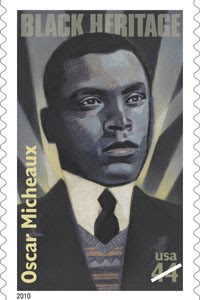
Film director, screenwriter, producer and distributor Oscar Micheaux, who illuminated the African-American experience through more than 40 feature films, was immortalized on a U.S. postage stamp today, taking his place as the 33rd person honored in the popular Black Heritage commemorative stamp series.

Micheaux’s unique storytelling ability shattered stereotypes and challenged film audiences with realistic representations of African-Americans. The stamp was dedicated today at a ceremony in Miller Auditorium at Columbia University.

“Oscar Micheaux was a transformational filmmaker and gifted storyteller with an uncompromising technique that embraced honest depictions of African-Americans,” said Delores Killette, vice president and Consumer Advocate for the U.S. Postal Service. “His films not only entertained, they left audiences with a sense of encouragement, hope and inspiration.”

Joining Killette at the event were Wycliffe Gordon, jazz musician and leader of the Wycliffe Gordon Quartet; Melvin Van Peebles, film director; Lisa Collins, producer, Right on Time Productions; and Jamel Joseph, chair, Film Department, Columbia University. Other events taking place in New York City to recognize the issuance of the Oscar Micheaux commemorative stamp will be held at the Adam Clayton Powell Jr. State Office Building on June 23 and at Steiner Studios in Brooklyn on June 24.

The stamp is designed by Derry Noyes of Washington, DC, and features a stylized portrait of Oscar Micheaux by artist Gary Kelly of Cedar Falls, IA. The artwork is based on one of the few surviving photographs of Micheaux, a portrait that appeared in his 1913 novel The Conquest.

All 33 stamp designs in the Black Heritage commemorative series can be viewed online at http://beyondtheperf.com/.

The Postal Service receives no tax dollars for operating expenses, and relies on the sale of postage, products and services to fund its operations.

Pictured: The 33rd stamp in the Black Heritage series honors pioneering filmmaker Oscar Micheaux, who wrote, directed, produced, and distributed more than 40 movies during the first half of the 20th century. An ambitious, larger-than-life figure, Micheaux thrived at a time when African-American filmmakers were rare, venues for their work were scarce, and support from the industry did not exist. Micheaux’s entrepreneurial spirit and independent vision continue to inspire new generations of filmmakers and artists. http://beyondtheperf.com/. (PRNewsFoto/U.S. Postal Service).

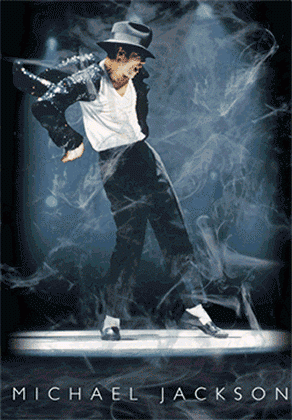
Michael Jackson Fans Will Moonwalk In Motion-Sensing Game

Gamers will have the opportunity to moonwalk alongside the King of Pop.

Video game developer Ubisoft announced it would release a new dancing-and-singing game featuring Michael Jackson this holiday season. The as-yet-unnamed game will be among the first to use Kinect and Move, the respective motion-detecting camera systems for Microsoft’s Xbox 360 and Sony’s PlayStation 3 due out later this year.

“Your goal is to dance like Michael,” said Tony Key, Ubisoft’s marketing vice president. “Do what the guy on the screen is doing and you’re there. It’ll score you based on the quality of your performance.”

The game’s launch will roughly coincide with the November debut of a new album containing unreleased Jackson recordings. Versions of the game, which will feature songs from Jackson’s catalog, including “Billie Jean” and “Beat It,” will also be available for Nintendo’s Wii and the Nintendo DS and PlayStation Portable handheld consoles.

The announcement was made during Ubisoft’s Electronic Entertainment Expo press conference at the Los Angeles Theater. No footage from the game was shown, but dancers from Jackson’s “This Is It” tour took to the stage to perform a routine set to “Beat It” at the conclusion of Monday’s event.

“With the technology that is available today, you will be able to learn how to be as good as those guys are and even better,” said Yves Guillemot, Ubisoft’s CEO.

It won’t be Jackson’s first appearance in a game. He starred in 1989’s action game “Michael Jackson’s Moonwalker.”

Ubisoft has already found the right moves with the dancing game genre. The game maker’s “Just Dance,” released for the Wii last year, has sold more than 3 million copies worldwide.

“Rock Band” developers Harmonix are also choreographing their own dancing title, unveiled at Microsoft’s press conference Monday with a routine set to Gwen Stefani’s “Keep On Dancing.” “Dance Central” uses Kinect to detect players’ movements and translate them to a flashy avatar on screen.

© 2009 The Associated Press. All rights reserved. This material may not be published, broadcast, rewritten or redistributed.

Ryman Arts’ 2010 Graduates Showcase Artwork at California African American Museum

LOS ANGELES, June 21 /PRNewswire-USNewswire/ — The Sixth Annual Ryman Arts Student Art Exhibition is hosted by and now on display at the California African American Museum (CAAM) in Exposition Park. The Exhibition, which features more than 200 of the Ryman Arts students’ best works from the 2009-2010 school year, showcases the art of the talented young artists, who take part in Ryman Arts’ intense training program. The exhibition will be on view through July 6, 2010.

“The Annual Exhibition reflects the depth of Ryman Arts’ training and the breadth of the students’ potential,” notes Diane Brigham, Executive Director of Ryman Arts. “The opportunity to have their best work displayed in public serves both as a tremendous learning experience and an exciting milestone for our students.”

Brigham attributes the success of Ryman Arts’ students to the program’s philosophy of “nurturing talent, inspiring growth and changing lives,” as well as to the passion and perseverance of the students themselves, who come from all over Southern California—from the Los Angeles urban core, to the outlying Orange and Los Angeles county suburbs—to attend Ryman Arts’ classes for 3 1/2 hours every Saturday.

Citing the students’ tremendous talent and motivation, Brigham says, “These teens demonstrate remarkable focus, creativity and tenacity in honing their skills through the program, making them highly desirable to art schools and universities. Significantly, in a region where so few high school graduates successfully pursue higher education, 98 percent of Ryman Arts’ alumni go on to college, and the majority are the first in their family to pursue a higher education.”

Brigham added that by nurturing young artists in developing their creative gifts, Ryman Arts helps ensure growth of the arts, as well as a sustainable cultural future and healthy economy for Southern California. Many Ryman Arts students go on to employment in art careers including graphic design, architecture, film, animation, fashion and environmental design.

“Each year we look forward to being as proud of the Ryman Arts students as we would be if we had trained them ourselves,” says Charmaine Jefferson, Executive Director of the California African American Museum. “For CAAM this is more than just a gesture. It is our chance to give back and support Ryman Arts, as a neighboring organization that we not only adore, but respect because they put their souls into nurturing and giving these students the best artistic training possible. CAAM in turn provides the space and patrons, and the opportunity for the students to experience curating and shaping a museum exhibition for their work and that of their peers. It’s an invaluable collaboration, and we couldn’t be more privileged to have the work of these talented and budding young artists presented in our galleries.”

The California African American Museum is located at 600 State Drive, in Exposition Park, Los Angeles, CA 90037. The museum is open Tuesday through Saturday from 10am to 5pm and Sunday from 11am to 5pm Parking is located at 39th & Figueroa Streets – $8.00 per vehicle. CAAM is a California State Museum as declared by Governor Arnold Schwarzenegger. Admission to the Museum is free and open to the public.

About Ryman Arts

Ryman Arts provides gifted teens the opportunity to reach their artistic potential through free high-level arts education in a rigorous studio environment. In addition to artistic training, Ryman Arts students also build self-discipline and confidence, and receive college and career guidance that helps position them for success in their careers and lives. Ryman Arts currently teaches talented high school students from more than 200 schools in Southern California, 80 percent of who reside in low-income communities and have no other opportunities to develop their artistic gifts.

The program began in 1990 to honor the memory of legendary Disney artist and mentor Herbert D. Ryman to encourage young artists to reach their potential. Courses, taught by professional teaching artists, foster students’ artistic development and provide the knowledge they need to pursue higher education and careers in the arts. Ryman Arts aims to inspire, nurture, and challenge the next generation of artists to reach their potential.

CONTACT:

Susan Dunn

818-762-4708

Arotin Hartounian

213/629-2787

L. Londell McMillan Receives Reginald F. Lewis Foundation Award at Third Annual Gala Luncheon in East Hampton

Entertainment Attorney and Entrepreneur to Receive Prestigious Business Award on Saturday, June 26 and Hosts JONES MAGAZINE SUMMER SOIREE to follow

NEW YORK, June 24 /PRNewswire/ — L. Londell McMillan, partner and co-head of the Media and Entertainment Global Industry Sector at the international law firm of Dewey and LeBoeuf LLP, will be honored at the Reginald F. Lewis Foundation Gala Luncheon on Saturday, June 26 at the Lewis Estate in East Hampton, New York. Wall Street veterans, Peter Offermann, Phyllis Schless and Robert C. Winters, Jr. will also be acknowledged, with each receiving a Millennium Member award recognizing the key roles they played in the life and career of Mr. Lewis. The event, which is sponsored by American Express, Bloomberg, Black Entertainment Television, Belvedere, Kate’s Paperie, The Camelot Group, GenNx360 Capital Partners, and The NorthStar Group will feature performances by singer, songwriter and Broadway performer Deborah Cox and the Alvin Ailey American Dance Theater. WCBS-TV News Anchor Maurice DuBois will serve as emcee.

“The Reginald F. Lewis Foundation is pleased to recognize the hard work of L. Londell McMillan and the wonderful contributions of Peter, Phyllis and Robert to the story and legacy of my husband,” said Loida Lewis, widow of the legendary mogul and foundation chair. “Perseverance and dedication, especially in entrepreneurship, normally pay off in individual success and community development, and help society in general. We are happy for their success and are grateful for their help of the Foundation.”

The prominent attorney, Mr. McMillan, will receive the Reginald F. Lewis Award, which honors African American entrepreneurs who succeeded internationally in business before the age of 50, as Lewis did. The first African American to build a billion-dollar company, Lewis led the largest leveraged buyout in the 1980s. He went on to shatter all expectations and inspire future generations of African American entrepreneurs.

Mr. McMillan, who has represented such luminaries as the late Michael Jackson, Prince, Stevie Wonder, Usher, LL Cool J, Roberta Flack and Spike Lee, joins the likes of Sean “Diddy” Combs and real estate mogul R. Donahue Peebles, past recipients. He is also one of the co-owners and partners with real-estate developer Bruce Ratner and hip-hop icon Jay-Z in the New Jersey Nets and the Atlantic Yards development in Brooklyn, future home to the NBA team. Additionally, Mr. McMillan is owner and Group Publisher of The NorthStar Group, which publishes Jones Magazine (www.jonesmag.com) and The Source (www.thesource.com) .

Following the Gala Luncheon later that evening, Mr. McMillan and Jones Magazine will host its first annual Summer Soiree to celebrate the successful launching of Jones Magazine, the premier fashion, beauty, travel and lifestyle shopping guide for women of color.

“I am humbled to be recognized in the name of the great Reginald F. Lewis to support the Foundation in his honor. Indeed, like others inspired by his legacy, I walk in footsteps he created to make the road clearer for many of us to follow” said Mr. McMillan. “We also look forward to celebrating the historic launch of Jones Magazine later than evening.”

Additional sponsors of the Gala are J.P. Morgan, Ariel Investments LLC, The NorthStar Group, Dewey & LeBoeuf LLP and Prudential Financial. The Jones Magazine Summer Soiree is sponsored by The NorthStar Group and Foxwoods Resort Casino.

SOURCE The NorthStar Group

Robert Shapazian dies at 67; founding director of Gagosian Gallery in Beverly Hills


The scholarly art dealer ran the blue-chip venue for a decade. He also was director of the Venice-based Lapis Press, which published fanciful, limited-edition artists’ books.

Shapazian died of lung cancer Saturday at his Los Angeles home, said Robert Dean, a friend.

“Robert just kind of sailed under the radar a bit,” said Dean, who also was a colleague at the Gagosian. “He’s more like a poet’s poet, if the poets were collectors. He both influenced and inspired a lot of people.”

When leading contemporary art dealer Larry Gagosian hired him in 1995 to oversee the launch of a West Coast outpost, he praised Shapazian’s knowledge of photography, 1990s art, and artists Andy Warhol and Marcel Duchamp, The Times reported at the time.

Under Shapazian’s direction, Gagosian shows were “always provocative,” adding “a ‘big time’ dimension to the local scene,” online magazine Artnet said in 2004. The magazine gave as an example the gallery’s survey of black-and-white Warhol paintings derived from advertising.

Shapazian ran the blue-chip venue for a decade, advising collectors to do as he did: Don’t invest for monetary gain but follow “ideas and feeling,” he said in a 2008 interview.

Business tycoon Eli Broad was one of Shapazian’s primary clients, Dean said.

From 1986 until its closing in 1994, Shapazian was director of the Venice-based Lapis Press, founded by artist Sam Francis to publish fanciful, limited-edition artists’ books.

Many titles were experimental, resulting in “books with an unusual degree of presence,” Shapazian told The Times in 1993.

The texts were often obscure, evocatively illustrated and of the highest quality while aiming to amuse.

An example of Shapazian’s playfulness was evident in philosopher Jean-Francois Lyotard’s study of Duchamp. The Lapis release was covered in green velour, the same material Duchamp used for his 1934 work “The Green Box.”

Robert Michael Shapazian was born in 1942 in Fresno to Ara and Margaret Shapazian.

Since he liked art, he started buying antique objects from Thailand when he was 13. He sold some of them to galleries and museums while starting his own collection, which grew to include Asian art, 18th century French furniture and illustrated Russian books.

After earning a bachelor’s degree at UC Berkeley in 1964, Shapazian studied English literature at Harvard University, earning a master’s in 1965 and a doctorate in 1970. He wrote his doctoral dissertation on pastoral poetry and painting in the Renaissance.

He had worked in his family’s agricultural business in Fresno and built a collection of experimental photography that critics considered extraordinary.

In recent years, Shapazian taught writing and art to at-risk youths, friends said.

Since traveling the world alone at 20, he continued to globe-trot and liked to visit “very traditional tribes in distant places in Africa,” he once said.

His contribution to the arts and literature had been recognized by the French government, which named him a Chevalier of the Order of Arts and Letters.

Shapazian is survived by a sister.

valerie.nelson@latimes.com

Hampton University Museum

Hampton University Museum

Founded in 1868, the Hampton University Museum is the nation’s oldest African American museum. With galleries dedicated to African American, African, American Indian and Asian and Pacific art and artifacts, the museum contains more than 9,000 objects representing cultures and people from around the world. Within its fine arts collection is the largest existing collection of works in any museum by the artists John Biggers, Elizabeth Catlett, Jacob Lawrence and Samella Lewis.

Located in the newly restored Huntington Building (the former library) on the grounds of historic Hampton University campus, The Hampton University Museum brings its remarkable collection to the public through an array of educational initiatives including permanent and changing exhibitions, the Children’s Curiosity Room, the Center for African American History and Life, Kids Korner (a story time), publications, lectures, symposia, art workshops and summer camps, school partnerships and the quarterly publication the International Review of African American Art. The Museum’s membership and community programs offers Museum supporters an assortment of lectures, workshops and group travel opportunities. The Museum also has an active group of volunteers, including The Biggers’ Circle, student support group.

The Museum also offers a wide assortment of hand-made crafts and other items relating to the collection through its Museum Shop. Proceeds from the Museum Shop sales support the educational mission of the Museum.

For a map, hours and additional contact information, please click here.

The City of Hampton: Through the Lens of Reuben V. Burrell and James Van Der Zee

February 28, 2010 – November 27, 2010

The City of Hampton’s 400th Anniversary

The City of Hampton: Through the Lens of Reuben V. Burrell and James Van Der Zee
Opening Reception and Birthday Celebration for Mr. Burrell – Sunday, February 28, 2010

Reuben V. Burrell has documented through photographs a half of a century of Hampton University events – both big and small. Not only is Mr. Burrell the Griot (historian) of the University but his lens goes beyond the campus into the surrounding community. Coming to Hampton as a student in 1938 Burrell finished his course requirements in 1940, after which, World War II was pending. He received a B.S. degree in Industrial Arts from Hampton in 1947, and then enrolled at New York University where he earned his M.A. degree in Industrial Arts Education in 1949. Hired at Hampton in December 1949, Mr. Burrell began his career as the school photographer. For more than sixty years, he has provided an invaluable service to the university documenting its history as well as reprinting historic photographs. He has also documented landmarks, businesses, social and civic activities in the city of Hampton. His photographs include well known individuals in the city as well.

James Van Der Zee is recognized as the dean of African American photographers based on his large body of photographs taken in Harlem, New York during more than half of the 19th century. In 1906 Van Der Zee left his hometown of Lenox, MA here he met and married Kate L. Brown, a seamstress from Newport News, Virginia. The couple’s first child, Rachel, was born in 1907 and shortly afterward they traveled to Virginia. The Van Der Zee’s decided to remain in Tidewater, VA where Van Der Zee found employment as a waiter at the Hotel Chamberlin. The photographs will share images of two categories: the everyday activities of Slabtown residents and the academic community at Whittier Preparatory School.

Partial funding for this exhibition provided by the City of Hampton, 400th Anniversary Celebration Fund.

Photographs, Reuben V. Burrell, Collection of Hampton University Museum


Call or email Vanessa Thaxton-Ward for more information at 757.727.5508 or email vanessa.thaxton-ward@hamptonu.edu.

Museum and gallery events around Philly, PA

Museum and gallery events around Philly, PA

Art Museums & Institutions

African American Heritage Museum 661 Jackson Rd., Newtonville, NJ; 609-704-5495. www.aahmsnj.org. Tanya Murphy Dodd. Donations accepted. Leonard R. Wilkinson Jr.. Donations accepted. Tue.-Fri. 10 am-3 pm.

Barnes Foundation 300 N Latchs La., Merion Station; 610-667-0290. www.barnesfoundation.org. Docent-led Gallery Tours. Thru 8/31: Wed.-Sun. 9:30 am-5 pm. Sept.-June Fri.-Sun. 9:30 am-5 pm.

Brandywine River Museum Rte. 1 & Rte. 100, Chadds Ford; 610-388-2700. www.brandywinemuseum.org. Eye to Eye: Miniature Portraits From the Collection of Jamie Wyeth. Closes 7/11. John Haberle: American Master of Illusion. Closes 7/11. Tours of N.C. Wyeth House & Studio. Regular admission. Brandywine Heritage Galleries. Andrew Wyeth Gallery. N.C. Wyeth Gallery. Bayard & Mary Sharp Gallery. Striking Poses: Portraits From the Museum’s Collections. Daily 9:30 am-4:30 pm.

Chemical Heritage Foundation 315 Chestnut St.; 215-925-2178. www.chemheritage.org. Marvels & Ciphers: A Look Inside the Flask. Free. Mon.-Fri. 10 am-4 pm.

Delaware Art Museum 2301 Kentmere Pkwy., Wilmington; 302-571-9590. www.delart.org. Howard Pyle & His Students. John Sloan. American Art, 19th Century to the Present. The Copeland Sculpture Park. The Pastoral Vision: British Prints, 1800-Present. Haiti: A Tribute in Art. Closes 7/11. Wed.-Sat. 10 am-4 pm, Sun. noon-4 pm.

Delaware Center for the Contemporary Arts 200 S. Madison St., Wilmington; 302-656-6466. www.thedcca.org/. Spectrum: Contemporary Color Abstraction. Free. Joseph Barbaccia: Eight Currents. Free. Tannaz Farsi: Of News & Reclamation. Free. Lawrence Cromwell: Make it Bigger. Free. Linda Celestian & Kyle Ripp: Crash, Hush. Free. Closes 6/27. Tue., Thu.-Sat. 10 am-5 pm, Wed. & Sun. noon-5 pm.

The Fabric Workshop & Museum 1214 Arch St.; 215-568-1111. www.fabricworkshopandmuseum.org. Duo-Chrome/Duotone: Ink to Light. Mon.-Fri. 10 am-6 pm; Sat.-Sun. noon-4 pm.

Institute of Contemporary Art 118 S. 36th St.; 215-898-7108. www.icaphila.org. Queer Voice. Free. Wed.-Fri. noon-8 pm, Sat.-Sun. 11 am-5 pm.

James A. Michener Art Museum 138 S. Pine St., Doylestown; 215-340-9800. www.michenerartmuseum.org. Icons of Costume: Hollywood’s Golden Era & Beyond. Michelle Berkowitz: Contemporary Costumes. The Lenfest Exhibition of Pennsylvania Impressionism. Ellis Island: Ghosts of Freedom. $10; $9 seniors; $7.50 students;$5 youth 6-18; free under 6. Tue.-Fri.10 am-4:30 pm, Sat. 10 am-5 pm, Sun. noon-5 pm.

La Salle University – Art Museum 1900 W. Olney Ave.; 215-951-1221. www.lasalle.edu/museum. An Exploration of Modernist Printmaking. Donations accepted. Mon.-Fri. 10 am-4 pm; Sun. 2 pm-4 pm.

Mid-Atlantic Center for the Arts 1048 Washington St., Cape May; 609-884-5404. www.capemaymac.org/. .

Noyes Museum of Art – Hammonton 5 S. Second St., Hammonton; 609-561-8006. www.noyesmuseum.org/hammonton.html. The Art of Tattoo. Free. Tue.-Wed. 11 am-6 pm; Thu. 1 pm-9 pm; Fri.-Sat. 11 am-7 pm.

Pennsylvania Academy of the Fine Arts 118-128 N. Broad St.; 215-972-7600. www.pafa.org. Violet Oakley’s Religious Art from the PAFA Collection. Closes 7/11. Este Es Mi Pais. Andy Warhol Polaroids and B&W Prints. The Vogel Collection. Selections From the Permanent Collection. Jasper Johns: Flag. Tue.-Sat. 10 am-5 pm; Sun. 11 am-5 pm.

Philadelphia Museum of Art 26th St. & Benjamin Franklin Pkwy.; 215-763-8100. www.philamuseum.org. Arts of Bengal: Wives, Mothers, Goddesses. Informed by Fire: Highlights of American Ceramics. Arts of Bengal: Town, Temple, Mosque. Interactions in Clay: Contemporary Explorations of the Collection. Notations/Forms of Contingency: New York & Turin, 1960s-1970s. Visions of Venice: Eighteenth-Century Prints From the Collection. Closes 7/18. Chinese Snuff Bottles. New York Dada. Railways of Hope & Fear: Selections from the Fernberger Print Collection. Closes 6/27. The Two Qalams: Islamic Arts of Pen & Brush. Isamu Noguchi at the Philadelphia Museum of Art. Late Renoir. $24; $22 seniors; $20 children 13-18; $14 children 5-12; free 4 and under. Tue.-Thu., Sat.-Sun. 10 am-5 pm; Fri. 10 am-8:45 pm.

Philadelphia Museum of Art – Perelman Building Fairmount Ave.; 215-763-8100. www.philamuseum.org. Kantha: The Embroidered Quilts of Bengal. Inspiring Fashion: Gfits From Designers Honoring Tom Marotta. Plain Beauty: Korean White Porcelain/Photographs by Bohnchang Koo. Tue.-Sun. 10 am-5 pm.

Philadelphia Museum of Jewish Art 615 N. Broad St.; 215-627-6747. www.rodephshalom.org. Permanent Collection. Free. Mon.-Thu. 10 am-4 pm; Fri. 10 am-2 pm.

Rodin Museum Franklin Parkway at 22d St.; 215-763-8100. www.rodinmuseum.org. Tue.-Sun. 10 am-5 pm.

Rosenbach Museum & Library 2008-2010 Delancey Pl.; 215-732-1600. www.rosenbach.org. Friend or Faux: Imitation & Invention From Innocent to Fraudulent. Closes 7/11. Tue., Fri. noon-5 pm; Wed.-Thu. noon-8 pm; Sat.-Sun. noon-6 pm; closed Mon. and holidays.

The Temple Judea Museum 8339 Old York Rd., Elkins Park; 215-887-2027. www.kenesethisrael.org/mus.htm. Mon.-Thu. 9 am-5 pm; Fri. 9 am-8 pm; Sun. 9:30 am-1 pm.

Trenton City Museum at Ellarslie Mansion 319 EState St., Trenton; 609-989-3632. www.ellarslie.org. Decorative Arts Collection. Free. Fine Arts Collection. Free. Historical Artifacts Collection. Free. History and Beauty: Valued Collections of the Trenton Museum. Free. Tue.-Sat. 11 am-3 pm; Sun. 1-4 pm.

Read more: http://www.philly.com/inquirer/weekend/20100625_Museum_and_gallery_events.html#ixzz0rsH7eURl
Watch sports videos you won’t find anywhere else