The search for Cuban art for future exhibit

There’s something about Cuba that captures the imagination of folks in South Florida.

Some of it is the proximity, the feeling it’s so close you can reach out and touch it.

Some of it is the embargo, the forbidden nature of the place.

“Whatever it is, it has people excited,” says Jack O’Brien, curator for the Naples Art Association. “I would tell people I was going to Cuba and they would get very excited.”

O’Brien recently returned from a trip the association is counting on to plant the seeds for a blockbuster exhibit in March. The hope is the show will provide a lift similar to that of the Princess Diana gowns exhibit, which has pushed record numbers through the doors at the von Liebig Art Center in Cambier Park.

“We wanted to put on something sig­nificant, like the Princess Diana exhibit,” says Joel Kessler, the association’s execu­tive director. “Obviously it won’t be as successful as Diana, but it will still be significant.”

That’s important for an organization facing financial stress. Unbudgeted repairs were needed to the tune of $200,000, a huge amount for an organiza­tion with a $1.3 million annual budget.

But this isn’t merely commercial en­terprise; its roots are very much in the art. The idea’s genesis came about five years ago, when O’Brien started working with a group who wanted to host a Latin America festival downtown. The goal was to put on an accompanying art show and put art in local galleries.

That idea continued to float around for years, never to get off the ground. But then a local art collector with strong ties to Cuba suggested to Kessler an exhibit of Cuban art could be arranged.

“Joel and (John Parke Wright) were both kicking around this idea at the same time,” O’Brien says. “When Parke said he could arrange it, we decided to go.”

What O’Brien says he found was a vibrant and well-organized arts scene still struggling with the ideas of identity and freedom decades after being closed off to its northern neighbor.

Perhaps it’s one too many viewings of “Buena Vista Social Club,” but there’s a tendency to imagine O’Brien’s trip as trip down tiny back streets in search of a rumored genius.

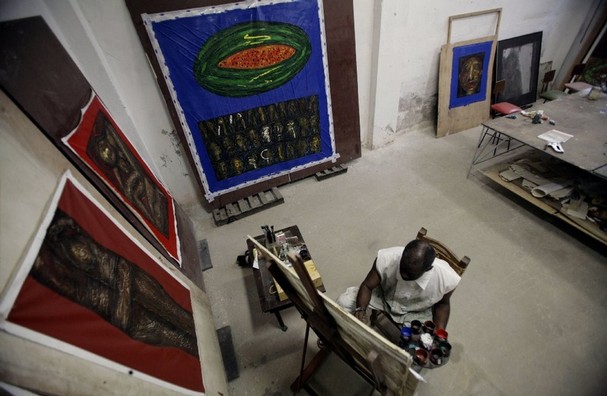
That couldn’t have been further from his experience, he says. Most of the art group’s time was spent being whisked between lunches and studio tours led by Roberto Chile, a Cuban artist and documentary filmmaker.

Walking down the streets they would have found art, but not the kind they were looking for, O’Brien says.

“It would have been so hard to do that,” he says. “We would have found a lot of art done for the souvenir market. But it wouldn’t have been art that explores concepts and ideas.”

Instead Chile took them directly to the source. Unlike major American artists with agents and galleries representing their work, the Cuban artists are left to fend for themselves in many ways. One of the exceptions to the U.S. embargo is that art can be purchased. So the artists have penetrated the American market better than they have in their own country.

Their work often explores loss of fam­ily who have left for Florida, personal freedoms and of a simpler time in their country’s life.

“There’s a certain nostalgia to the work,” O’Brien says.

That longing for the past is often the theme for Kadir Lopez, one of the artists O’Brien is hoping to display in March. Lopez takes salvaged metal advertising signs from before the revolution and imprints them with scenes of Cuban life. A giant sign encouraging people to drink Coca-Cola is the canvas for a photograph of people gathering along the Malecon, Havana’s famous waterfront boulevard.

The work evokes simple pleasures. But its composition shows an ingenuity shown by the artists in their search for mediums.
Read More >>>>

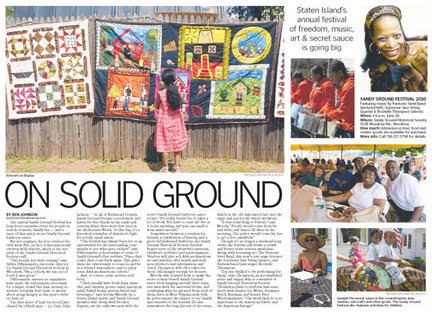
Music, art, history … and secret sauce

by Ben Johnson

The annual Sandy Ground Festival has long been a popular event for people in search of music, family fun — and a taste of that spicy, secret Sandy Ground barbecue sauce.

But last summer, the free outdoor festival went BIG. In fact, it was practically overrun with visitors, much to the surprise of the Sandy Ground Historical Society staff.

“The people just kept coming,” says Sylvia D’Alessandro, executive director for Sandy Ground Historical Society in Woodrow. “By 4 o’clock, we ran out of food! It was great.”

D’Alessandro assures us organizers have made the adjustments necessary for a larger crowd this time around, so visitors certainly don’t have to worry about going hungry at this year’s event from 1-6 p.m. June 26.

The first piece of land on record purchased by a black man — i.e. Capt. John Jackson — in all of Richmond County, Sandy Ground became a settlement and haven for free blacks in the early 19th century, when there were few even in the abolitionist North. To this day, it’s a historical reminder of America’s fight for a truly equal union.

“The festival has always been for us an opportunity for the surrounding community to see what goes on here” says D’Alessandro, a descendant of some of Sandy Ground’s first settlers. “Once they come, they come back again. This gives them the opportunity to come in and be in a relaxed atmosphere, and to enjoy some African-American culture.”

And, of course, some serious soul food.

“They usually have fresh ham, spare ribs, and chicken, potato salad, macaroni salad, baked beans, greens, bread and beverages,” says Jerome Moody, 65, a Staten Island native and Sandy Ground member who along with brother, Eugene, are the only two men with the secret Sandy Ground barbecue sauce recipe. “It’s really festive but it takes a lot of work. You have to start the fire at 6 in the morning, and you can smell it from miles around.”

Somewhere between a reunion for friends, a celebration of history, and a good old fashioned barbecue, the Sandy Ground Historical Society Festival boasts tours of the property’s museum, children’s activities and entertainment. Vendors will also sell African-American art and jewelry, offer health and wellness products and information, and Tracy Thompson will offer cakes for those still hungry enough for dessert.

Moody, who learned how to make the secret tomato-based Sandy Ground sauce from hanging around three separate men with the ancestral recipe, and combining what he gleaned from each of them, lives in West Virginia now. Still, he never misses the chance to see family and relatives at the festival. He also remembers the long history of the event, which in the old days lasted late into the night and ran for the whole weekend.

“It was something to behold,” says Moody. “People would come from far and wide, and dance till three in the morning. The police would come by, just to get a free sandwich.”

Though it’s no longer a weekend-long event, the festival still draws a crowd and boasts some serious musicians. Along with returning act The Pantonic Steel Band, this year’s tent stage features the Sojourner Jazz String Quartet, and Harlem-based jazz singer Rochelle Thompson.

“I’m just thrilled to be performing for them,” says Thompson, an accomplished artist and singer, who is a member of Sandy Ground Historical Society. Thompson plans to perform jazz standards with pianist Jon Weiss, drummer Butch Bateman, and bassist Fred Weidenhammer. “The work they do is so important to the American Fabric and the American lineage.”

Read More >>>>

The influence of slavery on African American dance

The enslavement of African citizens and the influences from their many and varied cultures greatly contributed to the evolving art form of African American dance. In many African societies dance was considered to play a more central role than the use of language and literacy in general. Even though the roots of African dance may not remain in their purest form in the modern African American dance styles, they have certainly been heavily influential in the development of American dance.

The Slave Trade:

Slaves were imported from a variety of ethnic backgrounds; from Senegal to the Congo-Angola region, Mozambique and Madagascar – from all over West and West-Central Africa. Each group of people brought individual cultural traditions and dance styles that were unique to the different regions. 95% of the slaves didn’t actually travel to America but were shipped to the Caribbean – there they were said to be Creolized; they acclimatized to their new home and inter-mixed with peoples and tribes from other parts of Africa. A melting pot of cultural and dance traditions was born.

~ Life in America:

By the 1800’s, offspring of the original African born slaves were dominant in numbers and a large quantity of them had now been relocated to America to the Greater Chesapeake area – to states such as Maryland, Virginia and North Carolina. Many of these slaves worked on the plantations of the American South and were initially prohibited from dancing due to the strict morality of the Protestant religion. A form of shuffling dance was invented by the black workers to overcome the rule of not being allowed to lift one’s feet high off the ground. The African rhythms and dance moves inherited from the past were mixed with European dance styles and a new African-American dance began to evolve.

In time, some plantation owners began to allow their workers to perform dances and competitions were arranged to determine who was the most skilled and agile of the dancers. Some slave owners gave out a small trinket as a prize to the winner; a new form of couple’s dancing called the cake walk was started – originally named as the best dancers were presented with a cake to award their efforts.

White society began performing dances like the cake walk in caricature form as part of minstrel shows. Although the manner of performance was largely an effort to ridicule the African

Sale Shines Light on Unheralded Art Legacy

Lovers of art and music will unite this week at “Out of the Blue: Modern Art Jazz,” a sale at Swann Auction Galleries on East 25th Street. Thursday afternoon’s auction will feature 76 pieces by African-American artists who found inspiration in blues and jazz.

The sale, featuring works ranging from the figurative to the abstract, was planned to coincide with the CareFusion Jazz Festival, which rose this year from the ashes of George Wein’s defunct New York Jazz Festival. The pieces in the sale will be open for public exhibition through Thursday. Though Swann is not officially affiliated with CareFusion, the auction house has collaborated with the festival to reach out to jazz enthusiasts, according to the director of African-American Fine Art at Swann, Nigel Freeman. For example, the CareFusion web site lists Swann as a New York jazz “hot spot” alongside such landmarks as Birdland and the Village Vanguard; similarly, Swann links to the CareFusion festival on its own site.

“Out of the Blue” will be Swann’s seventh sale dedicated to art by African-Americans, a genre still relatively new to auction. Swann, which launched its African-American Fine Art department just three years ago, remains the only major auction house to regularly offer sales devoted to African-American art.

“They really are the first auction house to have the kind of focus they have,” said Valerie Mercer, curator of the General Motors Center for African-American Art at the Detroit Institute of Arts, about Swann. “For so long, black artists’ work was not really appreciated or valued.”

Mr. Freeman said he expects works by Romare Bearden to be among the auction’s biggest sellers. “Back Porch Serenade” (1977), a collage composed of bright-colored papers with ink and colored pencil, could go for more than $60,000. Mr. Bearden (1911-1988) was best known for his semiabstract collages, which echo Cubist influences and are typically comprised of photographs and painted paper. Themes of jazz and the blues are common in his work. A Harlem-based artist who spent many days and nights with such jazz icons as Duke Ellington, Mr. Bearden even worked in a studio above the Apollo Theatre.

Robert O’Meally, a Columbia University English professor who examined Mr. Bearden’s collages in his 2008 book, “Romare Bearden: A Black Odyssey,” said last week that the art world is “on the verge of recognizing a truly international artist.”

In its short history, Swann’s biggest winner has been Aaron Douglass, a Harlem Renaissance painter whose 1944 piece, “Building More Stately Mansions,” sold in 2008 for $600,000 and is currently housed at the Museum of Art at the Rhode Island School of Design. Two years earlier, one of his works sold at auction for $6,600.

Since 2007, Swann has introduced more than 100 black artists to auction. Mr. Freeman said at least eight artists whose works have yet to be offered will be showcased in “Out of the Blue.” They include Frank Stewart, the senior staff photographer for Jazz at Lincoln Center.

Read More >>>>

The David C. Driskell Center for the Study Of The Visual Arts and Culture of African Americans and The African Diaspora

The David C. Driskell Center for the Study Of The Visual Arts and Culture of African Americans and The African Diaspora

1214 Cole Student Activities Building
University of Maryland
College Park , MD 20742
TEL: (301) 314-2615
FAX: (301) 314-0679
driskellcenter@umd.edu
Visit us on Facebook

Gallery Hours:
Monday – Friday: 11am – 4pm
Wednesday: 11am – 6 pm

Office Hours:
Monday – Friday: 8:30 am – 4:30pm

The David C. Driskell Center for the Study of the Visual Arts and Culture of African Americans and the African Diaspora at the University of Maryland, College Park, celebrates the legacy of David C. Driskell – Distinguished University Professor Emeritus of Art, Artist, Art Historian, Collector, and Curator – by preserving the rich heritage of African American visual art and culture. Established in 2001, the Center provides an intellectual home for artists, museum professionals, art administrators, and scholars, who are interested in broadening the field of African Diasporic studies. The Driskell Center is committed to collecting, documenting, and presenting African American art as well as replenishing and expanding the field.

read more….

David Driskell: The Importance of Documenting African American Art

David Driskell: The Importance of Documenting African American Art

Born in 1931 into a family of Georgia sharecroppers, David C. Driskell is today a renowned painter and collector of art, as well as one of the leading authorities on the subject of African American art and the black artist in American society. His paintings can be found in major museums and private collections worldwide. His contributions to scholarship in the history of art include many books and more than 40 catalogues for exhibitions he has curated. His essays on the subject of African American art have appeared in major publications throughout the world. In establishing the Driskell Center, the University of Maryland has proudly taken up Driskell’s challenge to “grow the field.”

Prof. Driskell studied at Skowhegan School of Painting and Sculpture in Maine and received his undergraduate degree in art at Howard University (1955) and a Masters in Fine Arts degree from Catholic University (1962). He joined the faculty of the Department of Art at the University of Maryland in 1977 and served as its Chair from 1978-1983. He has been a practicing artist since the 1950s and his works are in major museums throughout the world, including the National Gallery of Art, the High Museum of Art, and Yale University Art Gallery, to name a few.

nmIn 1976, Driskell curated the groundbreaking exhibit “Two Centuries of Black American Art: 1750-1950” which laid the foundation for the field of African American Art History. Since 1977, Prof. Driskell has served as cultural advisor to Camille O. and William H. Cosby and as the curator of the Cosby Collection of Fine Arts. In 2000, in a White House Ceremony, Prof. Driskell received the National Humanities Medal from President Bill Clinton. In 2007, he was elected as a National Academician by the National Academy.


Watch Video

Live Skin Care Product Demonstration This Saturday 6/26 1 to 3 PM Philly, PA


Live Skin Care Product Demonstration This Saturday 6/26 1 to 4 PM

The Skin is affected everyday by the personal care products we use. Since toxins can enter the body through the skin, the use of distilled water rather than city water, essential oils rather than fragrance oils and the best plant sourced oils rather than animal or petroleum oils with no preservatives offers the best choices for our products and a healthy lifestyle.

Our customers can take comfort in knowing that only the best ingredients from nature that bring no harm to animals, yet bring high quality to humans are included in our formulas.

Sometimes, skin problems begin with a product, not your skin. If we educate ourselves about natural alternatives, then we can purchase with more confidence from among the best solutions that Mother Earth offers.

At foreue we want our products to WORK! We strive to educate and offer the best natural products possible and we want to do our part to make the world a greener place.

Live Product Demonstrations Every Saturday 1 to 3 PM
6353 Greene Street (Germantown – Johnson & Greene Streets) Philly, PA 19144
Visit us online or call for more information about Foreue Natural Skin Care Products

www.foreue.com (267) 297-0188

RSVP requested not required Click Here

Admission FREE

FREE $75 Gift Bag. Print this ad and bring it to the Demonstration.
No purchase necessary.

Watch Foreue Video

Smithsonian National Museum of African American Art and Culture

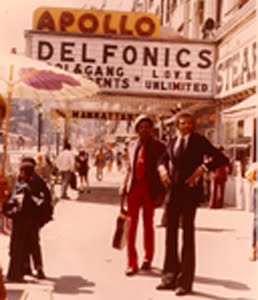
From NMAAHC — a celebration of the 75th anniversary of Harlem’s famed Apollo Theater. Ain’t Nothing Like the Real Thing: How the Apollo Theater Shaped American Entertainment features photographs and artifacts tracing the rich history and cultural significance of the theater from its origins in 1914 as a whites-only burlesque hall to its starring role at the epicenter of African American entertainment. Open through August 29, 2010 at NMAAHC’s gallery on the second floor of the National Museum of American History.

Apollo Events Calendar

An institution like no other, the Apollo Theater has spawned and nurtured the creative genius of some of America’s most famous stars of dance, comedy, and the musical genres of swing, cool jazz, bebop, rock ‘n’ roll, rhythm and blues, gospel, Latin, and hip-hop. What better way to celebrate this milestone in American entertainment history than to present a series of discussions and performances filtered through the Apollo’s lens?
Our upcoming programs are free and open to the public. Books will be available for purchase and signing after author events. For more information, call 202.633.0070.

read more….

Transitions: Contemporary South African Works on Paper


Transitions: Contemporary South African Works on Paper
Through August 8, 2010

This exhibition presents 13 works by eight artists and will explore how works of art can act as visual narratives and testimonials. In particular, these works will focus on the remarkable changes in the political and social landscapes in South Africa from 1974 during the height of Apartheid to 2002, two years before a decade of democracy was widely celebrated.

High Museum, Atlanta

Most Comprehensive Exhibition of Work by Atlanta Artist Radcliffe Bailey to Premiere at the High

ATLANTA, GA.- The High Museum of Art will organize and premiere the most comprehensive presentation of works by Atlanta-based artist Radcliffe Bailey beginning June 28, 2011. The exhibition “Radcliffe Bailey: Memory as Medicine” will highlight the artist’s experimentation with diverse media, showcasing sculptures, paintings, installations, works-on-paper, glass works and modified found objects. Comprising more than 25 works, “Memory as Medicine” will include new art created for the exhibition as well as works never before seen on public display. The exhibition will also juxtapose Bailey’s work with a display of classic African sculptures from the High’s permanent collection and selected loans of African art to show the influence of African aesthetic practices on the artist’s work.

“Radcliffe Bailey: Memory as Medicine,” organized by the High, will be on view in Atlanta from June 28 through September 11, 2011. The exhibition is scheduled to travel to the National Museum of African Art, Washington, D.C. (presented in partnership with the National Museum of african american History and Culture); the McNay Art Museum, San Antonio; the Museum for African Art, New York; and additional venues yet to be announced.

“In this exhibition, visitors will discover Radcliffe’s ability to a combine sculpture and painting, two- and three-dimensional forms and grand and intimate scales, creating works of art that are rich in texture, detail, color and, most importantly, meaning,” stated Michael E. Shapiro, the High’s Nancy and Holcombe T. Green, Jr. Director. “The High is pleased to debut this exhibition in Atlanta, underscoring the Museum’s continued commitment to celebrating the talents and legacies of our local artists.”

The exhibition will present Bailey’s work divided into three main themes: “Water,” “Blues” and “Blood.” Works included in the “Water” group will feature the artist’s references to the Black Atlantic as a site of historical trauma as well as an artistic and spiritual journey. “Blues” will highlight works that illustrate the importance of music as a transcendent artform, including Bailey’s 1999 painting “Transbluesency,” which references a book of poems by Amiri Baraka and echoes the “Blues” theme. The third theme, “Blood,” will feature works focusing on the ideas of ancestry, race, memory, struggle and sacrifice. This section will further explore the artist’s engagement with African sculptures in tandem with his investigation of his own family’s DNA.

In 2006 Bailey learned his family’s ancestral links to the Mende people of Sierra Leone. This inspired the smallest, most intimate work he ever created―a miniature drawing done in ink and coffee on a piece of sheet music that features a Mende mask framed within a tiny red-velvet lined, 19th-century tintype case, as though a family portrait. This work will be on view in the exhibition alongside more recent works, including a new sculpture that has the smooth, curvilinear forms of Mende masks. It is made of wood and was repeatedly rubbed with finishing wax in a daily studio ritual. Minus the functional purpose of Mende masks, this work becomes a Brancusi-esque objet d’art, an inscrutable prop for a Neo-Dada-style, contemporary art world performance. Another 2010 work, “Clean-up,” is a painted wooden sculpture in the form of a 10-foot-high baseball bat. Bailey comments, “The reason why I made the bat so big was to beat down all the things that I confront. Baseball being one of my first passions, before art, the bat was like my paintbrush. In baseball, the fourth batter that comes up is the clean-up hitter.”

At the core of the exhibition will be seven sets of “medicine cabinet sculptures.” Their contents include a broad range of culturally charged objects, imagery and raw materials, from indigo powder to tobacco leaves to Georgia red earth. Just as Kongo minkisi sculptures from central Africa contain healing and protective medicine within mirrored packets, the socially cathartic contents of Bailey’s medicine cabinet sculptures are deeply recessed under reflective, tinted glass. These sculptures were conceived to link the too often disconnected histories of peoples of Africa and the African Diaspora and to emphasize collective experiences.

“Radcliffe Bailey’s art is consistently informed by a strong social and historical consciousness, and solidly grounded in family and community. The exhibition combines a rich, narrative content with a high-level of abstraction and poetic resonance to explore questions of history and memory,” said Carol Thompson, the High’s Fred and Rita Richman Curator of African Art and curator of the exhibition. “Bailey’s art traces the complex network of his ‘aesthetic DNA’ to create an antidote to cultural and historical amnesia.”

A number of works in the exhibition will highlight the artist’s penchant to animate his work with large-scale photographic reproductions of black-and-white prints given to him by his grandmother as well as historic photos he collects, in order to place african americans at the center of both American and world history. “I am interested in an Africanism that permeates our contemporary world but goes unnamed and is not talked about or fully addressed culturally,” stated Bailey. “I am interested in the impulse of that mysterious African force that propels black people wherever they are in the world.” Bailey strives to convey an African sensibility and spirituality that he says “exists in the tangible and the intangible.”

Opening and closing the exhibition will be several works that reference Èsù, the guardian of the crossroads and mediator of opposites who is honored throughout Yoruba regions of Africa and the African Diaspora. These early 21st-century works by Bailey resonate with the late 19th- or early 20th-century dance staff for Èsù from the Fred and Rita Richman Collection, also included in the exhibition. Caged African Finches will add a sound element to the exhibition.

Radcliffe Bailey
Radcliffe Bailey was born in 1968, in Bridgeton, New Jersey. He grew up in Atlanta, earning a bachelor’s degree in fine art from the Atlanta College of Art in 1991. From 2001 to 2006 Bailey taught at the Lamar Dodd School of Art at the University of Georgia. He received a Joan Mitchell Foundation Grant (2004) and was a visiting faculty member at Skowhegan School of Painting and Sculpture (2006). In 2008, he created large-scale glass works as a participant in the Toledo Museum of Art’s Guest Artist Pavilion Project (GAPP). His work is represented in leading museum collections including the Metropolitan Museum of Art, New York; the Smithsonian Museum of American Art and the Corcoran Gallery of Art, Washington, D.C.; San Francisco Museum of Art; the Museum of Fine Arts, Houston; the Nelson-Atkins Museum of Art, Kansas City; the Art Institute of Chicago; and the High Museum of Art, Atlanta. In 1994 Bailey’s work was included in “The Hale Woodruff Memorial Exhibition” at The Studio Museum of Harlem. In 1996 Bailey gained acclaim for his large-scale mural “Saints,” a commission for Atlanta’s Hartsfield-Jackson International Airport for the 1996 Summer Olympics in Atlanta. “Saints” remains on view, welcoming travelers entering the airport at International Terminal E.

read more….

Posing Beauty in African American Art on View at Taubman Museum of Art

ROANOKE, VA.- The Taubman Museum of Art presents Posing Beauty in African American Culture as part of its summer exhibition schedule, along with works by James Grashow and Primitivo Suarez-Wolfe. Posing Beauty in African American Culture opened to the public on June 11, 2010 and will remain on view through August 22, 2010.

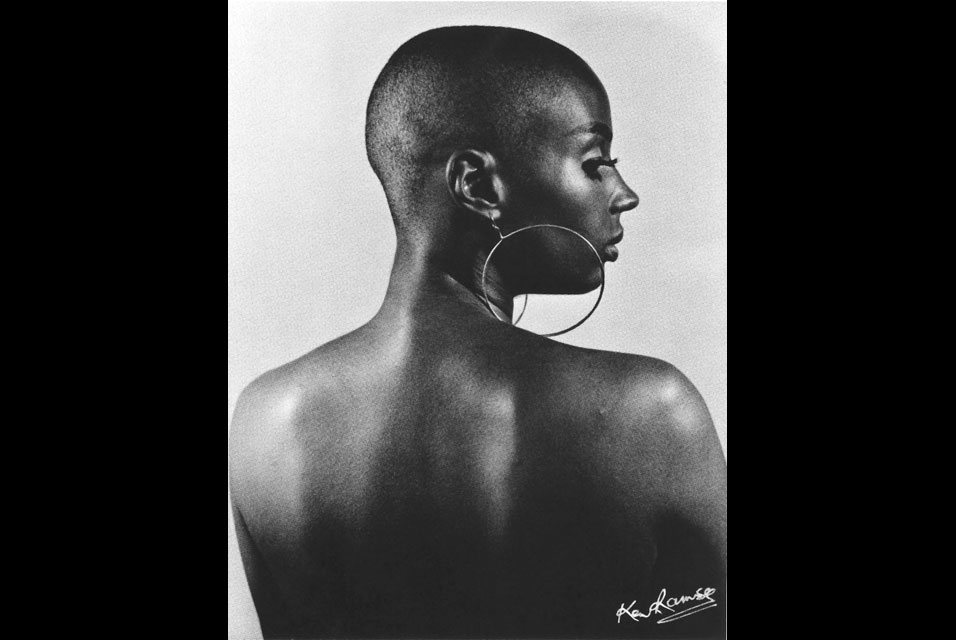
Posing Beauty in African American Culture explores the contested ways in which African American beauty has been represented in historical and contemporary contexts through photography. The 84 images in the exhibition challenge idealized forms of beauty in art by examining their portrayal and exploring a variety of attitudes about race, class, gender, popular culture, and politics as seen through the aesthetics of representation.

The first of three thematic sections, Constructing a Pose, considers the interplay between the historical and the contemporary and between self-representation and imposed representation, as well as the relationship between subject and photographer. The second thematic section, Body and Image, questions the ways in which our contemporary understanding of beauty has been constructed and framed through the body. The last section, Modeling Beauty and Beauty Contests, invites us to reflect upon the ambiguities of beauty, its impact on mass culture and individuals, and how the display of beauty affects the ways in which we see and interpret the world and ourselves.

With images dating from the 1890s to the present, Posing Beauty in African American Culture promises to transform the way we think about the history of African American visual culture. From posed studio portraits to dandies on parade to elegant debutantes, the exhibition constructs a bold narrative of the ever-changing idea of beauty, both female and male. Each photograph opens a window into an entire world of African American life. While celebrating ordinary people, the exhibition also is filled with photographs of the famous, from Josephine Baker to Lil’ Kim to James Brown and Serena Williams.

Artists in the exhibition include, among others, Carrie Mae Weems, Eve Arnold, Sheila Pree Bright, Renee Cox, Anthony Barboza, Bruce Davidson, Jeanne Moutoussamy-Ashe, Builder Levy, and Garry Winogrand.

Posing Beauty in African American Culture is curated by Deborah Willis, chair of the Department of Photography and Imaging at New York University – Tisch School of the Arts, and organized by Curatorial Assistance, Pasadena, California.

Designer Pledges $2 Million to Antipoverty Program

Designer Tommy Hilfiger is looking to bring the idea of ending global poverty into fashion.

On Wednesday, he will announce the formal launch of a five-year campaign to support Millennium Promise, a nonprofit founded by former private-equity financier Ray Chambers and economist Jeffrey Sachs in 2005 to help achieve the United Nations Millennium Development Goals to halve extreme poverty by 2015.

Earlier this month, Mr. Hilfiger visited Ruhiira, a rural community of 55,000 people in Uganda, where Millennium Village has worked since 2006.

“I never expected poverty to be so extreme,” Mr. Hilfiger says. “We saw firsthand how Millennium Village helps communities lift themselves out of poverty.”

Millennium Village uses community-led, science-based approaches to fight poverty. It seeks to address a broad spectrum of needs—from teaching farmers how to improve crop yields to providing access to clean water.

The charity says agriculture production in Ruhiira has nearly doubled and malaria prevalence among all ages has decreased from 17% to less than 1% since 2006.

Now Mr. Hilfiger plans to encourage his employees and customers to get involved. While no formal program has been created, he says interested employees will get the opportunity to travel to Ruhiira to volunteer.

In 2011, Mr. Hilfiger plans to launch a cause-marketing program to generate customer awareness and support for the program.

“We want to extend ourselves and use power of our brand to support efforts to end extreme poverty in our lifetime,” he says.

Mr. Hilfiger was born in Elmira, N.Y., where he opened his first store, the People’s Place, when he was 18 years old. In 1984, he founded Tommy Hilfiger Corp., which he took public in 1992 and then sold in 2006. He remains the brand’s principal designer.

During that time he created the Tommy Hilfiger Corporate Foundation, which began by focusing on education, health-related organizations and cultural youth programs in the U.S., supporting organizations such as the Martin Luther King Jr. National Memorial Project Foundation and the Race to Erase MS.

Through Millennium Promise, the foundation looks to “go global,” according to Mr. Hilfiger.

“Over the last 15 years we’ve developed our brand into a global brand and we wanted our giving to follow suit,” he says.

The $2 million pledged to Millennium Village project currently makes up the majority of the Tommy Hilfiger foundation’s assets, which the company funds on a year-to-year basis.

Write to Shelly Banjo at shelly.banjo@wsj.com

Sale Shines Light on Unheralded Art Legacy – Swann Galleries

By LAUREN FEDOR

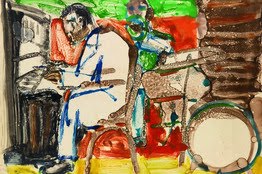
Romare Bearden’s ‘Jazz Musician at Piano’ is expected to fetch $15,000-$25,000 at Swann Auction Galleries.

Lovers of art and music will unite this week at “Out of the Blue: Modern Art Jazz,” a sale at Swann Auction Galleries on East 25th Street. Thursday afternoon’s auction will feature 76 pieces by African-American artists who found inspiration in blues and jazz.

The sale, featuring works ranging from the figurative to the abstract, was planned to coincide with the CareFusion Jazz Festival, which rose this year from the ashes of George Wein’s defunct New York Jazz Festival. The pieces in the sale will be open for public exhibition through Thursday. Though Swann is not officially affiliated with CareFusion, the auction house has collaborated with the festival to reach out to jazz enthusiasts, according to the director of African-American Fine Art at Swann, Nigel Freeman. For example, the CareFusion web site lists Swann as a New York jazz “hot spot” alongside such landmarks as Birdland and the Village Vanguard; similarly, Swann links to the CareFusion festival on its own site.

“Out of the Blue” will be Swann’s seventh sale dedicated to art by African-Americans, a genre still relatively new to auction. Swann, which launched its African-American Fine Art department just three years ago, remains the only major auction house to regularly offer sales devoted to African-American art.”They really are the first auction house to have the kind of focus they have,” said Valerie Mercer, curator of the General Motors Center for African-American Art at the Detroit Institute of Arts, about Swann. “For so long, black artists’ work was not really appreciated or valued.”

Mr. Freeman said he expects works by Romare Bearden to be among the auction’s biggest sellers. “Back Porch Serenade” (1977), a collage composed of bright-colored papers with ink and colored pencil, could go for more than $60,000. Mr. Bearden (1911-1988) was best known for his semiabstract collages, which echo Cubist influences and are typically comprised of photographs and painted paper. Themes of jazz and the blues are common in his work. A Harlem-based artist who spent many days and nights with such jazz icons as Duke Ellington, Mr. Bearden even worked in a studio above the Apollo Theatre.

Robert O’Meally, a Columbia University English professor who examined Mr. Bearden’s collages in his 2008 book, “Romare Bearden: A Black Odyssey,” said last week that the art world is “on the verge of recognizing a truly international artist.”

In its short history, Swann’s biggest winner has been Aaron Douglass, a Harlem Renaissance painter whose 1944 piece, “Building More Stately Mansions,” sold in 2008 for $600,000 and is currently housed at the Museum of Art at the Rhode Island School of Design. Two years earlier, one of his works sold at auction for $6,600.

Since 2007, Swann has introduced more than 100 black artists to auction. Mr. Freeman said at least eight artists whose works have yet to be offered will be showcased in “Out of the Blue.” They include Frank Stewart, the senior staff photographer for Jazz at Lincoln Center.

read more….

South Africa’s booming art market

From Robyn Curnow, CNN

Johannesburg, South Africa (CNN) — In recent years, African artists have seen their work increase in value as they attract global investors.

South Africa, in particular, has seen a significant rise in prices paid out for major works, according to Strauss and Co, a Johannesburg auction house selling 20th Century art.

Prices for major South African art are estimated to have increased by over 500 percent in the past five to 10 years, according to the auction house.

In recent years a new world record was set for a still-life by a South African artist when a stunning piece by Irma Stern sold for more than one million dollars.

Only halfway through the year, Strauss and Co. says it has already earned more from sales this year than in the whole of 2009.

Among the beneficiaries is Johannesburg-based William Kentridge, who is perhaps the closest the African art world has to a rock star.

He is one of Africa’s most commercially successful artists and his work is in demand around the globe.

But he acknowledged that the market for contemporary art is small. “A lot of work gets sold to institutions and wealthy patronizing collectors — patrons of the art,” Kentridge told CNN.

“The number of people that actually seriously collect, and are interested, and travel to exhibitions, and are knowledgeable about it is tiny. But they form the bulk of the collectors of contemporary art.”

In South Africa the pool of people buying serious art is even smaller. Most are white businesspeople. The country’s emerging black middle class and wealthy have not yet started buying South African contemporary art in the same way the newly monied classes snapped up art in China and India.

Ross Douglas organizes the Johannesburg Art Fair. He told CNN, “What we saw in China and India was that they suddenly got very rich and they started buying contemporary art at the same time the international art market started buying it. And one supported the other.

“In Africa there is very little local buying of contemporary art and that’s why artists go abroad. But that will change, slowly.”

There are signs that change is already happening. Young South African artists like Lawrence Lemaoana and Mary Sibanda earn a living from their art, which didn’t happen five years ago.

“As an artist you have to work extra hard,” said Sibanda. “You have to keep reinventing yourself because you can’t keep showing the same thing over and over again.”

They rely on galleries and the Johannesburg Art Fair — the only major art fair in Africa — to introduce their work to South Africans.

Lemaoana told CNN, “It is a great platform for introducing the normal public into walking into a gallery. Because one of the things we struggle with in South Africa is the idea of culture, and how culture is limited to a few people.

“I think it’s an interesting way of inviting Joe Soap to walk in and maybe buy an artwork.”

Before the economic meltdown, South African corporations such as big banks or mobile phone companies were the main investors in local art.

But gallery owners say those companies have cut back in the past two years, reasoning it might be difficult to explain to shareholders why they were buying art in the middle of the global credit crunch.

Those sentiments have been echoed in global art capitals such as New York and London.

“There was a huge bubble of extraordinary prices being paid for contemporary work, and that took a knock,” said Kentridge.

“It was astonishing how short that was. I think what happens when you have the crash in the art market the way you had in the late 1980s.

“There was a period in which it was very easy for galleries to survive and make money and do well; it’s much harder now.”

But at the top end of the market at least, things seem to be picking up. Which could be good news for those who were early investors in mid-20th century South African art.

source CNN……

The African sculptures mistaken for remains of Atlantis

By Stephanie Busari, CNN

London, England (CNN) — A hundred years ago when German explorer Leo Frobenius visited West Africa and came across some sculpted bronze heads and terracotta figures, he was sure he had discovered remains of the mythical lost city of Atlantis.

He refused to believe that the sophisticated and ornately carved bronze sculptures were made in Africa.

In his book, Voice of Africa, Frobenius wrote: “Before us stood a head of marvellous beauty, wonderfully cast in antique bronze, true to the life, incrusted with a patina of glorious dark green. This was, in very deed, the Olokun, Atlantic Africa’s Poseidon.”

“I was moved to silent melancholy at the thought that this assembly of degenerate and feeble-minded posterity should be the legitimate guardians of so much loveliness,” he added.

Frobenius was referring to the people who lived in the Kingdom of Ife and whose artists, in fact, created the sculptures over the course of some four centuries. Leading art experts believe they are among the most aesthetically striking and technically sophisticated in the world.

The Ife kingdom was believed to have flourished from the 12 to the 15 centuries in the lush forests of the lower Niger in West Africa in what is today the south western region of Nigeria.

Frobenius’ assertions helped reinforce long held assumptions of African art as primitive and inferior to European art.

However, 30 years later, Europeans were forced to revise these previously held assumptions when 18 brass and copper sculptures were discovered in the Ife kingdom. The works were later brought to London, where they were enthusiastically received.

A 1948 article in the Illustrated London News was headlined: “African art worthy to rank with the finest works of Italy and Greece” and “Donatellos of medieval Africa.”

As critic Michael Glover notes in the UK’s Independent newspaper, “At the same historical moment that Andrea del Verrocchio was doing his wonderfully painstaking, high-Renaissance drawing of a female head, anonymous artisans in Ife were working with brass, bronze, copper and terracotta to produce a series of exquisite heads that are not only the equal of Donatello in technical brilliance, but also just as naturalistic in their refinement. So much for African primitivism.”

Now, a worldwide touring exhibition is bringing the show to modern audiences in the first-ever show dedicated to the Ife sculptures.

The exhibition features more than 100 bronze, terracotta and stone sculptures, ranging in date from the ninth to the fifteenth centuries.

Many of these have never been on display outside Nigeria.

The sculptures are currently on display at the British Museum in London until 4th July and will move to the various states in the United States in August.

According to Neil Macgregor, Director of the British Museum, there was a conscious effort to display the Ife sculptures at the same time as an exhibition of Italian Renaissance drawings at the museum because he wanted to highlight the “relationship between Nigerian culture and the rest of the world.”

“We wanted to make the point that nobody when they learn European art history, studying Italy and Renaissance in the fourteenth, fifteenth centuries, is taught that at exactly the same time in West Africa, artistic production of the same level and the same quality is going on,” he said during a talk on Nigeria at the museum.

The sculptures depict human figures from a cross-section of Ife society and provide a fascinating insight into local customs and beliefs of the time.

However, not much is known about the origins of the Ife casts or who they were made for or for what purpose.

Macgregor said: “This is a history that is still very much in the making. And it’s not, of course, just the history of Ife. The bronze casting world of West Africa is an astonishingly large and rich one.

“The quality of the objects continues to astound and particularly the objects that have never been seen before,” Macgregor continued. “On any view they are a masterpiece, not just of observation but of sculpting and casting.”

source CNN….