An overview
St Helena, Ascension, Tristan da Cunha profiles
An overview

Connecting People with Art since 1985
An overview
An overview
An overview
Key facts, figures and dates
An overview
Key facts, figures and dates
Provides an overview of Rwanda, including key events and facts about this East African country that is still recovering from the genocide of 1994.
Provides overview, key facts and events, timelines and leader profiles along with current news about Uganda.
Key facts, figures and dates
Provides overview, key facts and events, timelines and leader profiles along with current news about The Gambia.
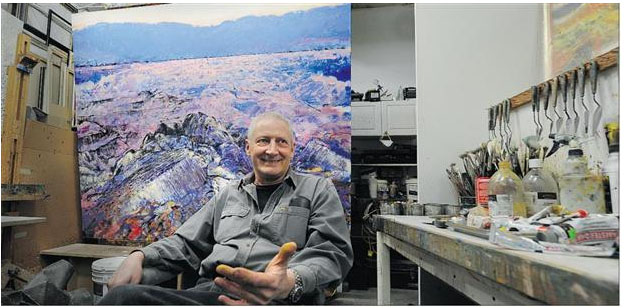
Noel Hodnett’s paintings are in “every national collection” in his native South Africa, including the South African National Gallery. After he emigrated to Vancouver in 1997, he was represented by local galleries such as Elliott Louis and Buschlen Mowatt.
But he’s never been a fan of the gallery system, which typically takes 50 per cent of the sale price of a work of art. So for the last four years, he’s had his own gallery, hfa contemporary, at 1000 Parker St. in East Vancouver.
Finding it is a bit of a treasure hunt. 1000 Parker is a sprawling remnant of Vancouver’s industrial past, a labyrinth of wood, brick and cement buildings built between 1916 and the mid-1970s. It’s quirky – the entrance is on George Street, not Parker, and there are railway tracks between two wings – and is a strong contender for the funkiest building in Vancouver.
It was once a Woodward’s warehouse, but today it’s largely occupied by artists, who love the building for its open spaces, high ceilings, and cheap rent (about a buck per square foot).
Hodnett’s had a studio at 1000 Parker since he moved to Canada. He’s one of 200 to 300 artists who have space there. The building is home to painters, sculptors, photographers, potters and woodworkers, as well as one-offs – there’s an artist who identifies herself as a “master knitter,” producing elegant shawls subtly coloured with natural mushroom dyes and lichen.
It’s amazing stuff, and this weekend you can check it out at the 15th annual Eastside Culture Crawl.
Up to 400 artists are expected to open up their studios to the public in 70-odd buildings in East Vancouver this Friday, Saturday and Sunday. There are studios in industrial buildings in Japantown, studios in houses in Strathcona, and studios in all sorts of buildings near Clark Drive.
An estimated 10,000 people now do the Crawl, which started off as the initiative of a small group of artists who simply wanted a little more exposure for their work.
It not only became a way for artists to meet the public, the Culture Crawl results in real commissions. Furniture maker Nick Vorstermans estimates 30 per cent of his income last year came from clients who met him at the Crawl.
“It’s pretty intense, pretty exciting,” says the 26-year-old, who works in studio 218 at 1000 Parker.
“There’s a lot of people coming though. It’s a great chance to show off your stuff and get people’s feedback. It’s pretty cool.”
Another furniture maker, Craig Pearce, signed up for the Crawl after he opened up the Union Wood Co. at 503 Railway in Japantown. Pearce makes beds, tables or what-have-you out of reclaimed wood and steel, and sells them through commissions. He was selling through a website and word-ofmouth, but decided to move to his new location because it offered him a chance to have a retail showroom in front and his shop in the back.
The showroom is in a dramatic open space with an 18-foot ceiling. Pearce’s furniture is displayed among antiques and collectibles he and partner Cara Donaldson have found around North America, from reproduction Edison light bulbs to vintage wooden theatre chairs and a 1969 Honda 350 motorcycle.
Donaldson thinks the Culture Crawl has helped to change the public perception of East Van, not to mention industrial strips like Railway Street.
“You can tell the city is moving east,” says Donaldson, 32. “The fact that we’re able to conduct a retail space this far east says a lot.”
One thousand Parker street is the perfect example. Until the Crawl, few people knew of the building, which was built in 1916 for the Restmore Furniture and Bedding company. It was built alongside a rail line that came in after the eastern end of False Creek was drained for railway lands. (False Creek used to run as far east as Clark Drive; the bend in the road along Prior/Venables by General Paint follows the contour of the original shoreline.)
The 1916 building is the threestorey wood structure at the western end of the site. You can still make out the “ghost sign” for Restmore Furniture on the exterior wall closest to the tracks, which doesn’t look like it’s been painted in decades.
It’s worthwhile taking a walk around the back of the building, because that’s where you find a cool space between the building’s three-and-four-storey wings where the old railway tracks can still be seen. It looks like an abandoned factory in the American rust belt.
Inside, however, 1000 Parker is abuzz with activity.
There are about 100 artists’ studios (often with multiple artists sharing the space), as well as warehouse space for non-art businesses.
Painter Corrinne Wolcoski has been renting a 350-square-foot space since July, part of a larger studio she shares with three other artists.
“There’s a lot of artists around, three really nice ones in this space,” says Wolcoski, 45. “It’s nice to not be isolated, to have some colleagues around to chitchat with, but not so many people it’s overwhelming and distracting.”
Wolcoski sells her landscapes at galleries in Vancouver, Whistler, Banff, Jasper and Victoria, but likes the Crawl because it gives her a chance to meet the public.
“It’s not necessarily about selling the work, it’s about meeting people and getting feedback from them,” she says.
“People do work just to sell [at the Crawl], little pieces. I think I tried to do that last year and I just can’t paint small. I thought ‘Forget it, I’ll just do what I do,’ and just enjoy meeting people.”
Julie Pongrac is the aforementioned “master knitter” in studio 424. “I’ve been knitting since I was five,” she laughs, “so that gives me 40-plus years.”
But she also has a PhD in pharmacology and toxicology (“you can understand why I’m interested in lichens”), and came to Vancouver to work in a lab at UBC.
“I occasionally do clinical trial work, but I’ve given up the academic side of my science life,” she says. “It really takes a full-time effort to be an artist. It’s a really tough business to be in, particularly in the recession.”
As such, the Culture Crawl provides welcome exposure to people who might be interested in her creations, which are delicate and beautiful, but also have a lot of thought behind them. The handspun, lichen-dyed shawl “is based on trying to get people to try to think about technology in terms of organisms” like lichens, which offer the natural “sensitivity and precision” of a man-made tool.
Her latest interest is volcanoes, a subject also being explored by Noel Hodnett in his new series of paintings, landscapes viewed from space. One features a squiggly red line surrounded by black – a fissure in the earth that shows molten lava coming out of a volcano.
“We’re looking at satellite kind of images – this is a volcanic flood,” explains Hodnett, 62.
Hodnett is relatively unknown in Canada, but has quite a resumé. He was the head of the painting and photography department at Rhodes University in South Africa, and has works in the Johannesburg Art Gallery, the Pretoria Art Museum, and the Nelson Mandela Metropolitan Art Museum in Port Elizabeth. He has a dealer in London and still sends work back to South Africa. But in Vancouver, he shows his work out of his studio and gallery in suite 320, with paintings priced from $6,000 to $40,000.
Hodnett clearly does not need to do the Culture Crawl – in fact, a mix-up meant he was left off this year’s pamphlet. But he’s still going to open his doors.
“The Crawl is a very interesting phenomenon for me,” he says. “In Vancouver, where do you get around 10,000 people over a weekend coming to look at art and culture?”
Hodnett won’t be just displaying paintings. For “a bit of fun” he obtained scans of vintage Vancouver panoramas and prints from the 1910s to 1940s, which he hand-tinted, digitally, like you would an old postcard.
He put a couple up at the last Crawl and people loved them, so he’s been printing them up on his Canon and HP printers and selling them. The metre-wide ones sell in print shops for about $50, but he’s done them as big as four metres for a corporate boardroom. One of his most arresting reprints is a drop-dead gorgeous photo of the Lions Gate Bridge.
“This photograph was taken around 1940 [in black and white],” he relates.
“I thought, ‘What colour was the Lions Gate Bridge?’ It was very interesting, because the Lions Gate Bridge was [originally] two colours, green with an orange suspension. Nowhere was there a [colour] photograph of that, but I found it on an old hand-coloured postcard.”
The photo has it all: a CP ferry going underneath the bridge, a float plane flying above it, and the subtly beautiful colour of a vintage postcard.
“It looks like it’s a real Kodachrome moment,” Hodnett says with a laugh.
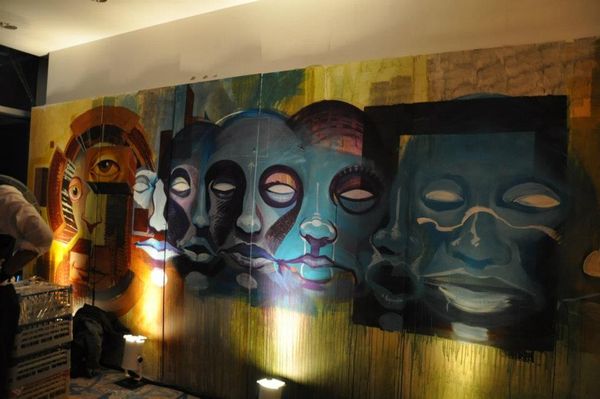
Anschutz Entertainment Group, which sent treasures from King Tut’s tomb around the world without apparent mishap, operates the Grammy Museum and runs the current touring exhibition, “America I Am: The African American Imprint,” now stands accused in U.S. District Court of destroying works by street artists Mear One, Chor Boogie and Shark Toof that had been displayed in a penthouse at its Ritz-Carlton Residences at L.A. Live hotel and condo tower.
It wasn’t AEG’s exhibitions wing, but its real estate division, that allegedly mishandled the five artworks, which ranged from 3.5 feet to 8 feet in height, and 12 to 35 feet in width, according to the suit, which was filed Monday and seeks damages under the federal Visual Artists Rights Act and California’s Art Preservation Act.
[Updated, 5:15 Tuesday] In a brief written statement Tuesday, AEG said that the lawsuit does not “accurately or completely set forth the facts of this matter,” and that it “looks forward to vigorously defending itself in court.”
According to the suit, the episode began with an attempt at synergy between street art and real estate sales: In conjunction with the L.A. Art Show last January at the Los Angeles Convention Center, AEG threw a promotional party with hopes of using the buzz around street artists to recruit well-heeled potential condo buyers.
In 2008, Kent Twitchell reached a $1.1 million settlement over the 2006 painting-over of “Ed Ruscha Monument,” a giant mural on a federally owned building in downtown L.A. It’s believed to be the largest award from a case brought under the Visual Artists Rights Act and California Art Preservation Act, whose provisions include penalties for the deliberate or grossly negligent destruction of art.
RELATED:
Shepard Fairey discusses future projects at L.A. Live party
Condos at L.A. Live set to open starting this month
Street artists hold protest performance at MOCA’s Geffen Contemporary
For the record, 6:40 pm.: An earlier version of this post included an incorrect photographer credit.
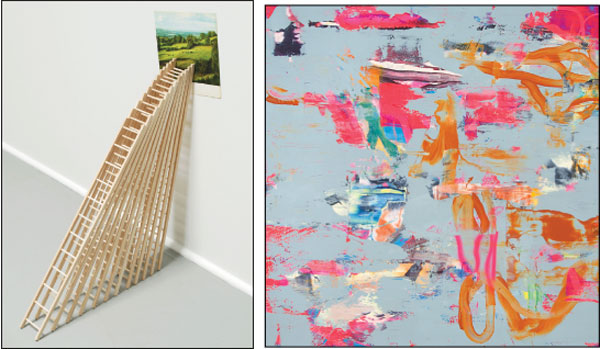
Klingbiel’s abstract paintings and large-scale woodblocks are characterized by vivid gestural strokes that are densely layered. Much of his aesthetic is rooted in the New York School (Willem de Kooning being a strong reference here) — but other sources of inspiration include Mayan cartographic pattern-making, Dutch tapestries, 18th century British engravings, comic books and computer models of the universe.
Despite these diverse and often historic citations, Klingbiel’s overall contemplation is determinedly contemporary. He employs abstraction as a means to process the overwhelming amount of information we face on a daily basis. His compositions strive for complexity. His forms are energetically interwoven — assembling, at times, into solid clusters before breaking apart to let light penetrate. They are rhythmic and confidently fluent and devoid of any notion of stagnancy. While things appear to be morphing constantly, Klingbiel still succeeds in establishing a sense of structure.
His visuals translate as elaborate networks, serving as metaphors for various information outlets. One gathers that Klingbiel is significantly inspired by how the layering of news channels and digital media co-exist and are often co-dependent. Despite this implication, his paintings are intuitive and spontaneous. Klingbiel runs on instinct rather than calculation. He is not concerned with analyzing contemporary existence, but rather to create a language for an era that lacks clarity.
His ambition is to develop and follow a steady stream of consciousness — a stark contrast to a world that increasingly faces fragmentation, quick shifts and a general lack of depth. To achieve this goal, Klingbiel ponders what the common denominator of a shared language could look like. He states: “I am after the idea of relationships, or the ghosts of relationships as different histories that veil and unveil themselves at points of demarcation, points of transition that are themselves in transit.”
At first glance, these energetic compositions produce much noise. Upon closer inspection, they become increasingly calming — and, at times, even meditative.
Through Dec. 17, at Masters & Pelavin (13 Jay St., btw. Hudson & Greenwich Sts.). Call 212-925-9424 or visit masterspelavin.com.
When incorporating these materials into his work, Northridge edits and rearranges them to the extent that they become disassociated from their original context. Whereas they once provided glimpses of contemporary culture, they now become part of a new landscape. In fact, Northridge’s works frequently evoke architectural structures, models and maps. Characterized by precision but without lacking humor, Northridge is less interested in improvisational freedom than clarity of thought.
His process involves self-established rules that are to be followed, which occasionally can be altered. His works appear to be both completed thoughts and beginnings of larger ideas. They are at once realization and inspiration.
In the back gallery, an installation of an ongoing series of collage works stands out. Named after a popular 1950s reference book published by Time Life, “The World We Live In” was begun in 2006 and currently involves over 165 pieces (each measuring 8 x 10 inches). The project is sparked by Northridge’s ambition to create a comprehensive account of today’s world — a concept that involves the natural and manmade. Employing found imagery, collage, photography, text and drawing, it translates as a thorough investigation of the subject matter. But more importantly, it translates as the inspired attempt to create a map for contemporary reality.
Through Dec. 17, at Kansas Gallery (59 Franklin St., btw. Lafayette & Broadway). Call 646-559-1423 or visit kansasgallery.com.
“Kindred Spirits” is a rare and overdue attempt to examine how Native American cultures of the Southwest and the surrounding desert landscape have resonated with Western (and especially American) artists for decades.
The exhibition features works of indigenous peoples from the Southwest region of the United States — including funerary vessels, paintings, pottery, weavings and baskets from 14 tribes (among them, the Apache, Hopi, Mimbres, Navajo and Zuni).
Arranged in elegant display cases or installed on the wall, these precious objects are shown alongside modern and contemporary works by artists such as Josef Albers, Max Ernst, Helmut Federle, Agnes Martin, Bruce Nauman and Charles Simonds.
Particular treasures include a Sioux parfleche box from circa 1900, two works on paper by Jackson Pollock and a stunning canvas by Georgia O’Keeffe. The latter’s “Blue, Black, and White Abstraction # 12” (1959) — which translates as an abstraction of a large black bird sweeping skyward — finds a beautiful counterpart in a Navajo drawing made in the early 20th century.
Meanwhile, a collection of iconic landscape and portrait photographs by Ansel Adams, Edward Curtis, Sumner Matteson, Paul Strand and Adam Clark Vroman establish an appropriate sense of grandeur. It is when viewing the six-volume set of Henry Rowe Schoolcraft’s legendary “Historical and Statistical Information, Respecting the History, Conditions and Prospects of the Indian Tribes of the United States” (published between 1847 and 1857) that one gets to ponder how Western civilization has viewed and analyzed Native American cultures in the past.
In art, scientific analysis and the reliance on statistics are void. Instead, while browsing the examples of Western works assembled here, we witness how personal and diverse the emotional and aesthetic impact of Native American art can be (and has been). A different voice is offered through works by the contemporary artist Nicolas Galanin (a Tlingit Aleut who comes from a long line of Northwest Coast artists). When entering the gallery, one has to step over his “Indians” — a sidewalk carving of the Cleveland Indians baseball team logo. Aiming to balance his origins with his contemporary practice, Galanin has noted: “In the business of this ‘Indian Art World,’ I have become impatient with the institutional prescription and its monolithic attempt to define culture as it unfolds.”
Culture is unfolding constantly, but “Kindred Spirits” is an avid reminder that inspiration is without boundaries and therefore timeless.
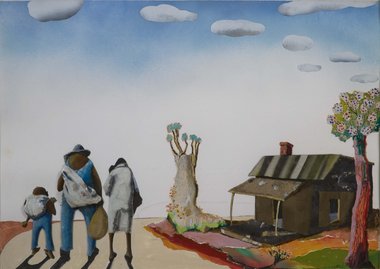
“Southern Journeys,” which opens Jan. 28, 2012, at Lauren Rogers Museum of Art, presents the responses of 54 artists to the South through a selection of paintings, sculptures, drawings, prints and mixed-media works. The museum is at 565 N. Fifth Ave. in historic downtown Laurel, Miss.
Artists in the exhibition range from the generation maturing in the 1930s to those who came of age in the 1990s and 2000s, and include both academically trained and self-taught artists.
Among the artists are Leroy Allen, Benny Andrews, Radcliffe Bailey, Richmond Barthé, Romare Bearden, Beverly Buchanan, Elizabeth Catlett, David Driskell, Clementine Hunter, Jacob Lawrence, Faith, Ringgold and Charles White.
The South is home to a unique concentration of distinctive African-American forms that can be seen in the work of the artists in “Southern Journeys.” The impact of the customs and experiences of everyday life is notable, as is that of African-American folk music, art and religion.
African-American oral and visual traditions intersect in much of their work, as do the sacred and secular. Musicians, storytellers, singers, dancers and the black church are key sources of inspiration. Themes from African-American history and culture appear frequently, spanning a period from the advent of slavery to the present day.
“Southern Journeys” is curated by Eloise Johnson, Ph.D., independent curator of Zachary, La., and Stella Jones, M.D., of the Stella Jones Gallery in New Orleans.
The exhibition is toured by ExhibitsUSA, a national program of Mid-America Arts Alliance. ExhibitsUSA sends more than 25 exhibitions on tour to more than 100 small- and mid-sized communities every year.
Mid-America is the oldest nonprofit regional arts organization in the United States. Information, go to www.maaa.org and www.eusa.org.
LRMA is open 10 a.m. until 4:45 p.m. Tuesday through Saturday and 1-4 p.m. Sunday. Admission is free; a donation of $3 is suggested for adult non-members. Information, call 601-649-6374 or go towww.LRMA.org.
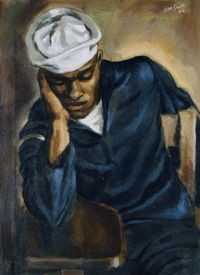
The Jule Collins Smith Museum of Fine Art at Auburn University presents the exhibition, Promises of Freedom: Selections from the Arthur Primas Collection, on display in the Bill L. Harbert Gallery and Gallery C from Dec. 10, 2011-March 10, 2012.
Promises of Freedom features an impressive range of works from a significant private collection of African American art. The exhibition includes 75 paintings, sculpture, drawings and prints by more than 30 artists and spans a period of 150 years.
Highlighting artwork by Benny Andrews, Richmond Barthé, Romare Bearden, Elizabeth Catlett, Sam Gilliam, Jacob Lawrence, Howardena Pindell, and Hale Woodruff, among others, the exhibition vividly illustrates the universal quest for freedom and its impediments.
Texas resident and prominent entertainment manager, Arthur Primas has amassed a richly rewarding and provocative collection of art, of which he considers himself not the “owner” but its “guardian.”
Until recently, art history curriculums and literature did not give adequate recognition to African American artists. Now these artists are widely acknowledged for their creativity, achievements and considerable contributions to the history of American art.
As Primas has benefitted so deeply from the lessons of this art and its makers, he considers it a valuable experience worth sharing, and thus has offered his collection for travel. Promises of Freedom is organized by Landau Traveling Exhibitions and The Heritage Gallery in Los Angeles.
Several related programs and events are scheduled during Jan.-March to complement the exhibition:
Thursday, January 19, 2012, 6 pm, Spring Opening, Lecture by collector Arthur Primas
Thursday, January 26, 2012, 5 pm, Poetry Reading: Ekphrasic poetry reading by 2007 Pulitzer Prize winner, Natasha Trethewey, who holds the Phillis Wheatley Distinguished Chair in Poetry at Emory University.
Thursday, February 9, 2012, 4 pm, Gallery Talk: “Three Paintings by Robert Colescott,” by Professor Kathryn Floyd, Auburn University Department of Art
Thursday, February 16, 2012, 5 pm, Lecture: “A History of African American Music,” Professor Rosephanye Powell and Professor William Powell, Auburn University Department of Music.
Thursday, March 1, 2012, 5 pm, Performance: Theatre and Music inspired by the Arthur Primas Collection.
Theatrical performances directed by Professor Heather May and performed by members of Auburn University’s Department of Theatre. Musical performances provided by faculty and students of Auburn University’s Department of Music. Thank you to Professor Howard Goldstein of Music for coordinating the music.
For more information on the exhibition or upcoming events, please visit jcsm.auburn.edu or call 334-844-1484.
About Jule Collins Smith Museum of Fine Art:
Open since 2003, the Jule Collins Smith Museum of Fine Art at Auburn University is Alabama’s only university art museum. Serving as the gateway into Auburn University, the museum is home to many pieces of culturally significant art. The collection includes 115 Audubon prints, a rare group of more than 40 Tibetan bronzes and works by important American artists, such as Arthur Dove, Georgia O’Keeffe and Lyonel Feininger. The museum rotunda hangs a three-tiered, hand-blown glass chandelier created especially for the museum by internationally-renowned glass artist Dale Chihuly. The beauty continues onto the grounds of the museum with fifteen acres of gardens, walking paths and water features, complete with an eleven and a half foot tall brass sculpture, Spinoff, created by Auburn alumna Jean Woodham.