Introduction of Sorts

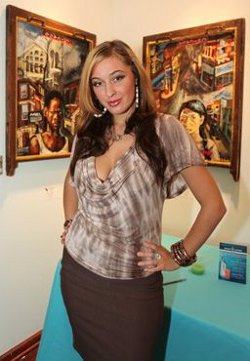
This is Carla C-W, the new intern over at October Gallery. Throughout the summer I’ll be helping out with the preparations for the Philadelphia International Art Expo in November 2009. The internship just started last Friday, but I already have a handful of things to do. I’m excited though and can’t wait to contribute to the success of the Expo. 

In the following weeks, this blog will be going through a few changes. I’ll be posting three to four times a week about anything that feels important and relevant. I can’t wait for the dedicated readers to continue coming back and hopefully we’ll get new faces on here.  

Let’s make this a great summer at the October Gallery blog!

Changing the Art on the White House Walls

Barack Obama is taking on health care, financial regulation, torture and environmental policy. He’s also revamping the White House art collection.

The Obamas are sending ripples through the art world as they put the call out to museums, galleries and private collectors that they’d like to borrow modern art by African-American, Asian, Hispanic and female artists for the White House. In a sharp departure from the 19th-century still lifes, pastorals and portraits that dominate the White House’s public rooms, they are choosing bold, abstract art works.

The overhaul is an important event for the art market. The Obamas’ art choices could affect the market values of the works and artists they decide to display. Museums and collectors have been moving quickly to offer up works for inclusion in the iconic space.

Their choices also, inevitably, have political implications, and could serve as a savvy tool to drive the ongoing message of a more inclusive administration. The Clintons received political praise after they selected Simmie Knox, an African-American artist from Alabama, to paint their official portraits. The Bush administration garnered approval for acquiring “The Builders,” a painting by African-American artist Jacob Lawrence, but also some criticism for the picture, which depicts black men doing menial labor.

Last week the first family installed seven works on loan from the Hirshhorn Museum and Sculpture Garden in Washington in the White House’s private residence, including “Sky Light” and “Watusi (Hard Edge),” a pair of blue and yellow abstracts by lesser-known African-American abstract artist Alma Thomas, acclaimed for her post-war paintings of geometric shapes in cheery colors.

Ernie Barnes dies at 70

Renowned painter Ernie Barnes died Monday at age 70.

Barnes came to painting after a career in professional football, as an offensive lineman with the San Diego Chargers and Denver Broncos. Teammates called him “Big Rembrandt.”

He could take on a defensive lineman, then commit the encounter to canvas. Many people would call Barnes a “black painter.” He preferred the description “neo-Mannerist.” Barnes never painted his subjects with their eyes open.

“We don’t see each other,” he said once in an interview. “We are blind to each other’s humanity.”

TRAVEL TO BRAZIL – Sisterhood of the Good Death

boamortre
Cachoeira, Bahia, Brazil
from Diga Brazil

The history of the Irmandade da Boa Morte (Sisterhood of the Good Death), a religious confraternity devoted to the Assumption of the Virgin, is part of the history of mass importation of blacks from the African coast to the cane-growing Recôncavo region of Bahia. Iberian adventurers built beautiful towns in this area, one of them being Cachoeira, which was the second most important economic center in Bahia for three centuries. In a patriarchal society marked by racial and ethnic differences, the confraternity is made up exclusively of black women, which gives this Afro-Catholic manifestation – as some consider it – a certain fame. It is known both as an expression of Brazilian baroque Catholicism, with its distinctive street processions, and for its tendency to include in religious festivals profane rituals punctuated by a lot of samba and banqueting. Read More

* Day trip to Festival da Boa Morte in Cachoeira, Bahia

– Seven Days, Six Nights
– Bed and Breakfast Style Accommodations
– Local Bilingual Host
– Two Tradicional Brazilian Meals per Day
– Daily House Keeping
– Airport Transfers

– $ 1,475* fOR COUPLES (*per person)

Airfare, Passport and Visa NOT INCLUDED

Panoramic Poetry – The 2nd & 3rd Friday of every month

Premiering
The 2nd & 3rd Friday of every month
7:30, $7

215.629.3939
panoramicpoetry@octobergallery.com

Panoramic Poetry will be held at
Cheyney University
701 Market Street
West Lobby 3rd Floor
Philadelphia, PA

24 Annual Philadelphia International Art Expo, November 13, 14 & 15, 2009

art
THE PHILADELPHIA INTERNATIONAL ART EXPO – The Art of Living Well

One of the Nation's Largest Art Expos The 24th Annual Philadelphia International Art Expo is an expo of popular. World Art and The Art of Living Well. It offers unique and unequaled opportunities to build a customer base, to network, to compare artistic talent & product information and to engage in “the art of the deal”.

MARK YOUR CALENDAR!!
Philadelphia International ART EXPO
November 13, 14 & 15, 2009
Friday and Saturday 10am – 10pm
Sunday 10am – 7pm
Liacouras Center – Temple University
Philadelphia, PA

Celebrating 10 years of the power of black art to transform, unite and enrich! MAY 20-23, 2009

art
This year, the Celebration of Black Writing Festival turns 25! The festival’s theme “Writing for Our Lives” will focus, as always, on literacy and asking how a book can save a life and a community that was once forbidden to read it.

Chelsea visits Havana

Guerilla Villa painting

An exhibition of American artworks has just opened in Havana — the first major American group show in Cuba for over 20 years. “Guerilla Villa,” is one of the works on display at the “Chelsea visits Havana” exhibition.

The “Chelsea visits Havana” exhibition is part of the 10th Havana Biennial art show, which opened on Saturday, and will take place at the prestigious “Museo Nacional de Bellas Artes.”

Works by more than 30 artists representing different galleries in New York City’s modern-art hub of Chelsea will be on display (read more).

What do you think of current American Cuba policies? Do they need to change?

Buy Local – Green Living

Buy Local

The concept of buying local is simply to buy food (or any good or service) produced, grown, or raised as close to your home as possible. With industrialization, our food is now grown and processed in fewer and fewer locations, meaning it has to travel further to reach the average consumer’s refrigerator.

Although this method of production is considered efficient and economically profitable for large agribusiness corporations, it is harmful to the environment, consumers and rural communities.

Why Collect Art?

The life enhancement that a piece of art generates for a collector is the most valid reason for selecting any art work. Collector motivation should be not solely whether a work of art will appreciate financially, but should be based on a link, a kinship, a connection with the essence and life force of the work.
‘The thing about art is that you only hold it in trust. There’s a living spirit in a great work of art. If you see it only in terms of its monetary value, the circle of communication is incomplete,” states Corrine Jennings of the Kenkeleba-Gallery, New York. An astute art collector will see the value of an artist’s work long before the investment oriented art collector takes note. A connoisseur with a sensitive eye uses aesthetics rather than economic considerations in acquiring art work. Only esthetics is intrinsic to the art work. Economic or investment appreciation may be considered for the long run after the collector has found some valid esthetic reason to purchase a piece of art.

Art Gallery vs Art Auction

What’s the difference between buying art at an art gallery and purchasing art from an auction house?

There are many advantages to buying from an art gallery. You may be able to “test drive” the art before you buy. Galleries may let you take art home for a limited consignment. In addition, the gallery later might assist you in reselling the art.

Art auction houses are better for finding works of art that may not be currently available in an art gallery. Deals are usually good at art auctions but you run the risk of getting caught up in the auction action. Plus, you generally pay a 5 to 25 percent “buyer’s premium” at auction houses and that should to be figured into the final price of the artwork.